
STEADI: Intervene
What seniors should do while waiting for power restoration
A timed, hour-by-hour plan for older adults waiting out a power outage — covering food, refrigerated medications, body temperature, and device batteries with exact safety limits, and the thresholds that signal when staying home is no longer safe.
In the first hour of a power outage, what seniors should do while waiting for power restoration is not “settle in and see what happens.” Start four clocks at once: food, refrigerated medications, body temperature, and device batteries. The house may still feel normal, the refrigerator may still be cold, and the phone may still show a comfortable charge. That is exactly why this hour matters.
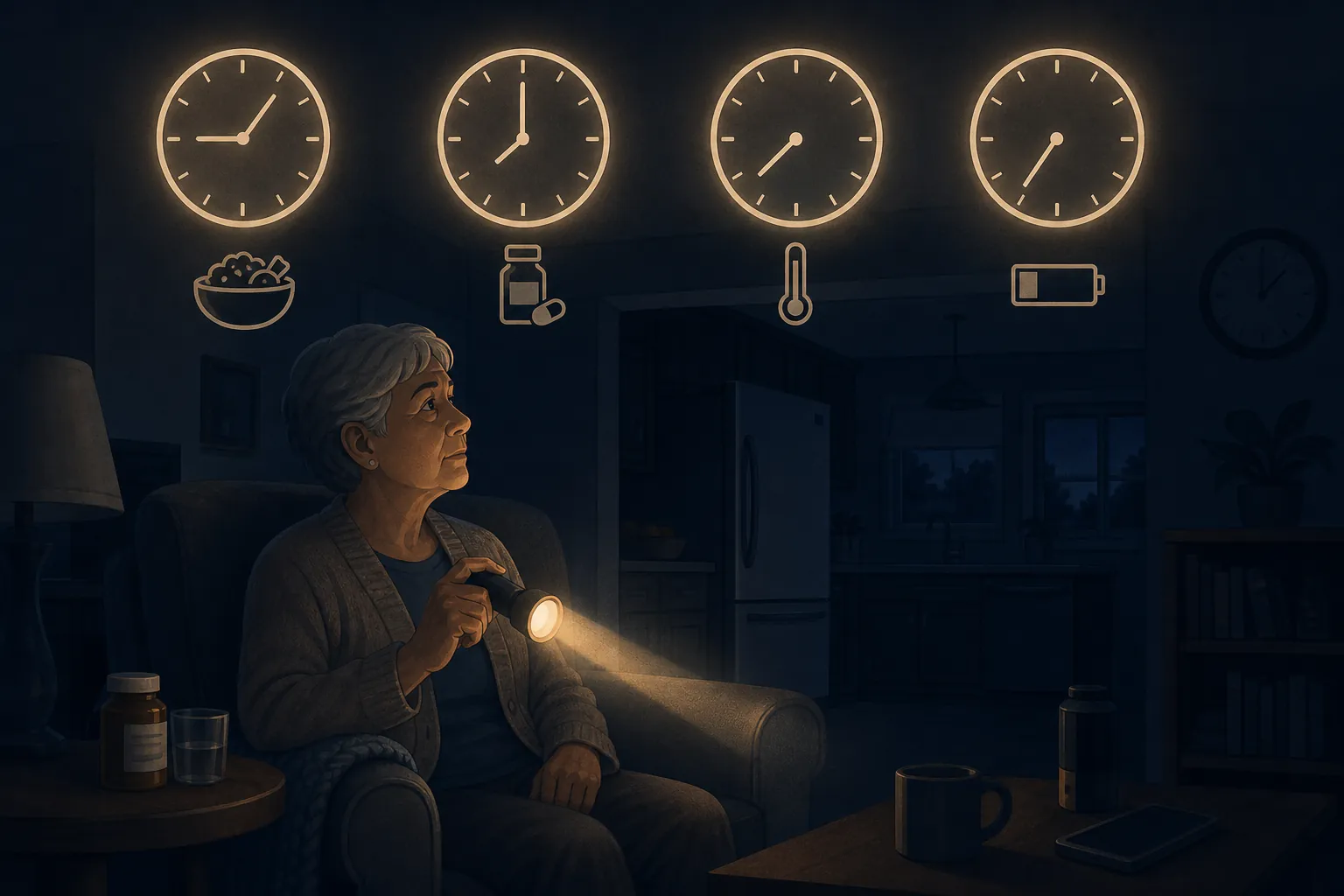
Use this as a timed playbook. If you are the older adult at home, keep it near you and mark the outage start time. If you are an adult child helping by phone, stop refreshing the utility map long enough to walk through these decisions in order.
| When | Do this now | What changes when the clock runs out |
|---|---|---|
| First 15 minutes | Write down the outage start time. Put a flashlight within reach of the older adult and in the bathroom path. Do not use candles. Do not use a gas oven or range for heat. | Poor lighting turns a routine walk into a fall risk, and open flames or gas appliances create hazards that are not worth negotiating. Ready.gov and the Red Cross recommend flashlights rather than candles and warn against using gas ovens or ranges to heat a home.[4][5] |
| First hour | Keep refrigerator and freezer doors closed. Identify every medication that requires refrigeration. Plug essential medical devices into charged backup power if available, and move phones into battery-saving mode. | Opening the refrigerator to “just check” spends cold air. Refrigerated food is expected to stay safe for about 4 hours if the door stays closed.[1] |
| Hours 1–4 | Check the older adult, not just the outage map: speech, walking, alertness, warmth, sweating, dizziness, and whether they can safely reach the bathroom in the dark. Keep one lamp switched on so you know when power returns. | The person may become unsafe before the utility estimate changes. |
| At about 4 hours | Treat the refrigerator decision as active. If power is still out, avoid more door opening. If you have appliance thermometers, use them when you must check. Perishable food held at 40°F or above for 2 hours or more should be discarded.[2][3] | Do not taste food to decide. If you cannot verify safety, throw it out.[1][2] |
| Hours 4–24 | Recheck refrigerated medications and the person’s body temperature risk. If essential medication cannot be kept within its handling guidance, call a pharmacist, clinician, or emergency line before guessing. | Medication and body-temperature clocks can expire before the freezer clock does. |
| At 24 hours | A half-full freezer is at its rough limit if it has stayed closed. A full freezer may still have more time, if it has remained closed. | Food in a half-full freezer is generally protected for about 24 hours; a full freezer for about 48 hours if doors remain closed.[1][2][3] |
| At 48 hours | Assume a full freezer has reached its rough limit unless you can verify safe temperatures and ice crystals. Make a leave-or-get-help decision if medication, heat, cold, lighting, or communication is also failing. | The outage has stopped being a short inconvenience. |
| When power returns | Keep one lamp on as your signal. Wait at least 15 minutes before switching other appliances back on. | Washington State Department of Health recommends leaving one lamp on and waiting at least 15 minutes before turning other appliances back on after restoration.[11] |
The first hour: make the house safer before anyone gets tired
The first hour is for reducing movement, preserving cold, and protecting communication. Put a working flashlight where the older adult is sitting, another on the route to the bathroom, and one near the medication area if possible. This is not the moment to hunt for decorative candles. Ready.gov recommends flashlights or battery-powered lanterns instead of candles, and the Red Cross gives the same basic outage-safety direction.[4][5]
Darkness is not just inconvenient for an older adult. UF/IFAS Extension specifically notes the fall concern during outages, especially when people move around without adequate lighting.[6] A hallway that was manageable at 3 p.m. can become a different place at 9 p.m. with a throw rug, a pet bowl, and a dead night-light.
- Write the outage start time on paper, not only in a phone note.
- Close the refrigerator and freezer and leave them closed.
- Gather refrigerated medications in your mind before opening anything: insulin, certain eye drops, injectables, liquid antibiotics, biologics, or any medication labeled for refrigeration.
- Move phones to low-power mode. Stop streaming video, turn down brightness, and use text messages when calls are not needed.
- If the person uses powered medical equipment, check the remaining battery, the backup battery, and who can help if both run down.
- Leave one lamp switched on. It will tell you when power is restored without requiring someone to wander through the house.
Do not use a gas range or oven to heat the home. Ready.gov and the Red Cross both warn against it during outages.[4][5] The same firmness applies to generators: if one is already being used, it belongs outdoors, at least 20 feet from doors, windows, and vents, with battery-backup carbon monoxide detectors. This is a safety boundary, not a generator tutorial.
The food clock: four hours is the refrigerator line
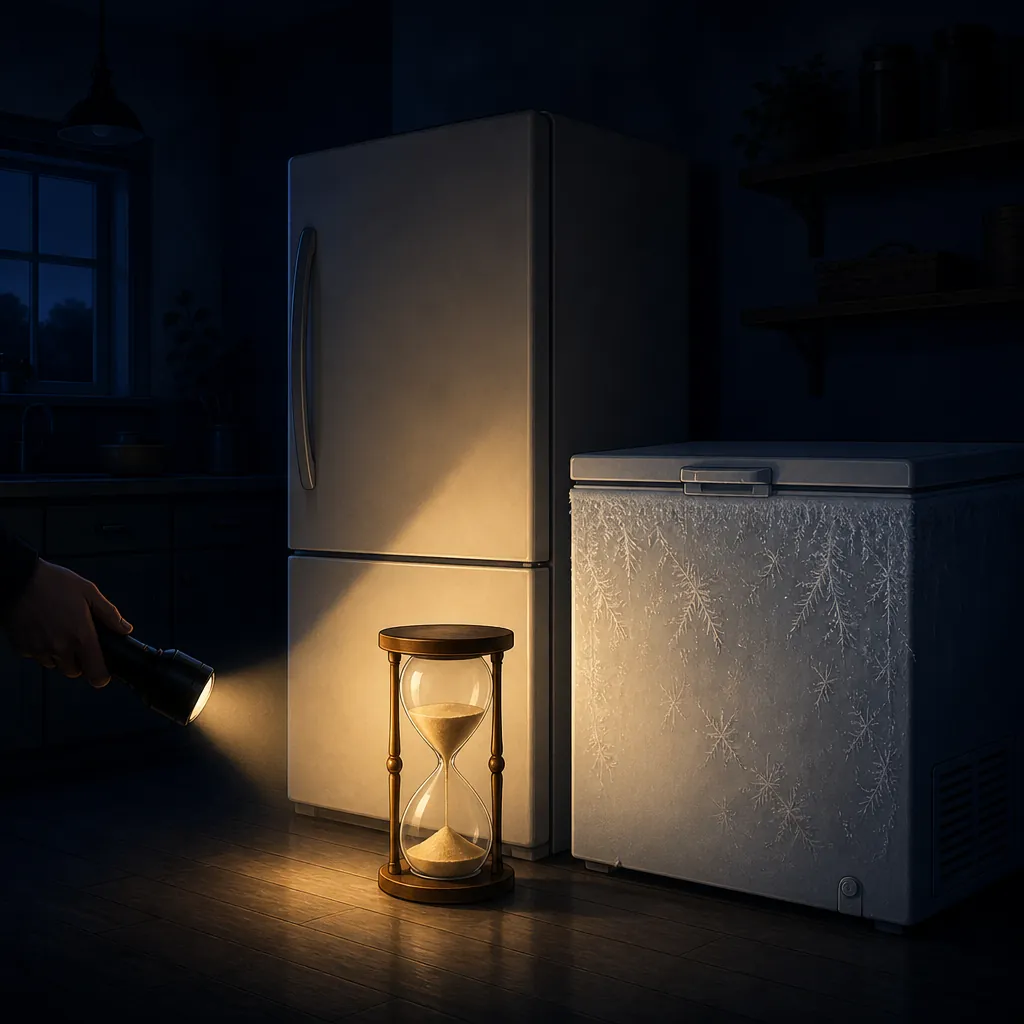
A closed refrigerator keeps food safe for about 4 hours during a power outage, according to CDC guidance.[1] That sentence is useful because it gives the household permission to stop pretending the refrigerator is a magic box. The cold is limited. Every unnecessary opening shortens the useful time.
The freezer clock is longer, but only if the door stays closed. A full freezer can hold food safely for about 48 hours; a half-full freezer for about 24 hours.[1][2][3] Those are not promises about every appliance in every kitchen. They are working limits for deciding when the situation has changed.
The hard discard rule is this: perishable food that has been at 40°F or above for 2 hours or more should be thrown away.[2][3] Meat, poultry, seafood, eggs, milk, cut fruit, cooked leftovers, and many prepared foods are not made safe again by good intentions. CDC and USDA guidance also says not to taste food to check whether it is safe.[1][2]
| Food situation | Action |
|---|---|
| Power has been out less than 4 hours and the refrigerator stayed closed | Keep it closed. Do not inventory the shelves. |
| Power has been out about 4 hours and refrigerator temperature is unknown | Limit opening. If you cannot verify safe temperature later, be prepared to discard perishables. |
| Food is 40°F or above and has been there for 2 hours or more | Discard perishable food. |
| Freezer is half-full and outage reaches about 24 hours | Treat freezer contents as time-sensitive unless temperatures are verified. |
| Freezer is full and outage reaches about 48 hours | Treat freezer contents as time-sensitive unless temperatures are verified. |
| Food smells fine but the time-temperature rule has failed | Throw it out. Smell and taste are not safety tests. |
Throwing away expensive food is painful. Food poisoning in an older adult is worse. If a caregiver is trying to persuade a parent, do not argue from disgust or blame. Use the clock and the temperature rule. It makes the decision less personal.
The medication cold-chain clock: insulin and refrigerated drugs need a real decision
Refrigerated medications deserve more care than “put them in a cooler.” Many refrigerated drugs are labeled for storage around refrigerator temperature, commonly 36°F to 46°F. During an outage, the immediate task is to identify which medications require cold storage, keep them cool without freezing, and call a pharmacist or clinician when you cannot maintain the label instructions.
Insulin is the medication families most often worry about, and rightly so. CDC emergency guidance says insulin should be kept as cool as possible, never frozen, and kept away from direct heat and direct sunlight. CDC also advises monitoring blood sugar if insulin has been stored above 86°F.[7]
Do not turn that into one universal room-temperature rule for every insulin product or every refrigerated drug. Product instructions vary. If the refrigerator has lost power and the medication matters today, read the package insert if available and call the pharmacy, prescribing clinician, nurse line, or emergency service. If the phone battery is limited, make this call before the battery becomes the emergency.
- Keep insulin and other refrigerated medications out of direct sun, away from a hot window, and away from heaters or generators.
- Do not place medication directly on ice or where it may freeze unless the product instructions specifically allow that handling.
- If using a cooler, separate medication from ice packs with a towel or barrier and check it often enough to prevent freezing.
- If insulin may have been exposed to heat, follow CDC’s advice to monitor blood sugar and seek professional guidance.[7]
- If an essential medication cannot be kept within safe handling guidance and no professional can be reached, staying home is no longer a casual waiting decision.
The body-temperature clock: confusion and slow walking are not just “being tired”
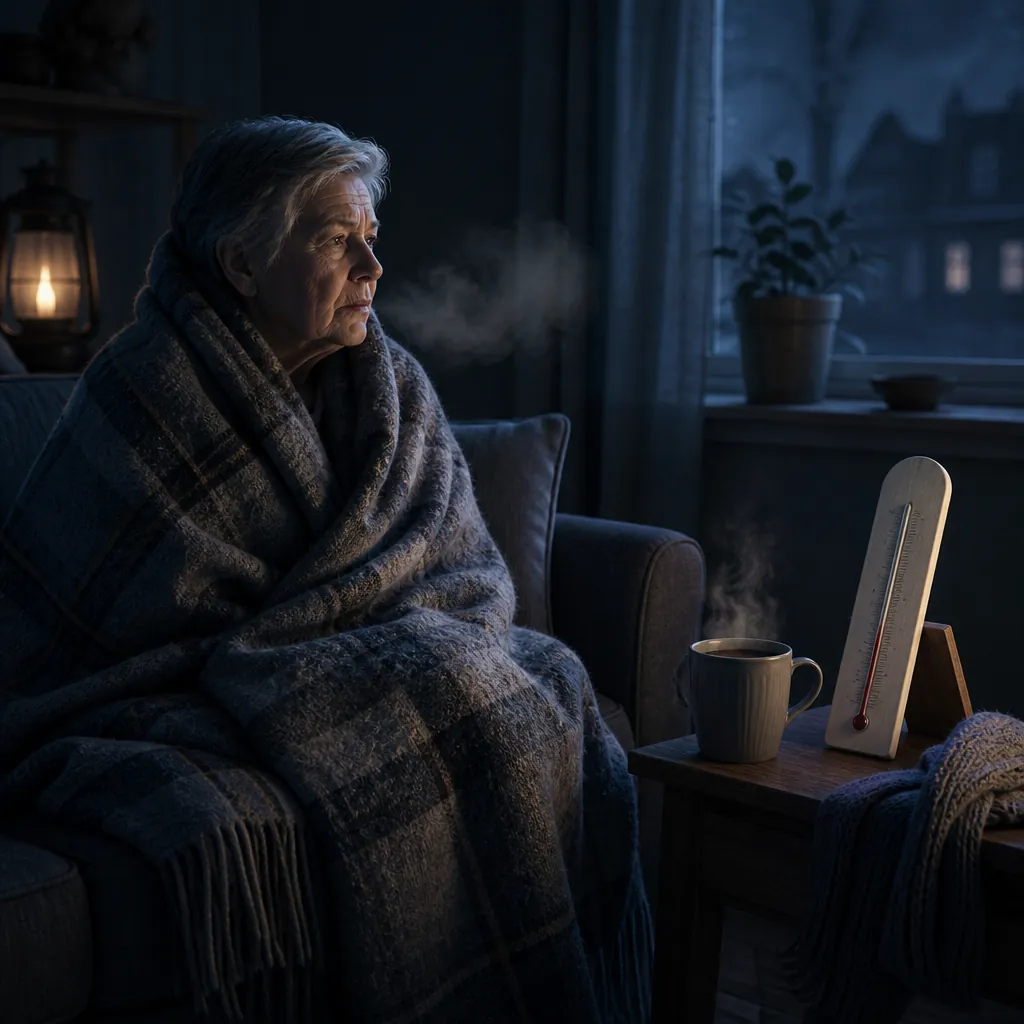
In a cold outage, watch the person before you watch the thermostat. The National Institute on Aging warns that hypothermia in older adults can show up as slow or slurred speech, confusion, sleepiness, shivering, stiffness in the arms or legs, slow reactions, poor control over body movements, or trouble walking. A body temperature of 95°F or below is a medical emergency.[8]
NIA also notes that a home kept at 60°F to 65°F may be too cold for older adults, and points to 68°F to 70°F as a safer indoor range.[8] That matters during a winter outage because an older adult may not complain dramatically. “I’m just chilly” can sit in the same room as confusion and unsafe walking.
Layer clothing, use blankets, close off unused rooms, and keep the person away from drafts if it can be done safely. But do not solve cold with a gas oven, an indoor grill, a charcoal device, or a generator near the house. If the person is becoming confused, unusually sleepy, slow in speech, or unsteady, stop treating the outage as a household comfort problem.
Heat can become just as unforgiving. CDC says adults aged 65 and older do not adjust as well as younger people to sudden temperature changes, and that fans may not be enough in extreme heat; older adults should get to air-conditioned places when needed.[9] If heat is the active danger, use a cooling center, public library, community site, neighbor’s air-conditioned home, or emergency service before the person becomes weak, dizzy, confused, or unable to drink and cool down. For a fuller heat-specific decision aid, use the senior heat safety checklist.
The battery clock: communication is part of the safety system
A dead phone changes the risk level. So does a powered medical device with a shrinking battery. The household may still have food and blankets, but if no one can call for help, receive instructions, check on a pharmacy, or arrange a ride, waiting has become thinner than it looks.
- Send one clear status text to the family: outage start time, phone battery percentage, medication concern, indoor temperature concern, and whether the older adult is alone.
- Choose one person to monitor utility updates. Everyone else should save battery.
- Turn off nonessential notifications, video, and background apps.
- If medical equipment depends on power, call the equipment provider, clinician, utility emergency line, or local emergency management before the backup battery is nearly gone.
- If the older adult cannot safely move through the house without light, do not wait for darkness to prove the point.
Utility medical registries, extra battery purchases, and better backup lighting are useful for next time. They do not fix a device that is dying tonight. If a powered medical device is essential and backup power is running out, the next step is help, relocation, or emergency services.
After the first day, stop assuming restoration will be quick
By the second day, a power outage is no longer mainly about being patient. The refrigerator clock has expired. A half-full freezer is at its rough limit. Medication handling may be uncertain. Phone and device batteries may be low. The older adult may also be sleeping poorly, drinking less, moving in dim light, or resisting a move because leaving feels like surrender.
Do not build the plan around the best-case restoration estimate. PowerOutage.us cites Hurricane Helene as an example of scale: 4.79 million customers affected, with some rural restorations taking more than 14 days.[10] That is one severe-event example, not a prediction for every outage. It is enough to show why rural location, blocked roads, widespread damage, or medical dependence should lower the household’s tolerance for waiting.
If the older adult lives alone, ask for an in-person check before conditions become dramatic. A neighbor can confirm whether the person is alert, warm or cool enough, able to walk safely, able to use the bathroom, and able to charge or use a phone. If ice, snow, debris, or darkness makes the outdoor route dangerous, handle that as a fall-prevention problem, not just a weather problem. For next-time exterior planning, see the guide to preventing falls on ice outdoors.
When the power comes back
Restoration is not the moment to switch everything on at once. Washington State Department of Health advises leaving one lamp on so you know when power returns, then waiting at least 15 minutes before turning other appliances back on.[11]
Then work through the expired clocks. Check refrigerator and freezer temperatures if you have appliance thermometers. Discard perishable food that crossed the 40°F-for-2-hours line. Review refrigerated medications before using them if storage was uncertain. Recharge phones, medical-device batteries, flashlights, and hearing-assistive devices. Clear cords, coolers, and extension lines from walking paths before someone trips over the cleanup.
If a fall happened during the outage, treat it as an event that needs follow-up, even if the person says they are fine. The next step is not blame; it is checking injury, medication effects, dizziness, lighting, footwear, and the route where the fall occurred. The Fall Prevention FAQ is the better place to continue after that kind of incident.
The decision line: when waiting is over
Staying home remains reasonable only while the main clocks are still inside safe limits: food, refrigerated medication, body temperature, lighting, communication, and medical-device power. Once one of those has failed, the question is no longer whether the outage is annoying. It is whether the older adult can remain safely where they are.
Waiting is over if the older adult shows cold-related warning signs such as confusion, slow or slurred speech, sleepiness, or trouble walking; has a body temperature of 95°F or below; cannot stay cool in dangerous heat; cannot keep essential refrigerated medication within safe handling guidance or reach a pharmacist or clinician; lacks safe light or communication; has essential medical equipment running out of power; or is relying on a gas oven, indoor flame, unsafe generator placement, or any other hazardous workaround. At that point, call for help, relocate to a safer place, or use emergency services.
References
- What to Do to Protect Yourself During a Power Outage, CDC
- Keep Your Food Safe During Emergencies, USDA FSIS
- Food Safety During Power Outage, FoodSafety.gov
- Power Outages, Ready.gov
- Power Outage Safety, American Red Cross
- Dealing with a Power Outage, UF/IFAS Extension, September 5, 2023
- Managing Insulin in an Emergency, CDC
- Cold Weather Safety for Older Adults, National Institute on Aging
- Heat and Older Adults (Aged 65+), CDC
- Power Outage Preparedness for Seniors & Elderly, PowerOutage.us
- Power Outages, Washington State Department of Health
Related reading
Noticed something outdated or inaccurate on this page? Flag a correction. We review every report against CDC, NIA, and AARP HomeFit guidance before updating a page.
Part of the Fall Prevention section.