
STEADI: Intervene
Going Out in the Rain? Fall Prevention Tips for Seniors
Decide whether to reschedule, modify, or go ahead with an older parent's rainy-day outing, then follow the footwear, stride, and check-in habits that reduce wet-surface fall risk — and know the first minutes after a slip.
Rainy weather fall prevention for seniors starts with one plain decision at the door: reschedule, modify, or go. The danger usually is not the rain falling from the sky; it is the wet step outside the door, the curb cut, the shiny store entrance, the dim walkway, and the rushed moment when someone is carrying keys, an umbrella, and a bag at the same time.
That decision deserves a little respect. A fall is not just an embarrassing interruption. The CDC says falling once doubles an older adult’s chance of falling again, and an older person who falls and hits their head should see a doctor promptly, especially if they take blood thinners [1][2]. That does not mean every rainy errand should be canceled. It means the outing needs conditions, not wishful thinking.
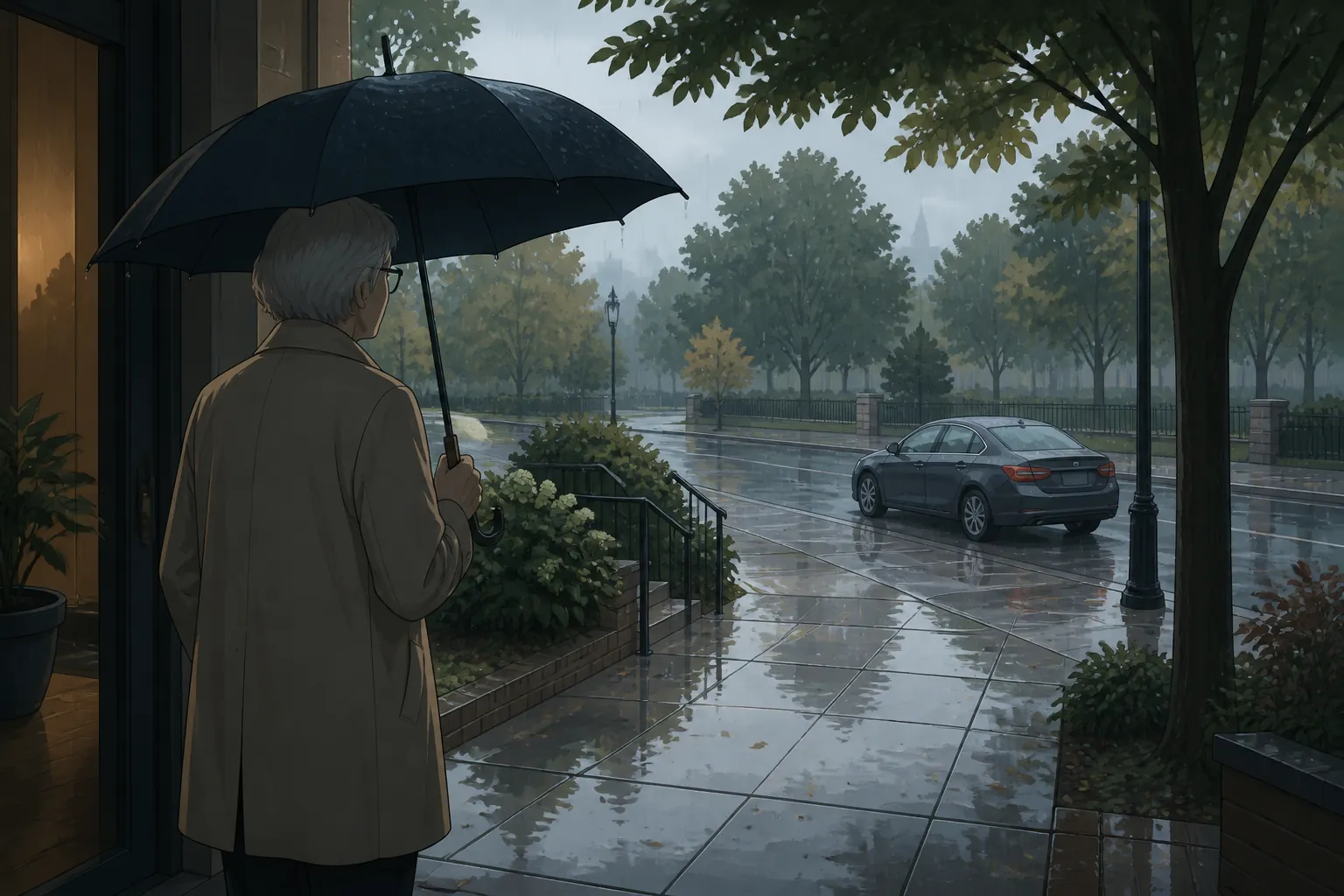
At the door: reschedule, modify, or go?
The useful question is not “Is it raining?” It is “What has to happen between this door and the destination?” A familiar five-minute drive can still include the worst part of the trip: the porch step, the wet driveway, the curb, the parking lot, and the entry mat that slides underfoot.
| Decision | Choose it when | Make it safer by |
|---|---|---|
| Reschedule | The errand is flexible; light is poor; rain is heavy; the route has steps, a steep driveway, puddles, or no rail; the older adult feels dizzy, weak, rushed, or unusually tired. | Moving the appointment, using delivery or curbside pickup, asking the office for a later time, or waiting until daylight. This is not “giving up”; it is refusing to turn a small errand into a recovery problem. |
| Modify | The outing matters, but the setup is wrong: the parking is far away, the entrance is slick, the person would need to carry items, or no one knows when they are expected back. | Dropping off at the closest safe entrance, choosing a building with a covered entry, taking only one small bag, asking staff for help, using a mobility aid already prescribed, or having someone walk alongside without pulling. |
| Proceed | The route is short and familiar; there is enough light; footwear is right; hands can stay mostly free; a phone is carried; someone knows the plan; and the older adult is willing to slow down. | Walking as if the ground is already slick, using handrails, avoiding phone distractions, taking shorter steps, and agreeing that the outing can still be abandoned if conditions look worse outside than they did from the window. |
There is no prize for pushing through a bad setup. The rain may ease in an hour. A pharmacy may deliver. A clinic may have a later opening. A lunch can become a shorter visit with door-to-door help. The point is to keep the older adult connected without pretending that all outings carry the same risk.
If the main concern is the home itself—entry mats, leaks, puddles inside the door, or lighting—the plan-ahead companion is the Rainy Day Home Safety Checklist for Elderly Parents. This article stays with the in-the-moment decision to go out.
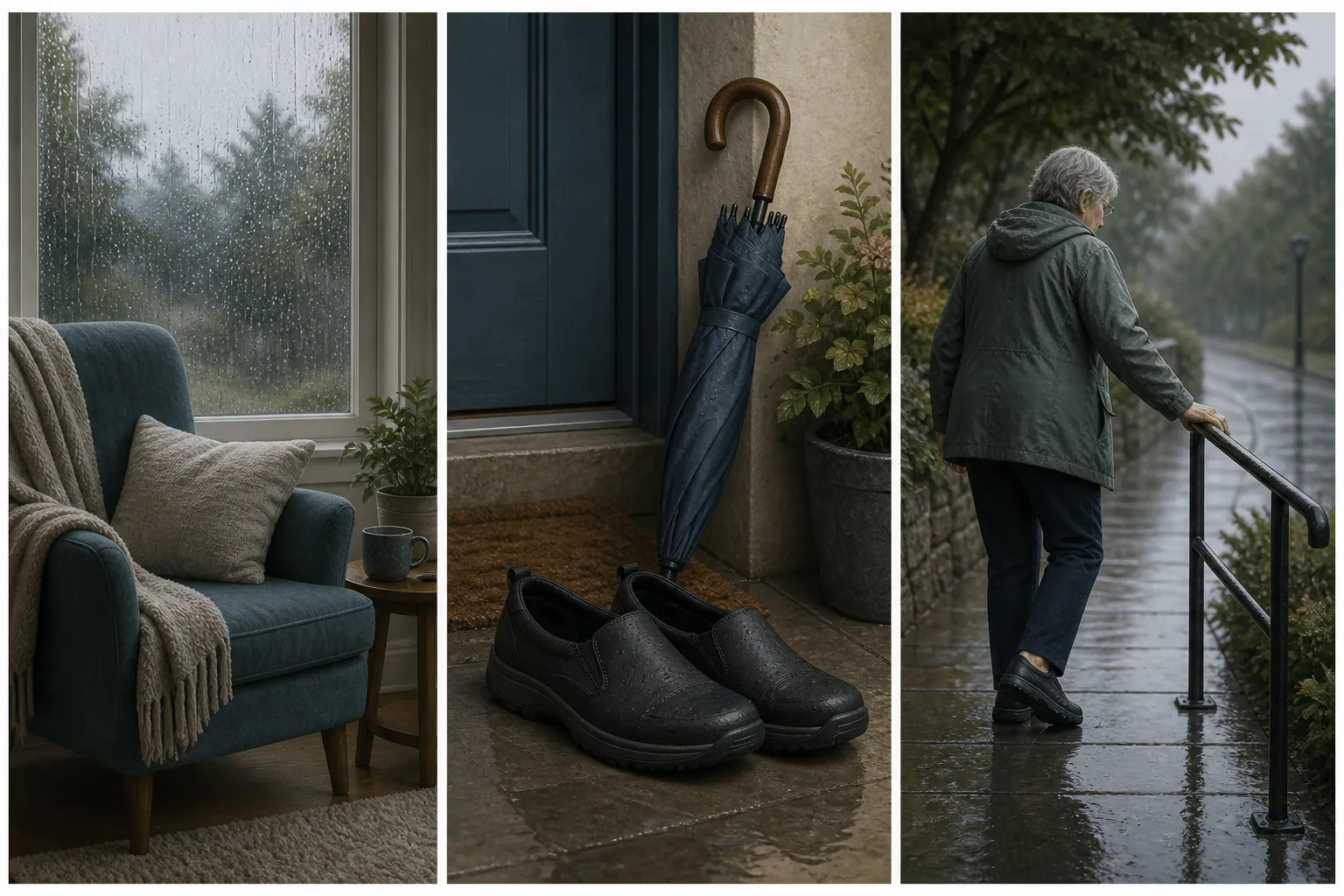
Before leaving, remove the small traps
Shoes first, then everything else
The wrong shoes can turn a careful person into an unstable one before they reach the car. Mayo Clinic’s fall-prevention guidance recommends properly fitting, sturdy, flat shoes with nonskid soles [3]. For a rainy outing, that means no loose slippers for “just the porch,” no backless shoes for “just the mailbox,” and no smooth-soled dress shoes if the route includes wet concrete or tile.
A useful rainy-day test is simple: if the shoes would make you nervous on a grocery store’s shiny entrance floor, they are not the shoes for this errand. Sturdy does not have to mean heavy. It means the shoe stays on, the sole grips, and the person is not compensating for wobble with every step.
Hands should not be doing three jobs
Wet-weather slips often happen during multitasking: locking the door, opening the umbrella, balancing a handbag, stepping off a curb, and trying to answer a phone. Before leaving, put keys where they can be reached without digging. Use a small crossbody bag or pockets if possible. If something must be carried, make it light enough that one hand can still use a railing or steady against a car door.
The phone is the exception: it should come along, but it should not be in use while walking. NCOA and the Ohio Department of Aging both emphasize carrying a phone and having a plan for who to contact; Ohio’s seasonal fall-prevention guidance also recommends telling loved ones when leaving and when expected back [4][5]. For some families, that plan may include a personal emergency response system or a smart-band fall-detection setup, but the basic rule is older than any device: someone should know where the person is going and when to worry.
Look at light and route, not just rainfall
A drizzle at noon on a level, well-lit route is a different outing from a drizzle at dusk across a cracked parking lot. University of Washington Environmental Health & Safety notes that slips, trips, and falls are more common in rainy or icy weather and darkness, and recommends using handrails, well-lit pathways, slip-resistant footwear, and staying free of distractions [6].
Before stepping out, choose the least clever route. The best path may be slightly longer if it has a rail, better lighting, fewer puddles, and no curb. A covered entrance is better than a closer uncovered one if it gives the older adult time to close the umbrella, adjust their footing, and enter without being bumped from behind.
- Turn on exterior lights before opening the door, even in late afternoon.
- Use the handrail every time there is one, including for a single step.
- Avoid puddles when possible; they can hide uneven pavement or a shallow drop.
- Pause before shiny indoor thresholds, especially at stores, clinics, restaurants, and apartment lobbies.
- Let faster walkers go around. Hurrying to be polite is a poor trade.
Walk as if the surface is already slick
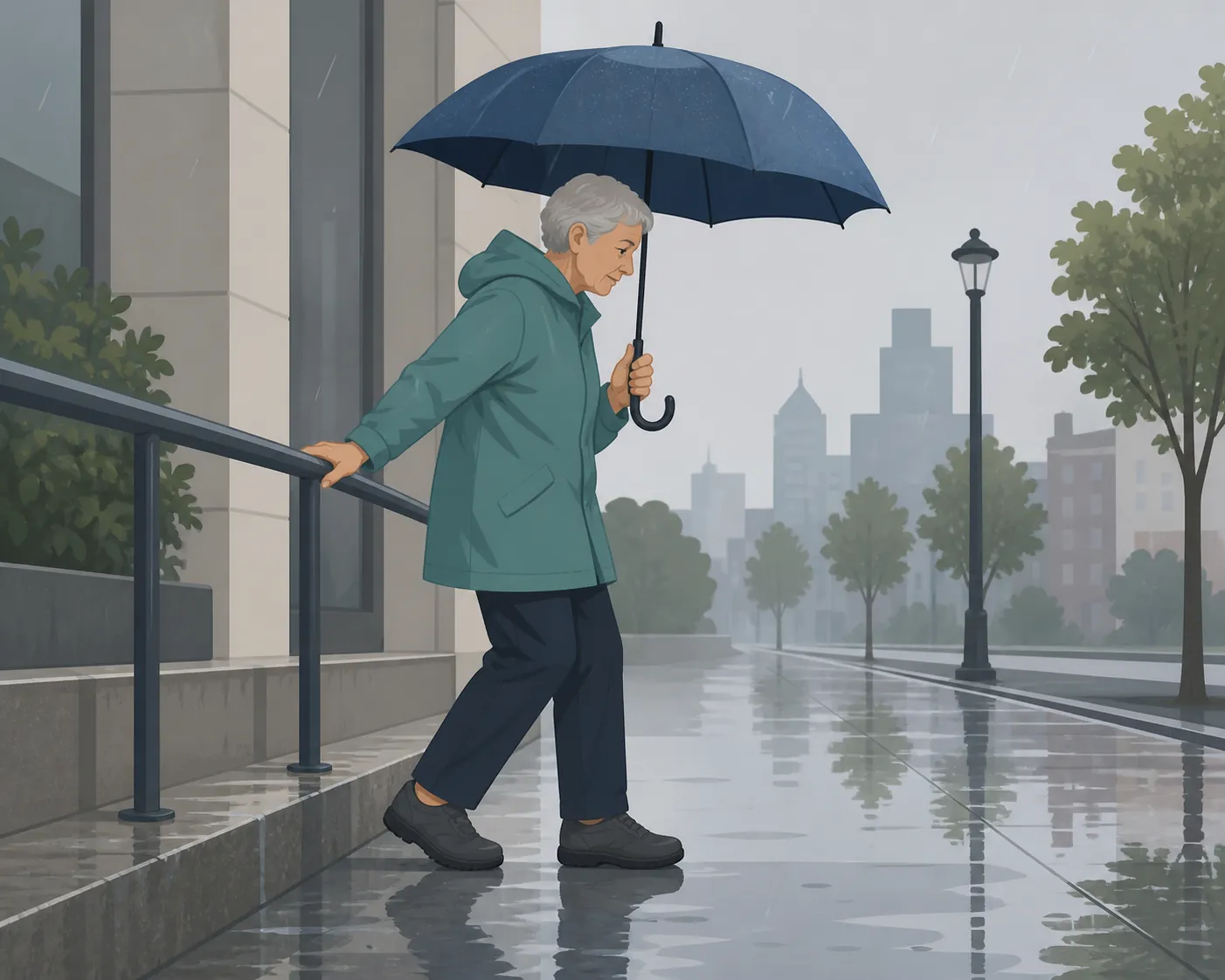
Once the outing is underway, the safest walking style is slower than most people naturally choose. Take shorter steps. Keep the feet a little farther apart than usual. Bend the knees gently. Place the foot down deliberately instead of reaching forward with the heel. This is a rain-adapted version of the cautious short-stride advice often used for winter ice; it should not be treated as proof that rain and ice behave the same way, only as a practical way to reduce overstriding on a slick surface.
The older adult should be the one controlling the pace. A caregiver can walk beside, open doors, carry the bag, point out a curb, or offer an arm. Grabbing at the last second is different; it can startle the person and shift their balance. If help is needed, it is better to say it plainly before the step: “Let’s use the rail here,” or “Take my arm until we’re past the curb.”
At curbs and car doors, slow down even more. These are the moments when the body changes direction, weight shifts, and attention gets divided. Before stepping off a curb, stop fully, look for pooled water, and step down with the expectation that the painted line, metal grate, or smooth concrete may be slick. At the car, let the older adult get both feet stable before reaching for the door or turning to sit.
- Do not text, scroll, or answer calls while walking.
- Use rails, walls, counters, or stable car frames as planned supports—not as last-second catches.
- Step onto mats carefully; a wet mat can slide, bunch, or hide a raised edge.
- Treat the first few indoor steps as part of the rainy route. Shoes may still be wet after crossing the threshold.
- If the older adult uses a cane or walker, do not abandon it because the distance is “only a few steps.”
For cold-weather overlap—slush, refreezing, snow at the curb, or black ice—the rainy-day plan is not enough. Use the site’s winter companion, How Seniors Can Prevent Falls on Ice Outdoors, because ice changes the walking problem.
Why the research points to surfaces, thresholds, and transitions
It is tempting to say, “Rain causes falls,” but the evidence is not that neat. A prospective three-year study of 240 older adults with glaucoma recorded 406 falls; about half occurred outdoors, and the authors noted prior work identifying wet ground and uneven surfaces as significant contributors to outdoor falls. In that same study, outdoor falls were more often injurious, but daily precipitation was not significantly associated with the odds of falling [7].
Other weather and season studies also resist a simple slogan. Stevens, Thomas, and Sogolow found no seasonal pattern in U.S. fatal and nonfatal fall rates among older adults, while fatal fall rates were 9.1% higher in colder climates [8]. A separate 2021 analysis using National Electronic Injury Surveillance System data found fall-related emergency department visits significantly higher in winter [9].
The practical conclusion is narrower and more useful: wet ground, uneven surfaces, low light, outdoor transitions, and hurried walking deserve attention. That is why the best rainy-day plan spends less time staring at the forecast and more time changing the few yards where the fall is most likely to happen.
If there is a slip, slow the next minute down
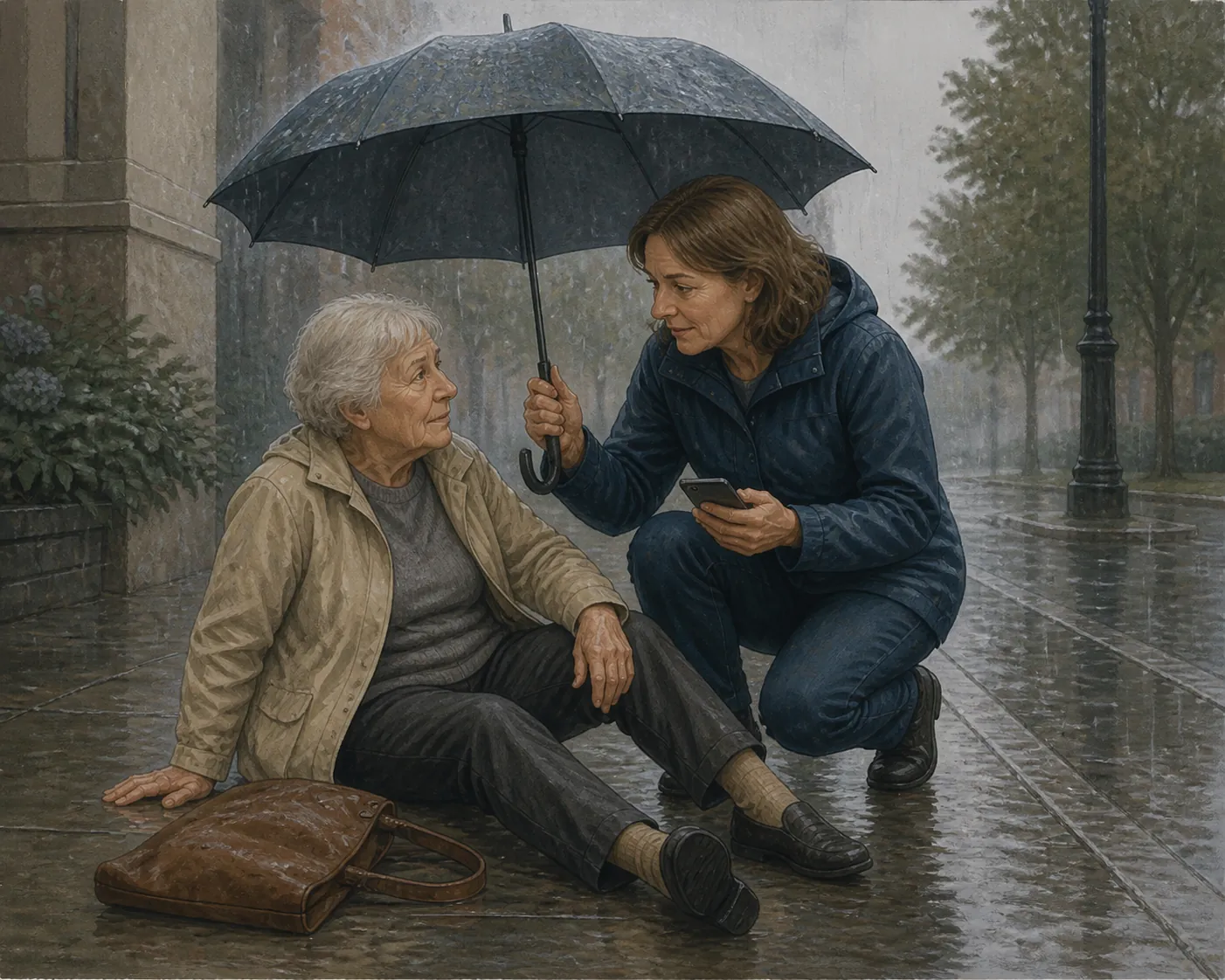
After a wet-weather slip, the first instinct is often to get up quickly and pretend nothing happened. Resist that. Pause. Keep the person warm and out of traffic if possible, but do not rush them to stand before checking what happened.
- Did the head hit the ground, a step, a wall, a car, or a doorframe?
- Is there new confusion, dizziness, sleepiness, severe headache, vomiting, weakness, or trouble speaking?
- Is there hip, back, wrist, shoulder, or leg pain that makes standing unsafe?
- Can the person move normally, bear weight, and get up without being pulled?
- Are they taking blood thinners or other medicines that make a head hit more concerning?
A head hit should be taken seriously, especially for someone on blood thinners; CDC STEADI materials advise prompt medical attention in that situation [2]. Call emergency help rather than continuing the errand if there is head injury concern, severe pain, inability to get up safely, confusion, fainting, chest pain, stroke-like symptoms, or any sense that moving the person may make things worse.
If there is no obvious emergency and the person can get up safely, the outing still deserves a reset. Sit somewhere dry. Check for pain that appears after the adrenaline settles. Replace wet shoes or clothing if possible. Let the person who was expecting a check-in know what happened. Because one fall raises future fall risk, it is worth reporting the fall to a clinician even if the person seems mostly fine afterward [1].
A serious fall can change living arrangements, confidence, and family responsibilities quickly. If that becomes the larger question after an injury, the next conversation may be closer to Aging in Place vs. Assisted Living After a Fall. In the first minutes on a rainy sidewalk, though, the job is simpler: do not rush, do not minimize a head hit, and do not turn a slip into a second injury by hauling someone upright.
A rainy-day routine that still lets people go places
The routine can be rehearsed without making rain dramatic. Decide before leaving whether the outing should be rescheduled, modified, or done as planned. Put on sturdy flat nonskid shoes. Carry a phone. Tell someone the destination and expected return time. Keep hands as free as possible. Use the rail. Walk with short, deliberate steps. Treat curbs, thresholds, and the first indoor steps as part of the wet route.
That is not a ban on rainy-day independence. It is the small agreement that errands, appointments, lunches, and visits are worth doing in a way that gives everyone a better chance of getting home without a frightening phone call.
References
- Facts About Falls | Older Adult Fall Prevention | CDC — CDC
- Patient & Caregiver Resources | STEADI | CDC — CDC
- Fall prevention: Simple tips to prevent falls — Mayo Clinic
- Winter Fall Prevention Tips for Older Adults — NCOA
- Falls Prevention in Every Season — Ohio Department of Aging
- Prevent slips, trips and falls in wet weather — University of Washington Environmental Health & Safety
- The Impact of Weather and Seasons on Falls and Physical Activity among Older Adults with Glaucoma — 2021
- Seasonal Patterns of Fatal and Nonfatal Falls Among Older Adults in the U.S. — 2007
- Seasonality of falls in the United States: a National Electronic Injury Surveillance System database study — 2021
Related reading
Noticed something outdated or inaccurate on this page? Flag a correction. We review every report against CDC, NIA, and AARP HomeFit guidance before updating a page.
Part of the Fall Prevention section.