
STEADI: Intervene
State Fair Safety for Seniors Starts With Booking Early
A plan-ahead checklist for state fair visits with an older adult: which accessibility services to book before you go, how to pace the day against heat, falls, and fatigue, and what to do if something goes wrong on the grounds. Based on official accessibility guides from major U.S. fairs plus CDC heat and fall guidance.
A safe state fair visit with an older adult usually begins before anyone reaches the gate. The hazards that wear people down at a fairground are not mysterious: long distances, heat, uneven walking surfaces, crowds, fatigue, and the possibility of getting separated. The workable answer is not to treat the fair as off-limits. It is to reserve or locate the supports that make the day smaller: a scooter or wheelchair, accessible parking or shuttle routes, first aid, rest stops, and a simple separation plan.
Scale alone changes the safety question. The Iowa State Fair, for example, lists about 445 acres of grounds, estimates 5,400 minutes to casually walk the fairgrounds, and recorded attendance of 1,182,682 in 2024.[1] That is not a casual stroll with snacks added. For an older adult with arthritis, balance concerns, heart or lung disease, medication timing, or limited stamina, it is a temporary city with livestock barns, pavement, grass, curbs, lines, heat, noise, and moving crowds.
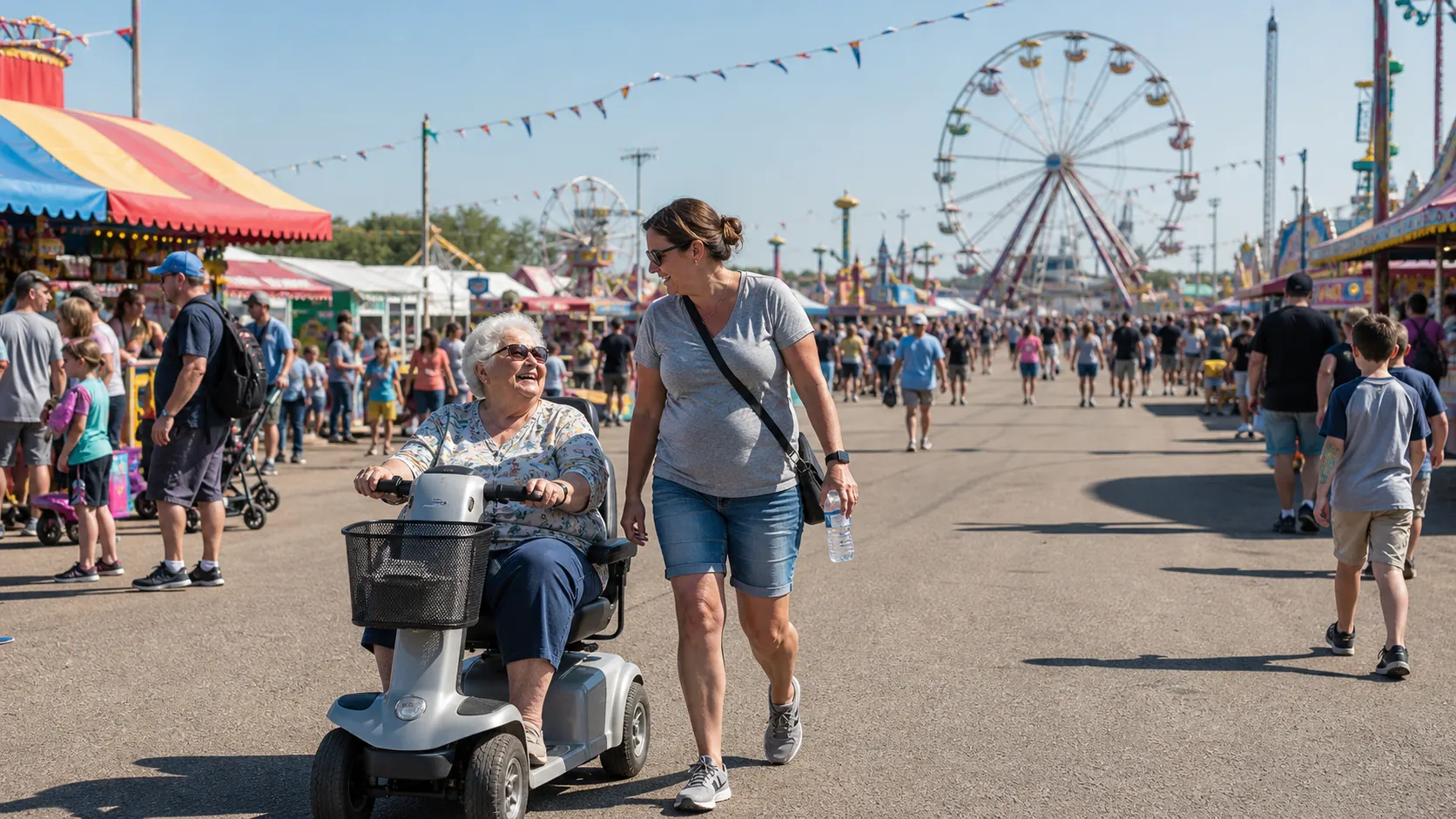
This is why “we’ll figure it out when we get there” is a weak plan. Major fairs do publish accessibility help, but much of it is conditional. Minnesota, New York, Texas, Ohio, and Iowa all tell visitors to reserve mobility equipment at least 24 hours ahead, while North Carolina’s fair describes wheelchair and scooter rentals as first-come, first-served.[2][3][4][5][6][7] Those two models produce very different mornings at the gate.
The first safety step is booking, not packing
A water bottle and comfortable shoes still matter. They just do not solve the hardest fairground problems if the scooter is gone, the accessible parking lot is full, the tram stop is on the wrong side of the grounds, or the adult child spends the first hour pushing through crowds looking for information.
The accessibility page for your specific fair should be read before tickets are bought, not skimmed in the parking lot. Look for the small operational sentences: where rentals are picked up, whether reservations close 24 hours in advance, whether rentals are held all day or released after a certain time, whether payment is cashless, and whether the pickup location is inside or outside the gate.
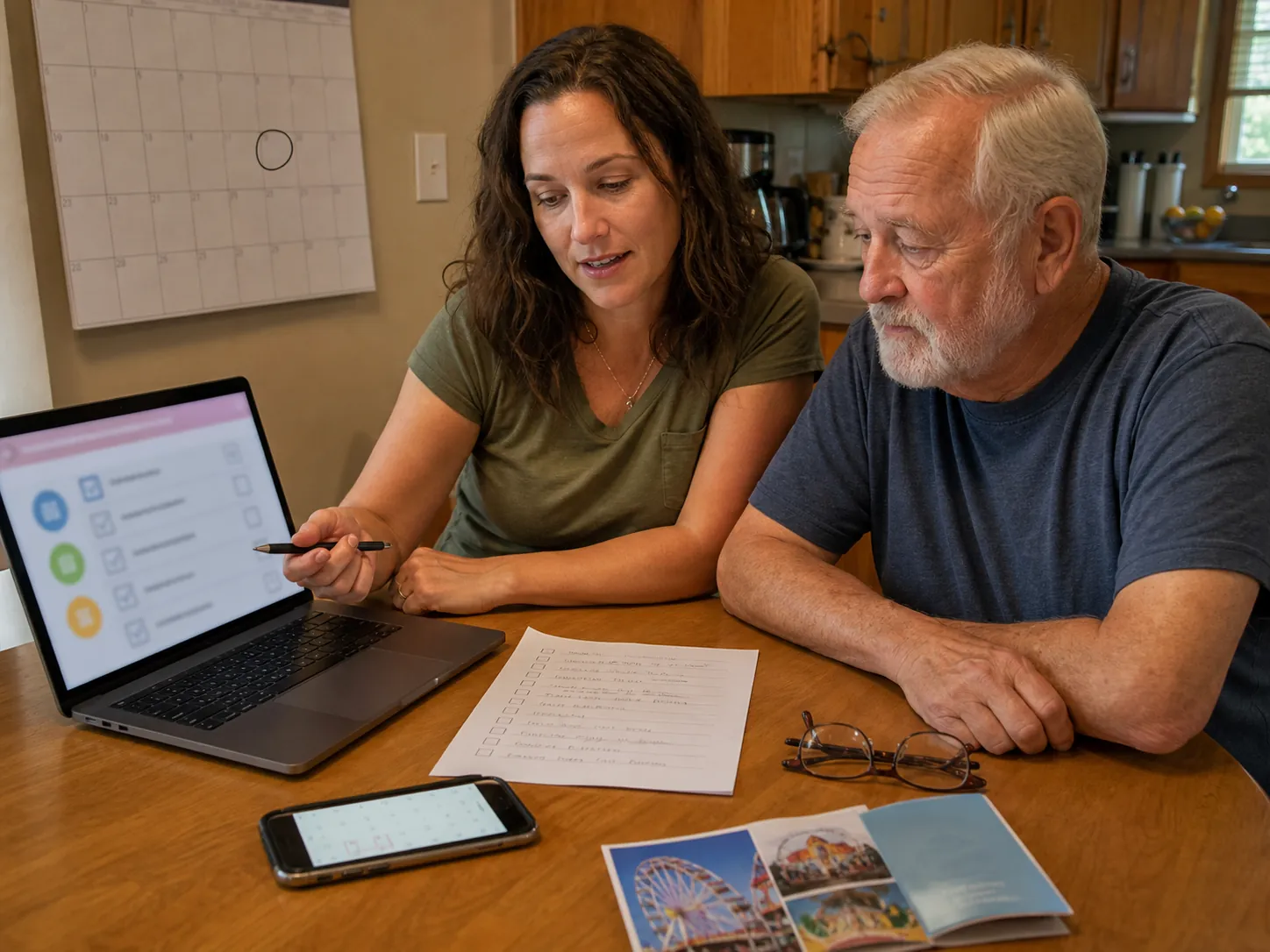
Use official fair pages as current-year sources, not old blog posts or last year’s family memory. Prices, vendors, pickup points, senior-day rules, and transportation routes can change. Minnesota’s accessibility guide, for instance, has listed scooters at about $80 per day as an example of the kind of detail worth checking directly rather than assuming.[2]
Before-you-go accessibility checklist
| Confirm before the visit | Why it matters for senior safety |
|---|---|
| Wheelchair or scooter reservation deadline | A 24-hour rule, first-come policy, or limited supply can decide whether the day is manageable from the start. |
| Pickup and return location | A rental desk far from parking can create the very walking problem the rental was supposed to prevent. |
| Accessible parking rules and arrival advice | A close space is not guaranteed just because a placard is available. |
| Shuttle, tram, Park & Ride, or cart routes | Riding between high-distance zones reduces fatigue and fall exposure. |
| Senior day or discount-day crowd expectations | Discounts can draw heavier crowds and make parking, seating, and rentals tighter. |
| Companion or caregiver ticket policies | Some fairs have specific rules for caregivers, aides, or sighted guides. |
| First-aid and EMS locations | The time to find first aid is before someone is dizzy, overheated, or injured. |
| Lost-person, paging, or information services | Crowds and low phone batteries make a backup contact plan necessary. |
Accessible parking deserves its own check. The State Fair of Texas specifically warns that accessible parking fills fast on Senior Citizen Days.[4] That sentence should change the plan: arrive earlier, identify an accessible shuttle or drop-off alternative, and decide in advance what you will do if the closest lot is full. Do not make the older adult wait in heat while the driver circles indefinitely.
Transportation inside and around the grounds can be just as important as the rental itself. New York lists free trams with 9 stops, Minnesota describes a wheelchair-accessible Park & Ride bus option, Ohio lists six complimentary accessible shuttles and free caregiver or sighted-guide companion tickets, and Iowa lists complimentary Mobility Assistance Carts as new for 2026.[3][2][5][6] Those services are not interchangeable. A tram route may help with distance but not with the first walk from the car. A companion ticket may solve access for an aide but not seating. A cart may help only along a defined route.
If your fair is first-come only for rentals, as North Carolina’s guide states, the plan should become stricter, not looser.[7] Arrive close to opening, bring a backup mobility aid if one is safely available, and decide ahead of time whether you will shorten the visit if no scooter or wheelchair is available. That is not pessimism. It protects the older adult from being pressured into “just trying” a long day on foot because everyone is already there.
Build the route around energy, shade, and exits
Once the main accessibility pieces are reserved or located, the day-of plan should become boring on purpose: enter early, do the highest-priority attraction first, rest before anyone is exhausted, and leave with enough energy to get back to the car, shuttle, or pickup point.
Older adults are more vulnerable to heat-related illness because aging, chronic medical conditions, and some medicines can affect the body’s ability to cool itself, according to CDC guidance.[8] The same CDC page gives a detail families should not skip: older adults who take water pills or have been told to limit fluids should ask a doctor how much water they should drink during hot weather.[8] That conversation belongs before fair day, especially if the plan includes several hours outdoors.
CDC also notes that extreme heat causes more than 700 deaths in the United States each year.[9] The point is not to make a fair sound dangerous by default. The point is to stop treating heat as a minor comfort issue. Heat changes walking tolerance, balance, decision-making, medication timing, and how quickly a pleasant outing becomes a medical problem.
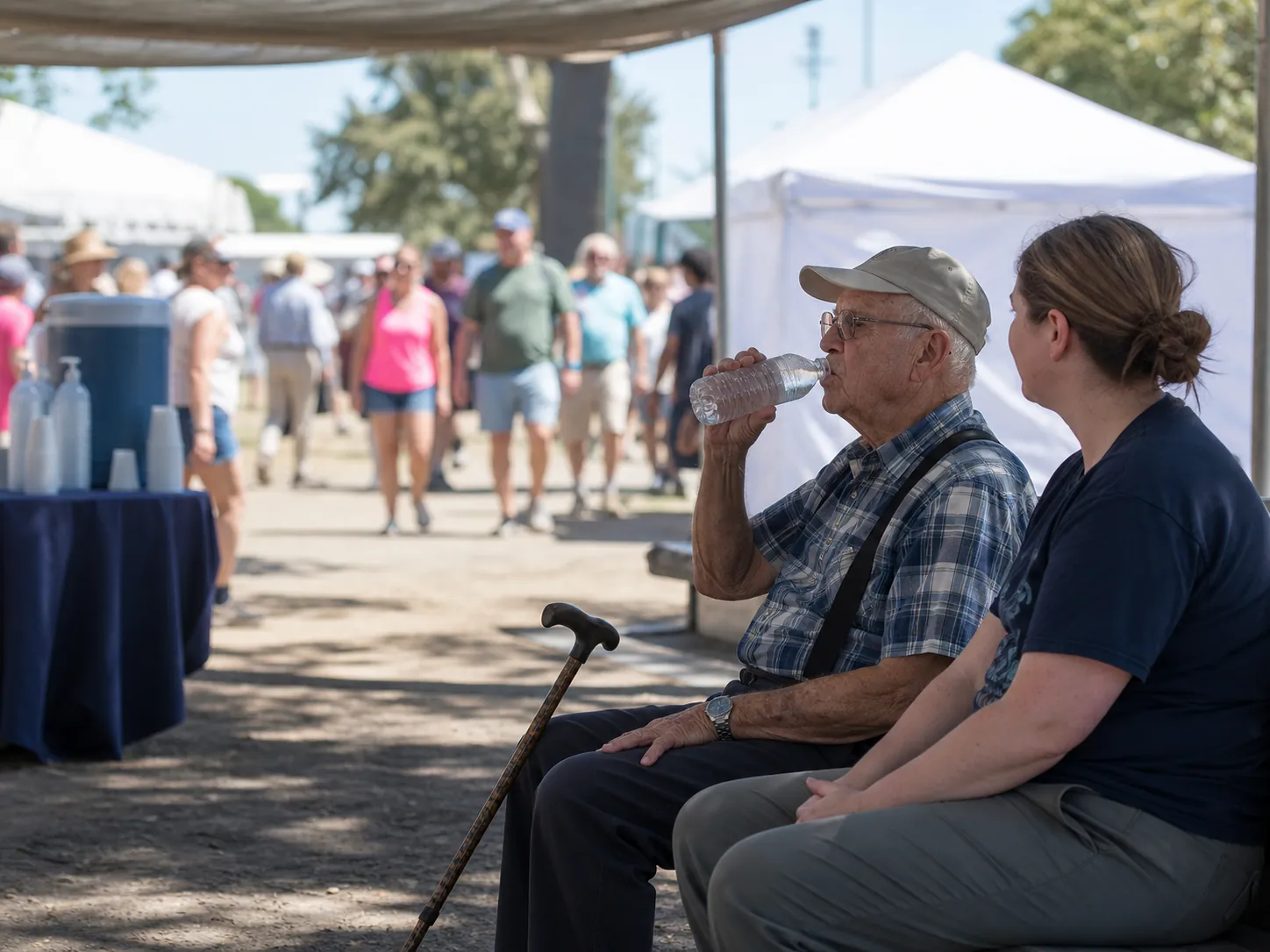
Falls deserve the same practical respect. CDC reports that 1 in 4 older adults falls each year, with about 3 million emergency department visits and about 1 million hospitalizations related to older-adult falls annually.[10] At a fair, the fall risks are ordinary things stacked together: fatigue, curbs, cords, grass, spilled drinks, steps into barns, crowds that stop suddenly, and a hurried walk to the next show.
A good fair route limits those stacked risks. Put shaded seating, restrooms, first aid, and transportation stops on the map before choosing food stands and entertainment. If the older adult uses a cane, walker, rollator, wheelchair, or scooter, plan entrances and paths that reduce transitions between pavement, gravel, grass, and barn thresholds. If a show is the main reason for going, arrive early enough to avoid rushing through a crowd for a seat.
- Set a time limit before the visit, such as “we leave after the afternoon show” or “we reassess at lunch.”
- Choose one or two must-do activities, then let everything else be optional.
- Mark rest stops on the map, not just attractions.
- Use trams, shuttles, carts, or Park & Ride services early, before fatigue becomes visible.
- Avoid making the longest walk of the day the final walk back to the car.
For families already using a home or weather checklist, the same logic applies here: plan around the moment when the environment becomes harder to manage. The checklists for severe weather preparedness for older adults and flash flood fall prevention use that same approach: do the deciding while conditions are calm.
Pack for the problems that actually interrupt the day
Packing for a senior fair visit is less about having every possible item and more about preventing the predictable failure points: heat, medication delays, low phone battery, sore feet, and difficulty proving what help was reserved.
- Reservation confirmation for scooter or wheelchair rental, saved on the phone and printed if possible.
- A current medication list and any time-sensitive doses needed during the visit.
- Water plan that follows the older adult’s medical instructions, especially if fluids are restricted or water pills are used.
- Sun protection, including a hat and light layers appropriate for the day’s forecast.
- Fully charged phone, portable battery, and written emergency contacts in case the phone dies.
- Small card with the older adult’s name, caregiver phone number, meeting place, and any urgent communication need.
- Mobility aid that is already familiar, not a brand-new cane or device being tested for the first time on uneven fairground surfaces.
This article is general safety information, not medical advice. If an older adult has heart disease, kidney disease, diabetes, dementia, a recent fall, recent surgery, fainting episodes, fluid restrictions, or medication questions, the fair plan should be checked with a clinician who knows that person’s situation.
If something goes wrong, use the fair’s system early
The first-aid location should be in the plan before the first funnel cake. Minnesota lists two first-aid stations, and Iowa lists the Hy-Vee Health and First Aid Center staffed by Des Moines Fire Department EMS.[2][6] Your fair may use different staffing, names, or locations, but the habit is the same: mark help on the map at the beginning of the visit.
Do not wait until the older adult is “really bad” to stop. If walking becomes unsteady, heat feels overwhelming, a medication dose was missed, pain changes the person’s gait, or the caregiver is no longer confident about getting safely back to transportation, pause the outing and use the nearest official help point. In a true emergency, call 911.
Separation needs the same calm advance plan. Pick one meeting place that is easy to describe, such as an information booth, first-aid station, or specific gate. Put it in writing. If the older adult has memory changes, hearing loss, or trouble using a smartphone, do not rely on “just call me.” Iowa’s fair lists a paging service for seniors, which is exactly the kind of service families should identify before the grounds are crowded and phones are low.[6]
- Take a photo of the older adult that morning so clothing is easy to describe if help is needed.
- Agree that if separated, both people stop moving and go to the planned meeting point or ask uniformed staff for help.
- Keep the fair map or app open to first aid, information booths, exits, and shuttle stops.
- Use official staff, first aid, EMS, paging, or information services sooner rather than trying to solve everything privately in a crowd.
What to verify on your fair’s current page
State fair safety and accessibility for seniors is not one national system. It is a set of local rules published by each fair, and those rules can change year to year. Before the visit, verify the current accessibility page for the specific fair, the specific date, and the specific senior-day or discount-day conditions.
- Mobility rental vendor, deadline, price, pickup location, and cancellation policy.
- Whether rentals are reservable or first-come only.
- Accessible parking location, overflow plan, shuttle route, and drop-off rules.
- Tram, cart, Park & Ride, or accessible shuttle availability and hours.
- Companion, caregiver, aide, or sighted-guide admission rules.
- First-aid, EMS, cooling, information, and lost-person or paging services.
- Weather policy and whether extreme heat, storms, or poor air quality would change your plan.
The fair can still be worth doing. An older parent can see the animals, eat the once-a-year food, sit through a show, and move through the day without being treated like cargo. But the visit is usually made safer by work that happens earlier: reserving what can run out, locating what may be hard to find, and agreeing on what to do if the day stops going smoothly.
References
- Iowa State Fair Trivia, Iowa State Fair
- Accessibility Guide, Minnesota State Fair
- Accessibility, The Great New York State Fair
- State Fair Cares: 2025 Amenities and Accessibility, Big Tex
- Accessibility, Ohio State Fair
- Disability Assistance, Iowa State Fair
- Accessibility Guide, NC State Fair
- Heat and Older Adults (Aged 65+), CDC
- Protect Yourself From the Dangers of Extreme Heat, CDC
- Facts About Falls, CDC
Related reading
Noticed something outdated or inaccurate on this page? Flag a correction. We review every report against CDC, NIA, and AARP HomeFit guidance before updating a page.
Part of the Fall Prevention section.