
STEADI: assess
Tornado Watch vs Warning for Older Adults With Walkers
This article explains the difference between a tornado watch and warning for older adults who use walkers or wheelchairs, and provides criteria for choosing a safe room that balances tornado protection with fall risk.
A tornado watch means conditions could produce a tornado, so this is the time to prepare the route, shelter room, alerts, lights, and kit. A tornado warning means a tornado has been reported or indicated, so the plan changes from preparation to movement: go now to the shelter you already chose.
For an older adult using a walker or wheelchair, that chosen shelter should not be judged only by how protected it is on a weather diagram. It has to be judged by whether the person can reach it without falling. A basement may be structurally better, but a dark stairway, a tight turn, a loose rug, or a walker that will not fit through the last doorway can turn the “best” shelter into a dangerous choice before the tornado ever arrives.
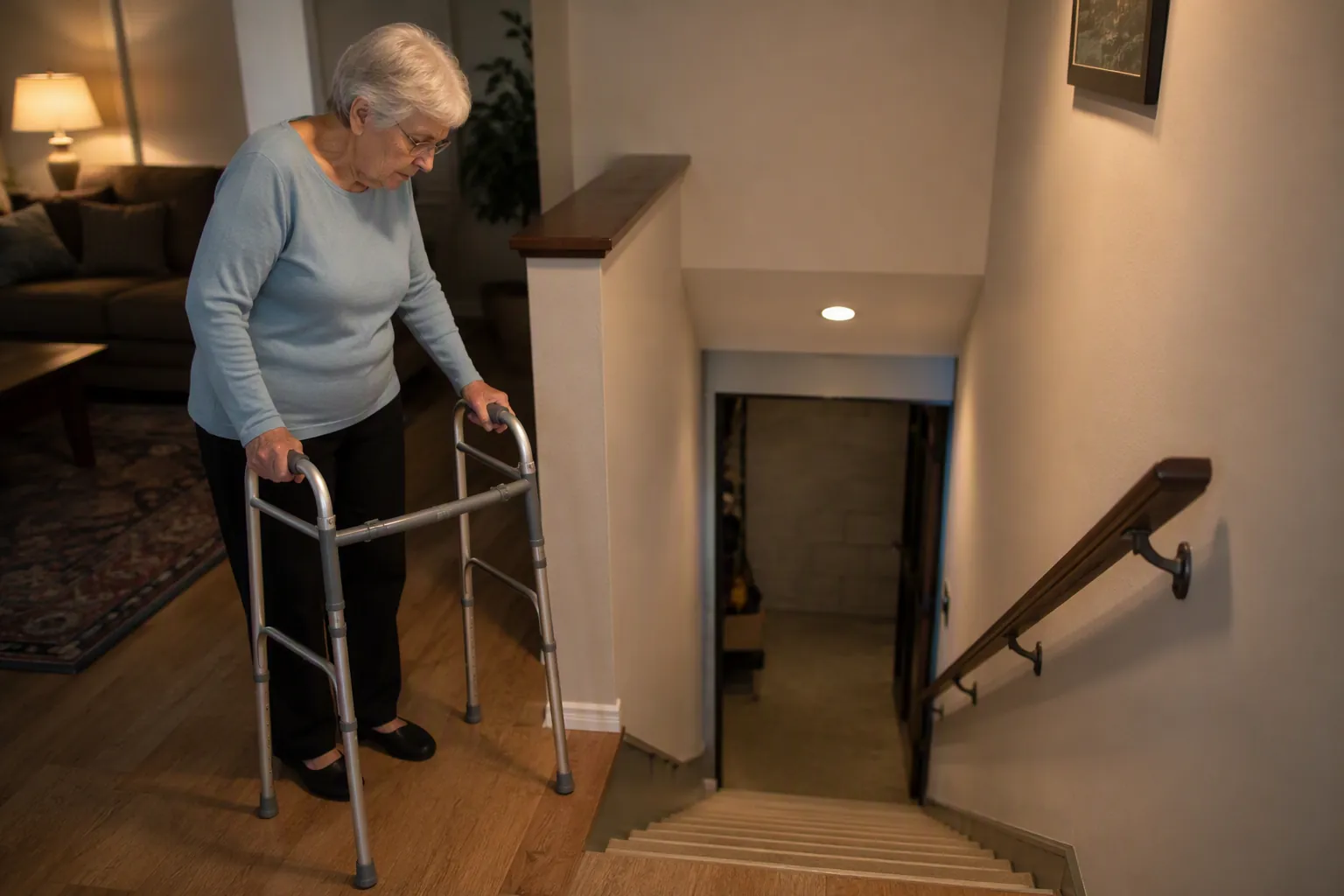
That is why the watch-versus-warning distinction matters more for limited mobility than it may at first appear. During a watch, there is still time to remove the rug, turn on battery lights, move the walker into position, and put the emergency kit inside the safe room. During a warning, those fixes should already be done. The older adult should not be asked to solve the house while also moving through it.
The safest room is the one that protects and can actually be reached
Older adults and disabled people are not being difficult when the standard advice does not fit. Seniors over 75 have the highest tornado fatality rates in population-adjusted National Weather Service data cited by Survive-A-Storm, and limited mobility or sensory impairment can delay shelter-seeking.[1] United Spinal Association also notes that people with disabilities are 2 to 4 times more likely to die or be injured in a disaster, citing the Partnership for Inclusive Disaster Strategies.[2] Those numbers should not be used to frighten a household into rushing. They explain why the last ten feet of the route deserve careful attention.
Start with the usual tornado hierarchy, then test it against the person’s body and home:
- A basement is often the strongest choice if the person can get there steadily, with a handrail, adequate lighting, and enough time.
- A ground-floor interior room may be safer for someone who cannot manage stairs without a high fall risk.
- A ramp-accessible storm shelter or FEMA-compliant above-ground safe room may be the realistic option for a wheelchair user or someone who cannot descend stairs.
- A mobile home requires a different plan: the shelter should be a sturdy off-site location that can be reached before conditions become dangerous, not an interior room inside the mobile home.
The decision is not “basement good, ground floor bad.” It is a tradeoff. Falling on basement stairs during a warning can be catastrophic, and it may leave the person injured in the wrong place. For a frail older adult, the more protected room is not automatically the safer room if reaching it requires a maneuver the person cannot perform reliably under time pressure.
Test the route before you bless the room
A safe-room choice should be walked, rolled, and turned through. Do not evaluate it from the doorway. Put the walker or wheelchair where it would actually be when a warning arrives, then move at the older adult’s normal pace to the proposed shelter. If the person usually rises slowly from a recliner, starts from bed, or pauses before a hallway turn, include that. The test should reveal friction, not hide it.
| Shelter option | When it may work | When it may fail for a walker or wheelchair user |
|---|---|---|
| Basement | The person can manage the stairs without rushing; the stairway is lit; handrails are usable; the walker can be safely staged at the bottom or an alternate support is available. | The person needs assistance on stairs, freezes at the top step, cannot carry or manage the walker, or would need to move through darkness or clutter. |
| Ground-floor interior room | The room has no windows, is near the person’s usual living area, has a wide enough doorway, and can be reached without stairs. | The doorway is too narrow, the turn is too tight, there is a step-over threshold, or stored items block the floor space. |
| Ramp-accessible shelter | The ramp is usable in wet weather, the door can be opened by the person or caregiver, and the route does not require crossing debris-prone outdoor space during a warning. | The shelter is too far away to reach after a warning, the ramp is steep or slick, or the door hardware is difficult for arthritic hands. |
| FEMA-compliant above-ground safe room | The person cannot use basement stairs and needs a code-recognized shelter that accommodates a wheelchair or walker. | A noncompliant closet, storage room, or ordinary interior room is being treated as if it were the same thing as an engineered safe room. |
| Off-site sturdy shelter | The household lives in a mobile home or another unsafe structure and can leave early during the watch or before storms arrive. | The plan depends on driving after a warning is issued or after wind, hail, darkness, or blocked roads make travel unsafe. |
The doorway matters. A room that requires a walker to be folded, lifted, or turned sideways is not ready for a warning. Survive-A-Storm identifies wide doorways of 32 inches or more as an accessibility feature for storm shelters used by older adults and people using walkers or wheelchairs.[1] That measurement is especially important for hall bathrooms, small closets, and basement entries, where the room may look close but the opening is the obstacle.
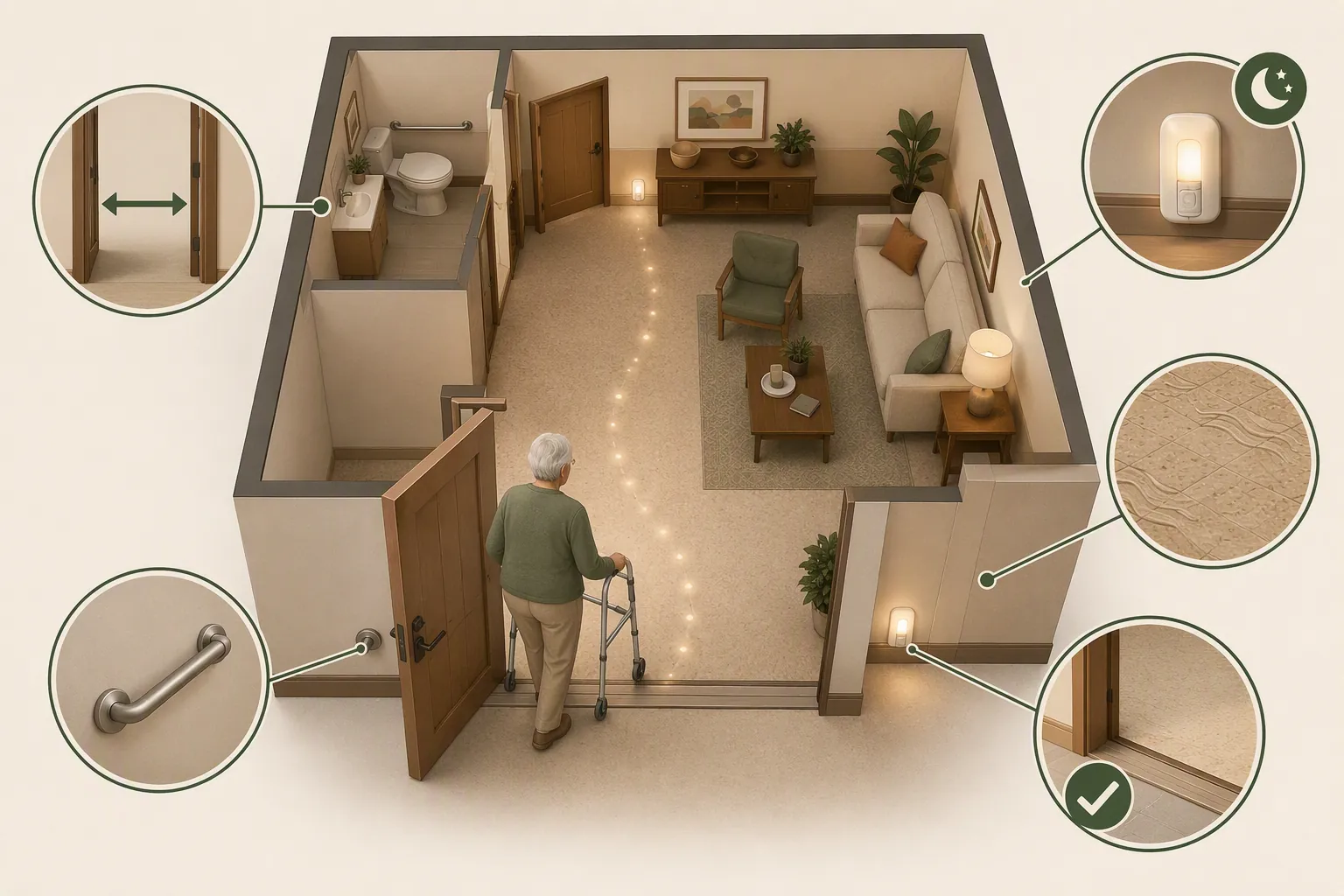
Check the threshold next. A small lip may be invisible in ordinary life and still be enough to stop a walker wheel or catch a toe during a warning. The floor should not be slick, curled, or loose. Refuge Shelters identifies non-slip steps and flooring as key safety and accessibility features for older adults using storm shelters.[3] In a home plan, that means removing throw rugs, replacing curled mats, and avoiding polished surfaces on the shelter route.
Then check the turn. A wheelchair may pass through a doorway and still fail at the angle into the room. A walker may fit straight ahead but not around the bed frame, laundry basket, or narrow hallway table. The room is not selected until the mobility aid can enter, turn as needed, and stop in a position where the person can remain protected without blocking the door for a caregiver.
During a watch, make the shelter usable
A watch is not the moment to sit beside the television waiting to learn whether the storm becomes serious. For a household with fall risk, a watch is the work period. For a broader preparation sequence before severe weather arrives, use a tornado watch safety checklist for seniors as the prior step. For the shelter room itself, be more specific: clear the path, light the path, stage the mobility aid, and put the kit where it will not require reaching, bending, or lifting.
Clear the route all the way to the stopping point
Clearing the route means more than opening the shelter door. Move shoes, pet bowls, oxygen tubing, laundry baskets, footstools, loose cords, and rugs from the path. If the person starts from a recliner, clear from the recliner. If nighttime warnings are common in the area, clear from the bed and bathroom too. A walker needs a predictable lane, not a general promise that someone will move things later.
Light the path before the power fails
Overhead lights are useful until the power goes out. Battery-powered nightlights or motion-sensor lights along the shelter route are a practical fall-prevention tool for low-light conditions and outages.[4] Put them where the older adult’s eyes need help: beside the bed, at the hallway turn, near the bathroom doorway, at the shelter threshold, and inside the shelter itself. The light inside the shelter matters because a person may need to sit, shift position, find medication, or avoid stepping on a kit after entering.
If hearing loss could delay the first alert, fix that during the watch phase too. A weather radio, phone alerts, visual alerts, bed shaker, or caregiver call plan only helps if it wakes or reaches the person early enough to move at a safe pace. For that part of the plan, see tornado preparedness for seniors with hearing loss.
Put supplies where they do not create another trip
The emergency kit should not live on a high shelf, in a garage cabinet, or at the back of a crowded closet. Oklahoma State University Extension advises older adults to store emergency supplies where they are quick and easy to access, and notes that people with arthritis may prefer a wheeled case instead of a heavy tote.[5] For tornado sheltering, the best location is often inside the selected shelter room, already low enough to reach without climbing and placed so it does not block the walker or wheelchair.
Small shelter rooms complicate that advice. A hall bathroom or closet may not have room for a full kit without making the floor harder to navigate. In that case, split the supplies: keep a compact shelter kit inside the room and a larger wheeled bag in an easy-access location near the bed or main chair. The compact kit can hold the items that must be available immediately in the room; the larger bag can serve broader emergency needs if there is time and help to bring it.
Helmets belong in the same category: useful if already placed where they can be put on quickly, unsafe if they turn into a last-minute errand. A caregiver should not send an older adult back across the house for head protection after a warning has sounded. If helmets are part of the plan, store them in or directly beside the shelter and practice putting them on without delaying movement.
Practice at the person’s real speed
A route that works only when an adult child is demonstrating it briskly does not work. United Spinal Association recommends practicing tornado shelter plans and identifying accessible shelter locations in advance for disabled people.[2] In a home, that practice should include the older adult’s actual starting point, usual footwear, normal mobility aid, and ordinary pace. If the person needs to pause at the hallway corner, that pause belongs in the timing.
Time the route, but do not turn it into a race. The useful question is whether the household knows how long the move takes and which parts cause instability. If the walker catches on the bedroom rug, the rug goes. If the person cannot pull the shelter door closed while holding the walker, add a reachable handle or assign that task to the caregiver. If the basement test produces shaking, breathlessness, or a near fall, the basement should not remain the plan simply because it sounds safer in general.
When the basement is not realistic
There are homes where the basement is clearly the better shelter for able-bodied occupants and clearly the wrong assignment for one person in the household. That does not mean the household has failed. It means the plan has to stop pretending that stairs disappear during emergencies.
A ground-floor interior room is usually the next candidate. Look for the smallest practical room or hallway on the lowest reachable level, away from windows and exterior walls when possible. Then apply the mobility test: at least a usable-width doorway, no step-over threshold, no loose rugs, enough room for the walker or wheelchair, reachable seating if the person cannot lower themselves to the floor, and a kit that does not reduce turning space.
Bathrooms often look promising because they are interior and small, but they can fail on access. A narrow bathroom door, bath mat, raised threshold, wet tile, or a toilet that blocks turning space may make the room less usable than a nearby interior hallway. Closets have a similar problem: they may be protected, but if the door is narrow or the floor is packed with stored items, they are not ready.
A grab bar near the entry can help with the final transition into the room, especially where the person must pivot from walker to chair or brace briefly while the caregiver closes the door. It should be installed as a support, not improvised from a towel bar, shelf, or door knob. The aim is to remove the awkward last movement that causes many near falls: one hand on the walker, one hand searching for something solid, feet turning on a small patch of floor.
Above-ground safe rooms are a serious option, not a casual label
For a wheelchair user or an older adult who cannot descend basement stairs, an above-ground safe room can be the right answer when it is built or installed to FEMA safe-room guidance, often referred to as FEMA P-320. United Spinal Association identifies FEMA-approved storm shelters and accessible shelter planning as important tornado preparedness measures for the disability community.[2] The accessibility benefit is obvious: the person can roll or walk in without attempting stairs.
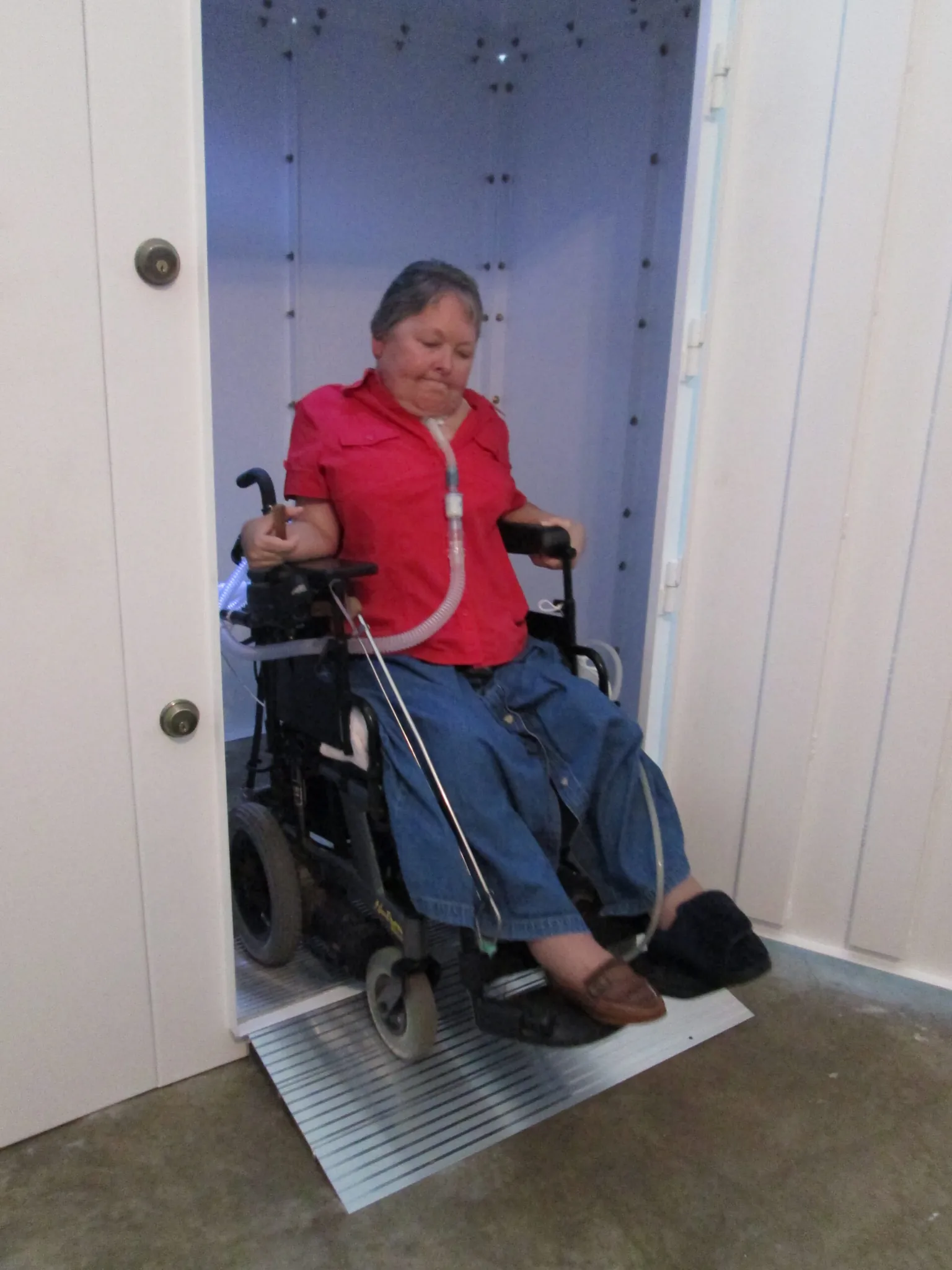
The caution is equally important. An above-ground safe room is not the same as deciding that any ground-floor closet is “good enough,” and not every product marketed as a storm shelter should be treated as equivalent to a code-recognized safe room. The household should verify the design standard, installation, anchoring, door hardware, ramp access, and whether the person can open, enter, turn, and close the shelter at their actual pace.
It is also fair to say that below-ground protection can still offer advantages in the most violent tornadoes. The practical question is whether that advantage can be used by this person without creating a high fall risk. If the answer is no, a properly designed above-ground safe room may provide a more usable and safer household plan than a basement the person cannot reach.
Mobile homes need an early off-site plan
For mobile home residents, the safe-room decision changes. United Spinal Association reports that 43% of tornado deaths in roughly the past 21 years occurred in mobile homes, citing National Weather Service data.[2] The practical conclusion is plain: the shelter plan should not be an interior hallway inside the mobile home. It should be a sturdy off-site shelter that can be reached early enough.
For an older adult with a walker or wheelchair, “go to a neighbor” is not a complete plan. Which neighbor? Is there a step at the door? Is the route paved? Can the wheelchair fit through the entry? Who opens the door if the caregiver is at work? Is the shelter available at night? Can the person leave during a watch rather than waiting for a warning? These questions should be answered before the season’s first storm, not during a siren.
When a warning is issued, stop improving the plan
A tornado warning is the moment to use the plan, not perfect it. Move to the selected shelter at the practiced pace. Use the walker or wheelchair the way it was used in the drill. Do not detour for a larger kit, a different pair of shoes, a blanket from another room, or a helmet stored somewhere else. If another person is helping, that helper should focus on clearing the immediate path, closing doors if possible, and getting the older adult settled without pulling, rushing, or crowding their mobility aid.
A separate fall-safe tornado warning plan for seniors can cover the minute-by-minute warning response. The room and route decision comes first: the warning should trigger a movement that has already been made physically possible.
After the person is inside the shelter, power loss can create a second fall risk: darkness, heat or cold, dead phone batteries, and difficulty exiting after the storm. That is the next layer of planning, addressed in senior tornado shelter safety when the power goes out.
The room is chosen only when the person can get there, enter it, stay there, and leave it without the plan depending on luck. If the “best” room cannot be reached safely, it is not the best room for this person.
References
- Protecting Infants and Elderly During Tornadoes, Survive-A-Storm.
- Tornado Preparedness for the Disability Community, United Spinal Association.
- Storm Shelters for Seniors: Key Features for Safety and Accessibility, Refuge Shelters.
- Emergency Preparedness for Seniors, Keystone Health.
- Older Adults and Planning Ahead for Severe Weather, Oklahoma State University Extension.
Related reading
Noticed something outdated or inaccurate on this page? Flag a correction. We review every report against CDC, NIA, and AARP HomeFit guidance before updating a page.
Part of the Fall Prevention section.