
STEADI: intervene
Stay or Go? Flood Warning Precautions for Older Adults
A decision tree for older adults with limited mobility to determine whether evacuating or sheltering in place during a flood warning is safer, based on objective criteria such as evacuation zone, medical-device dependence, and support network.
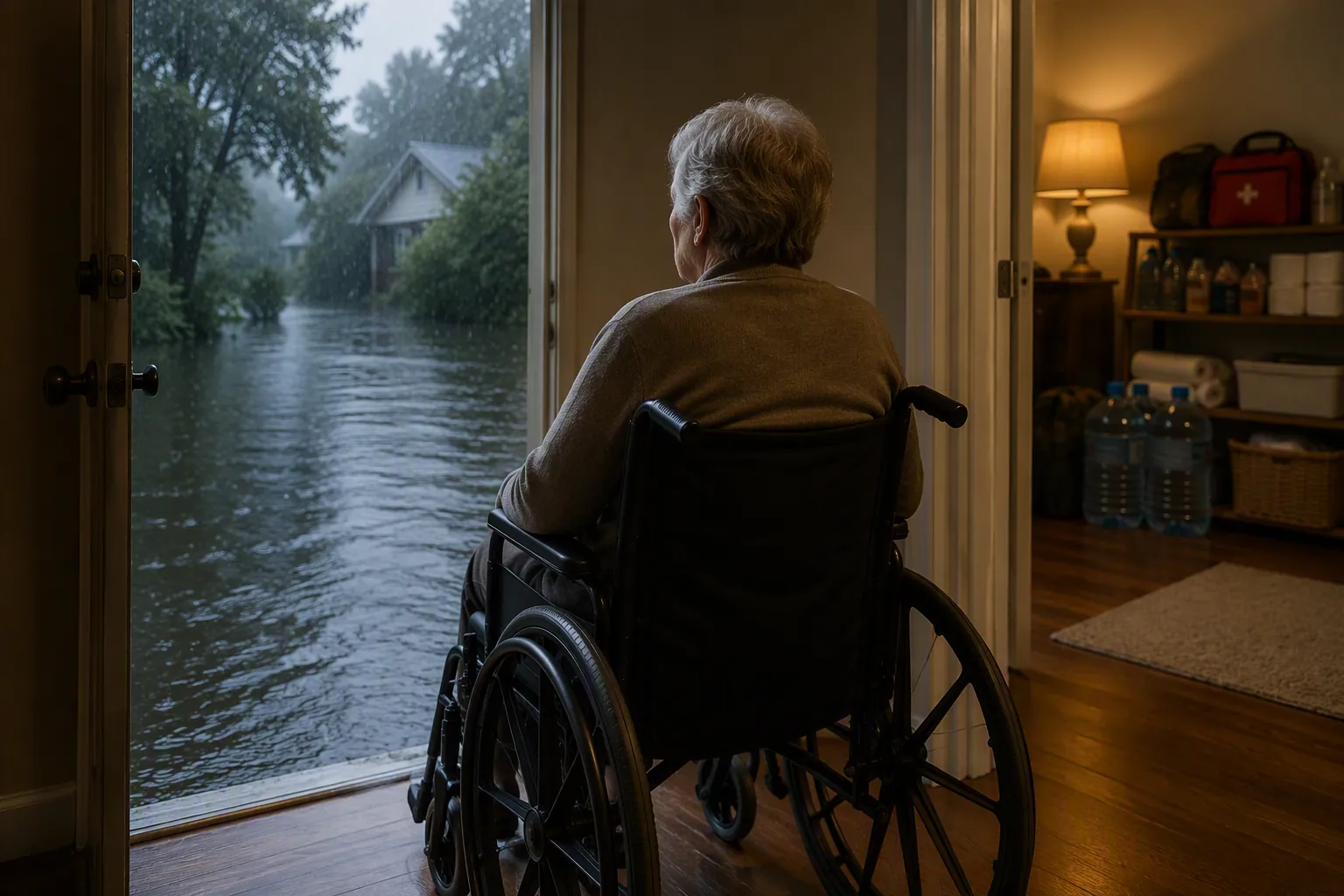
The flood warning is already active. Someone is asking whether to leave, and the older adult in the house cannot simply stand up, grab a bag, and move fast. The real question is narrower than “Is evacuation safer?” It is: which choice is safer for this body, in this home, with this support, before the water cuts off the next option?
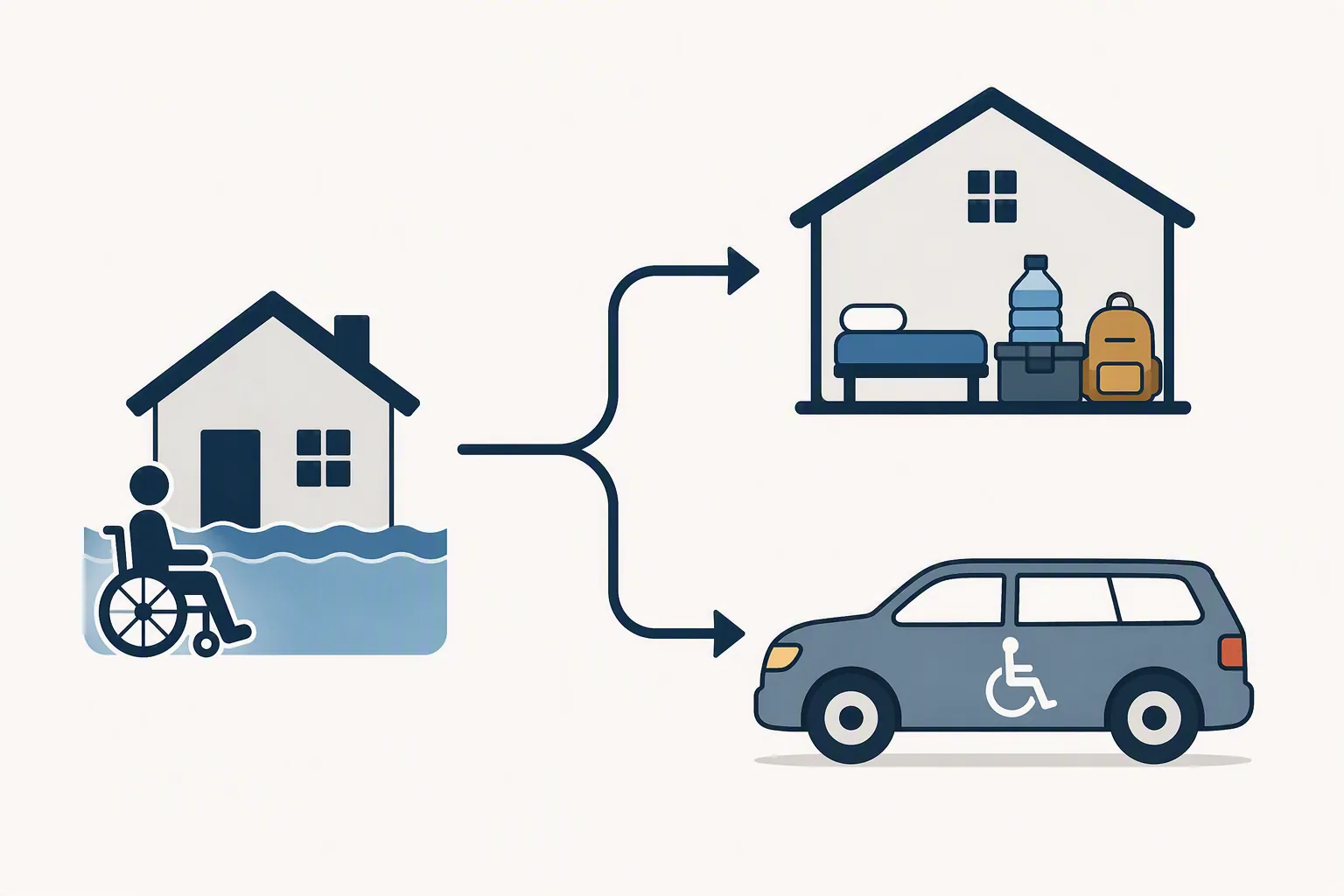
Start with the hard safety boundary. If there is a mandatory evacuation order, active flooding at the home, a mobile-home or unsafe-structure risk, or an electric medical-device power threat that cannot be backed up, the decision moves toward evacuation. That evacuation should be treated as a fall-prevention and medical-transfer job, not a car trip.
If those triggers are absent, sheltering in place can be considered, but only when the home is intact, the person can stay above floodwater without relying on elevators or unsafe stairs, supplies and medications are ready for at least a week, backup power is realistic where needed, and help can still reach the person by phone or in person.
The decision tree
Use this as a practical sorting tool during a flood warning. It is not a validated clinical instrument, and it does not replace local emergency management, 911, a clinician, or facility staff. Its job is to keep a stressed family from making the whole decision from confidence, guilt, or fear.
| Decision point | If yes | If no |
|---|---|---|
| Is the address under a mandatory evacuation order or inside an official evacuation zone? | Evacuate. Follow local emergency instructions and do not downgrade the order because the move is difficult. | Continue to the next decision point. |
| Is floodwater already entering the home, moving across the yard, covering the road, or blocking the safest exit? | Do not try to walk, roll, or drive through it. Call emergency services or local emergency management for rescue or assisted evacuation. | Continue only if the route out and the safe area inside the home are still dry. |
| Is the older adult in a mobile or manufactured home, a basement apartment, or a structure that may not remain safe? | Plan to leave before water or wind makes transfer impossible. Treat this as an assisted move if mobility is limited. | Continue to the home-integrity check. |
| Does the person depend on electricity for oxygen equipment, powered mobility, a hospital bed, suction, refrigeration for medication, or communication? | If backup power and a charging plan are not already in place, evacuate to a location with reliable power or request medical-assistance evacuation. | Continue if the device plan can survive the expected outage window. |
| Can the person remain on a dry, accessible level of the home without using an elevator or unsafe stairs? | Continue if the safe area, bathroom access, bed or recliner, and medical equipment are all reachable. | Evacuate early or request assistance. A safe second floor is not safe for someone who cannot reach it. |
| Are medications, water, food, continence supplies, oxygen or device supplies, batteries, chargers, documents, and caregiver necessities ready for 7+ days? | Continue to the support check. | Evacuate before roads close, or get supplies delivered while travel is still safe. |
| Is there reachable support if the caregiver falls, the older adult deteriorates, the power fails, or the plan changes? | Sheltering in place may be reasonable if all earlier checks are also favorable. | Move toward evacuation or assisted evacuation. One exhausted caregiver is not a support network. |
Official evacuation instructions carry special weight here. Ready.gov’s older-adult guidance tells people to make a plan around their specific needs and follow instructions from local officials during emergencies; in a flood warning, the local order is not just background information, it is a decision point.[5]
Branch 1: evacuate, but slow the transfer down
If the tree points to evacuation, the next mistake is treating speed as the only goal. For a frail older adult, the dangerous minutes may be the sit-to-stand from the recliner, the wet threshold, the porch step, the walker folded into the wrong part of the car, or the oxygen tubing snagging during transfer.
- Move before water reaches the exit path. Once water is moving across the route, the plan changes from family evacuation to rescue or assisted evacuation.
- Assign one person to the older adult’s body and one person to equipment if possible. The first person watches balance, breathing, pain, confusion, and fatigue; the second handles walker, wheelchair, oxygen, medication bag, phone, charger, and documents.
- Keep the mobility device with the person, not buried under luggage. A walker left in the trunk under bags creates a fall risk at the destination.
- Use shoes with traction, not slippers. Add a dry towel or small mat at the doorway and car door if it can be done without delaying departure into rising water.
- Bring the current medication list, actual medications, glasses, hearing aids, dentures, continence supplies, device chargers, backup batteries, and emergency contacts in one reachable bag.
- If the person cannot transfer safely with the available helpers, call for assisted evacuation rather than improvising a carry down wet steps.
A mandatory order does not mean the family has to perform a dangerous lift alone. It means the family needs to activate help earlier: local emergency management, 911 if danger is immediate, a home-health agency if one is involved, the building manager, a neighbor already named in the plan, or a medical transport option if time allows.
Branch 2: shelter in place only if the home can truly function as shelter
Sheltering in place is not “doing nothing.” It means the older adult can remain dry, reachable, medically supported, and physically safe while the warning period and its aftermath pass. A favorite recliner on the first floor is not a shelter if the bathroom is upstairs. A second-floor bedroom is not a shelter if the person cannot climb stairs after the power fails.
Use 7+ days as the planning threshold in this decision tree for medications, device supplies, water, food, continence products, pet needs, and caregiver supplies. NCOA’s emergency-preparedness guidance for older adults emphasizes planning before, during, and after disasters, including medications, documents, support contacts, and supplies; the point during a flood warning is to judge whether the house is already stocked enough, not whether someone could shop later.[6]
- Stay only if the chosen room is above expected water and reachable without stairs the person cannot safely use.
- Keep the phone charged and physically on the person, not across the room.
- Place medications, water, snacks, flashlight, incontinence supplies, hearing-aid batteries, glasses, and mobility aids within arm’s reach.
- Move oxygen tubing, electrical cords, rugs, and clutter out of the walking path before the lights go out.
- Set a check-in schedule with a person outside the flood area. Missed check-ins should have a clear next step, not just “try again later.”
- Know the point at which sheltering ends: water enters the living area, backup power fails, breathing worsens, the caregiver becomes unable to help, or officials order evacuation.
Branch 3: when neither option is safe, request assisted evacuation
Many families land in the uncomfortable middle: staying is medically risky, but leaving is physically risky. That is exactly when the plan should stop depending on one caregiver’s strength. Call the local emergency management office, local nonemergency public-safety number, building management, home-health provider, dialysis or oxygen supplier, or county aging-services office before the water rises. Regional programs differ, but California’s Department of Aging disaster tip sheets and local aging-service models are examples of the kind of local assistance network families should look for in their own area.[8]
High-rise housing needs special attention. If elevators fail, stairwells may be unusable for a person with serious mobility limits, and some independent-living settings may not have the kind of emergency-assistance plan families assume exists. First Contact warns that elevator failure can leave stairwells inaccessible for months and notes that independent living facilities often lack emergency assistance plans.[7]
Why “leave early” is not always a complete answer
Disasters punish age and mobility limits. During Hurricane Katrina, people age 75 and older were 6% of New Orleans’ population but accounted for 50% of the deaths. In the 2018 Camp Fire, 71 of 84 identified fatalities were age 60 or older.[1]
Those numbers explain why warnings must be taken seriously. They do not prove that every frail older adult is safer in every evacuation. The move itself can injure people. AARP’s Disaster Resilience Tool Kit cites post-hurricane research showing higher death rates among evacuated nursing home residents than among residents who sheltered in place during four hurricanes, with falls and transfer injuries among the hazards of relocation.[1] The American Association for Geriatric Psychiatry also describes transfer trauma and notes that physical disabilities and mobility limitations can delay or prevent urgent evacuations.[2]
That evidence comes largely from nursing-home populations, so it should not be pasted directly onto every older adult living at home. A community-dwelling person with one strong caregiver, a ramp, a dry driveway, and a nearby relative is in a different situation from a bedbound resident being moved with many others. Still, the lesson matters: relocation is a medical and physical event. It has its own risks, and the decision should account for them instead of pretending they disappear once a warning is issued.
Water-depth red lines for walkers, canes, and wheelchairs
Floodwater is not just “wet ground.” It hides curbs, holes, branches, broken pavement, electrical hazards, and changes in slope. It also pushes sideways against feet, wheels, and walker legs. The Red Cross warns that 6 inches of fast-moving water can knock over an adult.[3] For an older adult with impaired balance, neuropathy, weak legs, dizziness, low vision, or a walker, the practical danger point can be lower than that general-population warning.
Wheelchair users need an even stricter cutoff. Vantage Mobility advises that a wheelchair user should not navigate through moving water deeper than 3 inches because even a few inches of flow can cause wheels to lose grip.[4]
- Do not walk through moving floodwater with a cane, walker, rollator, or another person holding an arm.
- Do not roll a wheelchair through moving water deeper than 3 inches.
- Do not use the 6-inch warning as permission for an older adult to try crossing shallower water.
- Do not drive through flooded roads; if water is already covering the route, the family evacuation window may have closed.
- If water is between the older adult and the exit, call for help instead of turning the transfer into a rescue attempt.
A few situations that should change the answer
A plan that was safe in the morning may be unsafe by afternoon. Flood decisions should be revisited when any objective condition changes.
| Change | What it does to the decision |
|---|---|
| The warning becomes an evacuation order | Move to the evacuation branch and request help if the transfer cannot be done safely. |
| Power fails and backup power is limited | Reassess any oxygen, bed, lift, refrigeration, communication, or powered-mobility need immediately. |
| The only caregiver becomes sick, exhausted, injured, or trapped away from the home | Sheltering may no longer be safe, even if the house is dry. |
| Water appears on the road, driveway, stair landing, porch, garage, or lobby | Stop assuming a normal exit route. Do not test the depth with the older adult. |
| The elevator is shut down or likely to be shut down | A high-floor apartment may become inaccessible for evacuation, rescue, medication delivery, and caregiver access. |
| The older adult becomes more confused, short of breath, weak, chilled, or unable to transfer | Treat this as a medical change, not just a transportation problem. |
Write the chosen plan before the next warning
For this warning, make the safest decision with the information available. Afterward, write the plan down in plain language: who decides, which official trigger means leaving, who helps with the transfer, where the person goes, how oxygen or powered equipment travels, which entrance stays dry longest, and when the family stops trying to self-evacuate and calls for assistance.
If medical equipment or power loss is part of the decision, review medical-device planning during a power outage and a room-by-room power outage safety plan. For the recovery period, especially when floors are damp, lighting is poor, and routines are disrupted, use post-hurricane fall prevention guidance. Families building evacuation muscle memory may also find the logistics in wildfire evacuation planning for seniors useful, even though the hazard is different.
If your area also has tornado risk during severe storms, keep a separate shelter plan for that hazard. A tornado watch vs. warning guide for seniors and a fall-safe tornado warning plan can help keep those instructions from getting mixed together during a storm.
Last reviewed: July 30, 2026. Recheck the plan each season, after any hospitalization, after a new mobility device or medical device is added, and whenever local evacuation zones or emergency contacts change. When possible, verify the plan with local emergency management, a clinician, a home-health nurse, or the facility responsible for the building.
References
- AARP Disaster Resilience Tool Kit, AARP
- Older Adults and Disaster Preparedness and Response, American Association for Geriatric Psychiatry
- Older Adults Emergency Preparedness, American Red Cross
- Flood Safety Tips for Wheelchair Users, Vantage Mobility
- Older Adults, Ready.gov
- Emergency Preparedness 101: What to Do Before, During, and After a Disaster, National Council on Aging
- Disaster Preparedness for Older Adults and Caregivers, First Contact
- Disaster Tip Sheets, California Department of Aging
Related reading
Noticed something outdated or inaccurate on this page? Flag a correction. We review every report against CDC, NIA, and AARP HomeFit guidance before updating a page.
Part of the Fall Prevention section.