
STEADI: Intervene
A Severe Weather Plan for Elderly Parents Is a Fall Plan
Generic emergency checklists miss what matters most when the older adult is at fall risk. This severe-weather plan tackles the three weather-specific fall pathways — darkness during outages, ice and snow at entrances, and heat-related dizziness — with concrete countermeasures, so one plan covers emergency readiness and fall prevention together.
Severe weather is not an equal-opportunity emergency for older adults. In Hurricane Katrina, a CDC study reported by NBC News found that nearly half of Louisiana’s 971 Katrina-related deaths were among people 75 and older, with an average age of 69 among the dead.[1] After Winter Storm Uri, Texas attributed 246 deaths to the storm, and 58.8% were among adults 60 and older.[2] For heat, Harvard Medicine Magazine, citing Climate Central, reported roughly 12,000 heat-related deaths each year in the United States, with more than 80% occurring in people over 60.[3]
Those numbers come from different events, age cutoffs, and methods, so they should not be blended into one sweeping statistic. They do point in the same direction: when the weather turns dangerous, age changes the stakes. For an elderly parent who is already unsteady, has fallen before, uses a walker or cane, takes blood-pressure or sedating medication, or gets dizzy when overheated, a severe weather emergency plan is also a fall plan.
The fall side of the problem is not minor. The CDC reports that more than one in four adults 65 and older falls each year; falling once doubles the chance of falling again; falls are the most common cause of traumatic brain injury; and about 37% of falls cause an injury that requires medical treatment or restricts activity for at least one day.[4]
The three weather-created fall pathways
Most family emergency checklists ask whether the house has water, food, batteries, and a radio. Those things matter, but they do not answer the question that matters at 2 a.m. when the lights are out: can this person get from the bed to the bathroom without stepping over a cord, reaching for a towel bar, or walking into a dark hallway?
| Weather condition | Fall pathway | Countermeasure that belongs in the plan |
|---|---|---|
| Power outage | Darkness changes familiar walking routes: bedroom to bathroom, chair to kitchen, medication area, phone charger, shelter route, or exit. | Stage battery-powered lighting before dark and clear those exact routes before the storm arrives. |
| Winter storm | Ice and snow collect where an older adult must transition: porch, steps, sidewalk, driveway, garage threshold, mailbox route. | Assign someone to apply rock salt or de-icing compound plus sand before ice forms or before the parent needs to go out. |
| Heat wave or hot outage | Overheating and dehydration can lead to dizziness, weakness, and unsafe standing or walking. | Schedule hydration, arrange real indoor cooling, and check on the person at least twice daily during heat risk. |
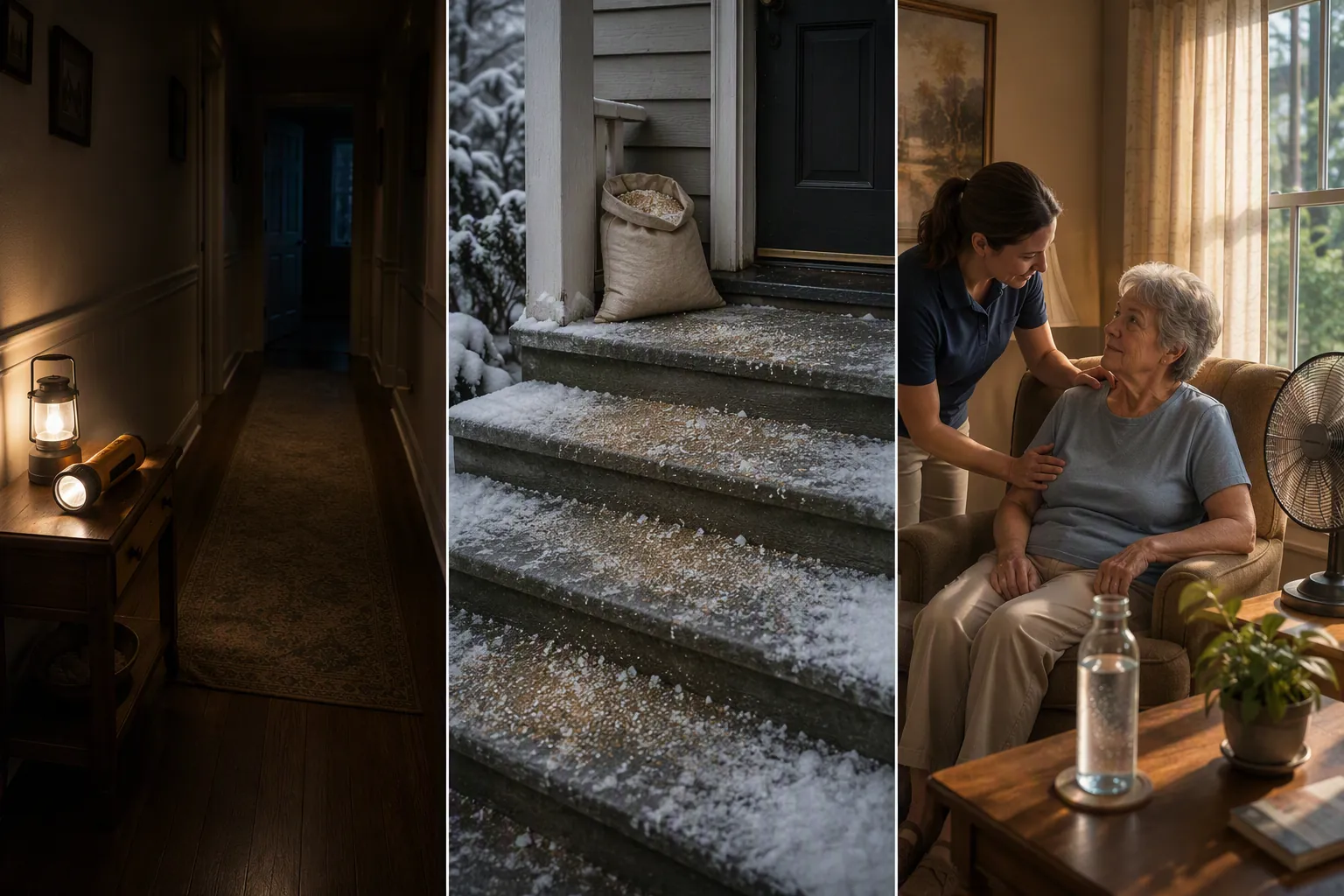
FEMA’s older-adult preparedness guide uses a useful structure: assess needs, create a plan, and engage a support network.[5] For a fall-risk parent, that structure should be applied to routes and timing, not just supplies. The plan should name who clears the hallway, who treats the steps, who confirms cooling is working, and who calls if the first helper cannot get there.
Start with the walking routes, not the kit
A severe weather emergency plan for elderly parents should begin with a short walkthrough of the routes the parent actually uses. Do it while the house is calm, not while weather alerts are already sounding. The point is not to inspect the home like a contractor. It is to find the predictable places where weather will make a normal movement unsafe.
- Bedroom to bathroom, including the side of the bed where the parent stands up.
- Favorite chair to kitchen, water, medication, and phone.
- Bathroom entrance, toilet, shower, and sink area.
- Front door, back door, garage entry, porch steps, sidewalk, driveway, and mailbox route.
- Interior shelter route for tornado warnings or severe wind.
- Exit route if the plan changes from staying home to leaving.
This is where a broad “support network” becomes useful. A neighbor who says “call if you need anything” is kind, but not yet a plan. A useful assignment sounds more like: before freezing rain starts, Jay will spread de-icer and sand on the front steps and sidewalk; Mara will text for confirmation; if Jay cannot do it, the backup is the neighbor across the street. The parent’s part is also specific: do not test the steps alone before that confirmation comes.
For a broader all-hazard supply, warning, and stay-or-go framework, use a severe-weather checklist as the outer layer. The fall plan sits inside it. See the severe weather safety checklist for seniors living alone for the larger household structure.
Power outages: stage light where the fall would happen
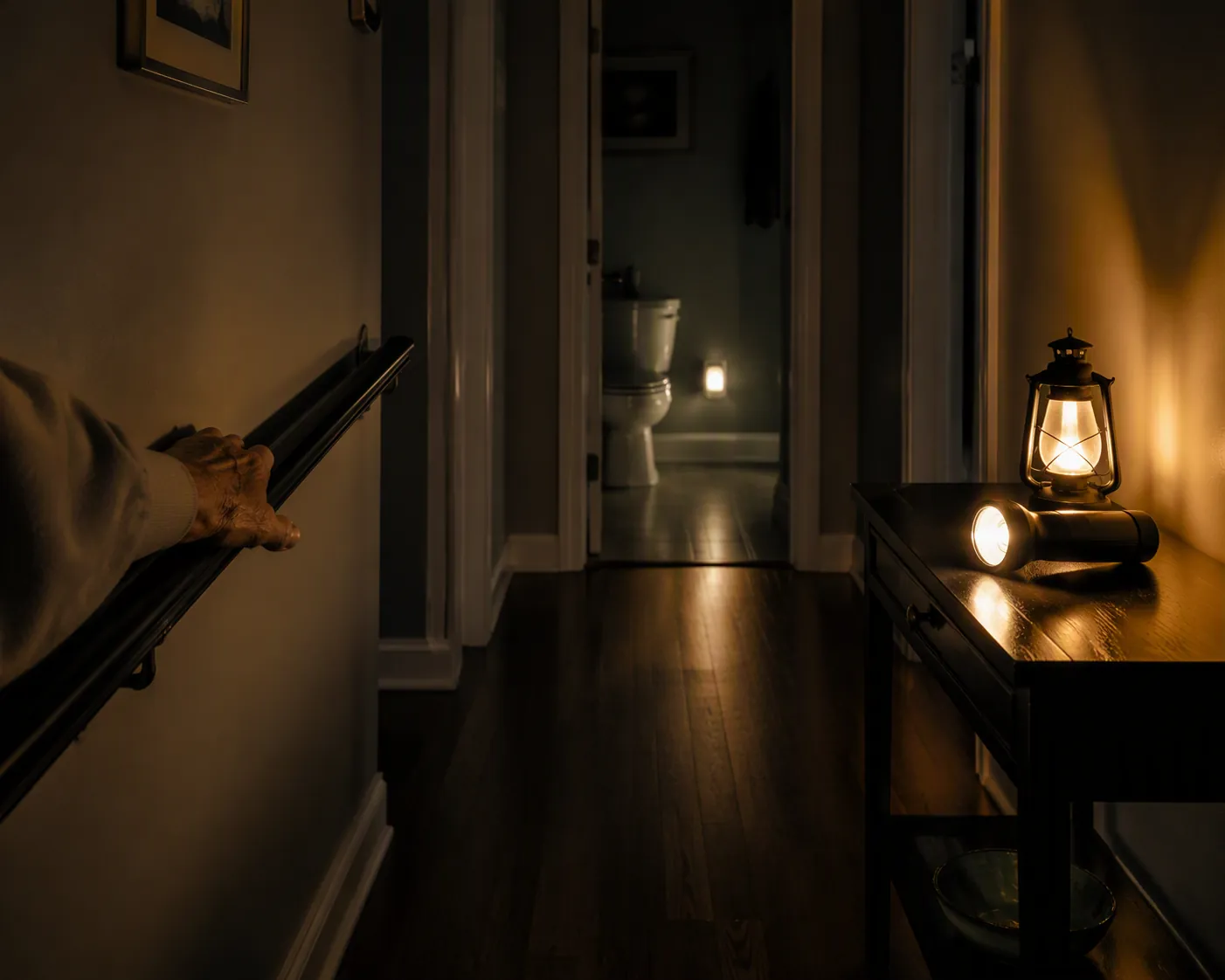
The CDC recommends battery-powered flashlights or lanterns during a power outage and advises against using candles because of fire risk.[6] That is emergency guidance. For an older adult at fall risk, it is also route guidance.
There is not a CDC statistic that says “power outages cause this many older-adult falls.” The fall-prevention logic is narrower and more honest: older adults already have a high baseline fall risk, outages remove normal lighting, and the CDC specifically points people toward flashlights and lanterns rather than candles. If a parent is unsteady in a lit hallway, the dark version of that hallway deserves attention before the weather arrives.
Where the lights should go
Do not store all flashlights in one kitchen drawer. Stage lighting where the parent will be standing when the power fails or when they wake up confused in the dark.
- At the bedside, within reach without standing.
- At the bathroom doorway or on a stable surface just outside it.
- Near the favorite chair or sofa.
- Near medication, water, and glasses.
- Near the phone-charging location or backup battery.
- Along the interior shelter route, if tornadoes or severe wind are part of the forecast.
- Near the exit route, but not on the floor where it becomes a trip hazard.
Lanterns are often easier than narrow-beam flashlights because they can light a small area while leaving both hands free. The exact device matters less than the placement. A flashlight in a closet does not help a person who has to cross the room to find it.
Clear the dark route before it is dark
The 24 to 48 hours before a storm are the right time to remove the things that become invisible later: throw rugs, loose shoes, laundry baskets, pet bowls, charging cords, low stools, and boxes moved “just for now.” If the parent uses a cane, walker, or rollator, make sure it is parked on the side of the bed or chair where they actually stand up.
Bathrooms deserve special attention because outages often collide with urgency. A person who would normally walk slowly may hurry when waking to use the toilet. If the bathroom route depends on grabbing a towel bar, that is not a safe substitute for a real grab bar. For bathroom hardware decisions, see Can a Towel Bar Be Used as a Grab Bar?.
If the home has a tornado shelter area, basement, interior hallway, or windowless bathroom used for warnings, treat that route the same way: light it, clear it, and practice the movement before the storm. The fall-safe tornado preparedness checklist for seniors goes deeper on shelter-route setup.
Keep outage tasks from creating new fall hazards
Some outage preparations are good in one way and risky in another. Charging phones is sensible; running a cord across a walking path is not. Moving supplies to the kitchen helps; stacking water cases where a walker turns does not. Keeping a cooler ready may help food safety; asking an unsteady parent to carry ice from the garage in the dark does not.
The CDC gives food and medication timing rules for outages, including that a refrigerator keeps food safe for about 4 hours if unopened, a full freezer for about 48 hours, and a half-full freezer for about 24 hours; it also says refrigerated medications should be discarded after about a day unless the drug label says otherwise.[6] Those are important, but in a fall plan they should not become a reason for a parent to repeatedly pace to the refrigerator in the dark. Decide in advance who will handle food checks, medication questions, and pharmacy calls.
Ice and snow: the entrance is part of the emergency plan
Winter storm planning often focuses on heat, pipes, food, and power. For an older adult at fall risk, the first dangerous surface may be the front porch. The CDC says many cold-weather injuries happen from falls on ice-covered sidewalks, steps, driveways, and porches, and recommends using rock salt or another de-icing compound, plus sand to improve traction.[7]
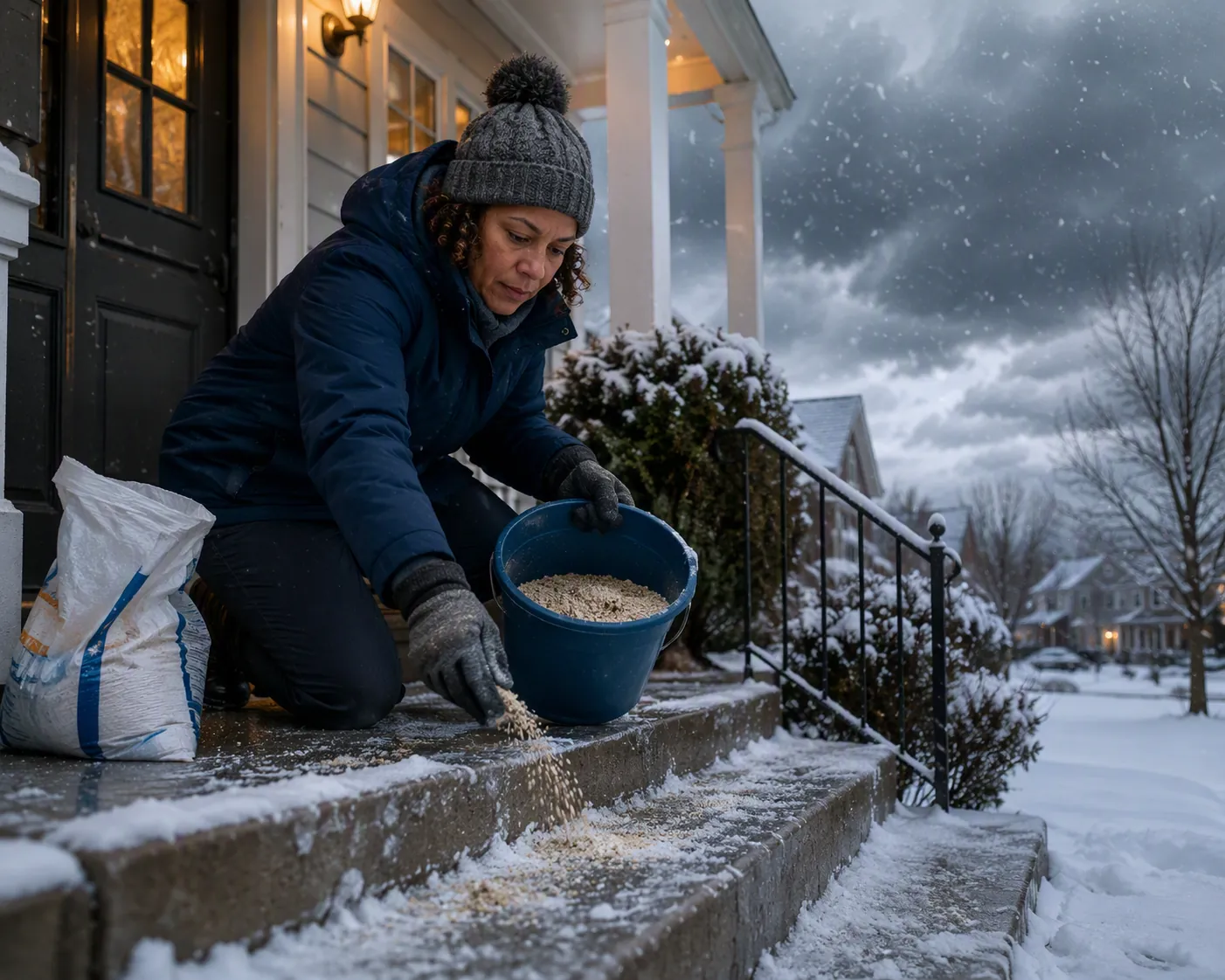
The timing matters. Rock salt, de-icer, and sand belong in the plan before the parent needs to step outside. If the forecast calls for freezing rain overnight, the assignment cannot wait until the parent opens the door in the morning and decides whether it “looks okay.”
Make the support assignment visible
A winter entrance plan should name the surface, the person, the time, and the confirmation. It can be short.
- Surface: front porch, steps, sidewalk to driveway, garage threshold, and path to the mailbox if it must be used.
- Person: the neighbor, adult child, paid helper, building maintenance staff, or snow-removal service responsible for treatment.
- Timing: before precipitation freezes, before the parent’s appointment, or before trash pickup if the parent is tempted to go out.
- Confirmation: a text, call, photo, or doorbell-camera check that the route was treated.
- Backup: the second person to call if the first person cannot get there.
This is not about treating an older adult like a child. It is about removing a high-consequence task from the person most likely to be injured by it. If a parent insists on independence, keep the request narrow: “Please wait until the steps are treated before you get the mail,” not “don’t do anything.”
Do not let heating safety create a walking hazard
Winter outages bring other dangers that belong in a general emergency plan. The CDC says never heat a home with a gas range or oven, keep space heaters at least 3 feet from flammable items, place generators at least 20 feet from windows, and treat hypothermia below 95°F as a medical emergency.[7] In this fall-focused plan, the key is to keep those safety measures from cluttering the route. A space heater cord across the hallway is not a safe solution. A generator check should not require the parent to walk outside on ice.
Heat: prevent the dizzy walk
Heat creates a different fall pathway. The floor is not slippery, and the lights may be on. The danger is the parent who becomes overheated, dehydrated, weak, or lightheaded and then stands up to get water, answer the door, adjust a thermostat, or walk to the bathroom.
The CDC says adults 65 and older are more prone to heat-related health problems, advises not relying on fans as the main cooling method, and recommends that caretakers check on older adults at least twice a day during heat risk.[8] A fan may move air, but it should not be treated as the whole cooling plan for a fall-risk parent in dangerous heat.
The fall-prevention version of a heat plan is practical: water within reach of the chair and bed, scheduled drinking rather than waiting for thirst, a working cooling location, and check-ins that ask about dizziness, confusion, weakness, and whether the parent has actually moved safely to cooler air. If the home cannot be kept cool, the plan needs a cooler place to go before the parent is too weak to leave comfortably.
For deeper heat-specific planning, use How to Build a Heat Wave Safety Plan for Elderly Parents, the Heat Wave Safety Checklist for Elderly Parents, and How Seniors Can Stay Safe Through a Heat Dome.
What changes 24 to 48 hours before impact
When the forecast turns serious, the plan should become assignments, not intentions. A short written list is enough if it changes what people do before the event arrives.
| Time | Fall-prevention action | Who confirms it |
|---|---|---|
| 24–48 hours before a power outage risk | Place flashlights or lanterns at the bed, bathroom route, chair, medication area, phone location, shelter route, and exit route. Clear cords, rugs, shoes, and clutter. | Parent, adult child by video call, neighbor, or in-home aide |
| Before freezing rain or snow | Put rock salt, de-icer, and sand where the assigned helper can reach them. Treat porch, steps, sidewalk, driveway, and garage threshold before the parent needs to go out. | Assigned neighbor, family member, maintenance staff, or paid service |
| Before dangerous heat | Set water within reach, confirm cooling is available, schedule check-ins, and decide where the parent will go if the home is too hot. | Caregiver, neighbor, building staff, or the parent if self-managing |
| Before a possible evacuation | Move mobility aid, shoes, medications, glasses, phone, charger, and documents near the exit without blocking the walking path. | Adult child, parent, neighbor, or aide |
If the event may require leaving home, do not wait for the walking route to become harder. Flood and wildfire evacuations add time pressure, smoke, water, poor visibility, and unfamiliar surfaces. Use the wildfire evacuation plan for seniors at fall risk and the flood preparedness checklist for elderly living alone for those stay-or-go decisions.
During the event, reduce trips
Once the storm, outage, ice, or heat emergency is underway, the safest route is often the one the parent does not have to take. Put water, medication, phone, glasses, hearing aids, a light, and a mobility aid within reach before the difficult hours begin. If the parent needs to move, slow the sequence down: sit up, pause, stand, pause, then walk with light on the route.
Check-ins should ask concrete questions. “Are you okay?” often gets “I’m fine.” Better questions are: Is the lantern beside the bed? Did you move the cord from the hallway? Has anyone treated the steps yet? Have you had water since breakfast? Is the room cool enough to stay in? Are you dizzy when you stand?
If a helper is nearby, the helper should take the outside or equipment task when possible: checking the generator area, bringing in a package, moving ice melt, inspecting steps, or carrying supplies. The parent should not have to prove the entrance is safe by stepping onto it.
The 72 hours after are still part of the plan
A fall plan should not end when the warning expires. The next three days often bring the awkward tasks: wet floors, spoiled food decisions, branches on walkways, refreezing slush, delayed trash pickup, medication calls, insurance photos, and a parent who is tired of being checked on.
Keep the same three pathways in view. After an outage, leave lights staged until the home is fully back to normal and cords are put away. After snow or ice, recheck the porch, steps, sidewalk, and driveway before the parent resumes mail, trash, or appointments. After heat, keep hydration and cooling checks going, especially if the parent seems weak, confused, or lightheaded.
This is also the time to notice what almost went wrong. If the parent had to cross the room for a flashlight, move the flashlight. If they nearly slipped at the garage threshold, add that surface to the winter assignment. If they skipped water because it was in the kitchen, put water where they sit. The plan gets better when it records the near-miss, not just the disaster.
A protective plan is small enough to execute
The best severe weather emergency plan for elderly parents is not the longest binder or the most impressive kit. It is the plan that prevents the predictable fall: the dark hallway on the way to the bathroom, the icy threshold before the steps are treated, or the overheated kitchen where a dizzy parent stands up too fast.
Use this as educational fall-prevention guidance, not individualized medical advice. A parent with recent falls, fainting, medication changes, confusion, dehydration, or heat or cold illness symptoms needs advice from a qualified clinician or emergency services as appropriate.
References
- Elderly were Katrina’s main victims, NBC News
- February 2021 Winter Storm-Related Deaths: Texas, Texas Department of State Health Services, December 30, 2021
- The Effects of Heat on Older Adults, Harvard Medicine Magazine
- Facts About Falls, CDC
- Disaster Preparedness Guide for Older Adults, Take Control in 1, 2, 3, FEMA, September 2023
- What to Do During a Power Outage, CDC
- Safety Guidelines: During & After a Winter Storm, CDC
- Heat and Older Adults (Aged 65+), CDC
Related reading
Noticed something outdated or inaccurate on this page? Flag a correction. We review every report against CDC, NIA, and AARP HomeFit guidance before updating a page.
Part of the Fall Prevention section.