
Track a Tropical Storm: When to Evacuate Your Elderly Parent
Learn how to monitor an approaching tropical storm's NHC cone, wind probability maps, and advisory cadence, then map each stage to a concrete evacuation action for your elderly relative — starting at the 48-hour watch, not the 36-hour warning.
If the cone on the National Hurricane Center map is touching your mother’s county and she cannot leave quickly on her own, the working rule is simple: make the go/no-go decision at the tropical storm watch stage, not at the warning stage.
A tropical storm or hurricane watch means those conditions are possible, usually about 48 hours before tropical-storm-force winds are expected. A warning means they are expected, usually about 36 hours before those winds arrive.[1] For a healthy adult with a car in the driveway, 12 hours may sound like a cushion. For an older adult who uses a walker, needs help transferring, depends on paratransit, or has to wait for a daughter to drive in from another county, those 12 hours can be the difference between a calm move and a risky one.
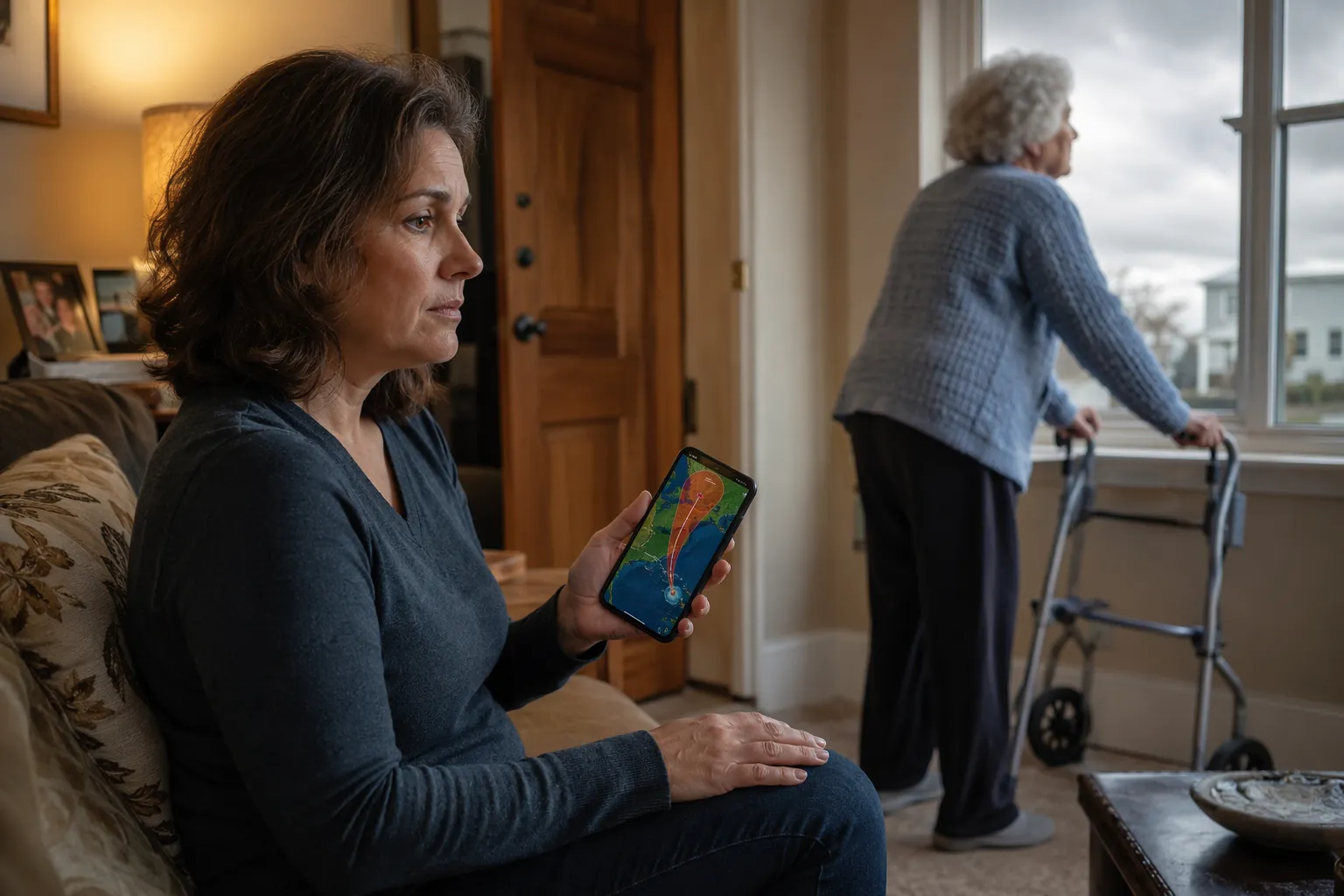
So the question is not only whether the storm will be bad. The question is when the safe window closes for this particular body, in this particular house, with this particular transportation plan.
Start With The Watch, Not The Warning
Emergency managers do not plan evacuations around the arrival of hurricane-force winds. The National Hurricane Center tells people to prepare before tropical-storm-force winds arrive, because those winds make travel dangerous and emergency response harder.[2] That matters when you are tracking a tropical storm for an elderly family emergency plan, because the older adult’s evacuation is usually slower than the public message makes it sound.
At the watch stage, the caregiver’s job is not to panic-pack. It is to decide whether the older adult can safely remain where they are if the forecast verifies, and whether the transportation and assistance they need will still exist by the next advisory cycle.
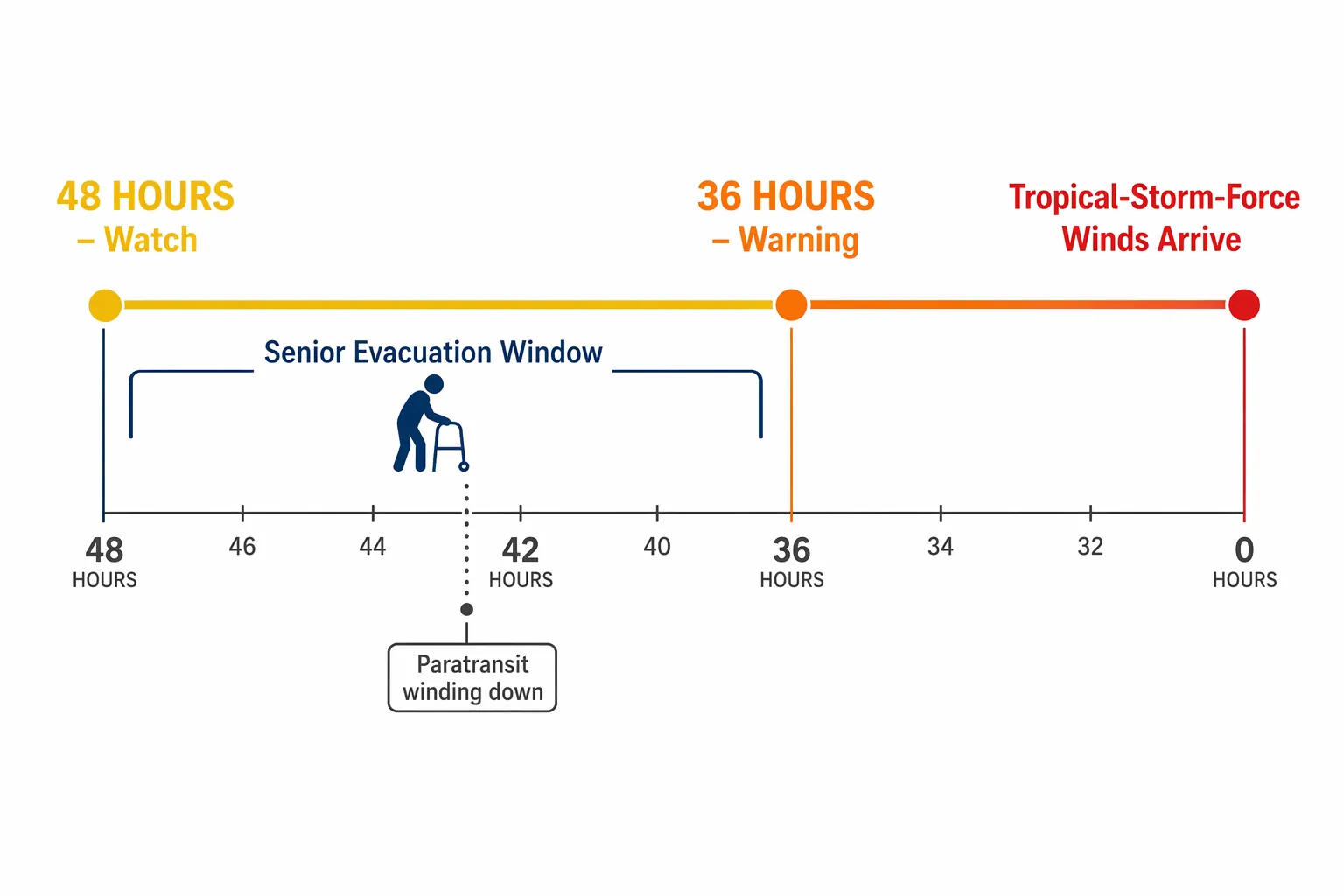
New Orleans’ public hurricane timeline makes the problem visible. NOLA Ready says transit services begin winding down 42 hours before landfall and shut down completely 18 hours before landfall.[3] That does not mean every county follows the same clock, and it does not make New Orleans’ timeline universal. It does prove the point families often learn too late: public and assisted transportation can start disappearing before the house looks threatened from the living room window.
Florida’s Special Needs Registry is another example of the same timing problem. It exists for people who may need evacuation assistance, but registration closes before an evacuation order is announced.[4] If your plan depends on county assistance, a wheelchair-accessible ride, a medical shelter, or a facility transfer, waiting for the warning can mean discovering that the system you planned to use has already moved into a different phase.
Read The Cone As Uncertainty, Not As A Promise
The center line is not the storm’s appointment with a town. The National Hurricane Center’s cone shows the probable track of the storm center, based on recent forecast errors, and it is designed so the center of the storm stays within the cone about two-thirds of the time.[5] Hazards can occur outside the cone, especially wind, rain, surge, and tornadoes.[6]
For 2026 Atlantic storms, the NHC’s cone radii are 25 nautical miles at 12 hours, 45 at 24 hours, 65 at 36 hours, 85 at 48 hours, 130 at 72 hours, 175 at 96 hours, and 200 at 120 hours. Those radii are based on 2021–2025 forecast errors and are updated annually.[5] The practical lesson is not that the NHC is vague. It is that the map is honest about uncertainty.
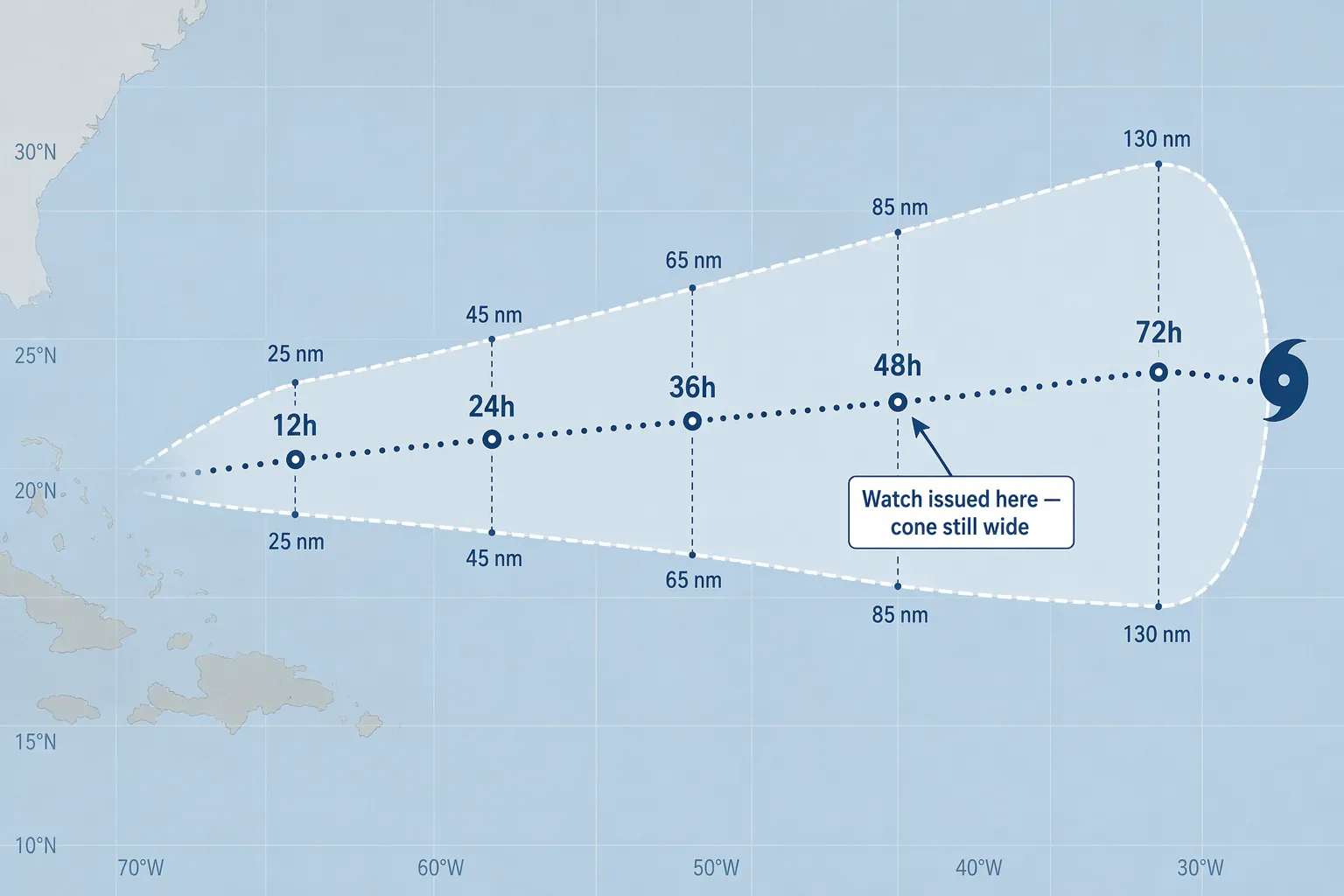
At 48 hours, the cone is still wide by design. If Mom’s county is inside it, near it, or listed in the local watch area, waiting for the line to look more certain is not a neutral choice. It spends the very hours you may need for calling siblings, reaching a pharmacy, arranging a ride, moving oxygen equipment, getting a walker into a trunk, or persuading a parent who insists the last storm “turned at the last minute.”
The cleaner way to read the tracker is in layers:
- Cone: Is the forecast track uncertainty close enough to your parent’s county that local impacts are plausible?
- Watch or warning language: Has the National Weather Service or local emergency management placed the area under a tropical storm or hurricane watch?
- Wind timing: When are tropical-storm-force winds expected to arrive, not when is landfall expected?
- Local instructions: Is the county telling certain zones, mobile homes, barrier islands, flood-prone areas, or medically vulnerable residents to leave?
That order matters. Storm category can grab attention, but the evacuation clock for a mobility-limited older adult is driven by when travel becomes unsafe and when help becomes unavailable.
Use The Advisory Cadence Instead Of Refreshing All Day
The NHC issues regular tropical cyclone advisories every 6 hours, at 5, 11, 17, and 23 UTC. When coastal watches or warnings are active, intermediate advisories come every 3 hours.[7] That cadence is a useful antidote to doom-scrolling. It gives the family a schedule for decisions.
| What You See | What It Means For An Older Parent | Caregiver Action |
|---|---|---|
| Storm is being monitored, no local watch yet | Planning time still exists, but uncertainty is real | Open the NHC cone, local emergency page, and family text thread; confirm who can physically reach the parent |
| Watch issued about 48 hours before expected tropical-storm-force winds | The senior evacuation decision window is open | Make the go/no-go call; contact parent, siblings, transportation provider, pharmacy, facility, and shelter or host home |
| Transit or assisted rides begin winding down locally | A parent without flexible private transportation may soon lose the practical ability to leave | Move from planning to departure if evacuation is the safer option |
| Warning issued about 36 hours before expected tropical-storm-force winds | The window is narrowing; travel may become harder, darker, wetter, and more crowded | Do not start a complicated evacuation unless local officials and the parent’s condition still make it safer than staying |
| Tropical-storm-force winds arrive | Evacuation should already be complete | Stay off roads; follow local shelter-in-place or emergency instructions |
At each advisory, do three checks, in the same order. First, check whether the cone, wind probabilities, or forecast discussion moved the expected conditions closer to the parent. Second, check the county or city emergency page for evacuation zones, transportation notices, shelter openings, bridge closures, and special-needs instructions. Third, check the human system: who has called Mom, who has keys, who can drive, who can lift the rollator, and who has the medication list.
The family text thread should not say, “Someone should check on her.” It should say, “I called at 11 a.m.; she has 5 days of medication; paratransit voicemail says they are still scheduling; county has no evacuation order yet; next check after the 5 p.m. advisory.” That level of detail feels fussy until the cell network is overloaded or three siblings each assumed another one had handled the pharmacy.
What To Do At The 48-Hour Watch
My bias here is intentional: for an elderly parent with mobility limitations, I would rather make one early, annoying evacuation than one late, dangerous one. That does not override local orders, medical advice, shelter availability, flooding risk, or the older adult’s own capacity. It does mean the family decision has to move up to the watch stage, while options still exist.
The watch-stage call is not simply “pack a bag.” It is a quick audit of whether staying put can be made safer than leaving.
- Mobility: Can the parent get from bed to bathroom, bathroom to kitchen, and house to vehicle without power, bright lighting, or a rested helper?
- Transportation: Is there a private driver available before conditions deteriorate, or does the plan depend on paratransit, a county program, ambulance transport, or facility coordination?
- Medical continuity: Are medications, oxygen, dialysis, refrigeration, wound care, or mobility devices portable and ready now?
- Destination: Is the safer location actually safer for this person — fewer stairs, accessible bathroom, power backup if needed, room for a walker, and someone awake enough to help?
- Local hazard: Is the home in an evacuation zone, flood-prone area, mobile home, high-rise with elevator dependence, or place where emergency access may be cut off?
If the answers point toward evacuation, the watch is when the move begins. Call the parent first, not last. Older adults deserve more than being treated like a package with prescriptions. Tell them what changed on the forecast, what time the next advisory comes out, where they would go, who is coming, and what they can choose: which sweater, which shoes, which neighbor to notify, which family photo or device charger comes along.
Then work the boring list fast: transportation provider, pharmacy, primary caregiver, home health agency, assisted living desk if relevant, county special-needs contact, shelter information, pet plan, oxygen or equipment supplier, and the sibling who is most likely to say, “I thought you were handling that.”
This is where confidence can be misleading. AARP research cited by Miami Jewish Health found that 59% of adults 50 and older felt confident navigating a natural disaster, while fewer than one-third had a comprehensive plan.[4] Confidence is not a ride. Confidence is not a generator, a medication refill, a ramp, or a hotel bathroom with grab bars.
The Transportation Cutoff Is Earlier Than The Emotional Cutoff
Families often wait until everyone emotionally agrees that leaving is necessary. Transportation systems do not wait for family consensus. They operate on staffing, road safety, vehicle availability, fuel, bridge closures, shelter intake, and emergency management orders.
A parent who can be driven away by a nearby relative has one kind of timeline. A parent who needs a wheelchair-accessible van has another. A parent who needs help transferring from a recliner into a car has another. A parent who will resist leaving until the last minute has another still, because persuasion itself takes time.
At the watch stage, ask the transportation question bluntly: “If we decide to leave after the next advisory, who can physically make that happen?” If the answer involves an agency, county service, facility, or neighbor with limited availability, call now. Do not wait until the warning to learn the phone line is busy, the registry is closed, or the van schedule is already full.
If the older adult lives in senior housing, assisted living, or a nursing facility, the watch-stage call is also when you ask what the facility is doing, not whether they “have a plan.” Ask whether they are evacuating or sheltering, what trigger changes that decision, how families will be notified, where residents would go, how medications and mobility devices are labeled, and whether family pickup is allowed or discouraged.
At The 36-Hour Warning, The Question Changes
By the warning stage, conditions are expected rather than merely possible, and the expected arrival of tropical-storm-force winds is closer.[1] For an older adult, that does not automatically mean “go now.” It means the family has to stop pretending this is still a flexible planning period.
If evacuation was chosen at the watch stage, the warning stage should find the parent already gone or actively moving with daylight, medication, devices, and assistance arranged. If staying put was chosen, the warning stage should find that decision documented against local guidance: the address, zone, forecast risk, power vulnerability, caregiver coverage, medication supply, food and water, lighting, charged devices, and the point at which 911 would be called.
A late evacuation can still be necessary if local officials order it or the home becomes clearly unsafe. But a late, improvised evacuation for a frail parent is not the same action as an early one. It may involve wet steps, crowded shelters, dark parking lots, fatigue, closed services, heavy traffic, and helpers moving faster than the older adult can safely move.
Treat Evacuation As Fall Prevention
Falls are not a side issue in hurricane planning for older adults. CDC injury data show that falls among adults 65 and older caused more than 38,000 deaths in 2021.[8] The storm does not have to injure someone directly to create the conditions for a fall: darkness, noise, wet floors, missing handrails, unfamiliar bathrooms, rushed transfers, and helpers carrying bags instead of steadying an elbow.
Power outages add another layer. PowerOutage.us cites NIH data that 22% of adults ages 65–74 and 55% of those 75 and older have disabling hearing loss, which can make dark, chaotic navigation even harder.[9] A parent who cannot hear instructions clearly in a dim hallway is not being difficult. They are operating with less information at exactly the moment everyone else is moving faster.
That is why the evacuation route should be fall-checked before the wind arrives: shoes on feet, walker or cane within reach, eyeglasses packed last and worn first, medications in one visible bag, phone charged, flashlight attached to the walker or placed in the parent’s hand, and one person assigned to the parent rather than to luggage.
If the safer decision is to stay, the same fall logic applies inside the home. Clear the path from bed to bathroom, add lighting where the parent actually walks, keep the mobility aid beside the chair or bed, and remove the rugs and cords that will become invisible when the power fails. For the during- and after-outage details, use the home safety steps in this storm power outage fall-prevention guide. Post-storm heat can also change balance, medication tolerance, and hydration; this extreme heat and senior fall-prevention guide is the better place for that part of the plan.
When Staying Put Is The Safer, Locally Advised Choice
Early evacuation is not always the safer answer. A medically fragile parent may be safer in place if the home is outside the evacuation zone, the building is sound, power backup exists for essential equipment, a capable caregiver is present, and local officials are not ordering that area to leave. A shelter may also be harder on someone with dementia, severe mobility limits, infection risk, or equipment needs if the destination is not properly matched.
But “we’re staying” needs to be an actual decision, not the residue of delay. Write down the reason: local guidance checked, zone checked, wind timing checked, flood risk checked, caregiver coverage confirmed, medical needs covered, emergency contacts reachable, fall hazards reduced. Then set the next advisory check by the NHC clock.
That record matters if siblings disagree. It also matters if conditions change. At the next 3- or 6-hour advisory, you are not starting over emotionally; you are updating a decision with new forecast and local information.
A Practical Tracker-To-Action Flow
When the NHC map is open and the county page is loading slowly, use the same sequence every time:
- Check the NHC advisory time so you know whether you are looking at the newest forecast.
- Look at the cone as a zone of track uncertainty, not a center-line prediction.
- Check whether the parent’s area is under a watch or warning, and whether the local emergency page adds evacuation-zone instructions.
- Find the expected arrival window for tropical-storm-force winds and work backward from that, not from landfall headlines.
- At the 48-hour watch stage, make the senior-specific go/stay decision and activate transportation, medication, caregiver, and destination plans.
- At the 36-hour warning stage, avoid beginning a complicated move unless local orders or immediate safety conditions make it necessary.
The decision point is not when the forecast feels certain. It is when the remaining safe hours are still usable by the person who has to move. For an elderly parent with mobility limits, that is why the watch stage carries so much weight.
Once the watch-stage call is made, the next task is smaller: wait for the next scheduled advisory, compare what changed, and confirm that the decision already made is still the safest one.
References
- Hurricane Watches, Warnings, Advisories, Outlooks, National Weather Service
- Hurricane Preparedness — Hazards, National Hurricane Center
- 72-hour Evacuation Timeline, NOLA Ready
- Hurricane and Emergency Preparedness for Seniors, Miami Jewish Health
- Definition of the NHC Track Forecast Cone, National Hurricane Center
- How to use the cone graphic, National Hurricane Center
- The Best Hurricane Tracking Apps and Tools, Team Rubicon
- CDC WISQARS, Centers for Disease Control and Prevention
- Power Outage Preparedness for Seniors, PowerOutage.us
Related reading
Noticed something outdated or inaccurate on this page? Flag a correction. We review every report against CDC, NIA, and AARP HomeFit guidance before updating a page.
Part of the Fall Prevention section.