
STEADI: Intervene
What Seniors Should Do During a Small Earthquake
A small earthquake is still a fall emergency for seniors. This article explains why trying to stand or walk during a minor tremor can be dangerous and provides adapted safety steps—whether you use a walker, cane, or wheelchair—to protect yourself without leaving your spot.
A cup rattles, the recliner gives one little shiver, and the first thought is often, “Was that enough to matter?” For an older adult, that is the wrong question. The better question is: “Am I about to stand up while the floor is moving?”
What seniors should do during a small earthquake is the same protective action they should start during any earthquake: stay where you are, get as low as you safely can, and protect your head and neck. Do not stand up. Do not walk to a doorway. Do not hurry to the kitchen, the hallway, the window, the pet, or the front door while shaking continues.
The American Red Cross says injuries and deaths happen when people fall while trying to walk or run during shaking.[1] That is the part worth taking seriously in a mild tremor: not the drama of the earthquake, but the ordinary fall that can happen in the few seconds after someone decides to “just” move.
There is another reason not to wait and judge the quake by feel. EarthquakeCountry notes that you will never know whether the first jolt is the start of a larger earthquake, so the recommended action is the same no matter how small the first shaking seems.[2] “Small” may be how it feels in your chair. It is not a safety category that gives permission to cross the room.
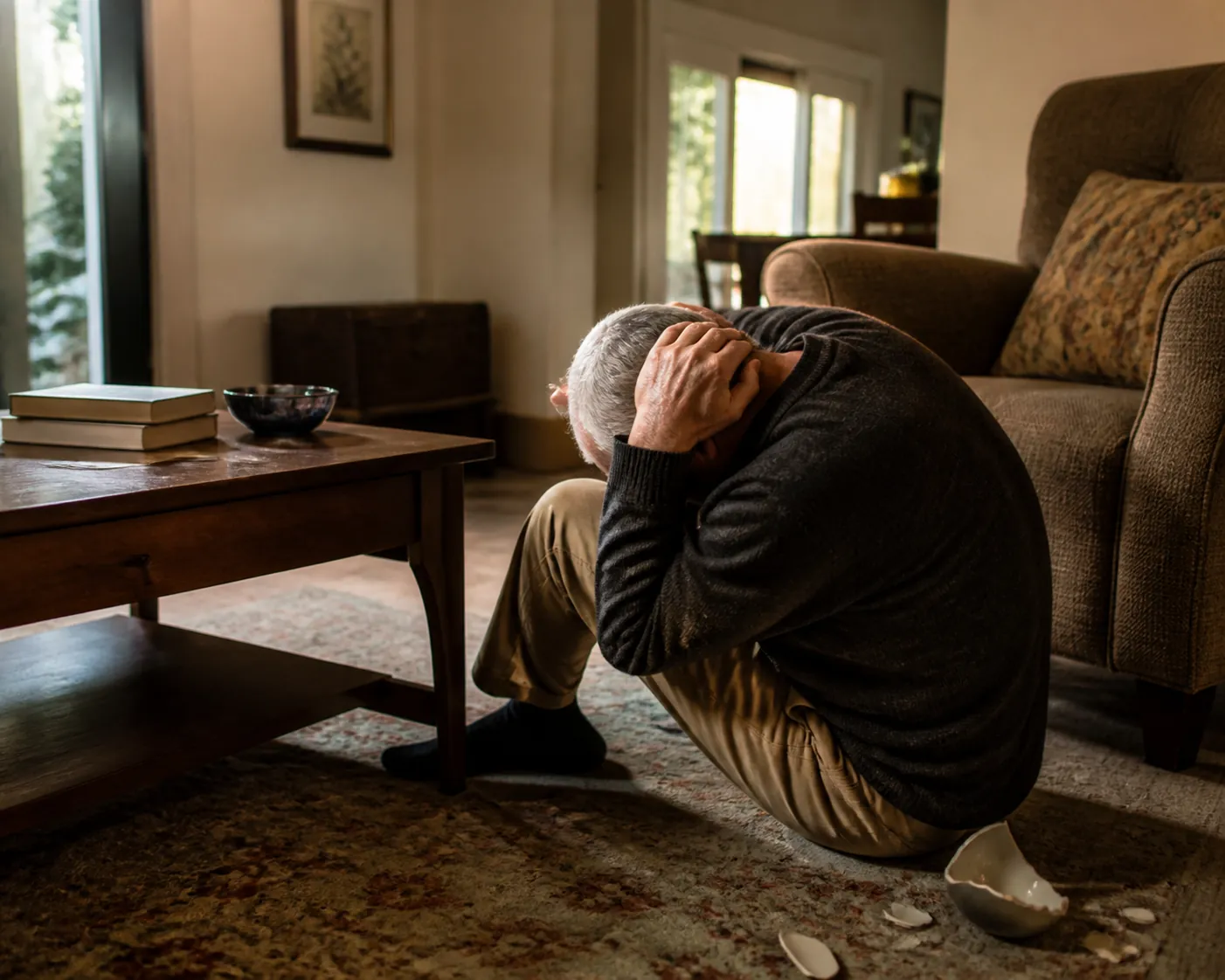
The Rule Is Simple Because the Moment Is Not
During shaking, the body does not get extra time to negotiate. A person halfway out of a chair is already off balance. A cane may slide. A walker may roll if the brakes are not set. A wheelchair can shift. Even a strong older adult can be caught in that awkward in-between place: not seated, not standing, and not able to recover quickly.
That is why the first instruction is not “find the safest room.” It is “make the place you are in safer without traveling.” If you can drop safely, drop. If you cannot, lower yourself as much as your body and equipment allow. Cover the head and neck with your arms, a pillow, a book, a jacket, or whatever is already within reach. Hold on to something stable if you are under a table or beside sturdy furniture.
The size you think the earthquake is does not change that first response. A short tremor can stop before you have finished deciding what to do. A stronger one can follow before you have made it across the room. The safest habit is to start the protective position immediately, then inspect, call, clean up, or check on someone after shaking stops.
If You Are Already Seated
Stay seated. Do not push up from the chair to “see what is happening.” If the chair is sturdy and not on wheels, bend forward if you can, bring your head and neck lower, and cover them with your arms. If there is a pillow, cushion, folded sweater, or blanket already close enough to reach without standing, use it over your head and neck.
Ready.gov’s adapted earthquake guidance includes sitting on a chair or bed and covering the head and neck for people using a cane, which is also the sensible action for many people who are already seated when shaking begins.[3] The point is not to perform a perfect floor-based drill. The point is to avoid turning a tremor into a standing fall.
If the chair has wheels, lock them if the brake is within easy reach. If it is not, do not twist or lunge for it. Bend forward as much as you safely can and cover your head and neck until the shaking stops.
If You Are in Bed
Stay in bed. Roll or turn only as much as needed to protect yourself, and cover your head and neck with a pillow or blanket. If you sleep with glasses, a phone, medication, or a flashlight nearby, keep them in a fixed reachable place before any emergency happens, not scattered across the room where you would have to get up during shaking.
The California Department of Aging gives the same plain advice for seniors: if you are in bed or sitting down during an earthquake, do not get up.[6] That instruction can feel too passive to someone who wants to check the stove, the front door, or a spouse in another room. It is not passive. It is the safer job for the seconds when the room itself is unreliable.
If You Use a Cane
A cane helps when the floor is steady. During shaking, it may not be enough to make walking safe. If you are standing with a cane when the earthquake starts, do not try to cross the room. Sit on the nearest safe chair or bed if it is immediately beside you. Then bend forward and cover your head and neck.[3]
If no chair or bed is close enough without taking steps, widen your stance only if you can do so safely, lower your body as much as you can without losing balance, and protect your head and neck. A cane user’s plan should be worked out room by room ahead of time: where is the nearest seat from the kitchen counter, the bathroom sink, the favorite chair, and the bedside?
That preparation does not need to be complicated. It can be as ordinary as keeping a sturdy chair near the place where you fold laundry, making sure pathways are not crowded, and not parking the cane across the room “just for a minute.”
If You Use a Walker
If you use a walker, the first useful action is to lock the wheels if your walker has brakes and the brakes are already in your hands. Ready.gov advises walker users to lock the wheels, bend low, and cover the head and neck.[3] Do that where you are. Do not use the walker to travel to a “better” spot while the shaking is still going.
A walker can make a person feel mobile enough to solve the problem by moving. That confidence is good on a normal afternoon and dangerous during shaking. The walker is not a shield from falling objects, and it does not make the floor steady. Its job in that moment is to help you stabilize, get lower, and protect the head and neck.
If bending low is painful or unsafe, bend only as far as you can control. The safer position is the one you can hold without tipping, sliding, or needing a rescue from the floor afterward.
If You Use a Wheelchair
Stay in the wheelchair unless there is an immediate danger that makes staying impossible. Lock the wheels. Bend forward if you can. Cover your head and neck with your arms or with something already in reach.[3] If you use a power chair, know ahead of time how to stop and secure it quickly.
This is where standard earthquake advice can fail people if it is repeated too rigidly. “Drop, Cover, and Hold On” is still the idea, but the drop may mean lowering your upper body, not leaving the chair. The cover may be your arms, a lap blanket, a cushion, or the shelter of a nearby sturdy table if you are already positioned there. The hold may be the locked chair and a stable part of the chair frame.
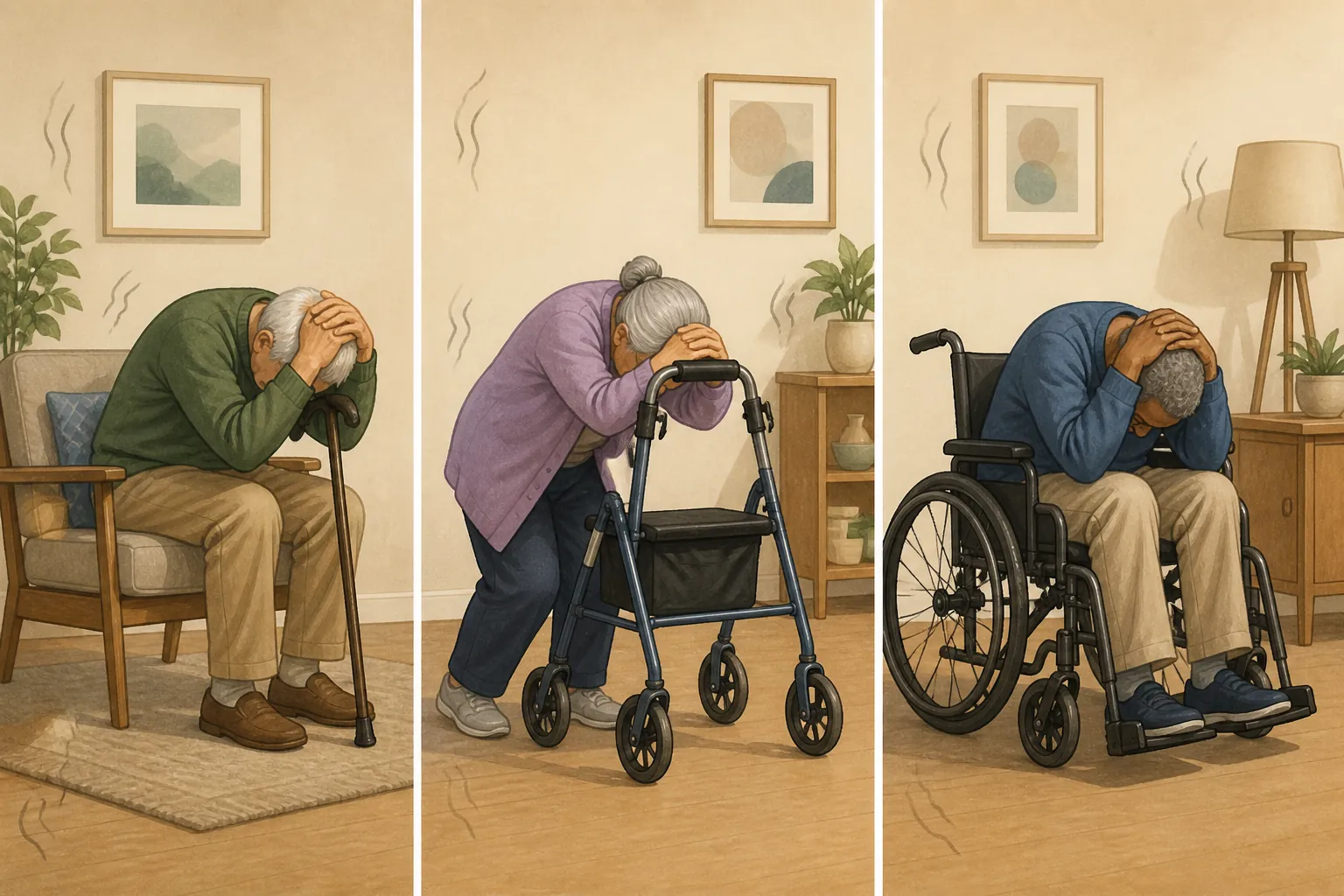
For a fuller walkthrough of adapted positions, see earthquake safety for seniors with limited mobility. The important thing during a mild tremor is not to improvise a heroic version of the drill. Use the version your body can actually perform.
Why Walking Is the Hazard to Avoid
Falls are already common among older adults. The CDC reports that one in four older adults falls each year.[4] That number is not earthquake-specific, and it should not be treated as if every fall happens during a disaster. It simply reminds us that many older bodies are already managing balance, vision, medication effects, joint pain, neuropathy, weakness, or slower reaction time before the floor starts moving.
A trauma-center study from the University of Rochester Medical Center found that among adults age 70 and older treated for ground-level falls, the fatality rate was 4.5%, three times higher than for adults younger than 70.[5] That study looked at trauma-center patients, not every older adult who falls at home. Still, it says something important about stakes: a fall that sounds minor in words can become a serious medical event in an older body.
Put those facts beside the Red Cross warning about people being injured or killed when they fall while trying to walk or run during shaking, and the practical conclusion is narrow but strong: during an earthquake, movement is not proof of quick thinking. For many seniors, movement is the danger that can be controlled.[1]
The Doorway Is Not the Goal
The old doorway advice has hung around in households for a long time. EarthquakeCountry says that in modern homes, doorways are no stronger than other parts of the house.[7] If you are already in a doorway and can safely protect yourself there, fine. But do not get up from a chair, leave a bed, or steer a walker across the room to reach one.
Do not move toward exterior walls, either. EarthquakeCountry identifies exterior walls as among the most dangerous places to be near during shaking.[7] Windows, outside walls, and exits can wait until the shaking has stopped and you can assess the next step without the floor moving under you.
After the Shaking Stops
After the shaking stops, pause before standing. Look for broken glass, shifted furniture, fallen objects, spilled liquids, and anything that could catch a cane, walker, oxygen tubing, or wheelchair wheel. If you are in a safe position, it may be better to call for help than to rush into a room that now has new trip hazards.
It is natural to want to check on a pet, a stove, a water heater, or a noise from another room. That impulse is not foolish; it is human. But it belongs after the shaking, not during it. The first few seconds are for protecting the head and neck. The next minute is for deciding how to move without creating a second emergency.
Practice the Response Before You Need It
Planning for a small earthquake does not mean memorizing fault maps. It means knowing what you will do from the places where you actually spend time: the recliner, the bed, the bathroom, the kitchen counter, the desk, the porch chair.
- Keep canes, walkers, wheelchairs, glasses, phones, flashlights, and essential medications in predictable reachable places.
- Choose sturdy chairs or beds in each room that can serve as the nearest safe seated position.
- Practice locking walker or wheelchair brakes without looking down for long.
- Keep a pillow, cushion, lap blanket, or firm book close to favorite sitting and sleeping spots.
- Talk through the plan with family or caregivers so no one tells you to run outside during shaking.
Caregivers can help by practicing the exact words that should be used during a call: “Stay seated. Cover your head and neck. Do not get up until the shaking stops.” Clear words matter when someone is frightened, annoyed, half-asleep, or already halfway out of a chair.
Earthquake planning also fits into broader emergency readiness. A household that has already made an emergency contact binder for aging parents or a long-distance caregiver emergency response plan has fewer decisions to invent after a scare. If medical equipment depends on electricity, power outage preparedness for elderly adults with medical equipment belongs in the same conversation.
The immediate earthquake rule stays shorter than the preparation list: during shaking, the senior’s job is not to inspect, evacuate, or prove independence. Stay where you are, get as low as you safely can, and protect your head and neck until the shaking stops.
References
- Earthquake Safety, American Red Cross.
- Step 5: Drop, Cover, and Hold On, EarthquakeCountry.
- Earthquakes, Ready.gov.
- Facts About Falls, Centers for Disease Control and Prevention.
- Ground-Level Falls Prove Fatal for Elderly, University of Rochester Medical Center.
- Disaster Tip Sheets, California Department of Aging.
- Drop, Cover, and Hold On, EarthquakeCountry.
Related reading
Noticed something outdated or inaccurate on this page? Flag a correction. We review every report against CDC, NIA, and AARP HomeFit guidance before updating a page.
Part of the Fall Prevention section.