
STEADI: Intervene
Severe Weather Safety Checklist for Seniors Living Alone
Severe weather planning for an older adult living alone needs senior-specific specs a generic family kit does not provide. The four-layer checklist — supplies sized for medications and multi-day stay-at-home, redundant warnings, a stay-or-go decision, and a trained support network — covers watch-or-warning rules and a printable summary.
A severe weather safety checklist for an elderly person living alone has to do more than gather water, food, and a flashlight. It has to answer the questions that become urgent when roads close, power fails, or a warning comes at night: Are there enough medications? Can the person hear or receive the alert? Will the oxygen concentrator, lift chair, CPAP, or phone still work? Who can get inside if the door is locked?
The practical plan has four layers: a supply kit sized for an older adult, at least three warning methods, a written stay-or-go decision, and a support network that can actually reach the home. The senior-specific details matter. The American Red Cross advises older adults to keep at least 30 days of medications and extra assistive items such as a cane or eyeglasses, and its winter storm guidance separates supplies into a 3-day Go-Kit and a 2-week Stay-at-Home Kit.[1][2] Ready.gov tells older adults to include a support person with an extra key, knowledge of where supplies are kept, and training on lifesaving equipment.[3] The National Weather Service recommends at least three ways to receive warnings.[4]
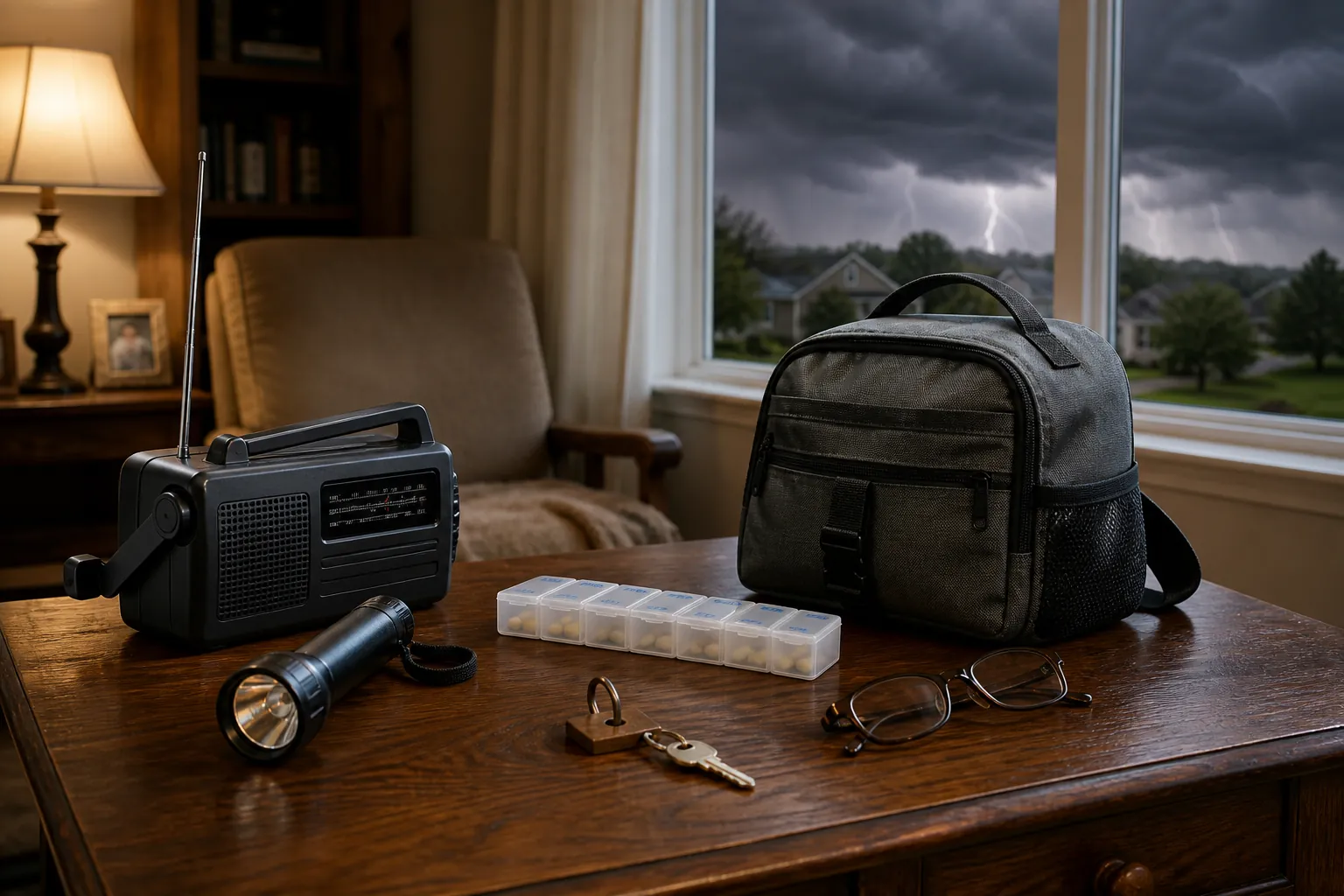
This guide is for emergency planning, not medical, legal, or financial advice. Confirm medication storage, oxygen or medical-device backup, mobility limits, evacuation needs, and home-health arrangements with the clinician, pharmacist, equipment provider, local emergency management office, or utility as appropriate.
The four-layer checklist
| Layer | What must be true before severe weather |
|---|---|
| 1. Supplies | The home has several days of basic emergency supplies, at least 30 days of medications, a 2-week stay-at-home supply for winter conditions, a 3-day Go-Kit where winter evacuation is possible, and backup planning for power-dependent equipment.[1][2][3] |
| 2. Warnings | The older adult has at least three ways to receive weather warnings, including at least one that does not depend on a smartphone battery or cell service.[4] |
| 3. Stay-or-go decision | The household has written down when the older adult stays home, when a support person comes over, and when evacuation or relocation happens before conditions become dangerous. |
| 4. Support network | At least one trusted person has a spare key, knows where supplies are stored, understands essential equipment, and has a backup if they cannot come.[3] |
Do not treat these as optional upgrades. A pantry full of food does not help if the alert is missed. A good warning system does not help if the walker, medication list, or spare glasses are left behind. A devoted daughter, neighbor, or friend does not help if no one gave them the key.
Layer 1: Build a supply kit around the person, not the pantry
Ready.gov’s basic kit list is still the starting point: water, nonperishable food, a battery-powered or hand-crank radio such as a NOAA Weather Radio, flashlight, extra batteries, first aid supplies, a manual can opener, and cell phone chargers. Ready.gov specifies 1 gallon of water per person per day for several days and a several-day supply of nonperishable food.[5] For an older adult living alone, those items need to be placed where they can be reached without climbing, carrying a heavy tote, or crossing a dark basement stairway.
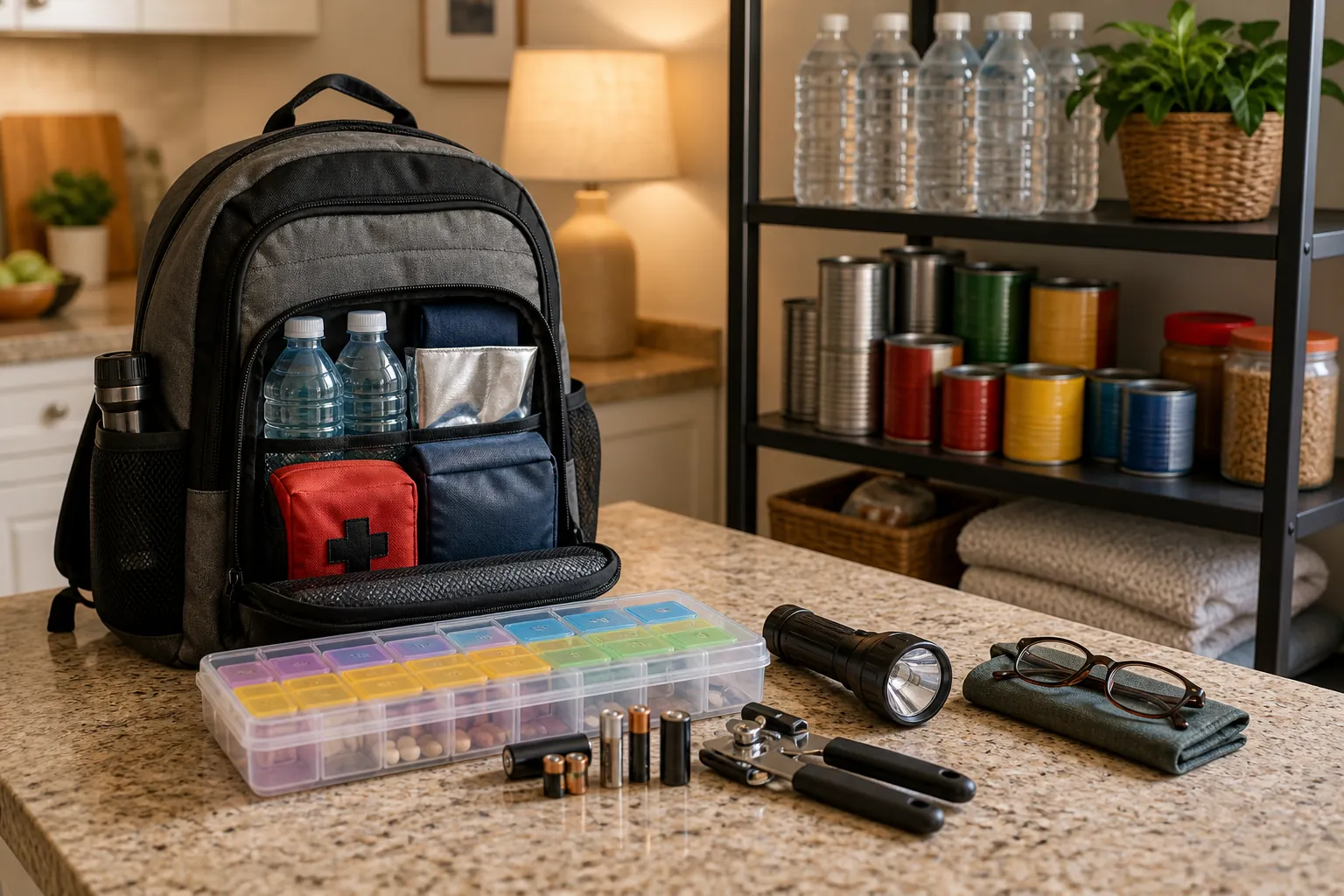
The medication part deserves its own pass. Keep an up-to-date medication list with drug names, doses, prescribing clinicians, pharmacy phone number, allergies, and major diagnoses. The Red Cross recommends at least 30 days of medications for older adults.[1] If the prescription, insurance, or storage rules make that difficult, the planning task is to ask the pharmacist or prescriber what refill timing, emergency refill options, or mail-order backup is realistic before storm season.
The kit should also include the things that make a normal instruction usable: spare eyeglasses, hearing-aid batteries or charger, denture supplies, incontinence supplies, labeled mobility aids, a spare cane tip if used, copies of insurance and ID, and written emergency contacts. Red Cross specifically calls out extra assistive items such as a cane and eyeglasses for older adults.[1]
Size the kit in three parts
- Everyday reachable supplies: flashlight, phone charger, radio, medications list, glasses, spare batteries, water, and a simple snack within reach of the usual chair and bed.
- Stay-at-home supply: enough food, water, medications, hygiene items, pet supplies if needed, and comfort items to remain home through several days of closed roads or service interruptions. For winter storms, the Red Cross frames this as a 2-week Stay-at-Home Kit.[2]
- Go-Kit: a bag light enough to carry or roll, with copies of documents, medication list, hearing and vision supplies, chargers, a change of clothes, hygiene items, and essentials for a short relocation. For winter storms, the Red Cross recommends a 3-day Go-Kit.[2]
Power-dependent equipment needs a written backup plan, not a hopeful note. List each device: oxygen equipment, CPAP or BiPAP, powered bed, lift chair, electric wheelchair or scooter, refrigerator-dependent medication, stair lift, phone, and internet router if it supports medical monitoring. For each one, write who services it, what the backup battery can and cannot do, whether the utility offers a medical needs or priority-contact program, and where the manual or emergency instructions are kept. Ready.gov tells older adults to plan for medical devices that use electricity and to make sure a support network member is trained on lifesaving equipment.[3]
Place the main supply station where a helper can find it in under a minute. A kitchen counter, hall closet shelf, or labeled rolling bin usually beats a perfect kit hidden in a storage room. Tape a one-page inventory to the inside of the cabinet or bin lid. If the older adult uses a walker, make sure the path to the supplies stays wide enough after the go-bag, water, and pet food are added.
Layer 2: Set up three warning methods
The National Weather Service recommends at least three ways to receive severe weather warnings.[4] For an older adult living alone, those three should not all be phone-based. A phone can be charging in another room, silenced, out of hearing range, or dead after a long outage.
- NOAA Weather Radio with fresh batteries or hand-crank power, programmed if the model requires local setup.
- Wireless Emergency Alerts on the cell phone, with volume and vibration settings checked.
- Local TV, radio, or trusted weather app alerts.
- A human alert: a neighbor, family member, building manager, church contact, or senior-service contact who calls or knocks when a warning is issued.
Before storm season, test the volume from the bedroom and the usual chair. If hearing loss is part of daily life, the alert plan may need a vibrating phone setting, bed shaker, flashing alert device, or a person assigned to call twice and then send someone if there is no answer. The National Weather Service also advises checking radio and flashlight batteries before storms.[4]
Layer 3: Write the stay-or-go decision before the sky gets dark
The worst time to decide whether an older adult should leave home is after the warning arrives. A stay-or-go card belongs with the supply kit and on the refrigerator. It should be plain enough that the older adult, a neighbor, or an out-of-town daughter can use the same instructions.
- Stay home if: officials have not ordered evacuation, the home is outside the known flood or wildfire evacuation area, heat or safe indoor temperature can be maintained, essential equipment has backup power, and the support network can check in.
- Have someone come over if: a watch is issued and the older adult cannot move quickly to shelter, cannot hear alerts reliably, is anxious or confused by changing instructions, depends on powered medical equipment, or cannot safely prepare food, water, lighting, and medications alone.
- Leave early if: local officials order evacuation, the home is flood-prone, heat or cold will become unsafe without power, medical equipment cannot be supported, the caregiver cannot reach the home once conditions worsen, or the older adult cannot use the safe room without help.
Flood risk needs its own written route, ride, timing, and destination plan. If the home is in a flood-prone area, use a dedicated flood evacuation plan for older adults rather than trying to improvise from a general storm checklist.
Layer 4: Build a support network that can open the door
A support network is not a group text. It is a short list of people with assigned jobs. Ready.gov’s older adult guidance is unusually concrete: at least one person in the network should have an extra key, know where emergency supplies are kept, and know how to use lifesaving equipment.[3] That sentence is worth taking literally.
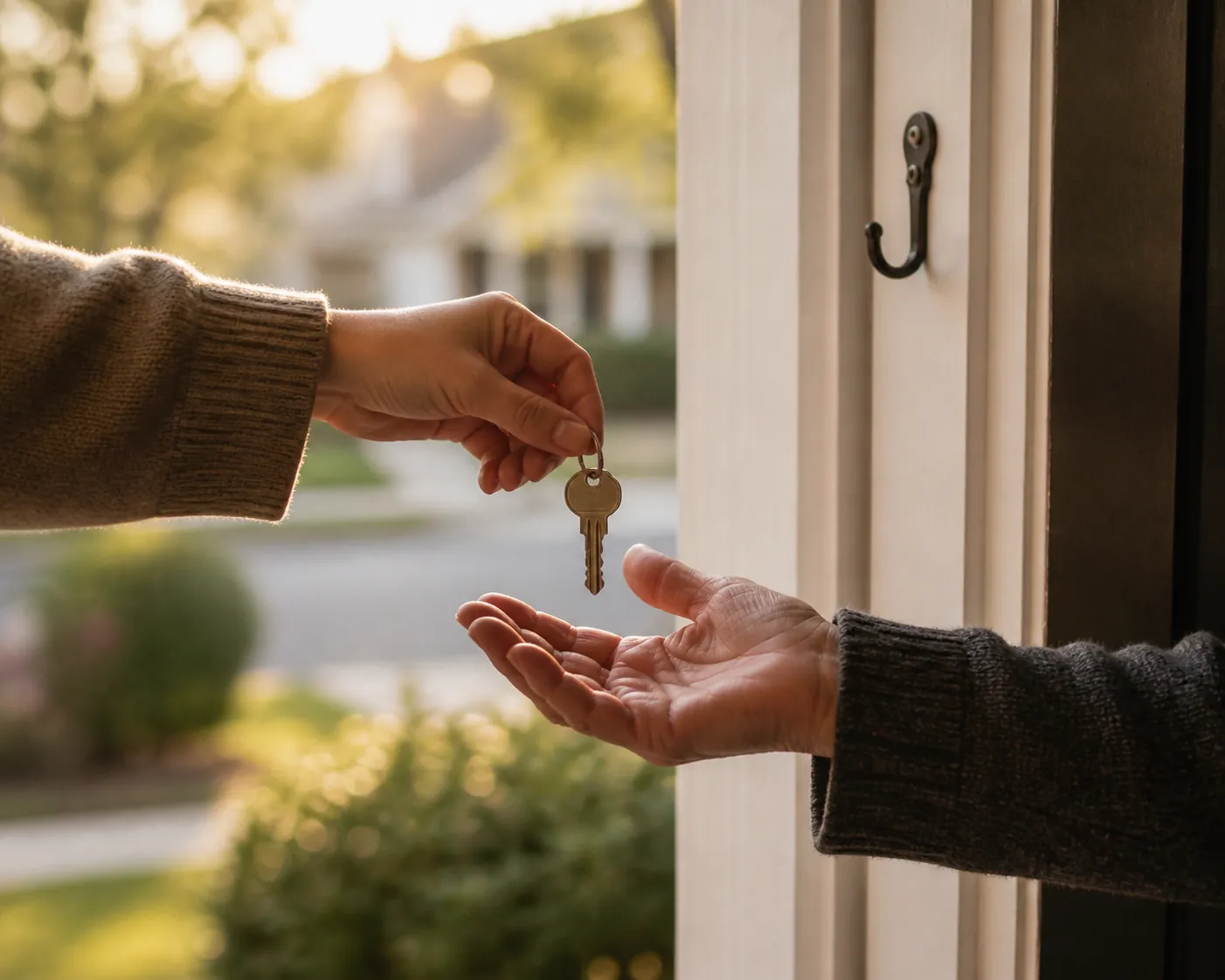
Write the network as a call order, not a vague list of names. The first person may be the adult child. The second might be a neighbor who can walk over sooner. The third might be a sibling, church friend, building staff member, or home-care agency contact. The plan should say who calls, who drives, who has the key, who can physically help with stairs or a walker, and who knows the medical-device instructions.
What each support person needs
- Address, entry instructions, alarm code if applicable, and the location of the spare key.
- A current medication list and pharmacy contact.
- The location of the supply kit, Go-Kit, documents, flashlight, and radio.
- Basic instructions for oxygen, CPAP, mobility devices, stair lift, medical alert device, or other essential equipment, confirmed with the equipment provider or clinician.
- The stay-or-go card, including preferred evacuation destination and backup destination.
- A rule for no-answer situations, such as calling once, calling again after a few minutes, then contacting the neighbor with the key.
A neighbor with a key may be more useful in the first 20 minutes than a loving relative 40 minutes away. That does not make the neighbor responsible for everything. It means the plan should match distance to task: the nearby person checks the door, alert status, lighting, and immediate safety; the family member handles medical calls, evacuation destination, transportation, and follow-up.
Extreme heat add-on
Heat planning for an older adult living alone starts with cooling, not toughness. CDC guidance for adults 65 and older says to stay in air-conditioned buildings as much as possible, drink more water than usual and not wait until thirsty, and avoid relying on a fan as the main cooling source.[6] The reason is not that every older adult is frail; it is that aging, chronic conditions, and some medications can make heat harder to tolerate.[6]
Recent emergency department data also argues for taking heat alerts seriously without overstating the age pattern. In 2023, heat-related emergency department visit rates were 303 per 100,000 visits during July–August, compared with 97 per 100,000 visits during the other warm-season months; HHS Region 6 had the highest regional rate at 483 per 100,000 visits.[7] The same report did not show adults 65 and older having the highest heat-related ED visit rates; the checklist should rest on the CDC’s older-adult risk guidance, not on a claim the data does not support.[6][7]
- Write down the cooling location: home air conditioning, a neighbor’s home, a family member’s home, a cooling center, library, senior center, or other air-conditioned site.
- Assign transportation before the hottest part of the day if the older adult does not drive.
- Keep water within reach of the usual chair and bed, and build reminders into calls or medication routines.
- Ask the pharmacist or clinician how heat affects medications, insulin or other refrigerated drugs, and medical supplies instead of guessing.
- Treat a power outage during a heat wave as a stay-or-go trigger, not just an inconvenience.
For a deeper single-hazard plan, use the heat wave preparedness guide for seniors, especially if heat also increases fall risk, dizziness, or rushing to answer calls and alerts.
Winter storm and power outage add-on
Winter storm planning is where a generic kit can fail quietly. The issue is not only snow. It is indoor temperature, darkness, icy steps, carbon monoxide, closed pharmacies, and equipment batteries running down. The National Institute on Aging says older adults should keep indoor heat set to at least 68°F, that homes at 60–65°F can lead to hypothermia in older adults, and that a body temperature below 95°F is a medical emergency.[8]
Carbon monoxide rules should be written in the plan because they are easy to violate when the house is cold. The Red Cross says generators, grills, and camp stoves should be used only outdoors and away from windows, and that an oven should never be used to heat a home.[2] Ready.gov adds that generators should be kept at least 20 feet from windows, doors, and attached garages, and that carbon monoxide detectors should be installed on every level of the home.[9]
- Put a flashlight, batteries, warm clothing, sturdy shoes, and a charged phone within reach before the storm begins.
- Move water, food, medications, blankets, and pet supplies to the main living level if stairs may become unsafe.
- Confirm how the older adult will keep warm if power fails, and when they will relocate if the indoor temperature drops.
- Check that the path from bed to bathroom has lighting that works during an outage.
- Do not use outdoor cooking or heating devices inside, in a garage, or near windows.
For the outage details, use the step-by-step guide on what to do during a power outage for an elderly person and the fall-focused guide on how older adults can avoid falls during a power outage. This checklist should decide who prepares, who checks in, and when the older adult leaves; the outage guides can carry the room-by-room detail.
Tornado add-on
For a tornado warning, the National Weather Service’s instruction is short enough to tape to the wall: get in, get down, and cover up. It also advises keeping shoes, phone, keys, and ID nearby.[4] For an older adult living alone, the tornado plan should identify the exact safe place and how the person gets there with a walker, cane, wheelchair, or poor balance.
- Safe place: a basement, storm shelter, or small interior room on the lowest level, away from windows.
- Path: clear enough for the mobility aid, with no throw rugs, boxes, or furniture blocking the route.
- Ready items: shoes, phone, keys, ID, flashlight, medication list, and glasses or hearing aids.
- Support trigger: if a tornado watch is issued and the older adult cannot reach shelter quickly alone, the assigned support person comes before the warning.
Alert terms to translate into action
| Alert term | What it means for the plan |
|---|---|
| Watch | Conditions are possible. Charge devices, check radio and flashlight batteries, move supplies into reach, review the safe room or evacuation route, and have the support person check in.[4] |
| Warning | The hazard is occurring or imminent. Act now: shelter, leave if ordered, or move to the written safe location. Do not wait for a second confirmation if the warning applies to the home.[4] |
| Tornado warning | Get in, get down, cover up, and keep shoes, phone, keys, and ID nearby.[4] |
| Blizzard | The Red Cross defines blizzard conditions as winds of 35 mph or more with visibility under 1/4 mile for 3 hours or more.[2] |
The watch is the time to solve access problems. The warning is the time to execute. If the older adult needs help transferring, hearing instructions, handling oxygen equipment, or getting to a safe room, the support call belongs in the watch phase whenever possible.
Printable summary checklist
Before severe weather season
- Create a medication list and confirm how to keep at least 30 days of medications available.
- Build a stay-at-home supply with water, nonperishable food, manual can opener, flashlight, batteries, radio, chargers, hygiene supplies, pet supplies, and comfort items.
- Prepare a light Go-Kit with documents, medication list, assistive items, chargers, glasses, hearing-aid supplies, clothing, and essentials.
- List every power-dependent device and confirm backup instructions with the equipment provider or clinician.
- Set up at least three warning methods, including one that is not dependent on a smartphone.
- Write the stay-or-go card and tape a copy near the supply kit.
- Give a spare key to a trusted support person or set up another safe entry method.
- Show the support person where supplies, documents, medications, and equipment instructions are kept.
- Choose a backup support person if the first person is unavailable.
When a watch is issued
- Charge the phone, medical alert device, mobility device, and backup batteries.
- Check radio and flashlight batteries.
- Move medications, glasses, shoes, phone, keys, ID, flashlight, and water within reach.
- Have the assigned support person call, visit, or prepare to come over based on the written plan.
- If heat, cold, flooding, or power-dependent equipment makes staying home unsafe, leave before conditions worsen.
When a warning is issued
- Follow the warning immediately; do not wait to gather the whole kit.
- For tornado: get in, get down, cover up.
- For evacuation order: take the Go-Kit, medications, assistive items, phone, charger, keys, ID, and leave by the written route.
- For heat without air conditioning: go to the written cooling location.
- For winter outage or unsafe indoor cold: use the relocation trigger on the stay-or-go card.
- If the older adult does not answer, the support network follows the no-answer rule.
This plan stops at preparation and during-alert decisions. For re-entry, cleanup, spoiled food, wet floors, debris, and checking whether the home is safe after the storm, use the after-storm home safety checklist for seniors.
References
- Emergency Preparedness for Older Adults — American Red Cross
- Winter Storm Preparedness — American Red Cross
- Older Adults — Ready.gov
- Severe Weather Safety Checklist — National Weather Service
- Build A Kit — Ready.gov
- Heat and Older Adults Aged 65+ — Centers for Disease Control and Prevention
- Heat-Related Emergency Department Visits — United States, May–September 2023 — Morbidity and Mortality Weekly Report
- Cold Weather Safety for Older Adults — National Institute on Aging
- Winter Weather — Ready.gov
Related reading
Noticed something outdated or inaccurate on this page? Flag a correction. We review every report against CDC, NIA, and AARP HomeFit guidance before updating a page.
Part of the Fall Prevention section.