
Glossary entry
Residential Care Homes: The ‘Hidden’ Senior Housing Option Explained
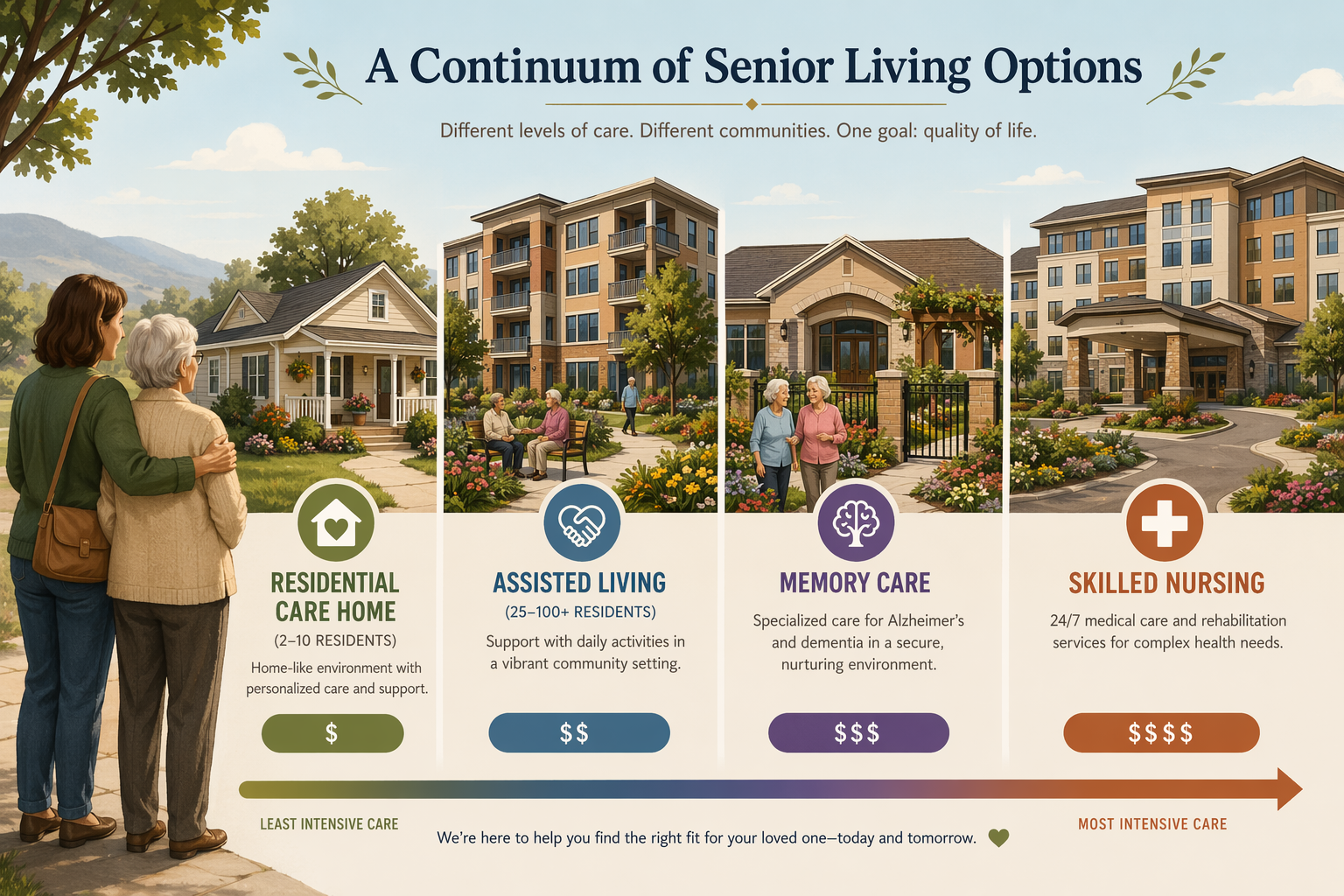
What Is a Residential Care Home?
A residential care home — also called a board and care home, adult family home, or group home — is a small, private facility typically located in a converted single-family house in a residential neighborhood. These homes usually house 10 or fewer residents and provide personal care assistance, meals, housekeeping, and around-the-clock staff supervision. What they do not provide is skilled nursing or on-site medical treatment.
The National Institute on Aging defines these facilities as small private residences where residents receive help with activities of daily living (ADLs) — bathing, dressing, toileting, eating, and transferring — but where nursing and medical care are not typically part of the package. This distinction matters: a residential care home is a housing-and-personal-care solution, not a medical facility.
Because they are individually operated rather than part of large corporate chains, residential care homes rarely have the marketing budgets of major assisted living communities. This makes them harder to discover through online searches, but it also means they often operate with lower overhead and pass those savings on to families.
Residential Care Home vs. Assisted Living: Key Differences
The most obvious difference is scale. Assisted living communities typically house 25 to 100 or more residents in a campus-like setting with multiple buildings, shared dining rooms, activity centers, and amenity spaces. Residential care homes are private houses — often with four to six bedrooms, a shared living room, a communal dining table, and a backyard.
But scale is only the starting point. The table below summarizes the practical differences that matter most to families making a decision.
| Dimension | Residential Care Home | Assisted Living |
|---|---|---|
| Typical size | 2–10 residents | 25–100+ residents |
| Setting | Converted single-family home in a residential neighborhood | Purpose-built community with multiple buildings or floors |
| Staff-to-resident ratio | Higher — often 1:4 or better | Lower — averages around 1:8 |
| National median monthly cost (2026) | $4,500 semi-private / $5,500 private | $5,419 |
| On-site devotional activities | 38% of homes offer them | 76% of communities offer them |
| Complimentary transportation | 38% of homes offer it | 73% of communities offer it |
| Room service | 20% of homes offer it | 64% of communities offer it |
| On-site salon / fitness center | Rare | Common |
| Planned social activities | Fewer, less structured | Daily scheduled activities and outings |
The trade-off is straightforward: residential care homes offer more one-on-one staff attention and a quieter, home-like atmosphere, but they lack the amenity-rich environment of larger communities. For a senior who values privacy, routine, and close relationships with caregivers, that trade-off can be a significant advantage.
Who Is a Good Fit for a Residential Care Home?
Residential care homes are not right for everyone. They serve a specific resident profile, and understanding that profile is the key to making a good match.
A residential care home may be a strong fit if your parent:
- Needs help with two or more ADLs (bathing, dressing, toileting, eating, transferring) but does not require 24/7 skilled nursing.
- Prefers a quiet, intimate environment over a bustling social calendar.
- Would feel overwhelmed, anxious, or lost in a large community with hundreds of residents.
- Values consistent, familiar caregivers who know their daily routines and preferences.
- Has a limited budget and needs a more affordable alternative to assisted living.
A residential care home may not be the right choice if your parent:
- Thrives on social interaction and wants a wide range of daily activities, group outings, and entertainment options.
- Requires on-site physical therapy, occupational therapy, or regular skilled nursing visits.
- Has advanced dementia with significant behavioral symptoms that may exceed what a small, non-specialized home can manage safely.
- Wants access to amenities like a fitness center, salon, or restaurant-style dining.
The key insight is that residential care homes fill a gap that many families do not realize exists: they offer the personal care assistance of assisted living in a setting that feels more like home, often at a lower cost. For the right person, they can be a better fit than either staying at home with part-time help or moving into a large facility.
2026 Cost Breakdown: What Families Actually Pay
Cost is often the deciding factor, and residential care homes have a clear advantage. According to A Place for Mom's 2026 data, the national median monthly cost for a residential care home is $4,500 for a semi-private room and $5,500 for a private room. By comparison, the national median for assisted living is $5,419 per month — meaning a semi-private room in a care home saves families roughly $900 per month on average.
State-level variation is dramatic. The table below highlights the most striking examples from the 2026 data. Note that cost data for residential care homes is less standardized than for larger facilities because most homes are individually operated; some state figures are based on small sample sizes.
| State | Monthly Median (Private Room) | Note |
|---|---|---|
| Minnesota | $8,700 | Highest reported |
| North Carolina | $8,100 | Second highest |
| Pennsylvania | $2,300 | Lowest reported |
| Kentucky | $2,950 | Second lowest |
| National median | $5,500 (private) / $4,500 (semi-private) | 2026 data |
The wide range — from $2,300 in Pennsylvania to $8,700 in Minnesota — reflects differences in local real estate costs, state regulations, and the level of care provided. It also means that families in high-cost states should not assume care homes are out of reach; a home in a less expensive suburb or neighboring county may offer significant savings.
For a deeper look at assisted living costs and payment strategies, see our guide on the true cost of assisted care in 2026.
What Services Are Included in the Monthly Fee?
The base monthly fee at a residential care home typically covers the essentials of daily living and personal care. While the exact package varies by home, most include the following:
- Three daily meals and snacks. Meals are usually prepared in the home's kitchen and served in a shared dining area.
- Housekeeping and laundry. Regular cleaning of the resident's room and common areas, plus personal laundry and linens.
- Assistance with ADLs. Help with bathing, dressing, grooming, toileting, and transferring.
- Medication management. Staff ensure medications are taken on schedule and in the correct dosage.
- Transportation. About 38% of care homes offer complimentary transportation to medical appointments and errands.
- 24/7 staff supervision. A caregiver is always present, though the overnight staff may be a single person.
Extra fees to watch for:
Not everything is included. The national median fee for medication administration is $300 per month, and some homes charge extra for night care, specialized dietary needs, or incontinence supplies. Always ask for a complete list of potential add-on charges before signing a contract.
How to Pay for a Residential Care Home
Unlike larger assisted living communities, residential care homes rarely accept Medicare. In fact, Medicare does not cover the cost of residential care homes at all. Families must rely on other payment sources.
- Private pay. This is the most common method. Families pay the monthly fee out of pocket, often using a combination of the senior's savings, Social Security income, and pension benefits.
- Medicaid HCBS waivers. Some states offer Home and Community-Based Services (HCBS) waivers that can help cover the cost of care in a residential care home. Eligibility and coverage vary significantly by state.
- VA Aid & Attendance. Veterans and surviving spouses who qualify for this pension benefit can use it to pay for residential care. The benefit is designed to help cover the cost of personal care services.
- Long-term care insurance. Policies vary widely. Some cover residential care homes; others only cover licensed assisted living or nursing homes. Review the policy's definition of covered facilities carefully.
- Life insurance conversion. Some life insurance policies can be converted into a long-term care benefit or sold via a life settlement to generate cash for care costs.
How to Find a Residential Care Home in Your Area
Finding a residential care home requires more legwork than finding an assisted living community. These homes are not listed on billboards or in large online directories. They are discovered through local networks, state databases, and professional referrals.
Actionable steps to locate care homes in your area:
- Work with a senior placement agency. These agencies are free to families (they are paid by the facilities they refer to) and often have relationships with smaller care homes that do not advertise. A senior care advisor can save hours of searching.
- Check your state's licensing database. Most states maintain an online directory of licensed board and care homes, adult family homes, or personal care homes. Search using your state's specific term.
- Contact your local Area Agency on Aging. AAAs maintain lists of licensed care providers and can often recommend homes that have a good track record with local families.
- Ask local senior centers, social workers, and discharge planners. Professionals who work with seniors daily often know which care homes in the area have good reputations.
- Drive through residential neighborhoods. Many care homes are unmarked or have only a small sign. Look for houses with wheelchair ramps, multiple mailboxes, or a small professional sign near the door.
Once you have a list of potential homes, visit them — ideally unannounced. The NIA recommends visiting at a different time of day than your scheduled tour to see how the home operates under normal conditions. Ask about staff-to-resident ratios, staff turnover, how emergencies are handled, and what happens if the home cannot meet a resident's changing needs.
For families who need a structured approach to evaluating all senior care options, our 3-step decision framework provides a practical method for comparing care types side by side.

Browse more in the Glossary.