
Is It Safe for Someone with Dementia to Drive? A Stage-by-Stage FAQ for Caregivers
Last reviewed: — Review date is particularly important for Medicare coverage, device specifications, and clinical guidance, which change frequently.
Dementia and Driving: A Stage-by-Stage Framework
One of the hardest questions a family caregiver faces after a dementia diagnosis is whether the person behind the wheel is still safe. The answer is not a single yes or no — it depends almost entirely on where the disease falls along its progression. A person in the early, mild stage may still be able to drive under certain conditions and with regular re-evaluation. Someone in the moderate or severe stage should not drive at all. This is not a matter of opinion; it is the consensus position of the National Institute on Aging, the Alzheimer's Association, and the American Academy of Neurology.
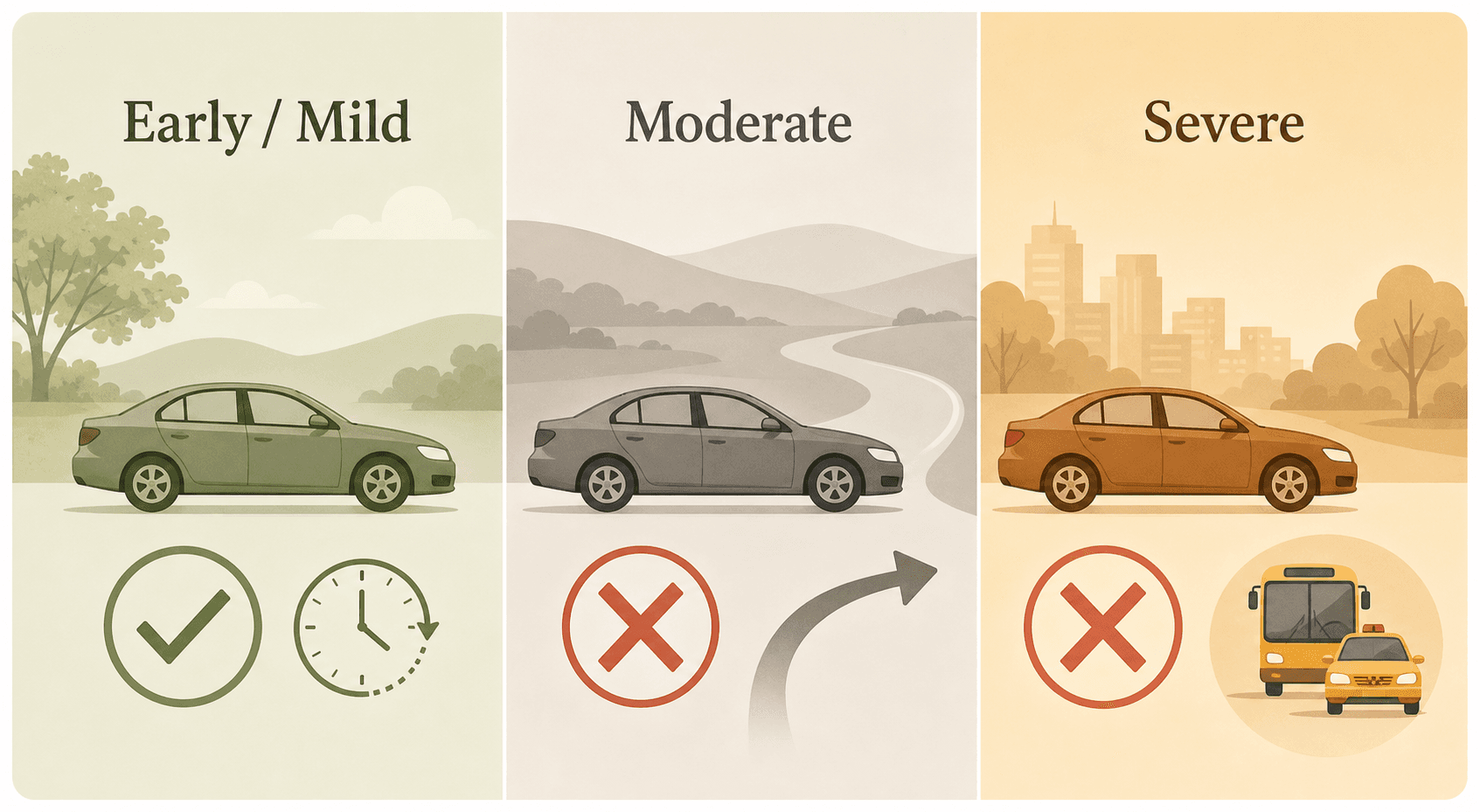
Most online advice treats this topic generically: a list of warning signs, a single recommendation to "talk to the doctor," and a handful of transportation resources. That approach fails caregivers because it does not tell them what to do right now, based on where their parent actually is in the disease. This FAQ is organized differently. Every answer is anchored to a specific dementia stage so that you can find the guidance that applies to your situation today — and know what will change as the disease advances.
Can My Parent Drive with Early-Stage Dementia?
The short answer is: possibly, but with firm restrictions and a mandatory re-evaluation schedule. The National Institute on Aging notes that some people in the early stages of Alzheimer's may still be able to drive safely for a period of time. The American Academy of Neurology recommends that people with mild dementia who continue to driving undergo a reassessment every six months — not annually, not "when something happens." The condition can change faster than annual checkups capture.
A French study published in 2018 compared 20 early-stage Alzheimer's drivers with 21 healthy controls using in-car video recording. The drivers with Alzheimer's had twice as many accidents and near-accidents, and in two-thirds of those events the driver showed no awareness that anything had happened. They were less able to adapt speed, maintain a safe following distance, and change lanes safely. This is the central danger of early-stage impairment: the person may not recognize their own mistakes.
The following warning signs are especially important to watch for in early-stage dementia, according to the National Institute on Aging, the Alzheimer's Association, and the Mayo Clinic:
- Getting lost on routes that should be familiar — the grocery store, a friend's house, the pharmacy
- New dents, scrapes, or damage on the car that the driver cannot explain
- Near misses or close calls that the driver dismisses or does not notice
- Confusing the brake and gas pedals, even once
- Failing to observe traffic signs, stop lights, or yield markings
- Driving at inappropriate speeds — either too fast or too slow for conditions
- Difficulty staying in the lane or drifting across center lines
The Family Caregiver Alliance recommends keeping a written log of specific driving incidents — date, location, what happened — so that you have concrete evidence when discussing the issue with your parent and their doctor. Vague concerns are easier to dismiss than a dated record of three near-misses in two weeks.
Is It Safe to Drive with Moderate or Severe Dementia?
No. The answer is unambiguous, and it is supported by every major health organization that has issued guidance on this question. The National Institute on Aging, the Alzheimer's Association, the American Academy of Neurology, the Mayo Clinic, and the Family Caregiver Alliance all state that people with moderate or severe dementia should not drive.
At this stage, the cognitive functions that driving depends on — judgment, reaction time, spatial awareness, multi-tasking, and the ability to interpret and respond to unexpected situations — are too impaired for safe operation of a vehicle. The behaviors that make driving unsafe at moderate and severe stages include:
- Confusion about where the car is or where it needs to go, even in the immediate neighborhood
- Inability to recognize or respond to traffic signals, stop signs, and road markings
- Mistaking the brake for the gas pedal, or pressing both at once
- Hitting curbs, mailboxes, parked cars, or other stationary objects
- Becoming angry, confused, or frightened while driving
- Drifting across lanes or driving onto the shoulder without awareness
The California Department of Motor Vehicles, which has one of the most structured state-level processes for dementia and driving, automatically revokes the license of anyone diagnosed with moderate or severe dementia. That is the standard: at this stage, the state itself considers driving unsafe.
What Does the Research Say About Crash Risk and Dementia?
The research tells a more nuanced story than a simple "dementia makes driving dangerous" headline — and understanding that nuance helps caregivers make better decisions.
The clearest finding comes from the Safety in Dementia resource, which states that drivers with dementia are more than twice as likely to be involved in motor vehicle collisions compared to older drivers without dementia. That is the headline number that matters for safety decisions: per mile driven, the risk is dramatically higher.
However, a large 2018 study by Fraade-Blanar and colleagues published in the journal Injury Epidemiology found something that at first seems contradictory. The researchers analyzed a cohort of 29,730 licensed drivers aged 65–79 in Washington State and found that people with a diagnosed dementia diagnosis actually had a lower police-reported crash rate: 14.7 crashes per 1,000 driver-years, with an adjusted hazard ratio of 0.56 compared to drivers without dementia. How can drivers with dementia be both more dangerous and less likely to crash?
"Drivers who have dementia are more than twice as likely to be involved in motor vehicle collisions." — Safety in Dementia
Additionally, a 2008 study cited by the Fisher Center for Alzheimer's Research Foundation found that the accident rate per mile driven is 9 times higher for drivers age 85 and older compared to younger drivers. While that statistic covers all older drivers — not just those with dementia — it underscores that age-related cognitive changes compound the dementia-specific risk.
How Do I Get a Professional Driving Evaluation?
If your parent is in the early stage and you are unsure whether driving is still safe, the gold-standard assessment is a clinical driving evaluation conducted by an occupational therapy driving rehabilitation specialist. Neither you, nor your parent's primary care doctor, nor a family discussion can substitute for this evaluation. It is the most objective tool available.
The National Institute on Aging and the Alzheimer's Association both direct caregivers to the to find a certified driving rehabilitation specialist. The evaluation typically includes three components:
- Clinical assessment — vision tests, reaction time, cognitive screening, and physical range-of-motion checks
- Off-road or simulator-based testing — evaluating decision-making, attention, and spatial awareness in a controlled setting
- On-road test — a structured driving assessment in a vehicle with dual controls, conducted by the specialist
The American Academy of Neurology recommends that anyone with very mild dementia who continues to drive be reassessed every six months. That means an evaluation at diagnosis, another at six months, and another at twelve months — not a single check and forget. Cognitive decline in early-stage dementia is not linear, and a pass today does not guarantee safety tomorrow.
What Are the State Laws About Dementia and Driving?
State laws governing dementia and driving vary dramatically across the United States, and understanding the rules in your state is essential. Some states require physicians to report a dementia diagnosis to the Department of Motor Vehicles. Others do not. Some offer confidential family reporting pathways. Others leave the decision entirely to the family and the doctor.
California provides the most detailed and well-documented example. Under California Health & Safety Code §103900, physicians are required to report any dementia diagnosis to the local county health department, which forwards the information to the DMV. For moderate or severe dementia, the result is automatic license revocation. For mild dementia, the DMV conducts a re-examination that may include a vision test, written test, an interview, and an on-road driving test. California's Senate Bill 335, effective January 2001, also allows family members within three degrees of consanguinity to submit a confidential written referral requesting a DMV re-examination of a driver they believe is unsafe.
Regardless of state law, remember that the clinical and safety standard — not just the legal standard — is what should guide your decision. Even if your state does not require reporting or does not automatically revoke a license for moderate dementia, the medical consensus is that driving at that stage is unsafe.
How Do I Talk to My Parent and Handle Refusal?

Telling a parent they can no longer drive is one of the most emotionally charged conversations in dementia caregiving. It touches on independence, identity, and the fear of being trapped at home. The approach should be compassionate but firm, and the Alzheimer's Association recommends involving the person with dementia in the conversation as much as possible while the disease is still early.
If your parent refuses to stop driving despite clear evidence that it is no longer safe, the Mayo Clinic, the National Institute on Aging, and the Family Caregiver Alliance recommend a graduated set of last-resort strategies:
- Control access to the car keys — hide them, or keep them in a place the person cannot reach
The emotional toll of driving cessation is real. Caregivers should be prepared for the person with dementia to feel anger, sadness, or a sense of loss. Validating those feelings — "I know this is hard, and I hate that we have to do this" — does not weaken your position. It preserves trust and makes the next difficult conversation easier.
What Transportation Alternatives Are Available?
If you are going to take the keys away, you must have a plan for what comes next. The person with dementia still needs to get to medical appointments, the pharmacy, the grocery store, and social activities — and if those trips vanish, the emotional impact of losing the car multiplies. Planning transportation alternatives before the driving conversation gives you something to offer, not just something to take away.
The National Institute on Aging and the Alzheimer's Association recommend the following options, which can be used alone or in combination:
| Option | How to Access It | Best For |
|---|---|---|
| Eldercare Locator | 800-677-1116 — connects to local senior transportation services | Medical appointments and essential errands |
| Rides in Sight | 855-607-4337 — a national ride referral service for seniors | One-time or occasional trips when family is unavailable |
| Family and friend networks | Create a shared calendar for scheduled rides | Regular weekly trips — church, lunch, social groups |
| Area Agency on Aging | Local contact via Eldercare Locator or state directory | Low-cost or volunteer driver programs in your area |
| Delivery services | Grocery delivery, pharmacy delivery, meal delivery | Reducing the number of trips needed each week |
Read the Full Guide
FAQs provide a concise answer. For comprehensive coverage, see these related guides.
- CAPS Contractor: How to Find and Vet a Certified Aging-in-Place Specialist for Home Modifications
A Certified Aging-in-Place Specialist (CAPS) holds a voluntary NAHB/AARP training credential — not a state contractor license — so family caregivers need to know how to locate genuine CAPS professionals, separately verify their trade licenses and insurance, ask the right vetting questions, and recognize contractor fraud red flags before committing to a home modification project.
- Middle-Stage Alzheimer's Care: A Decision Timeline for Family Caregivers
This guide helps family caregivers navigate the critical transitions of middle-stage Alzheimer's—from driving cessation to legal planning, home safety, and care options—with a clear timeline of warning signs and actions to reduce crisis-mode decisions.
- CAPS Contractor vs General Contractor: Which Do You Need for Aging-in-Place Home Modifications?
Deciding between a CAPS-certified specialist and a general contractor for home modifications? This article compares their training, focus, and costs to help you choose the right professional for your aging-in-place project.
Comments
Join the discussion with an anonymous comment.