
Senior Care Assistance Triage: What to Do Now, Next Week, and Next Month
Last reviewed: — Review date is particularly important for Medicare coverage, device specifications, and clinical guidance, which change frequently.
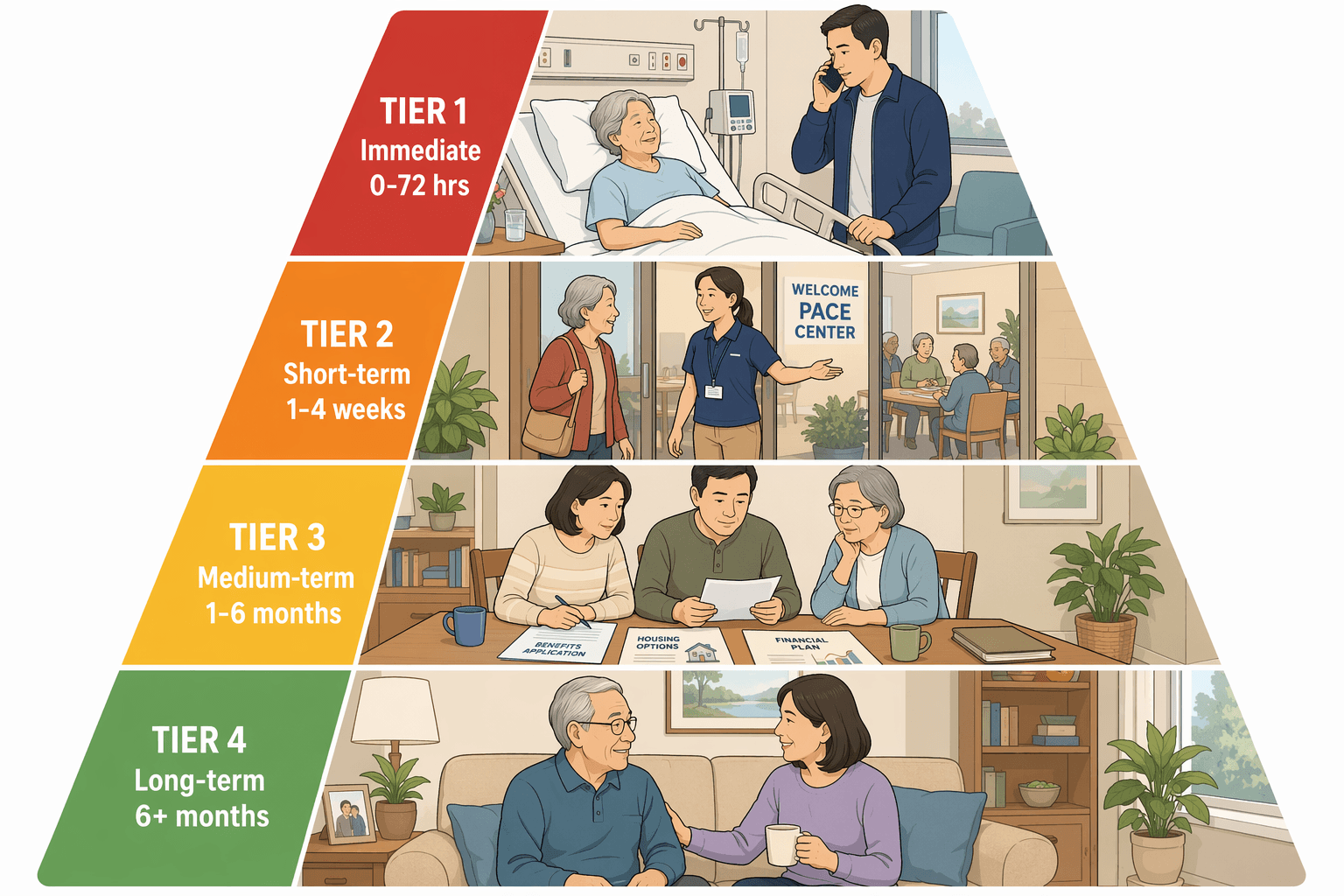
Why Most Families Waste Critical Time on the Wrong Programs First
When a parent is discharged from the hospital after a fall, or a spouse receives a dementia diagnosis, the instinct is to search for help. Most families start with the programs they have heard of — Medicaid, Medicare, maybe the VA — and quickly discover that none of them deliver assistance this week. That is not a failure of the programs. It is a failure of timing.
Senior care assistance programs exist on a time-sensitive spectrum. Some are designed for immediate crisis response. Others require weeks of assessment and enrollment. Still others involve applications that take months to process. The problem is that most families pursue them in the wrong order — starting with the slowest programs first because those are the most visible — and lose weeks or months they could have used to stabilize their situation.
Consider this: there are more than 600 Area Agencies on Aging (AAAs) across the United States, established under the Older Americans Act in 1973. These agencies can provide same-day crisis assessment and emergency respite. Yet fewer than 30% of family caregivers contact an AAA as a first step. Meanwhile, families spend hours researching Medicaid Home- and Community-Based Services (HCBS) waivers — programs that, in 41 states, have waiting lists averaging 32 months. They are starting with the wrong tier.
Tier 1: Immediate — What to Do in the First 0 to 72 Hours
The first 72 hours after a crisis are not the time to research long-term care insurance policies or compare assisted living facilities. They are the time to stabilize the immediate situation and prevent the next crisis from occurring. Two actions matter most in this window.
Call the Eldercare Locator — Right Now
The single most important phone call you can make in the first hours is to the Eldercare Locator at 1-800-677-1116. This national hotline connects you directly to your local Area Agency on Aging. The AAA system — more than 600 offices nationwide — is designed for exactly this moment. They can dispatch a crisis assessment, arrange emergency in-home support for bathing and dressing, coordinate home-delivered meals, and provide benefits counseling for Medicare and Medicaid. They also administer the National Family Caregiver Support Program (NFCSP), which can fund emergency respite care.
Secure the Hospital Discharge
If your parent is currently in the hospital or was recently discharged, the discharge process is a critical triage moment. Up to 40% of seniors leave the hospital with medication errors — incorrect dosages or harmful drug interactions. Before leaving the facility, you need a post-discharge care plan created with the hospital social worker, nurses, and physicians. This plan should include:
- A complete medication reconciliation comparing pre-hospitalization and discharge medication lists
- Scheduled follow-up appointments with the primary care physician and any specialists
- Arrangements for home health nursing, physical therapy, or occupational therapy if ordered
- Contact information for the hospital social worker who can help coordinate post-discharge services
Hospital staff can help arrange home health services as part of the discharge. Do not leave the facility without a clear plan for who will provide care in the first 24 to 48 hours at home.
Tier 2: Short-Term — Programs You Can Access in 1 to 4 Weeks
Once the immediate crisis is contained, you have a window of one to four weeks to access programs that require assessment and enrollment but can deliver services relatively quickly. These are the programs most families discover too late, after the crisis has already passed.
PACE: The Most Comprehensive Option You Have Never Heard Of
The Program of All-Inclusive Care for the Elderly (PACE) is one of the most underutilized resources in senior care. PACE provides comprehensive medical and daily care for older adults who would otherwise need nursing home care — all coordinated through a single care team. As of the most recent data, there are 194 PACE programs in the United States, serving 87,750 participants, available in 33 states and the District of Columbia.
Eligibility requirements are straightforward: the individual must be 55 or older, live in a PACE service area, be certified by the state as meeting the nursing home level of care, and be able to live safely in the community with PACE support. No financial criteria are considered. The average PACE participant is 76 years old with multiple complex conditions, and approximately 90% are dually eligible for Medicare and Medicaid.
The enrollment assessment can begin in person within days. Once enrolled, PACE provides all Medicare- and Medicaid-covered services through a coordinated care team — including primary care, specialist visits, therapies, prescription drugs, adult day care, transportation, and home care. For those not on Medicare or Medicaid, the average cost is $4,000 to $5,000 per month.
Contingency Path: What to Do If PACE Is Not Available in Your State
If your state does not have a PACE program, your next best short-term options are:
- Medicare Home Health Benefit: Medicare Part A and B cover home health services — including skilled nursing, physical therapy, and occupational therapy — if the individual is homebound and needs intermittent skilled care. This benefit does not cover 24-hour care, meal delivery, or personal care (bathing, dressing) unless it is provided alongside skilled care. See our detailed guide on the Medicare home health coverage gap for a full explanation of limitations.
- Veterans Directed Care: If the senior is a veteran, the Veteran Directed Care pilot program is available in 43 states plus DC and Puerto Rico. This program allows veterans to manage their own home care budget and hire family members (excluding spouses) as paid caregivers. Contact the local VA medical center to determine eligibility and availability.
- Adult Day Care Enrollment: Adult day centers provide structured daytime care, social activities, and meals. They can be accessed within one to two weeks and cost significantly less than in-home care. Some Medicare Advantage plans and state Medicaid programs cover adult day care. Your local AAA can help identify centers in your area.
| Program | Time to Access | Key Limitation | Best For |
|---|---|---|---|
| PACE | 1-4 weeks | 33 states + DC only | Comprehensive coordinated care for nursing-home-eligible seniors |
| Medicare Home Health | Days to 2 weeks | Skilled care only; no 24/7 or personal care alone | Post-hospital recovery with PT/OT needs |
| Veteran Directed Care | 2-4 weeks | Veterans only; 43 states + DC + PR | Veterans who want to hire family caregivers |
| Adult Day Care | 1-2 weeks | Daytime only; no overnight care | Working caregivers needing daytime coverage |
Tier 3: Medium-Term — Starting the 1- to 6-Month Processes Now
The programs in this tier take months to access, but the application processes must begin now — not after the crisis has passed. Delaying these applications costs families critical time and, in some cases, thousands of dollars in avoidable out-of-pocket spending.
Medicaid HCBS Waivers: Start the Eligibility Determination Today
Medicaid Home- and Community-Based Services (HCBS) waivers are the primary funding source for long-term home care for low-income seniors. They can pay for personal care, homemaker services, respite care, home modifications, and assistive technology. However, the demand far exceeds the supply.
According to the Kaiser Family Foundation's 2025 survey, 41 states maintain waiting lists or interest lists for HCBS waivers. In 2025, over 600,000 individuals were on waiting lists nationally, with an average wait time of 32 months. People with intellectual or developmental disabilities wait an average of 37 months, and those in states that do not screen for eligibility wait even longer — 49 months compared to 32 months.
Here is the critical point most families miss: most people on waiting lists (over 80%) are eligible for other types of home care through Medicaid state plans while they wait. You do not need to be at the top of the waiting list to get some help. The eligibility determination itself — which can take weeks to months — should be started immediately. Contact your state Medicaid office or local AAA to begin the application.
VA Aid & Attendance: A 3- to 6-Month Process Worth Starting Now
For veterans and surviving spouses who need help with daily activities — bathing, feeding, dressing — the VA Aid & Attendance benefit provides a monthly cash allowance added to a VA pension. The benefit is also available to those who are bedridden, in a nursing home due to disability, or have limited eyesight (5/200 or less in both eyes).
The application requires VA Form 21-2680, completed by a physician, and claims are processed in the order they are received. Typical processing time is 3 to 6 months. This means a family that starts the application today may begin receiving payments in late 2026 or early 2027. A family that waits until the next crisis will lose months of potential benefits.
Importantly, VA Aid & Attendance can pay family caregivers — excluding spouses — for care provided at home. In consumer-directed states, Medicaid HCBS waivers also pay family caregivers $13 to $18 per hour. These programs can transform a family's financial situation, but only if the applications are submitted early.
NFCSP Caregiver Support Services
The National Family Caregiver Support Program, administered through your local AAA, provides a range of services including respite care, counseling, support groups, and training. Unlike the HCBS waiver, NFCSP services are not tied to a waiting list in most areas — they are allocated based on available funding and local program design. Contact your AAA to determine what is available in your area and how to access it.
| Program | Typical Processing Time | What It Provides | Action to Take Now |
|---|---|---|---|
| Medicaid HCBS Waiver | Eligibility: 1-3 months; Waitlist: 32 months avg. | Personal care, homemaker services, respite, home modifications | Contact state Medicaid office to start eligibility determination |
| VA Aid & Attendance | 3-6 months | Monthly cash allowance for veterans/survivors needing ADL help | Download VA Form 21-2680 and schedule physician appointment |
| NFCSP | Varies by locality; typically 2-6 weeks | Respite, counseling, support groups, training | Call local AAA through Eldercare Locator |
Tier 4: Long-Term — Planning for 6 Months and Beyond
The programs in this tier are not for the current crisis. They are for the stability that comes after — the months and years of ongoing care that require financial and legal structures to be in place.
Medicaid Nursing Home and Assisted Living Coverage
If the senior's condition progresses to the point where nursing home or assisted living placement becomes necessary, Medicaid can cover the cost — but only after the individual meets strict financial eligibility requirements. This process, often called "Medicaid spend-down," involves documenting assets, income, and medical expenses to qualify. It is a complex legal and financial process that should be started months before placement is needed, not when the hospital is ready to discharge.
Spousal impoverishment protections allow the community spouse (the one not entering the facility) to retain a certain amount of income and assets. These rules vary by state and change periodically. An elder law attorney or your local AAA benefits counselor can help navigate this process.
Personal Care Agreements and Long-Term Care Insurance
A personal care agreement is a written contract between a senior and a family caregiver that formalizes the care arrangement and allows the caregiver to be paid from the senior's assets. This is a legitimate legal tool when structured properly, and it can also help document care needs for Medicaid eligibility purposes.
If the senior has a long-term care insurance (LTCI) policy, now is the time to review it carefully. Most policies have elimination periods (typically 30 to 90 days) before benefits begin, and they require documentation of functional need — usually the inability to perform two or more activities of daily living (ADLs) or the presence of cognitive impairment. Starting the claims process early ensures benefits are available when needed.
For a deeper dive into these long-term financial planning tools, see our guides on Financial Assistance for Caregivers of Aging Parents and How to Pay for Senior Home Care.
Your Situation → Your Timeline → Your Next Three Calls
The triage framework above is comprehensive, but when you are in the middle of a crisis, you need a simpler question: "What do I do right now?" The decision tree below maps your situation to your timeline and gives you the three most important actions to take immediately.
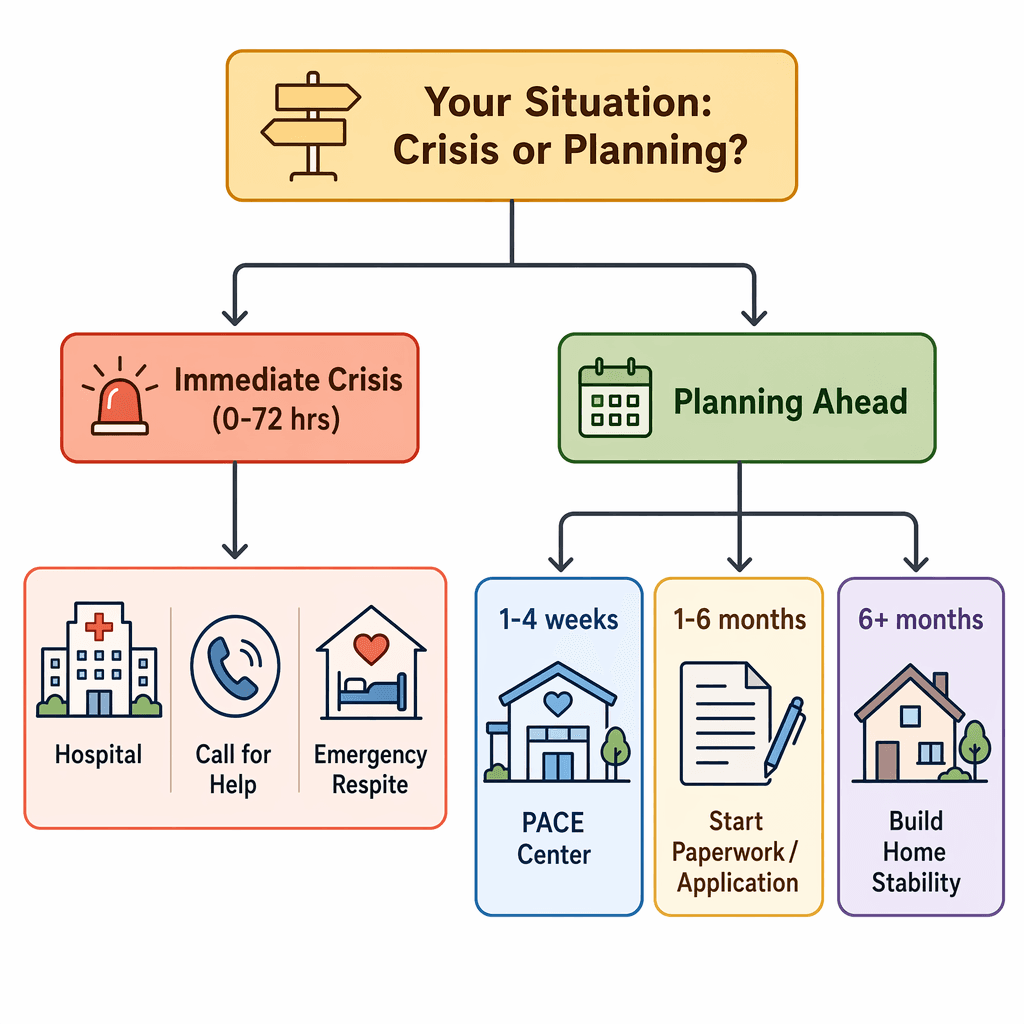
If You Are in Crisis (Post-Fall, Hospital Discharge, or New Diagnosis)
Your timeline is Tier 1 (0-72 hours). Make these three calls immediately:
- Call the Eldercare Locator at 1-800-677-1116 to reach your local AAA for crisis assessment and emergency respite.
- If the senior is still in the hospital, request a meeting with the hospital social worker to create a post-discharge care plan and reconcile all medications.
- Call your local AAA back to ask about NFCSP-funded respite care and short-term in-home support.
If You Are Planning Ahead (No Immediate Crisis)
Your timeline spans all four tiers. Make these three calls this week:
- Call the Eldercare Locator to identify your local AAA and ask about PACE program availability in your area.
- If the senior is a veteran or surviving spouse, call the nearest VA medical center to begin the Aid & Attendance application process.
- Contact your state Medicaid office to start the HCBS waiver eligibility determination — even if the waiting list is long, the clock starts now.
How This Framework Complements Our Other Guides
This triage framework is the first resource on this site organized by time-to-access rather than by program name, funding source, or care tier. It answers the question that overwhelms most new caregivers: "What do I do NOW versus later?"
If you have already identified your time horizon and need a deeper dive into a specific program, the following resources on this site can help:
- Our Complete Guide to Government Help for Elderly and Disabled Adults provides a comprehensive program-by-program overview — use it after you have identified which tier applies to your situation.
- Our 3-Step Decision Framework organizes care options by care tier (in-home, community-based, residential) — a different but complementary lens to the time-horizon approach here.
- Our Financial Assistance for Caregivers of Aging Parents guide covers government programs and how to apply in 2026 — essential reading for Tier 3 and Tier 4 planning.
- If you are brand new to caregiving, start with our Getting Started as a Family Caregiver guide for broader context on your new role.
- For short-term respite and emergency care options, see our Respite Guide for Caregivers.
The senior care assistance landscape is fragmented and overwhelming. But it becomes manageable when you stop trying to learn everything at once and instead ask: "What can I access right now?" Start with Tier 1. Make the calls. Then move to the next tier. The system is designed to help you — but only if you start in the right place.
Read the Full Guide
FAQs provide a concise answer. For comprehensive coverage, see these related guides.
- When More Medications Means More Risk: A Caregiver's Guide to Polypharmacy in Older Adults
For family caregivers whose parent takes five or more medications, this guide explains why aging bodies process drugs differently, how prescribing cascades silently multiply harm, what the Beers Criteria means for caregiver advocacy, and how to initiate a deprescribing conversation with a physician.
- Private Caregiver vs. Home Care Agency: A Decision Framework for Families Weighing Cost, Risk, and Control
This article helps adult children decide whether to hire a private caregiver directly or use a home care agency. It centers on the employer-responsibility trade-off, comparing hourly costs, hidden employer expenses, backup reliability, safety vetting, legal exposure, and caregiver continuity, and provides a structured decision matrix with diagnostic questions.
- How to Hire a Private Sitter for an Elderly Parent: A Complete Step-by-Step Guide
A practical playbook for adult children who have decided to hire a private caregiver directly. Covers the full process from needs assessment and sourcing candidates to legal setup, tax compliance, contracts, and backup care planning.
Comments
Join the discussion with an anonymous comment.