
When Is It Time for In-Home Nursing Care? A Decision Framework for Family Caregivers
Last reviewed: — Review date is particularly important for Medicare coverage, device specifications, and clinical guidance, which change frequently.

The Emotional Barrier: Why This Decision Feels So Hard
If you are reading this, you are likely carrying a weight that has no name. It is the feeling that you should be able to manage this yourself — that bringing in a stranger means you have failed. That guilt is not a sign of weakness. It is a sign that you care deeply, and it is the single most common barrier to getting the right care for a parent.
The guilt is often mirrored. Your parent may feel they are a burden. You may feel you are not doing enough. Both of you are wrong, but both of you feel it. Johns Hopkins Medicine addresses this directly: "When you feel that you cannot adequately meet the needs of your loved one, it's best to hire somebody to come in and help with activities of daily living." Notice the framing — it is not about giving up. It is about adequacy. You are recognizing a gap and filling it.
The data underscores why this reframe is necessary. Family caregivers provide an estimated $1+ trillion in unpaid care annually (2024 AARP data). That is not a measure of love — it is a measure of structural strain. You are not supposed to do this alone. The system was never designed for one person to provide round-the-clock medical and personal care while also holding a job and raising a family.
Once you accept that professional help is appropriate, the next question is harder: what kind of help? That distinction — between a home health aide who helps with bathing and a registered nurse who manages a wound vac — is the difference between safety and risk, and between hundreds of dollars per week in costs.
Understanding the Two Types of In-Home Care: Non-Medical vs. Skilled Nursing
The term "in-home care" is dangerously broad. It covers everything from a companion who plays cards with your mother to a registered nurse who administers IV antibiotics. Confusing the two can lead to unsafe care — or to paying for a level of service you do not need.
| Dimension | Non-Medical Home Care | Skilled Nursing Care |
|---|---|---|
| Who provides it | Home health aides, personal care aides, companions, CNAs | Registered Nurses (RNs), Licensed Practical Nurses (LPNs/LVNs) |
| What they do | Bathing, dressing, toileting, meal prep, light housekeeping, companionship, medication reminders | Wound care, IV therapy, injections, tube feeding, medication administration, vital signs monitoring, care plan management |
| Training required | Varies by state; home health aides typically complete 75+ hours of training; CNAs complete 4-8 week state-approved programs | RNs require an ADN or BSN (2-4 years) plus NCLEX-RN licensure; LPNs require ~12 months of vocational training plus NCLEX-PN |
| Supervision | May work independently or under RN supervision depending on state regulations | Practice independently within their scope; RNs can supervise LPNs and aides |
| Typical cost (2026 national median) | $34/hour for non-medical home care | 50-100% higher than non-medical care; exact rates vary by region and skill level |
| Insurance coverage | Almost always private pay; Medicare does not cover custodial/personal care alone | Medicare Part A/B covers skilled nursing if the patient is homebound and care is ordered by a physician; Medicaid covers in some states via HCBS waivers |
The critical takeaway: home health aides cannot perform medical tasks. If your parent needs a wound dressing changed, an IV line monitored, or a medication regimen that requires professional assessment (not just a reminder), you need a licensed nurse. An aide who attempts these tasks is practicing outside their legal scope, and the consequences can be serious.
For a deeper look at the full spectrum of care types — from companion care through registered nursing — see our guide on Home Care vs. Home Health Care: A Decision Framework for Seniors With Chronic Conditions in 2026. For now, the question is not whether to get help — it is whether that help needs to be a nurse.
The Four-Domain Assessment Framework: When Is Skilled Nursing Needed?
Rather than waiting for a crisis — a fall, a hospitalization, a medication error — use this framework to assess your parent's situation across four domains. Each domain has observable signals and a simple rating. The goal is to identify not just whether help is needed, but whether that help must come from a licensed nurse.
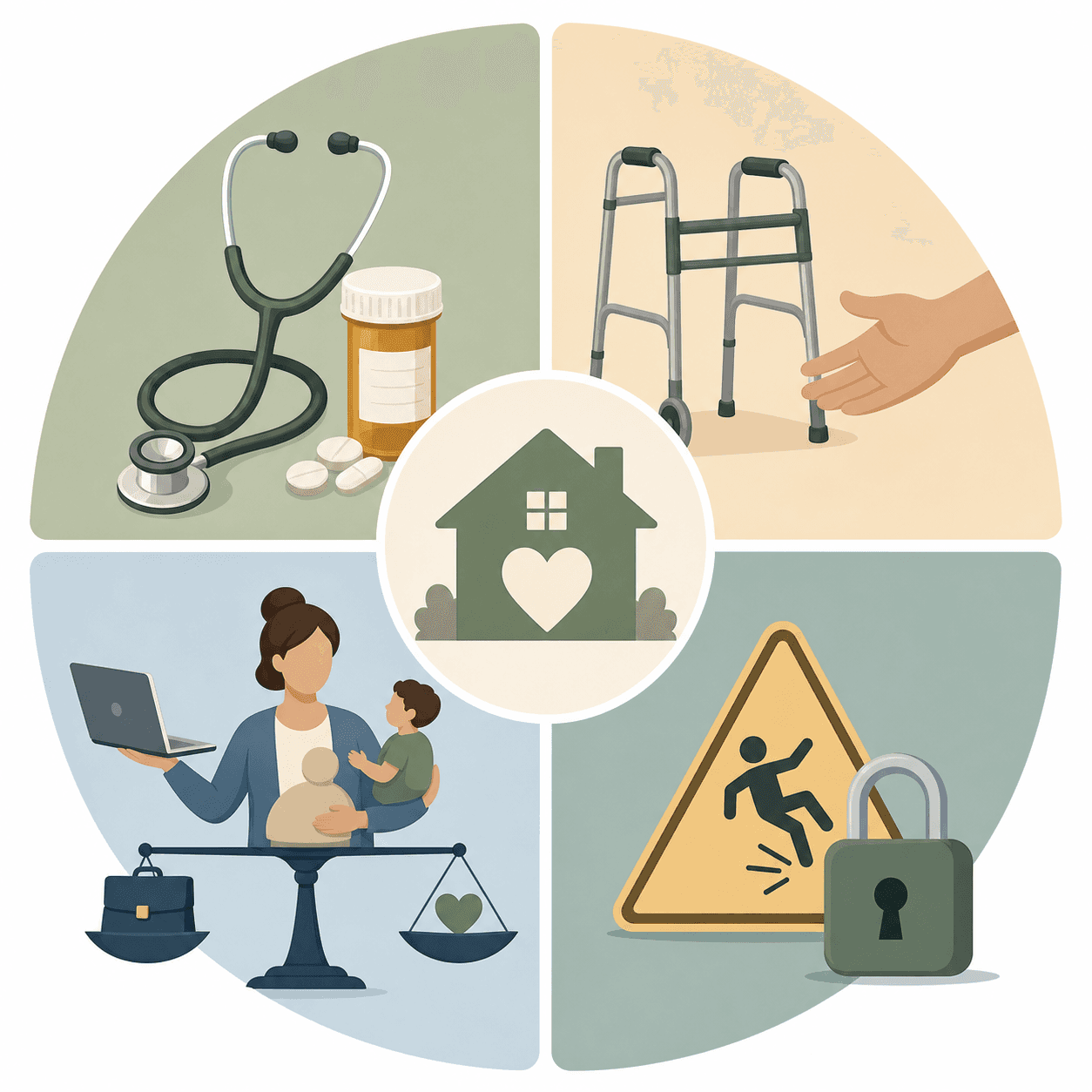
| Domain | Green (Low Risk) | Yellow (Monitor) | Red (Skilled Nursing Likely Needed) |
|---|---|---|---|
| Medical Complexity | Stable chronic conditions; medications are oral and taken correctly; no recent hospitalizations | New diagnosis or medication change; occasional missed doses; one hospitalization in past 6 months | Wound care needed; IV or injectable medications; unstable vital signs; tube feeding; post-surgery monitoring; multiple hospitalizations |
| Functional Decline | Independent with most ADLs; needs help with 1-2 IADLs (transportation, finances) | Needs help with 2-3 ADLs (bathing, dressing, transferring); uses a walker or cane; occasional incontinence | Needs help with 4+ ADLs; unable to transfer without assistance; frequent incontinence; significant mobility limitations |
| Caregiver Capacity | You feel in control; have backup support; can take breaks; sleep is adequate | You feel tired but managing; missed work occasionally; no regular breaks; sleep is disrupted | You feel exhausted, resentful, or unwell; have missed significant work; no backup; sleep deprivation is chronic; you live more than 1 hour away |
| Safety Risk | No falls in past year; home is well-lit and clutter-free; parent is aware of limitations | One fall in past 6 months; some home hazards present; parent resists using mobility aids; mild confusion at times | Multiple falls; wandering behavior; medication errors; weight loss or dehydration; leaving stove on; getting lost outside the home |
How to use this table: Go through each domain honestly. If you find yourself in the red zone for any domain, it is time to have a conversation with your parent's primary care provider about a skilled nursing referral. If you are in the yellow zone for two or more domains, schedule that conversation proactively — before a crisis forces the decision.
If you are concerned about night-time safety — wandering, getting up to use the bathroom unassisted, confusion after dark — our guide on When Does a Senior Need Overnight Care? Recognizing the Warning Signs Before a Crisis can help you assess whether overnight skilled monitoring is needed.
Red-Flag Thresholds: When You Need a Licensed Nurse, Not Just an Aide
The four-domain framework gives you a structured view. But some situations are non-negotiable. If any of the following is true, your parent needs a licensed nurse (RN or LPN) — not a home health aide, not a companion, not a personal care assistant.
- Complex wound care: Surgical wounds, pressure ulcers, or diabetic ulcers that require sterile dressing changes, wound assessment, or negative pressure wound therapy (wound vac). Only an RN or LPN can perform these tasks.
- IV therapy or injectable medications: IV antibiotics, hydration, or pain management; insulin injections that require dose adjustment based on blood glucose readings; injectable blood thinners. These require nursing assessment and administration.
- Tube feeding: Nasogastric (NG) or percutaneous endoscopic gastrostomy (PEG) tube management, including formula administration, site care, and monitoring for complications. This is a nursing procedure.
- Unstable vital signs: Blood pressure that fluctuates dangerously, oxygen saturation below 90%, heart rate irregularities, or fever that requires monitoring and clinical judgment. An aide can take vitals but cannot interpret or respond to abnormal values.
- Medication regimens requiring professional assessment: Not just taking pills — but managing medications where dosages change based on symptoms (e.g., pain management, anticoagulation, insulin), or where the patient has a history of adverse reactions. An RN can assess for side effects and communicate with the prescribing physician.
- Post-hospitalization or post-surgery monitoring: After a hip replacement, stroke, or cardiac event, the first weeks at home carry the highest risk of complications. Skilled nursing provides daily assessment for infection, blood clots, falls, and medication reactions.
If none of these red flags apply, your parent likely needs non-medical home care — an aide or companion who can help with bathing, dressing, meals, and companionship. That is still a significant and valuable intervention. But it is a different service, with a different cost structure and different coverage options.
How to Have the Conversation: Scripts for Talking to a Resistant Parent
You have assessed the situation. You know what is needed. But your parent says no. This is not defiance — it is fear. Loss of independence is terrifying, and accepting help feels like admitting defeat. The conversation needs to be framed around what your parent values most: staying at home, maintaining dignity, and remaining in control.
Here are scripts for the three most common objections, adapted from clinical guidance on caregiving communication.
Objection 1: "I don't want a stranger in my house."
Response: "I understand. It feels invasive. But the alternative is me trying to do things I am not trained for — and I am worried I will hurt you or miss something important. What if we start with someone coming just twice a week for two hours? You can meet them first, and if you do not like them, we try someone else. You are in charge of who comes into your home."
Objection 2: "I'm fine. You're overreacting."
Response: "I hope you are right. But I am not sleeping well because I am worried about you falling or forgetting your medication. Would you be willing to let a nurse come for one visit to do a check-up? If she says everything is fine, I will stop worrying. If she finds something, we will know what we are dealing with. Either way, we have answers."
Objection 3: "We can't afford it."
Response: "Let us look at what is actually covered. If your doctor orders skilled nursing, Medicare may pay for it. If you have long-term care insurance, that may cover part of the cost. And even if we pay out of pocket for a few hours a week, it is cheaper than a hospital stay or a nursing home. Let us figure out the numbers together before we decide it is impossible."
For a complete guide on what to do after the conversation — including how to find and vet a home care agency — see our first-steps playbook for new caregivers.
The 'Try It First' Approach: Starting Small to Build Comfort
The biggest mistake families make is waiting until a crisis forces a full-time, high-intensity care arrangement. By then, the older adult is already destabilized — physically and emotionally — and the transition is traumatic for everyone.
A better approach: start small. Begin with a few hours of non-medical care per week — meal preparation, light housekeeping, companionship. This serves two purposes. First, it builds familiarity. The older adult gets used to having someone in the home. Second, it frees you up to focus on quality time rather than task management.
"There's evidence that even small amounts of in-home care, such as helping someone with meals or light housekeeping, can extend their independence." — Vicki Demirozu, quoted in A Place for Mom's 2026 Home Care Costs Guide
If skilled nursing is eventually needed, the transition is smoother because the infrastructure is already in place. The older adult is already accustomed to having a care provider visit. The nurse simply replaces or supplements the aide.
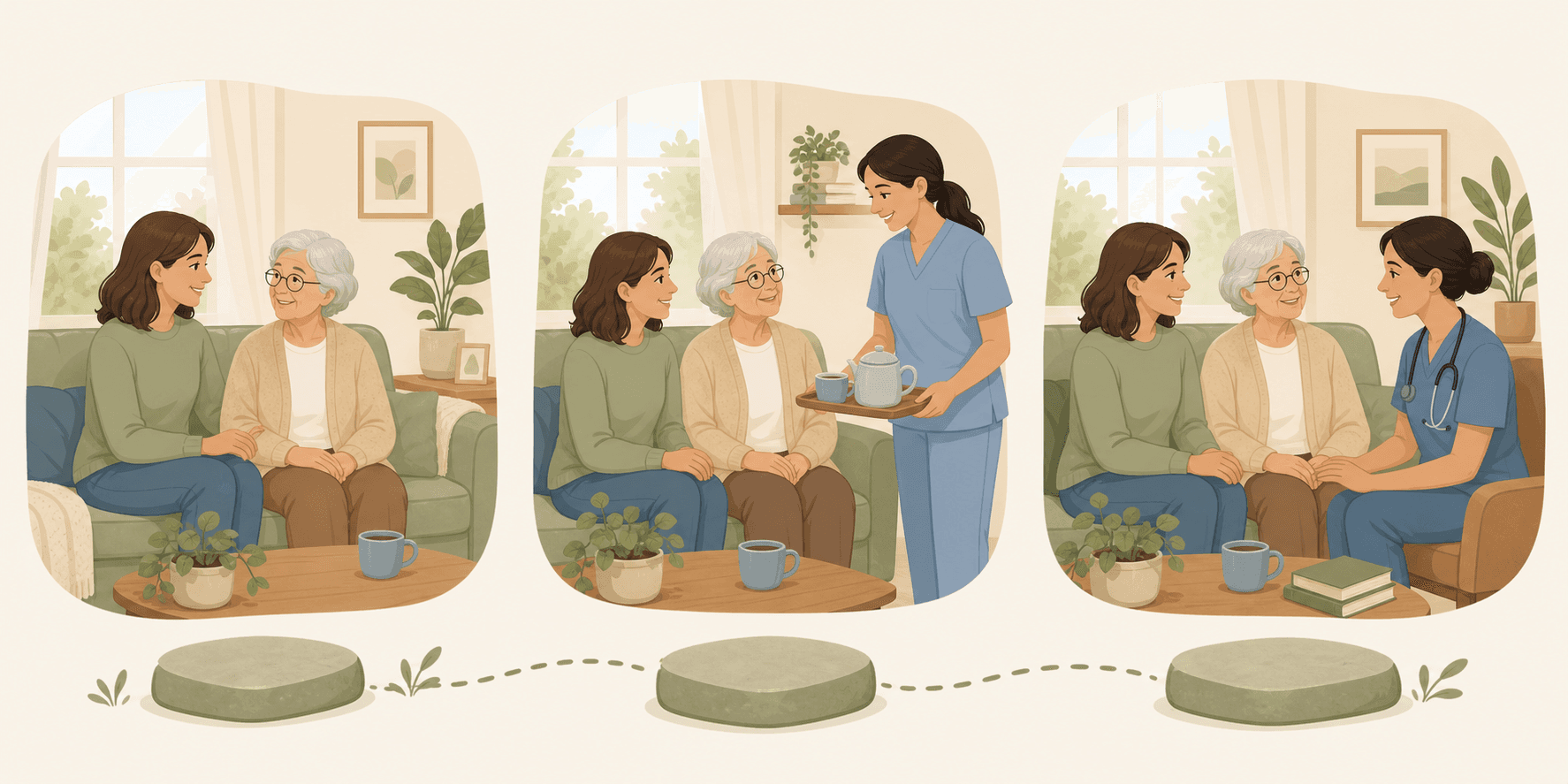
For families who want to start with low-cost or free community services before paying for private care, our guide on Building Your Parent's Services Stack: A Step-by-Step Guide to Layering Home Care From Free Community Services to Skilled Nursing at Home provides a structured approach to escalating services as needs change.
What the Research Says: The Case for Acting Early
If you are still hesitating, let the data do some of the work. The evidence consistently shows that acting early — before a crisis — leads to better outcomes for both the older adult and the family caregiver.
- 60% of older adults who live independently would want to stay in their home with a caregiver if they could no longer manage alone, but only 37% say this is highly likely to happen (Pew Research Center, February 2026). The gap between desire and reality is where families get stuck.
- 56% of adults who turned 65 between 2021 and 2025 are expected to need long-term services and supports at some point (HHS, cited in AARP's 2026 Long-Term Care Affordability Report). Planning for this eventuality is not pessimism — it is prudence.
- The median annual cost of home care at 30 hours per week reached $51,480 in 2026 — more than double the average Social Security benefit of approximately $23,700 (AARP, citing BLS and SSA data). Home care costs rose 7.9% from May 2025 to May 2026 alone, and have increased 39% since 2021.
- Only 21% of adults 65 and older have long-term care insurance (Pew Research Center, 2026). Most families will pay out of pocket for non-medical care, but skilled nursing may be covered by Medicare if the patient is homebound and care is ordered by a physician.
The takeaway is not that care is unaffordable — it is that the cost of not acting is often higher. A single fall that results in a hip fracture can cost $40,000+ in hospital and rehab costs. A medication error that leads to an ER visit can cost thousands. Early, modest investment in home care is both a safety measure and a financial hedge.
Resources for a Same-Day Start: Where to Turn Now
If you have read this far and recognize that your parent needs skilled nursing — or even just non-medical support — do not wait. Here is where to start today.
- Call the Eldercare Locator at 800-677-1116. This free, nationwide service connects you to your local Area Agency on Aging, which can help you find home care agencies, understand Medicaid waiver programs, and access community-based services. It is the single most useful number for any family caregiver.
- Contact your parent's hospital discharge planner or social worker. If your parent was recently hospitalized, the discharge planner can arrange for Medicare-covered home health services — including skilled nursing — as part of the discharge plan. This is the fastest path to getting a nurse in the home.
- Check with your state's Medicaid office about Home and Community-Based Services (HCBS) waivers. These waivers can cover in-home care for older adults who meet financial and functional eligibility criteria. Rules vary significantly by state, so you will need to verify your state's specific requirements.
- Review long-term care insurance policies. If your parent has a policy, check whether it covers home care, what the daily or monthly benefit is, and whether there is a waiting period before benefits begin.
- Use the Medicare Compare tool to find Medicare-certified home health agencies in your area. Only Medicare-certified agencies can bill Medicare for skilled nursing services.
For a complete, step-by-step guide to setting up in-home nursing care — including how to vet agencies, what questions to ask, and how to manage the first week — see our guide: How to Set Up In-Home Nursing Care for an Elderly Parent: A Step-by-Step Decision Guide.
And if you are still unsure whether skilled nursing is the right level of care, our Senior Services Decision Framework provides a broader lens for matching services to your parent's actual needs — from free community programs through full-time skilled nursing.
Read the Full Guide
FAQs provide a concise answer. For comprehensive coverage, see these related guides.
- 6 Signs Your Aging Parent Needs a Sitter — A Decision Guide for Family Caregivers
Worried about a parent living alone but unsure if it's 'time' to hire a sitter? This guide outlines six concrete, observable warning signs — from social withdrawal to safety concerns — and explains how a senior sitter can address each one, helping you make a confident, informed decision.
- Is It Time for Home Help? Recognizing When Your Aging Parent Needs Assistance and How to Start the Conversation
A practical guide for adult children who notice subtle declines in an aging parent but aren't sure if it's 'just aging' or a sign they need to intervene. Learn a structured 7-day observation framework to turn vague worry into actionable data, plus conversation scripts that frame help as support for independence — not loss of control.
- Cutting Senior Care Costs Without Cutting Quality: 15 Evidence-Backed Strategies for Families in 2026
Most families overpay for senior care because they buy services their loved one doesn't yet need. This guide offers 15 actionable, evidence-backed strategies for middle-income caregivers to reduce costs without sacrificing care quality.
Comments
Join the discussion with an anonymous comment.