
Caregiver decision guide
How to Set Up In-Home Nursing Care for an Elderly Parent: A Step-by-Step Decision Guide
A sequenced playbook for adult children whose parent is being discharged from the hospital or has had a recent fall or diagnosis. Covers assessing needs, getting a doctor's order, choosing an agency vs. private hire, verifying insurance, conducting interviews, and managing care over time.

Step 0: Determine Whether You Need Skilled Nursing or Personal Care
The term "in home nursing care for elderly" is deceptively broad. It can mean a registered nurse changing a wound dressing, a home health aide helping someone bathe, or a companion preparing meals. These are not interchangeable services, and the path to getting each one is fundamentally different. The most common and costly mistake families make is conflating them.
Skilled nursing care involves medical tasks that only a licensed professional can perform: wound care, injections, IV therapy, catheter placement, medication administration, and monitoring of unstable health conditions. This type of care is prescribed by a physician and is often covered by Medicare, but only under strict eligibility rules. Personal care, sometimes called custodial care, covers non-medical assistance with activities of daily living (ADLs) — bathing, dressing, toileting, eating, and transferring. Medicare does not cover personal care when it is the only care needed.
Many families need both types of care simultaneously. A parent recovering from hip replacement surgery may require a visiting nurse for incision monitoring (skilled) and a home health aide for bathing and mobility assistance (personal). The key distinction: skilled care requires a doctor's order and a formal plan of care; personal care can be arranged directly with an agency or a private caregiver.
| Care Type | Who Provides It | What They Do | Typical Cost | Insurance Coverage |
|---|---|---|---|---|
| Skilled Nursing | RN or LPN | Wound care, injections, IV therapy, medication management, health monitoring | $50–$150/hr | Medicare Part A/B (if eligible), private insurance, Medicaid |
| Home Health Aide | CNA or HHA | Bathing, dressing, toileting, mobility assistance, vital signs | $25–$45/hr | Medicare (only if also receiving skilled care), Medicaid HCBS waivers |
| Personal Care / Companion | PCA or companion | Meal prep, light housekeeping, companionship, transportation | $20–$35/hr | Private pay, long-term care insurance, some Medicaid waivers |
For a deeper comparison of caregiver types — including the training requirements for CNAs, HHAs, LPNs, and RNs — see our decision framework for choosing between companion care, personal care, and a home health aide. That guide covers the caregiver ladder in detail; this guide focuses on the sequence of actions once you know what type of care you need.
Step 1: Get the Doctor’s Order and Face-to-Face Assessment
If your parent needs skilled nursing or therapy services, the very first step is not to search for a caregiver — it is to get a physician's order. Medicare requires that a doctor or other health care provider certify that the patient is homebound and needs skilled care. This certification must be based on a face-to-face encounter that occurs no more than 90 days before or 30 days after the start of home health care.
During this assessment, the provider will evaluate whether your parent meets Medicare's definition of "homebound." According to Medicare.gov, a patient is considered homebound if leaving home is not recommended because of their condition, or if leaving home requires considerable and taxing effort. Being homebound does not mean being bedridden — a patient can leave home for medical treatment or short, infrequent non-medical trips (like attending religious services) and still qualify.
- Schedule a face-to-face appointment with the primary care physician or the hospital discharge team. This can happen during the hospital stay, at a follow-up visit, or via telehealth.
- Ask the doctor to document the specific skilled services needed (e.g., skilled nursing for wound care, physical therapy for gait training, occupational therapy for ADL retraining).
- Confirm that the doctor will sign a home health certification and establish a plan of care. Without this signed order, a Medicare-certified agency cannot begin services.
- Request a copy of the certification and the plan of care for your records. You will need these documents when you contact agencies.
If your parent only needs personal care (bathing, dressing, meal preparation) and does not require skilled nursing or therapy, you can skip the doctor's order step and proceed directly to finding a caregiver or agency. However, it is still wise to discuss the situation with the doctor — sometimes a short-term skilled need (like physical therapy after a fall) is present but not yet identified.
Step 2: Find and Vet a Medicare-Certified Home Health Agency
Once you have the doctor's order, the next step is to find a Medicare-certified home health agency. Medicare only pays for services provided by agencies that are certified and meet federal health and safety requirements. The National Institute on Aging recommends using the Medicare Care Compare tool to find and compare agencies in your area.
When evaluating agencies, look beyond the star rating. Here is what to check:
- Certification status: Confirm the agency is Medicare-certified. If it is not, Medicare will not cover its services.
- Quality of patient care ratings: Medicare Care Compare provides star ratings for quality measures like timely initiation of care, improvement in mobility, and management of pain.
- Patient satisfaction scores: Look for agencies with high marks on communication, timely care, and overall rating from patients and their families.
- Acceptance of Medicare assignment: Agencies that accept assignment agree to accept the Medicare-approved amount as full payment. This means you will not be charged more than the Medicare coinsurance or deductible.
- Service area and availability: Confirm the agency serves your parent's address and has the capacity to start care promptly.
Contact two or three agencies that meet your criteria. Ask whether they accept your parent's specific Medicare plan (Original Medicare or Medicare Advantage). Medicare Advantage plans may have different rules and provider networks than Original Medicare, so it is essential to verify coverage before proceeding.
Step 3: Understand the Plan of Care and 60-Day Recertification
Once you select an agency, they will develop a plan of care in coordination with the doctor. This document specifies the type and frequency of services, the goals of treatment, and the expected duration. For Medicare-covered home health, the plan of care must be reviewed and recertified by a doctor every 60 days.
Medicare's coverage limits are specific and often surprising to families. According to Medicare.gov, coverage is limited to part-time or intermittent skilled nursing care and home health aide services combined — typically up to 8 hours per day and 28 hours per week. This can be extended to 35 hours per week on a short-term basis if the doctor documents the need. Medicare does not cover 24-hour-a-day care, and it does not cover personal care (bathing, dressing) unless the patient is also receiving skilled nursing or therapy.
| Coverage Element | Medicare Rule |
|---|---|
| Maximum daily hours | 8 hours per day (skilled nursing + home health aide combined) |
| Maximum weekly hours | 28 hours per week (extendable to 35 hours short-term) |
| 24-hour care | Not covered |
| Personal care only | Not covered unless also receiving skilled care |
| Meal delivery, homemaker services | Not covered |
| Durable medical equipment | Covered at 80% (after Part B deductible) |
| Recertification | Every 60 days by a physician |
If your parent's needs exceed these limits — for example, they require 12 hours of care daily or 24/7 supervision — Medicare will not cover the full cost. This is the point where many families discover the gap between what Medicare covers and what their parent actually needs. For a deeper explanation of this gap and how to plan for it, see our guide to the Medicare home health coverage gap.
Step 4: If Medicare Doesn’t Cover It: Agency vs. Private Hire
When Medicare coverage is insufficient or unavailable — which is the case for most families needing ongoing personal care — you face a fundamental choice: hire through an agency or hire a private caregiver directly. Each option has significant trade-offs in cost, risk, and convenience.
According to A Place for Mom's 2026 cost report, the national median rate for non-medical in-home care is $34 per hour. At this rate, 30 hours per week of care costs approximately $4,416 per month. State medians range from $25 per hour in Mississippi to $44 per hour in South Dakota. These rates apply to agency-provided care.
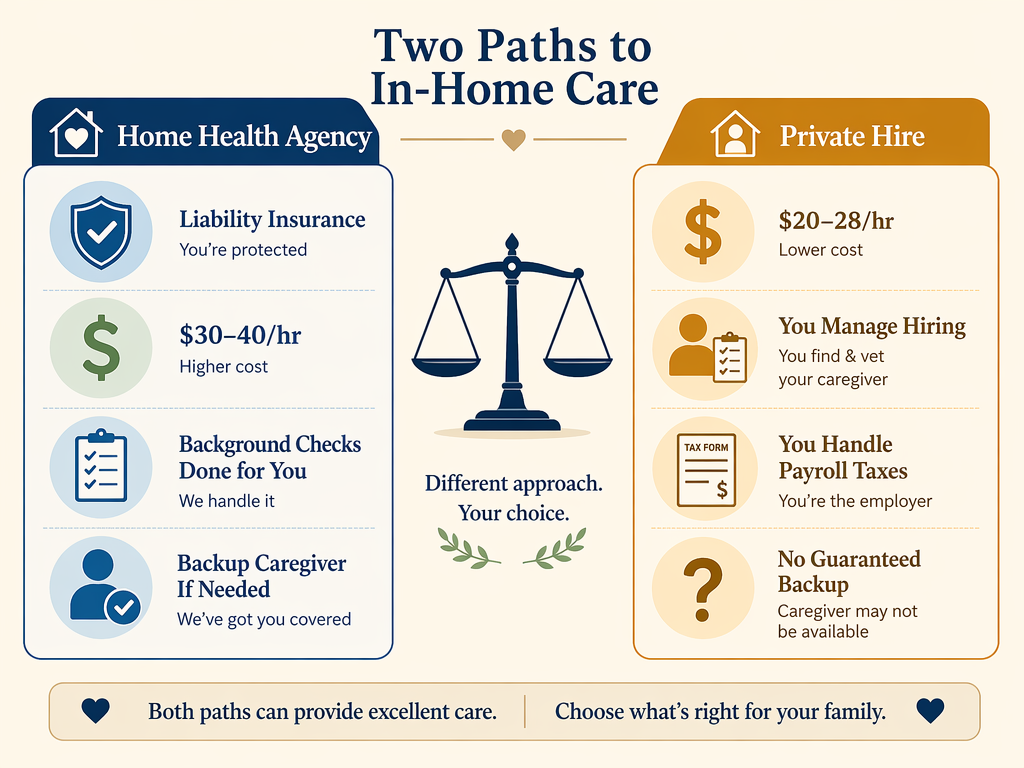
| Factor | Agency | Private Hire |
|---|---|---|
| Hourly cost (national median) | $34/hr | $20–$28/hr (estimated) |
| Background checks | Conducted by agency | Family must conduct |
| Liability insurance | Provided by agency | Family must verify or purchase |
| Payroll and taxes | Handled by agency | Family must manage (employer responsibilities) |
| Backup caregiver | Agency provides if primary is unavailable | No guaranteed backup |
| Training and supervision | Agency provides | Family must arrange |
| Worker's compensation | Covered by agency | Family may be liable if not covered |
Agencies handle the administrative and legal burdens of employment: background checks, training, payroll taxes, worker's compensation insurance, and liability coverage. They also provide backup caregivers when the regular caregiver is unavailable. This reliability comes at a higher hourly rate. Private-hire caregivers charge less because there is no agency overhead, but the family becomes the employer. This means managing payroll taxes, verifying credentials, conducting background checks, and accepting liability for workplace injuries.
Some states offer Medicaid Home and Community Based Services (HCBS) waivers that allow families to hire and pay a relative as a caregiver. These programs vary significantly by state. For a comprehensive overview of payment options — including VA benefits, long-term care insurance, and state-specific programs — see our guide to paying for elderly home care.
Step 5: Interviewing Caregivers and Checking References
Whether you choose an agency or a private hire, the interview process is your best opportunity to assess whether a caregiver is a good fit for your parent's personality, needs, and home environment. The National Institute on Aging provides a worksheet of questions to ask before hiring a care provider, which is a useful starting point.
Here are the essential questions to ask, organized by topic:
Experience and Skills
- How long have you worked in home care, and what types of clients have you cared for?
- Do you have experience with my parent's specific condition (dementia, diabetes, mobility limitations, post-surgery recovery)?
- Are you trained and comfortable with any medical tasks my parent needs (medication reminders, blood pressure monitoring, wound care)?
- What would you do in an emergency situation?
Availability and Reliability
- What are your available hours? Are you able to work weekends, holidays, or overnight shifts if needed?
- What is your backup plan if you are sick or unable to come?
- How much notice do you need for schedule changes?
Background and Credentials
- Have you passed a background check? Can you provide a copy?
- Do you have current certifications (CNA, HHA, CPR, first aid)?
- Do you have liability insurance and worker's compensation coverage? (For private hires, ask to see proof.)
- Can you provide at least two professional references from recent clients?
Communication and Personality
- How do you prefer to communicate with family members about changes in the client's condition?
- How do you handle a client who is resistant to care or refuses help?
- What do you enjoy most about caregiving?
After the interview, check references thoroughly. Ask previous clients about reliability, communication, respect for privacy, and whether they would hire the caregiver again. If using an agency, ask for references from families who had a similar care situation.
Step 6: Ongoing Management — Monitoring Quality and Adjusting the Plan
Setting up care is not a one-time event. Your parent's needs will change over time, and the care plan must adapt. Ongoing management involves three key activities: monitoring quality, communicating with the care team, and reassessing needs.
Monitoring Quality
- Conduct regular check-ins: Visit unannounced at different times of day to observe care. Ask your parent how they feel about the caregiver.
- Use a care log: Ask the caregiver to keep a daily log of tasks completed, meals eaten, mood, and any changes in condition. Review it weekly.
- Watch for red flags: Unexplained bruises, changes in your parent's mood or hygiene, missed medications, or the caregiver arriving late or leaving early are all signs that something may be wrong.
Communicating with the Care Team
- Establish a regular communication schedule with the agency or private caregiver — a weekly 10-minute phone call or a shared messaging thread.
- If using an agency, request a case manager or supervisor who can serve as your primary point of contact.
- Keep the doctor informed of any changes in your parent's condition. A change in mobility, appetite, or cognition may require a revised plan of care.
Reassessing Needs
Every 60 to 90 days, step back and assess whether the current care arrangement still meets your parent's needs. Ask yourself: Has their mobility declined? Are they eating less? Have there been any falls or hospitalizations? Is the caregiver showing signs of burnout? If the answer to any of these is yes, it may be time to adjust the plan — add more hours, change the type of care, or consider a different provider.
For a broader view of how home care fits into the full aging-in-place picture — including home modifications, monitoring technology, and community services — see our complete guide to home helps for the elderly.
Decision Tool: When to Escalate from Home Care to Assisted Living or a Nursing Home
Home care is not always the right answer forever. At some point, the cost, complexity, or safety risks may make a facility a better option. The decision is deeply personal, but there are objective indicators that it is time to consider a change.
| Indicator | What It Looks Like | What to Consider |
|---|---|---|
| 24/7 supervision needed | Parent cannot be left alone even for short periods; wanders; has frequent falls at night | Home care for 24/7 coverage is extremely expensive (over $200,000/year at $34/hr); assisted living or memory care may be more cost-effective |
| Caregiver burnout | You or the primary family caregiver are experiencing exhaustion, irritability, or health problems | Your ability to provide oversight and advocacy is essential; if you burn out, the quality of care for your parent will decline |
| Cost exceeds facility care | Monthly home care costs exceed the cost of assisted living in your area | See the break-even analysis below for a detailed comparison |
| Medical needs exceed home care capacity | Parent requires daily skilled nursing that exceeds Medicare's part-time limits, or has complex medical needs that require frequent monitoring | A skilled nursing facility may be the only option that can provide the necessary level of care |
| Safety risks at home | Parent has had multiple falls, has difficulty navigating stairs, or the home cannot be made safe even with modifications | A facility with a single-level layout, grab bars, and 24/7 staff may be safer than a modified home |
One of the most useful financial benchmarks is the break-even point where home care costs exceed assisted living. At the national median rate of $34/hour, 44 hours per week of home care costs approximately $6,478 per month. In many areas, this exceeds the cost of assisted living. For a detailed state-by-state comparison and a framework for making this decision, see our break-even analysis of home care vs. assisted living.
The decision to set up in-home nursing care is rarely a straight line. You may move back and forth between steps as your parent's condition changes. The value of this sequence is not that it is rigid — it is that it gives you a map. When you know which step you are on, you know what to do next. And when the map no longer fits, you will recognize the signs and know it is time to redraw it.
Questions to bring to a clinician or OT
This is not medical, legal, or a family's final decision — only a framework. Bring these questions to a clinician, occupational therapist, or your local Area Agency on Aging.
Find Local HelpRelated reading
- How Much Does a Live-In Caregiver Cost in 2026? A Complete Pricing Breakdown
- ACASA Senior Care vs. Visiting Angels vs. Comfort Keepers vs. Home Instead: How to Choose Between National Franchise Home Care Providers
- Is It Time? A Practical Framework for Assessing When an Elderly Parent Needs Home Assistance
Noticed something outdated or inaccurate on this page? Flag a correction. We review every report against CDC, NIA, and AARP HomeFit guidance before updating a page.