
Clinical term
How to Lower Fall Risk in Aging Adults With Suspected CTE
Last verified 2026-08-25
When an aging former athlete or veteran starts shuffling more, reaches for the wall on the way to the bathroom, or seems groggy after evening medications, the fall-prevention question has to come before the label. Suspected CTE can include symptoms that matter for falls—trouble walking, balance problems, parkinsonism, loss of coordination, and tremors—but CTE cannot be confirmed during life, and those same changes can have other treatable or co-occurring causes.[1][2]
That distinction keeps the caregiver’s job clear. You are not trying to diagnose CTE from the hallway. You are looking at what has changed in the person’s movement, memory, alertness, and route through the house, then making the home safer while clinicians sort out the medical cause.
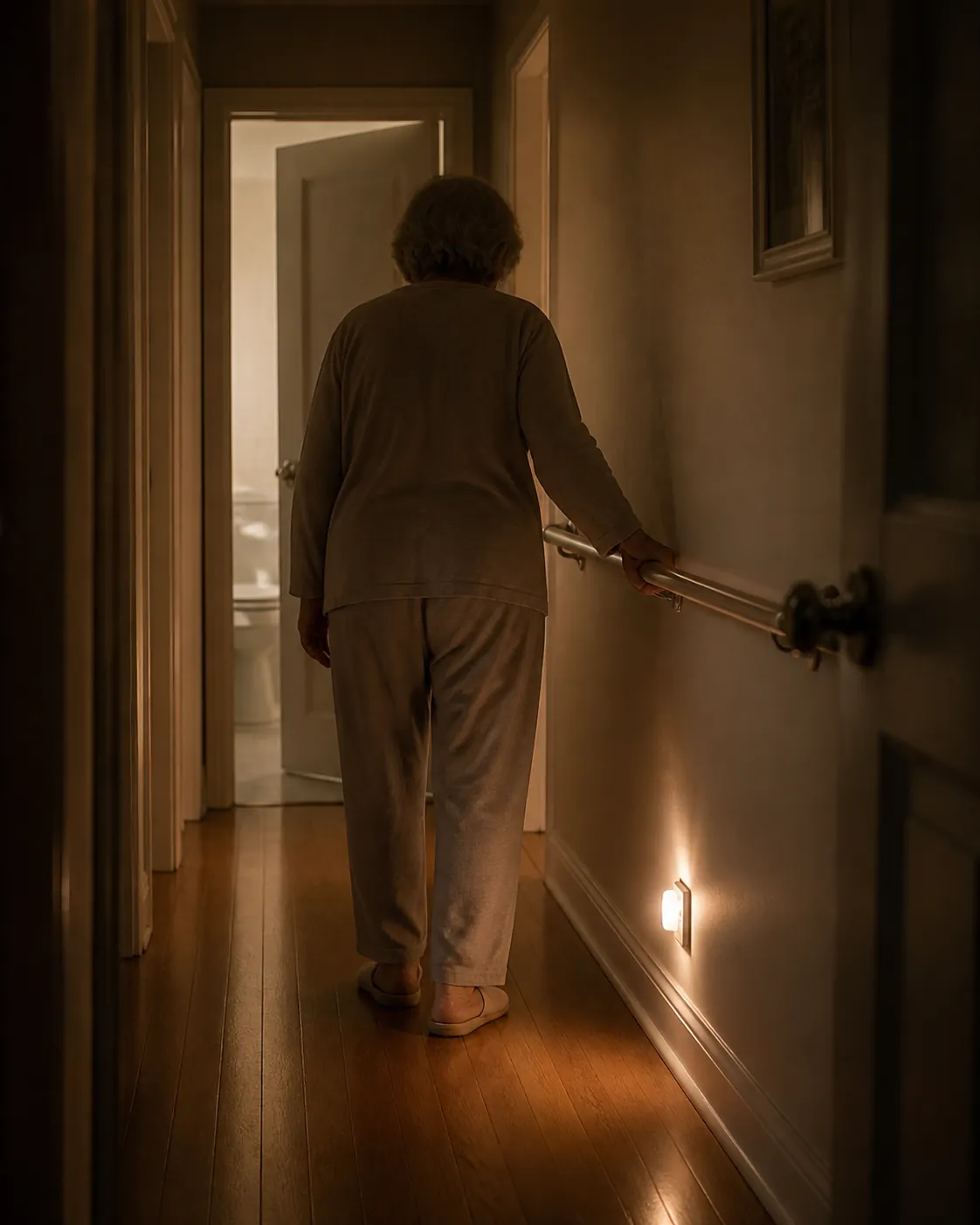
Why suspected CTE can change fall risk at home
The fall-risk picture is usually layered. Mayo Clinic lists physical symptoms of chronic traumatic encephalopathy that can include parkinsonism, trouble walking, and balance problems; Cleveland Clinic also describes movement-related symptoms such as tremors, loss of muscle coordination, and trouble walking.[1][2] Wounded Warrior Project, writing for a veteran audience, also names tremor and balance difficulty among physical signs that may appear in people with possible CTE-related concerns.[3]
Those symptoms do not prove CTE. They do tell you which household moments have become higher stakes: stepping over a shower threshold, turning in a narrow hallway, standing up from the toilet, carrying a glass of water across the kitchen, or getting out of bed half-awake.
Dementia-related fall factors add another layer. NHS inform notes that falls in people with dementia can be affected by mobility and balance problems, muscle weakness, memory and wayfinding difficulty, slower visual processing, and medicines that cause drowsiness, dizziness, or drops in blood pressure.[4] That is the practical bridge from “his balance is worse” to “the hallway needs a nightlight, the rug has to go, and the medication list needs a review.”
There is also a dementia reason to take suspected CTE seriously without overstating it. A January 2026 Boston University–linked study in Alzheimer’s & Dementia reported that stage IV CTE pathology in brain donors was associated with about 4.5 times higher odds of dementia, and 82.5% of donors with stage IV CTE had dementia.[5] The same research did not support a blanket claim that all CTE stages explain dementia, and it did not turn CTE pathology into a fall-causation finding. For caregivers, the useful point is narrower: when dementia-like symptoms and movement changes are both present, home safety deserves immediate attention.
If you need a fuller symptoms overview before making the safety pass, start with how to spot CTE dementia symptoms in aging adults. This article stays with the next problem: what to change in the home now.
Do the first home-safety pass in the path they actually use
Walk the home at the same time and speed the person uses it. If the hardest trip is bed to bathroom at 2 a.m., do that route after dark. If the first near-fall happened at the garage step, start there. A generic checklist misses the detail that matters: where the person turns, hesitates, reaches, shuffles, or forgets the route.
The National Institute on Aging’s room-by-room fall-prevention guidance emphasizes the basics that become less basic when balance, coordination, vision processing, or memory are changing: remove tripping hazards, improve lighting, use grab bars, add contrast where needed, and make high-risk areas easier to recognize and navigate.[6]
| Area | What to look for | What to change first |
|---|---|---|
| Entryway and garage door | A raised threshold, loose mat, poor lighting, packages left near the door, or a step that blends into the floor | Clear the landing, secure or remove mats, add bright lighting, mark step edges with contrast, and make sure there is a stable place to hold while entering |
| Hallways and nighttime routes | Narrow turns, clutter along walls, low contrast between floor and doorway, or no light between bedroom and bathroom | Keep the full path open, add nightlights, remove cords and small tables, and use contrast or simple signs to help the person identify the bathroom |
| Stairs | Dim stairwells, missing handrails, items stored on steps, patterned carpet that hides edges, or rushing because the person is confused | Install or repair sturdy handrails, improve lighting at top and bottom, keep steps empty, and use high-contrast tape or nosing if edges are hard to see |
| Bedroom | Bed height that makes standing hard, slippers across the floor, furniture blocking the route, or the person rising while sleepy | Create a straight route to the door, keep shoes and mobility aids in the same place, add a bedside lamp or motion light, and consider a stable chair for dressing |
| Bathroom | Wet floors, towel bars being used as grab bars, a low toilet, a tub wall to step over, or confusion about where to hold | Install real grab bars, use non-slip surfaces, improve lighting, keep toiletries within reach, and make the toilet and shower area visually clear |
| Kitchen | Reaching overhead, turning while carrying hot liquids, slippery flooring, pets underfoot, or cluttered counters | Move daily items to waist-to-shoulder height, clear walking lanes, use non-slip floor surfaces, and reduce the need to carry items across the room |
Entryway: treat the first step inside as a balance test
The entryway is where a small movement problem becomes visible. An older adult may manage a flat sidewalk but lose stability when stepping over a threshold, turning to close a door, or carrying mail while trying to remove shoes. If coordination is fading, do not rely on “be careful.” Put a stable handhold where the turn happens, clear the landing, and make the edge of any step easier to see.
Hallways: make the route obvious, not just clean
A clear hallway matters, but dementia-related wayfinding problems mean the route also needs to make sense. The bathroom door should be easy to identify. The path should not require weaving around a laundry basket, plant stand, pet bed, or decorative table. At night, lighting should show the floor, the doorway, and the turn into the bathroom without forcing the person to search for a switch.
Contrast can help when visual processing is slower. A light switch plate that blends into a wall, a dark rug on a dark floor, or a doorway that disappears in shadow may be manageable for someone fully alert. It can become a trap for someone who is sleepy, tremoring, or unsure which room they are entering.
Stairs: remove the decision-making
Stairs ask for balance, depth judgment, strength, and sequencing. That is a lot to ask from someone with possible parkinsonism, tremor, slower processing, or dementia-like confusion. Keep stairways empty every time, not just when company comes. Handrails should be easy to grip and available where the person starts and finishes the stair movement. Lighting should be strong enough that the top and bottom step are clear.
If the person has started pausing at the top of the stairs, stepping down sideways, or avoiding the stairs altogether, that is useful information for the clinician and possibly an occupational therapist. It may also mean the home’s daily routine needs to move to one level before there is a fall, not after.
Bedroom: plan for the half-awake stand-up
Many falls begin before the person is fully awake. Keep the route from bed to bathroom short, lit, and predictable. Shoes or non-slip slippers should be easy to reach without bending into a wobble. A cane, walker, or other mobility aid is only useful if it is parked where the person can reach it before the first step.
Watch bed height. If the person drops down onto the mattress or rocks several times to stand, the bedroom setup is no longer neutral. A stable chair for dressing can also reduce the risky one-leg balancing act that happens when someone tries to put on pants, socks, or shoes while standing.
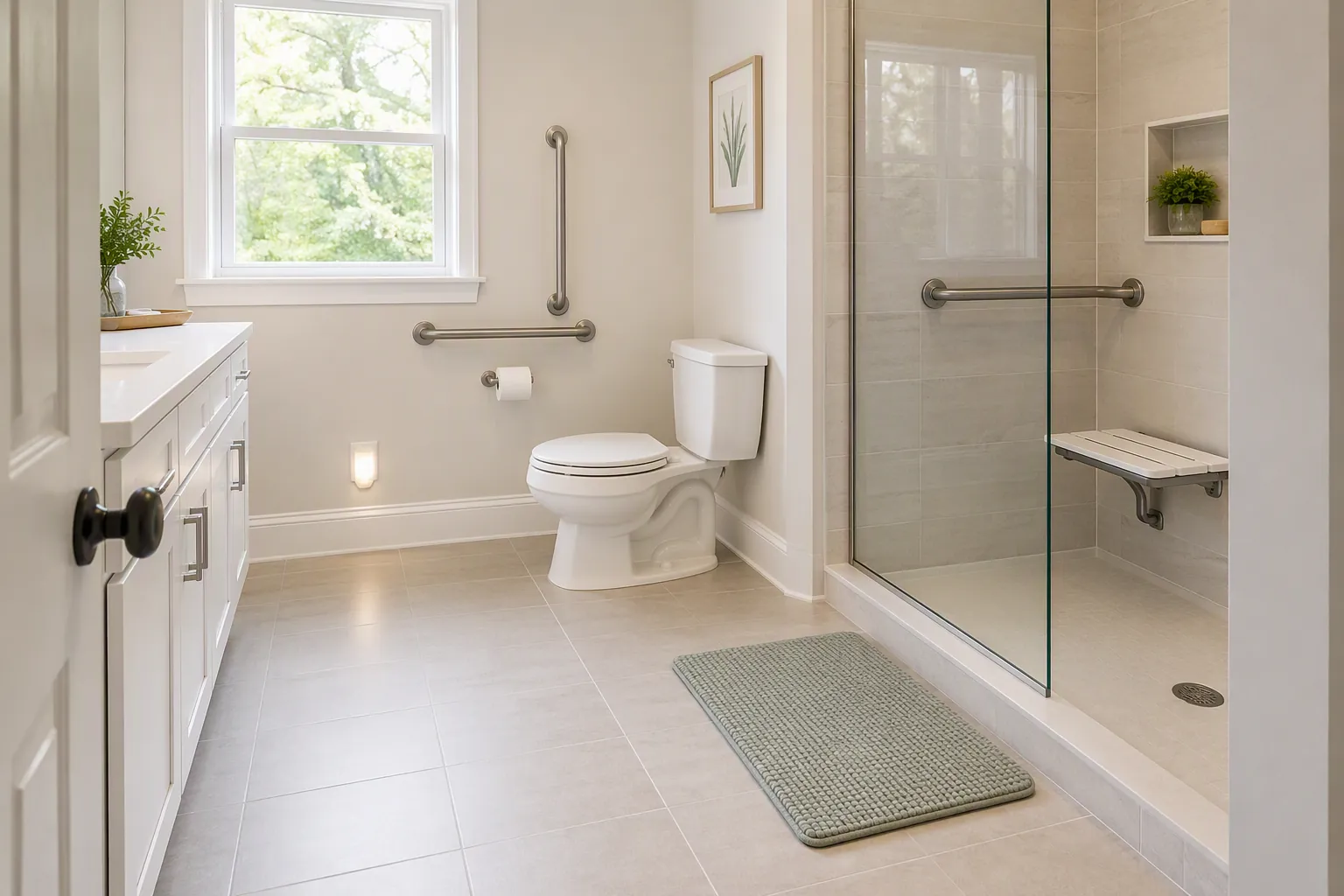
Bathroom: replace balance demands with supports
The bathroom is unforgiving: hard surfaces, water, urgency, small turns, and clothing changes. Towel bars are not grab bars. If the person reaches for the wall, sink, shower door, or towel rack, treat that as a request for proper support. Install grab bars where the person transfers, turns, and stands, not just where the brochure shows them.
Make the toilet and shower easier to recognize and use. Good lighting, a nightlight, non-slip flooring, and clear contrast around the toilet or shower entrance can reduce hesitation and missteps. Keep soap, shampoo, towels, and clothing within reach so the person does not have to twist, bend, or take wet steps across the room.
Kitchen: lower the reach, shorten the carry
A tremor or coordination change makes the kitchen harder before it looks dangerous. Move everyday dishes, cups, medications, snacks, and pet supplies to waist-to-shoulder height. Keep counters clear enough that the person can set something down quickly. If carrying a hot drink across the room has become shaky, change the routine rather than waiting for a spill and a fall.
For a broader dementia-focused home setup, compare this pass with the frontotemporal dementia home safety guide for families. The CTE-specific concern here is the added weight of movement symptoms—balance, gait, tremor, and coordination—on top of memory and wayfinding problems.
Medication review belongs in the fall-prevention plan
If an older adult is already unsteady, a medication that adds sleepiness, dizziness, or a blood-pressure drop can turn a careful walk into a fall. NHS inform specifically includes medicines that may cause drowsiness, dizziness, or low blood pressure among fall-risk factors for people with dementia.[4] The caregiver’s role is not to stop medicines alone. It is to bring the right evidence to the pharmacist or prescriber.

Before the review, gather everything the person actually takes:
- Prescription medicines, including as-needed pills
- Over-the-counter sleep aids, pain relievers, allergy medicines, cold medicines, and stomach medicines
- Vitamins, supplements, cannabis products if used, and herbal products
- The weekly pill organizer, because it shows what is happening in practice
- A short log of falls, near-falls, dizziness, new sleepiness, confusion, tremor changes, and the time of day they happen
- Recent blood-pressure readings if the household already tracks them, especially readings connected with dizziness or standing
The most useful report is concrete: “He nearly fell twice on the way to the bathroom after the evening dose,” or “She is sleepier after lunch and shuffles more until midafternoon.” That gives the pharmacist or doctor a pattern to evaluate. It is much more useful than “the medicine seems bad,” and it avoids the unsafe guessing that happens when caregivers start changing doses on their own.
Ask the pharmacist or prescriber to look specifically for medicines or combinations that could worsen drowsiness, dizziness, blood-pressure drops, coordination, alertness, or nighttime bathroom trips. Also ask whether the timing of doses could be contributing to the riskiest walking periods. The answer may be simple, complicated, or “do not change this without the specialist,” but it should come from a clinician who can weigh fall risk against the reason the medicine was prescribed.
This is the same practical medication-risk mindset used in other senior fall-prevention situations, including GLP-1-related fall risk in older adults and fall risk after cancer vaccine side effects: the point is not to blame one medication automatically, but to notice when side effects are stacking on top of gait, balance, cognition, or weakness.
Bring clinicians into the home problem
A safer home does not replace medical care. NHS guidance on chronic traumatic encephalopathy describes care planning that may involve different professionals, including physiotherapy, occupational therapy for adaptations at home, and speech and language therapy depending on the person’s needs.[7] For fall prevention, the occupational therapy piece is often the one families wish they had asked for earlier: someone trained to look at transfers, thresholds, bathrooms, lighting, equipment, and the way the person actually moves through the house.
Cleveland Clinic also notes that CTE symptoms worsen over time and encourages planning ahead, including legal, financial, and advance-care planning.[2] That planning can feel far away when the immediate worry is a bathroom fall, but it belongs in the same conversation. If decision-making, memory, or judgment is changing, the family needs a safer home and a clearer plan for who can approve care, equipment, repairs, and supervision.
When you call the doctor’s office, describe the home problem in plain language. Say where the near-falls happen, what time of day, whether the person is using furniture for support, whether tremor or shuffling is new, and whether confusion or wandering is part of the pattern. If you have video of gait changes or a written fall log, ask whether it would help the clinician review what you are seeing.
Some families also add technology after the home-safety basics are in place. A device cannot fix a slippery bathroom or a sedating medication schedule, but it may shorten the time someone waits after a fall. If that layer is appropriate, compare options in the senior fall-detection watch guide.
When a balance change is no longer a home-planning issue
A gradual pattern of unsteadiness deserves a planned response: home modifications, medication review, mobility evaluation, and follow-up with the person’s medical team. A sudden or rapidly worsening change is different. Seek urgent medical evaluation if balance, walking, tremor, coordination, confusion, or fall frequency changes quickly, especially if the person is suddenly unable to do a route they managed recently.
This is where the uncertainty around suspected CTE matters most. Because CTE cannot be confirmed during life and movement symptoms can come from many causes, a sharp change should not be written off as “probably the CTE.” Infection, medication effects, dehydration, blood-pressure problems, neurologic events, pain, vision changes, and other conditions can all change gait or alertness. Some require fast treatment.
While you are waiting for an appointment or instructions, lower the immediate risk: supervise bathroom trips if needed, keep the person off stairs, improve lighting, remove loose hazards, and avoid having them walk alone when sleepy or newly confused. If the pattern includes wandering, heat illness risk, or broader decline, the related guides on keeping older adults safe during record heat and spotting health decline in aging parents can help you organize what else has changed.
None of this asks a spouse or adult child to solve the diagnosis. It asks them to respect what they can see: slower turns, shakier hands, a missed doorway, a sleepy walk to the bathroom, a new reach for the wall. For caregivers, those observations are enough to justify safer rooms, a medication review, and a timely medical call.
References
- Chronic traumatic encephalopathy - Symptoms and causes. Mayo Clinic.
- Chronic Traumatic Encephalopathy (CTE). Cleveland Clinic.
- 5 Things to Know About Veterans and CTE. Wounded Warrior Project.
- Falls and dementia. NHS inform.
- Association of chronic traumatic encephalopathy stage with clinical dementia, neuropsychiatric symptoms, and functional independence. Alzheimer’s & Dementia. January 2026.
- Preventing Falls at Home: Room by Room. National Institute on Aging.
- Chronic traumatic encephalopathy. NHS.
Browse more in the Glossary.