
Room checklist
After a Fall: A Time-Based Triage Guide to Aging-in-Place Home Modifications
This guide helps adult children (40s–50s) prioritize home modifications after a parent’s fall by providing a clear timeline: immediate action in the first 72 hours, professional assessment in the first month, and structural upgrades over the first year.
Your parent fell yesterday. You're still shaken. Now you're searching for what to do, and every search result shows you a checklist that covers twenty rooms and fifty modifications. That's not what you need right now.
I've worked with dozens of families the day after a fall. I've watched parents spend the first week researching stair lifts while the bathroom still has no grab bar by the toilet. The question you need answered tonight is not "what could we do eventually." It's "what must we do before tomorrow morning so this doesn't happen again?"
Over half of all falls happen at home. More than one in four people 65 or older fall each year. The statistics are overwhelming, but they don't tell you what to do at 8 PM on a Tuesday. This guide gives you a time-based triage: what to do in the first 72 hours, the first month, and the first year. You don't need a renovation plan. You need a safety intervention, prioritized by urgency.
First 72 hours: What to do tonight
This section is the most important. If you finish reading and cannot name three actions to take tonight, the guide has failed. Here is what matters now.
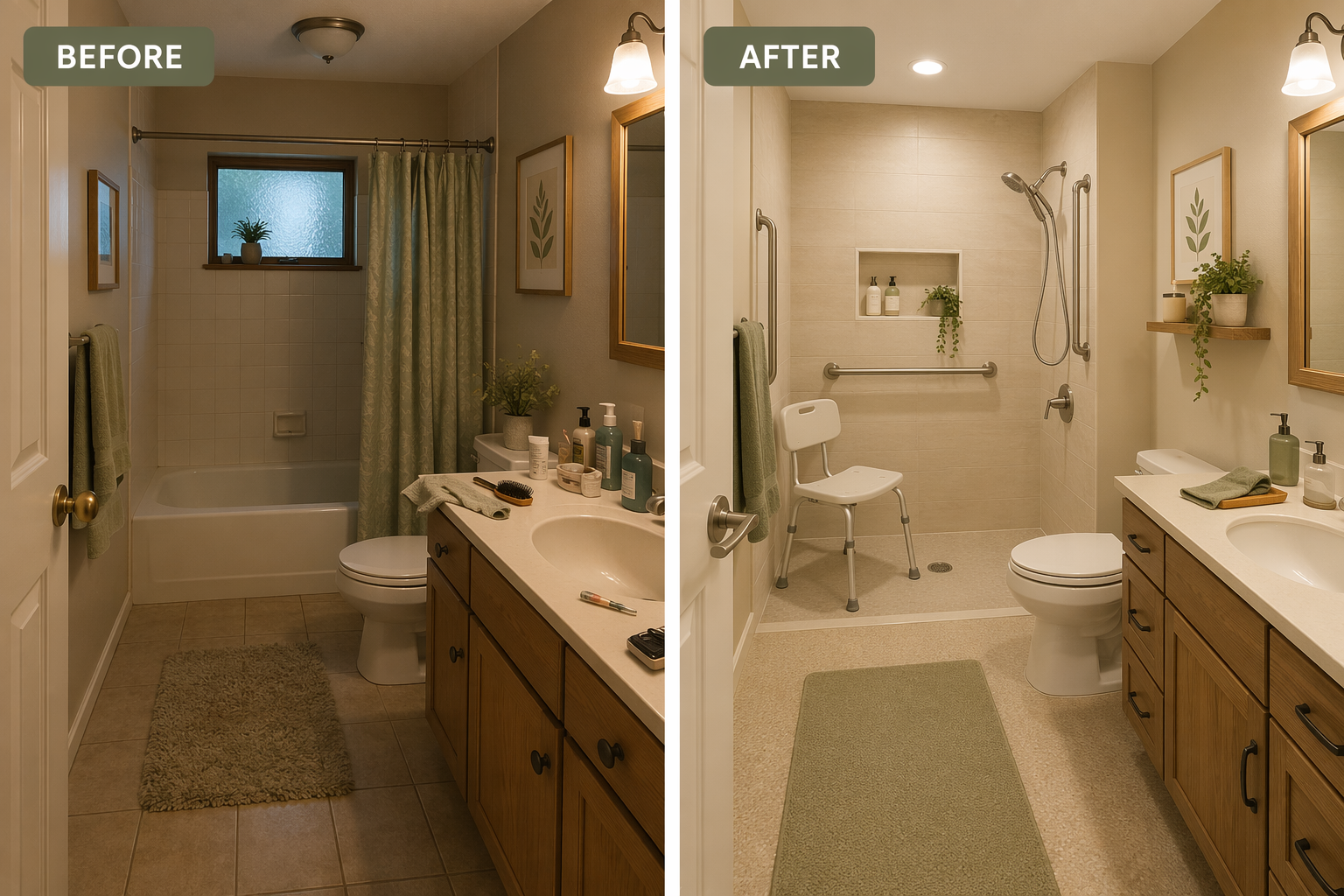
Install grab bars by the toilet and in the shower
The bathroom is the most physically hazardous room in the house. Almost 28% of bathroom injuries for people 65 and older are toilet-related. A study in the Journal of the American Geriatrics Society found that people using grab bars were about 76% more likely to recover their balance when they started to fall. That is one study, and the conditions matter, but it is the best evidence we have that a simple piece of hardware can prevent a fracture.
Install one near the toilet and one inside the shower or tub. They cost $100 to $400 each installed. If you can't get a contractor tonight, buy a temporary suction-cup grab bar at a hardware store—it won't be as sturdy, but it's better than nothing. Then schedule permanent installation for this week.
Light the way to the bathroom
This is the cheapest intervention on the list. Buy two nightlights—one in the bedroom, one in the hallway to the bathroom. Plug them in tonight. The path should be visible without turning on bright overhead lights that disorient at 3 AM. That nightlight costs $8. A hip fracture costs $50,000 and months of rehab. I'm not saying every fall leads to a nursing home bill, but the comparison illustrates the value of prevention.
Clear the pathways
Walk through the house tonight. Pick up every throw rug, every cord, every magazine stack on the floor. Move furniture so there's a clear path from the bedroom to the bathroom to the kitchen. This takes 20 minutes and costs nothing. Tomorrow, order non-slip mats for the bathroom and kitchen—that's $20 total.
Set up single-floor sleeping
If your parent's bedroom is upstairs, move a bed or a recliner to the ground floor tonight. Stairs are the most dangerous thing in a home for someone who just fell. They can sleep in the living room for a few nights while you figure out a longer-term arrangement. The goal is to eliminate stair use until you can assess whether a stair lift or a bedroom move makes more sense.
Have a way to call for help
If your parent fell and couldn't get up, they need a way to reach you or emergency services without crawling. A cell phone on the nightstand works. A medical alert pendant or a simple cordless phone beside the bed also works. Set it up tonight.
For a deeper room-by-room checklist, see our Bathroom Safety Checklist for Seniors. But the five items above are the priority.
First month: Get a professional assessment (often free)
After the immediate fixes, the next step is not hiring a contractor. It's getting an occupational therapist to evaluate the home. OT home safety evaluations are often covered by Medicare Part B or private insurance. Many people don't know this—they assume they have to pay out of pocket for any assessment.
Here's what you do: call your parent's primary care provider and ask for a referral for an occupational therapy home safety evaluation. State clearly that there has been a fall. The OT will come to the house, watch how your parent moves, identify hazards, and give you a written priority list tailored to their specific mobility and daily routines. This is not the same as a contractor's quote. It's a clinical assessment.
You may also hear about CAPS—Certified Aging-in-Place Specialists. CAPS contractors are trained to design and install modifications, but they are not a substitute for an OT. The OT tells you what to prioritize. The CAPS tells you how to build it. A common mistake is going straight to a contractor without an OT assessment and ending up with expensive modifications that don't actually address the biggest risks.
If you're not sure which route to take, read our decision guide: Should My Aging Parent See an Occupational Therapist or a CAPS First?. It explains the difference and when each one is appropriate.
First year: Three structural upgrades that matter most
Now you have the immediate safety done and a professional assessment in hand. It's time to think about major modifications. I'm going to narrow the long list of possibilities to three that have the highest impact for most families: stair lifts, curbless showers, and ramps.
- Stair lifts: $2,500 to $18,000 (straight stairs cost less, curved stairs cost more). If your parent has bedrooms or bathrooms on multiple levels, a stair lift may be more practical than moving them to one floor. See our Stair Safety article for when a small fix is enough and when to invest in a lift.
- Curbless or low-threshold shower: $8,000 to $18,000. This eliminates the step over a tub edge, which is a major fall risk. If your parent has difficulty stepping into a tub, this is the priority.
- Ramp for entryways: $1,500 to $12,000. If your parent uses a walker or wheelchair and there are steps at the front door, a ramp makes home accessible. Even a temporary modular ramp can be installed quickly.
Cost ranges are national averages and vary by region, contractor, and home age. The exact cost will depend on your situation. A full home aging-in-place remodel runs $15,000 to $60,000 or more, but you don't have to do it all at once. A phased approach spreads those costs over months or years.
Funding is available. The VA Specially Adapted Housing grant offers up to $126,526 for FY 2026 for qualifying veterans. USDA Section 504 provides grants up to $10,000 for homeowners age 62 and older in rural areas. State Medicaid waivers and local Area Agencies on Aging may also have programs. For a full breakdown, see our How to Pay for Aging in Place Home Modifications guide.
When to stop modifying: The cost comparison
Home modifications are not always the right answer. Sometimes the home itself is the problem: multiple levels, narrow doorways throughout, or a layout that would require tens of thousands to make safe. You need to weigh the one-time cost of modifications against the recurring cost of assisted living or a nursing home.
| Option | Typical Cost | Notes |
|---|---|---|
| Major home modifications (structural) | $15,000–$60,000 (one-time) | Includes stair lifts, curbless showers, ramps, door widening |
| Full bathroom/kitchen ADA renovation | $9,000–$40,000 (one-time) | Varies by scope and region |
| Assisted living | $64,200/year (recurring) | ChoiceMutual estimate |
| Nursing home (semi-private room) | $100,000+/year (recurring) | Highly variable |
Warning signs that the current home may not be salvageable: the home has two or more stories and your parent can't safely use stairs now or in the near future; your parent needs help with more than one activity of daily living (bathing, dressing, toileting); their mobility is declining rapidly due to conditions like Parkinson's or advanced arthritis. In these cases, the cost and logistical complexity of modifications may exceed the benefit.
This is a hard decision, and I won't pretend it's easy. But the triage framework gives you a way to think about it: if the first 72-hour fixes and the first-month OT assessment reveal that the house is fundamentally unsafe, it's okay to consider a move. The goal is safety, not a perfect home.
Take it step by step: the marathon, not the sprint
You are not failing if you only install grab bars this month. That is a win. A year from now, you might do the shower. That is another win. The marathon is about incremental safety, not a perfect home.
I've seen families burn themselves out trying to do everything at once. They end up exhausted, broke, and no safer than when they started because they never finished anything. The triage framework is designed to prevent that. You do the simple things today. You get a professional assessment this month. You plan the big changes over the next year. And you let yourself feel good about each step.
Your parent fell. You're scared. That's normal. But you are reading this article, which means you are already taking action. That nightlight you're about to buy, that grab bar you're about to install—those are concrete steps that reduce the chance of it happening again. That is what matters.
Related reading
- The Caregiver's Guide to Home Modifications for Aging in Place: What Actually Works, What It Costs, and What to Do First
- The Evidence for Aging-in-Place Home Modifications: What Research Says About Fall Prevention, Independence, and Cost Savings
- What Your Parent's Home Needs Now: A Caregiver's Decision Framework for Aging in Place Modifications
Need a professional assessment?
Find a CAPS-credentialed professional or local aging services through our outbound resource list — we never name or rank individual contractors.
Find Local HelpNoticed something outdated or inaccurate on this page? Flag a correction. We review every report against CDC, NIA, and AARP HomeFit guidance before updating a page.