
Room checklist
Bathroom Remodel for Elderly Safety: A Phased Cost Guide with Financing Options (2026)
A practical, cost-focused guide for adult children planning a bathroom remodel after a parent's fall. Learn a phased investment approach — from under $500 in immediate fixes to full renovations — plus federal grants, loans, and nonprofit programs that can offset the cost.
Why the Bathroom Is the Highest-Risk Room in the Home
When an older adult falls, the bathroom is the most likely location. The CDC reports that approximately 235,000 Americans over 65 visit emergency rooms every year due to bathroom-related falls and injuries. That is more than 640 people per day — and the actual number is likely higher because many falls go unreported unless they result in a fracture or head injury.
The reasons are structural. Standard bathrooms were designed for able-bodied adults in their 30s and 40s, not for someone with reduced balance, lower-body weakness, or slowed reflexes. A 6-inch tub step-over becomes a trip hazard. A 14-inch toilet seat requires deep knee bending to stand up. Glossy tile floors turn slippery the moment water hits them. Add dim lighting and the absence of anything to grab onto, and the bathroom becomes a daily obstacle course.
The scope of the problem extends beyond individual homes. According to U.S. Census Bureau data cited in a 2025 systematic review published in PMC, only 10% of American homes meet basic aging-ready criteria. That means 9 out of 10 homes — including the one your parent likely lives in — were not built with the safety needs of an aging occupant in mind.
The good news is that you do not need a $25,000 renovation to make a meaningful difference. Research supports this: a randomized controlled trial by Stark et al. (2017) with 300 participants found that home modifications reduced falls by 39% in the intervention group compared to the control group. A separate study by Carnemolla et al. (2019) with 157 participants found that home modifications reduced weekly care hours by 42%, with informal care dropping 46% and formal care dropping 16%. The evidence is clear: strategic, prioritized changes deliver disproportionate safety gains.
This guide is built around a phased investment framework. You can start with under $500 in immediate fixes this week, plan mid-range upgrades over the next few months, and budget for structural renovations when they become necessary. And for each phase, there are federal grants, loans, and nonprofit programs that can offset the cost — if you know where to look.
If you are not sure whether your parent's home needs a professional evaluation before you start buying grab bars, our guide on 10 signs your parent's home needs a CAPS assessment can help you decide.
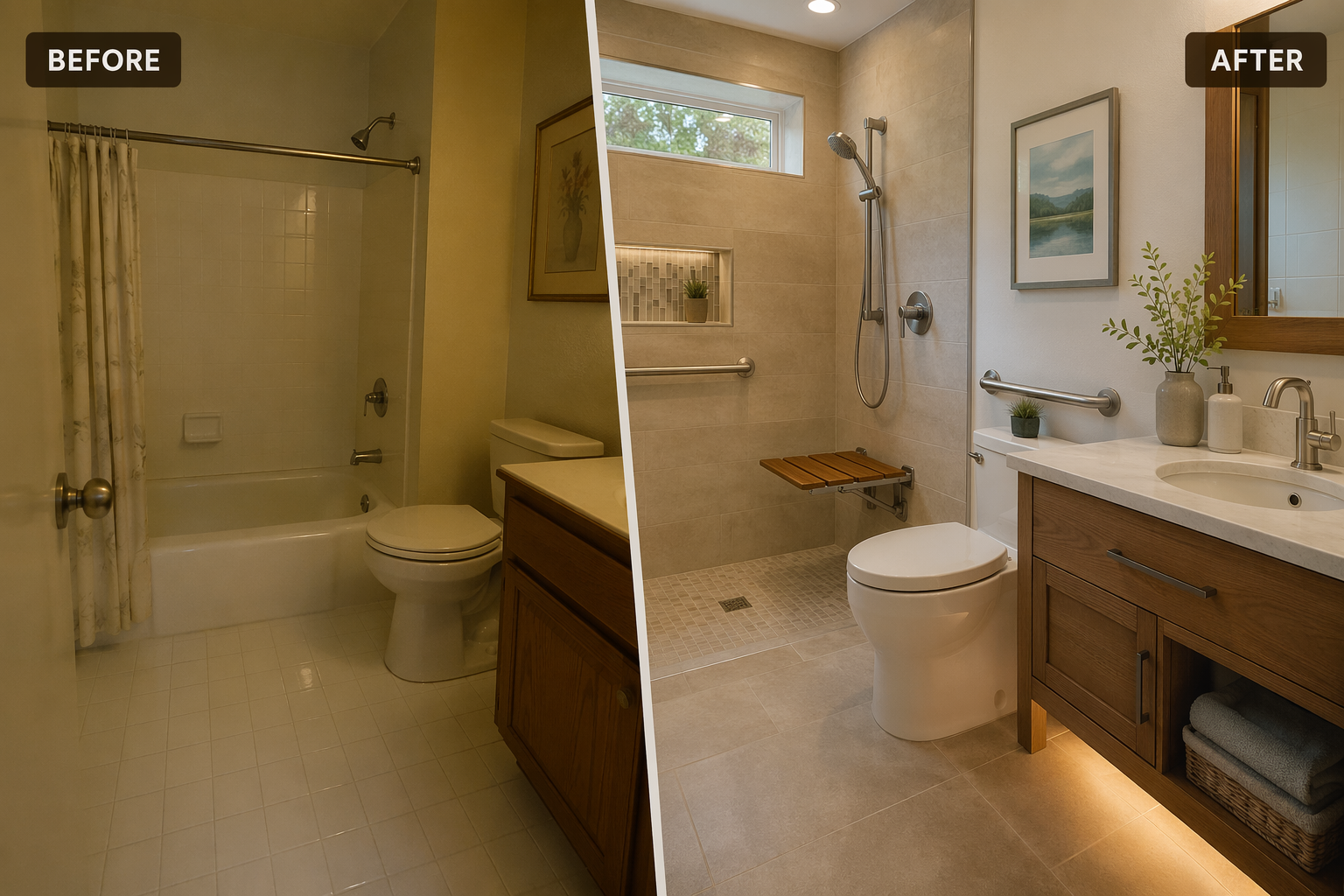
The Phased Approach: Prioritize for Maximum Safety Impact
The most common mistake families make is assuming a bathroom remodel is an all-or-nothing decision. Either you do a full gut renovation for $15,000, or you do nothing. That binary thinking keeps thousands of bathrooms dangerous because families feel overwhelmed by the cost and complexity.
A smarter approach is to think in phases, organized by cost bracket rather than by timeline. Each phase targets the most common fall scenarios in the bathroom: entering and exiting the shower, sitting down and standing up from the toilet, and navigating the room in low light or on wet surfaces.
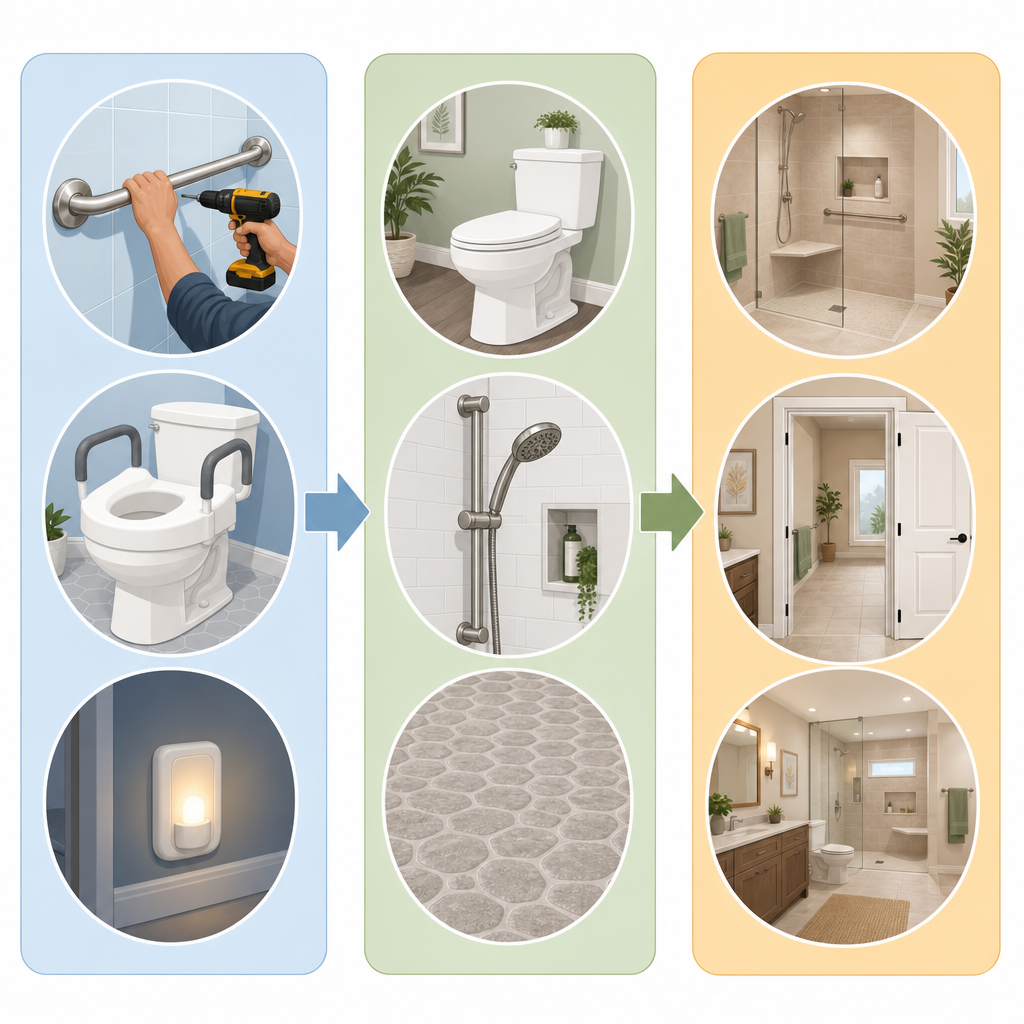
Here is the framework at a glance:
- Phase 1 — Immediate Safety Fixes (Under $500): Grab bars, a raised toilet seat, and motion-activated night lights. These can be installed in a single afternoon and address the most common fall triggers immediately.
- Phase 2 — Mid-Range Upgrades ($1,000–$3,000): A comfort-height toilet, handheld showerhead on a slide bar, and non-slip flooring. These upgrades make daily bathroom use safer and more comfortable for someone with reduced mobility.
- Phase 3 — Full Structural Renovations ($5,000–$25,000): A curbless walk-in shower, widened doorways, and a complete accessible bathroom remodel. These are for seniors with significant mobility limitations, including wheelchair use.
The key insight is that Phase 1 and Phase 2 together — costing between $1,500 and $3,500 — address the vast majority of bathroom fall risks. Phase 3 is necessary only when mobility has declined to the point where stepping over a tub wall or navigating a narrow doorway is no longer possible. Most families can stop after Phase 2 and achieve a dramatically safer bathroom.
Phase 1: Immediate Safety Fixes (Under $500)
Phase 1 is about addressing the three most dangerous moments in a bathroom: stepping into or out of the shower, sitting down or standing up from the toilet, and moving through the room in the dark. These three actions account for the majority of bathroom falls, and they can all be made safer with modifications that cost less than a typical dinner out.
Grab Bars ($200–$600 for Professional Installation of 3–4 Bars)
Grab bars are the single most effective safety feature you can install. They provide a stable point of support during the highest-risk transfers: entering and exiting the shower, and sitting down and standing up from the toilet. The key specifications: bars must have a diameter of 1.25 to 1.5 inches, be mounted at 33 to 36 inches above the floor, and be capable of supporting at least 250 pounds. They must be anchored into wall studs or installed with appropriate blocking — suction-cup bars are not safe for weight-bearing support.
For maximum coverage, install three bars: one vertically or horizontally at the toilet for sit-to-stand support, one at the shower entry for step-over stability, and one inside the shower on the control wall for balance while washing. Professional installation is strongly recommended unless you are experienced with finding studs and anchoring into tile without cracking it.
Raised Toilet Seat ($30–$80)
Standard toilet seats sit at about 14 to 15 inches. For someone with knee or hip weakness, standing up from that height requires significant lower-body strength and balance. A raised toilet seat adds 3 to 5 inches, bringing the total height to 17 to 19 inches — the same as a comfort-height toilet. This reduces the angle of knee flexion and makes standing up significantly easier and safer.
Look for models with built-in armrests for additional support. These are a temporary solution — if the raised seat works well for your parent, consider replacing the entire toilet with a comfort-height model in Phase 2.
Motion-Activated Night Lights ($15–$50)
Nighttime bathroom trips are among the most dangerous. An older adult waking up disoriented, walking through a dark house, and navigating a dark bathroom is at high risk for tripping over a bath mat, misjudging the toilet location, or losing balance. Motion-activated night lights placed along the path from the bedroom to the bathroom and inside the bathroom itself eliminate this risk for under $50. Plug-in models that illuminate the toilet and sink area are widely available and require no installation.
Phase 2: Mid-Range Upgrades for Daily Independence ($1,000–$3,000)
Once the immediate fall risks are addressed, Phase 2 focuses on making the bathroom comfortable and functional for daily use. These upgrades are particularly valuable for older adults who use a walker or cane, have reduced grip strength, or experience joint pain that makes standing for long periods difficult.
Comfort-Height Toilet ($300–$1,200)
A comfort-height toilet sits at 17 to 19 inches — 2 to 3 inches higher than a standard toilet. This is the same height as a raised toilet seat, but integrated into the fixture itself, which means a cleaner look and no wobble. For someone with arthritis, hip replacement, or general lower-body weakness, those extra inches make the difference between an independent bathroom visit and needing assistance.
The cost range depends on the brand, finish, and whether you need a plumber for installation. A basic model from a home improvement store costs $300 to $500; a higher-end model with a comfort-height bowl, elongated seat, and slow-close lid runs $600 to $1,200 including installation.
Handheld Showerhead on a Slide Bar ($100–$400)
A fixed showerhead forces the user to stand directly under the water stream, which is difficult for someone who needs to sit on a shower chair or who has limited mobility. A handheld showerhead on a slide bar allows the user to adjust the height of the spray and direct water exactly where it is needed while seated. This is a low-cost upgrade that dramatically improves bathing independence and safety.
Look for models with a long hose (at least 60 inches), a slide bar that adjusts easily without tools, and a pause button on the handle so water can be stopped without reaching for the faucet. Installation is typically a DIY project that takes 30 minutes.
Non-Slip Flooring with DCOF Rating of 0.60 or Higher ($500–$1,500)
Glossy ceramic or porcelain tile is the most common bathroom flooring material, and it is also the most dangerous. When wet, these surfaces can have a coefficient of friction so low that a single misstep leads to a fall. The tile industry standard for slip resistance is a Dynamic Coefficient of Friction (DCOF) rating of at least 0.42 for commercial spaces, but for aging-in-place bathrooms, the recommended minimum is 0.60 or higher.
Options include textured porcelain tile, luxury vinyl plank with a slip-resistant finish, or rubber flooring. If replacing the entire floor is not in the budget, a temporary solution is to install slip-resistant vinyl sheet flooring over the existing tile — this costs $200 to $500 and can be done in a day.
| Upgrade | Cost Range | Key Benefit | Installation Complexity |
|---|---|---|---|
| Comfort-height toilet | $300–$1,200 | Reduces fall risk during sit-to-stand transfer | Moderate (plumber recommended) |
| Handheld showerhead on slide bar | $100–$400 | Enables seated showering, reduces reaching | Low (DIY, 30 minutes) |
| Non-slip flooring (DCOF 0.60+) | $500–$1,500 | Prevents slips on wet surfaces | High (professional recommended) |
Phase 3: Full Structural Renovations ($5,000–$25,000)
Phase 3 is for older adults with significant mobility limitations — those who use a wheelchair, have difficulty stepping over a 6-inch tub wall, or require assistance with transfers. These renovations are structural and require professional design and installation, but they can extend independent living by 5 to 10 years.
Curbless Walk-In Shower ($3,000–$15,000)
A curbless (zero-threshold) shower eliminates the step-over hazard entirely. The shower floor is flush with the bathroom floor, allowing a wheelchair or walker to roll directly in. This is the single most impactful structural change for someone with significant mobility limitations. The cost varies widely depending on whether the existing drain location can be used, whether the subfloor needs to be sloped, and what finishes are chosen.
A basic curbless shower conversion — removing the tub, installing a linear drain, and adding a slip-resistant floor — starts at around $3,000 to $6,000. A full custom shower with built-in seating, grab bars integrated into the tile, a handheld showerhead, and a niche for toiletries runs $8,000 to $15,000. AARP reports that a curbless shower typically costs $6,000 to $10,000, while a wet room (where the entire bathroom floor is the shower floor) averages $9,000 per Angi.
Widened Doorways ($300–$2,500)
Standard bathroom doorways are 24 to 28 inches wide — too narrow for a standard wheelchair (which requires at least 32 inches of clear width) or a walker with a wide base. Widening a doorway involves removing the existing door frame, cutting the wall opening wider, installing a new frame, and hanging a new door. The cost depends on whether the wall is load-bearing and whether the new opening requires relocating plumbing or electrical.
A simpler alternative is to install offset hinges (also called swing-clear hinges) that allow the door to swing completely out of the way, adding 1.5 to 2 inches of clear width without structural work. This costs $50 to $100 per hinge and can be done in an hour.
Full Accessible Bathroom Remodel ($8,000–$28,000)
A full accessible bathroom remodel includes all of the above: a curbless shower, comfort-height toilet, non-slip flooring, widened doorway, grab bars, handheld showerhead, and often additional features like a fold-down shower bench, lever-style faucets, and motion-activated lighting. The national average for a full accessible bathroom remodel is $8,000 to $28,000, with a mid-range remodel typically falling between $7,000 and $13,000.
For a broader comparison of aging-in-place costs versus assisted living, see our guide on the hidden costs of aging in place in 2026.
Complete Cost Comparison Table: All Modifications at a Glance
Use the table below to compare every modification discussed in this guide. This is designed as a quick-lookup reference for time-poor caregivers comparing options and building their budget.
| Modification | Phase | Cost Range | Key Benefit |
|---|---|---|---|
| Grab bars (3–4, professionally installed) | 1 | $200–$600 | Primary support during transfers; highest-impact safety feature |
| Raised toilet seat with armrests | 1 | $30–$80 | Immediate sit-to-stand assistance; temporary solution |
| Motion-activated night lights | 1 | $15–$50 | Prevents nighttime trip hazards; minimal cost |
| Comfort-height toilet (17–19 inches) | 2 | $300–$1,200 | Permanent sit-to-stand solution; cleaner than raised seat |
| Handheld showerhead on slide bar | 2 | $100–$400 | Enables seated showering; reduces reaching and twisting |
| Non-slip flooring (DCOF 0.60+) | 2 | $500–$1,500 | Prevents slips on wet surfaces; essential for safety |
| Curbless walk-in shower | 3 | $3,000–$15,000 | Eliminates step-over hazard; wheelchair accessible |
| Widened doorway (to 32+ inches) | 3 | $300–$2,500 | Wheelchair and walker access; offset hinges as low-cost alternative |
| Full accessible bathroom remodel | 3 | $8,000–$28,000 | Comprehensive safety and accessibility; extends independent living 5–10 years |
Financing Your Bathroom Remodel: Federal, State, and Nonprofit Programs (2026)
The single biggest barrier to bathroom safety modifications is cost — not awareness, not willingness. Most families know what needs to be done; they just do not know how to pay for it. The following programs can offset some or all of the cost, depending on your parent's age, income, veteran status, and location.
VA Specially Adapted Housing (SAH) Grant — Up to $117,014 (2026)
For eligible veterans and service members with permanent and total service-connected disabilities, the VA SAH grant provides up to $117,014 in 2026 to adapt a home to meet their needs. This can cover bathroom modifications including curbless showers, widened doorways, grab bars, and non-slip flooring. The grant does not need to be repaid. Eligibility is determined by the VA based on the nature and severity of the service-connected disability.
A separate program, the VA Home Improvements and Structural Alterations (HISA) grant, provides up to $6,800 for service-connected modifications and can be used for bathroom safety upgrades. This grant has a broader eligibility criteria than the SAH grant and may be easier to qualify for.
USDA Section 504 Home Repair Program — Up to $10,000 in Grants + $40,000 in Loans
The USDA Section 504 Home Repair Program is one of the most underutilized funding sources for aging-in-place modifications. It offers up to $10,000 in grants and $40,000 in low-interest loans for very low-income homeowners aged 62 and older in eligible rural areas. The grant does not require repayment as long as the home is not sold within three years. Funds can be used for bathroom modifications including grab bars, non-slip flooring, comfort-height toilets, and curbless showers.
Eligibility is based on income (very low-income thresholds vary by county) and property location (must be in a rural area as defined by USDA). Applications are processed through local USDA Rural Development offices.
Medicaid Home and Community-Based Services (HCBS) Waivers
Medicaid HCBS waivers allow states to use Medicaid funds to pay for home modifications that enable an individual to remain in their home rather than moving to a nursing facility. Bathroom modifications — including grab bars, ramps, and bathroom renovations — are covered under many state waiver programs. Eligibility is based on financial need (income and asset limits) and functional need (a determination that the individual would otherwise require institutional care).
Because HCBS waivers are administered at the state level, the specific modifications covered and the application process vary significantly. Contact your state's Medicaid office or the local Area Agency on Aging to determine eligibility and begin the application process.
HUD Title I Property Improvement Loan — Up to $25,000
The HUD Title I Property Improvement Loan program provides loans of up to $25,000 for home improvements, including bathroom modifications. These loans are insured by the Federal Housing Administration (FHA) and are available through approved lenders. No home equity is required, and the loan can be used for structural changes, safety features, and accessibility improvements. Interest rates are typically lower than unsecured personal loans.
Nonprofit Programs: Rebuilding Together and Habitat for Humanity
Rebuilding Together's Safe At Home program provides free home repairs and safety modifications for low-income seniors through volunteer teams. Services can include full bathroom retrofits, safety assessments, grab bar installation, and ramp construction. Eligibility is based on income and age (typically 60+), and services are provided at no cost to the homeowner.
Habitat for Humanity's Aging-in-Place program offers free or low-cost bathroom renovations in select cities, using volunteer labor and donated materials. Availability varies by local affiliate, and there is often a waiting list. Contact your local Habitat for Humanity affiliate to inquire about their aging-in-place services.
Area Agencies on Aging (AAA)
Area Agencies on Aging are local organizations that provide information and referrals for senior services, including home modification funding. They can help identify state-specific grant programs, local nonprofit services, and sliding-scale contractors. The Eldercare Locator — reachable at 1-800-677-1116 — can connect you to your local AAA.
Medicare Clarification: What It Does and Does Not Cover
Original Medicare (Parts A and B) does not cover bathroom remodeling costs. Medicare considers home modifications to be structural changes to the home, not medically necessary care. However, Medicare Part B may cover 80% of the cost of durable medical equipment (DME) that a doctor prescribes as medically necessary — this can include a shower chair, raised toilet seat, or grab bars if they are prescribed as DME.
Some Medicare Advantage (Part C) plans may cover certain home safety equipment or structural modifications, but coverage varies significantly by plan and by state. If your parent has a Medicare Advantage plan, call the plan directly and ask about coverage for home safety modifications. Be prepared with a list of specific modifications and a letter of medical necessity from their doctor.
| Program | Maximum Amount (2026) | Eligibility | Repayment Required |
|---|---|---|---|
| VA SAH Grant | $117,014 | Veterans with permanent, total service-connected disability | No |
| VA HISA Grant | $6,800 | Veterans with service-connected conditions | No |
| USDA Section 504 Grant | $10,000 | Very low-income, age 62+, rural areas | No (if home kept 3 years) |
| USDA Section 504 Loan | $40,000 | Very low-income, age 62+, rural areas | Yes (low-interest) |
| Medicaid HCBS Waiver | Varies by state | Income and asset limits; functional need | No |
| HUD Title I Loan | $25,000 | Homeowners with acceptable credit | Yes (FHA-insured) |
| Rebuilding Together | Free services | Low-income seniors (60+) | No |
| Habitat for Humanity | Free/low-cost | Varies by local affiliate | No/varies |
For a broader overview of home modification costs beyond the bathroom, see the complete cost guide to aging-in-place remodeling.
How to Prioritize Modifications Based on Your Parent's Mobility Level
Not every family needs Phase 3. The right phase depends on your parent's current mobility level. Use the following framework to match modifications to their functional needs.
Independent but Unsteady — Start with Phase 1
If your parent walks independently but has reduced balance, slower reflexes, or mild joint pain, Phase 1 is sufficient. Install grab bars at the toilet and shower, add a raised toilet seat, and place motion-activated night lights along the nighttime path. These three changes address the most common fall scenarios for this mobility level. Monitor for changes — if your parent starts using furniture for support while walking, it is time to move to Phase 2.
Uses a Walker or Cane — Add Phase 2
If your parent uses a walker or cane for stability, Phase 1 is necessary but not sufficient. The raised toilet seat should be replaced with a permanent comfort-height toilet for better stability. A handheld showerhead on a slide bar will allow them to shower while seated on a shower chair. Non-slip flooring with a DCOF rating of 0.60 or higher is essential — a walker or cane provides less stability on wet surfaces than on dry ones. At this mobility level, the bathroom should be evaluated for doorway width: if the walker does not fit through the door, consider offset hinges or a wider doorway.
Uses a Wheelchair or Has Significant Transfer Difficulty — Plan for Phase 3
If your parent uses a wheelchair or requires physical assistance for transfers, Phase 3 is necessary. The bathroom needs a curbless walk-in shower with a built-in or fold-down bench, a comfort-height toilet with grab bars on both sides, a widened doorway (at least 32 inches of clear width), and non-slip flooring throughout. A full accessible bathroom remodel is the most cost-effective approach at this mobility level, as individual modifications done piecemeal often cost more in total and may not integrate well.
- Independent but unsteady: Phase 1 only (under $500). Reassess every 6 months.
- Uses a walker or cane: Phase 1 + Phase 2 ($1,500–$3,500). Check doorway width.
- Uses a wheelchair or has significant transfer difficulty: Phase 3 ($5,000–$25,000). Plan for a full accessible remodel.
Choosing a CAPS-Certified Contractor: A Quick Checklist
For Phase 2 and Phase 3 work, hiring a Certified Aging-in-Place Specialist (CAPS) is strongly recommended. CAPS certification — offered by the National Association of Home Builders — indicates that the contractor has received training in aging-in-place design principles, including bathroom safety, universal design, and accessibility standards. However, certification alone does not guarantee quality work. Use the following checklist to vet any contractor before hiring.
- Verify CAPS certification: Ask for their certification number and verify it through the NAHB website. Not all contractors who claim to specialize in aging-in-place are actually CAPS-certified.
- Request multiple bids: Get at least three written bids for any project over $1,000. Bids should include materials, labor, permits, and a timeline. Be wary of bids that are significantly lower than others — they may cut corners on structural safety.
- Check references for aging-in-place projects: Ask for references from clients who had similar bathroom modifications done. Call those references and ask specifically about the contractor's understanding of accessibility needs, not just general renovation quality.
- Confirm grab bar installation method: Ask the contractor to explain how they will install grab bars. The correct answer is: into wall studs or with 3/4-inch plywood blocking between studs. Any contractor who suggests using toggle bolts or adhesive alone for weight-bearing grab bars should not be hired.
- Verify licensing and insurance: Confirm that the contractor is licensed in your state, carries general liability insurance, and provides workers' compensation coverage. Ask for certificates of insurance and verify them with the issuing agency.
- Ask about permitting: Structural changes — including curbless showers, widened doorways, and toilet replacements — often require permits. A reputable contractor will pull the necessary permits and schedule inspections. Avoid contractors who suggest skipping permits to save money.
For a broader roadmap on fall prevention services that complement bathroom modifications, see our guide on how fall prevention services enable aging in place.
Related reading
- How to Pay for an Elderly Parent's Bathroom Remodel: VA Grants, Medicaid Waivers, Tax Deductions, and More
- Bathroom Remodeling for Aging in Place: A Complete Decision Guide for Family Caregivers
- The Complete Cost Guide to Aging-in-Place Remodeling: What Every Modification Actually Costs and How to Pay for It
Need a professional assessment?
Find a CAPS-credentialed professional or local aging services through our outbound resource list — we never name or rank individual contractors.
Find Local HelpNoticed something outdated or inaccurate on this page? Flag a correction. We review every report against CDC, NIA, and AARP HomeFit guidance before updating a page.