Aging in Place Remodel: What the Evidence Actually Says Works for Fall Prevention and Independence
A 2025 systematic review of 20 studies confirms that home modifications reduce falls by up to 79%, cut caregiving hours by 42%, and improve quality of life — but only when personalized and correctly installed. This evidence synthesis helps family caregivers understand which modifications have the strongest research backing and which are still emerging.
Potential funding: VA grants, Medicaid waivers, USDA Rural Development loans
Cost ranges are estimates. Verify eligibility directly with each program.
By Editorial Team
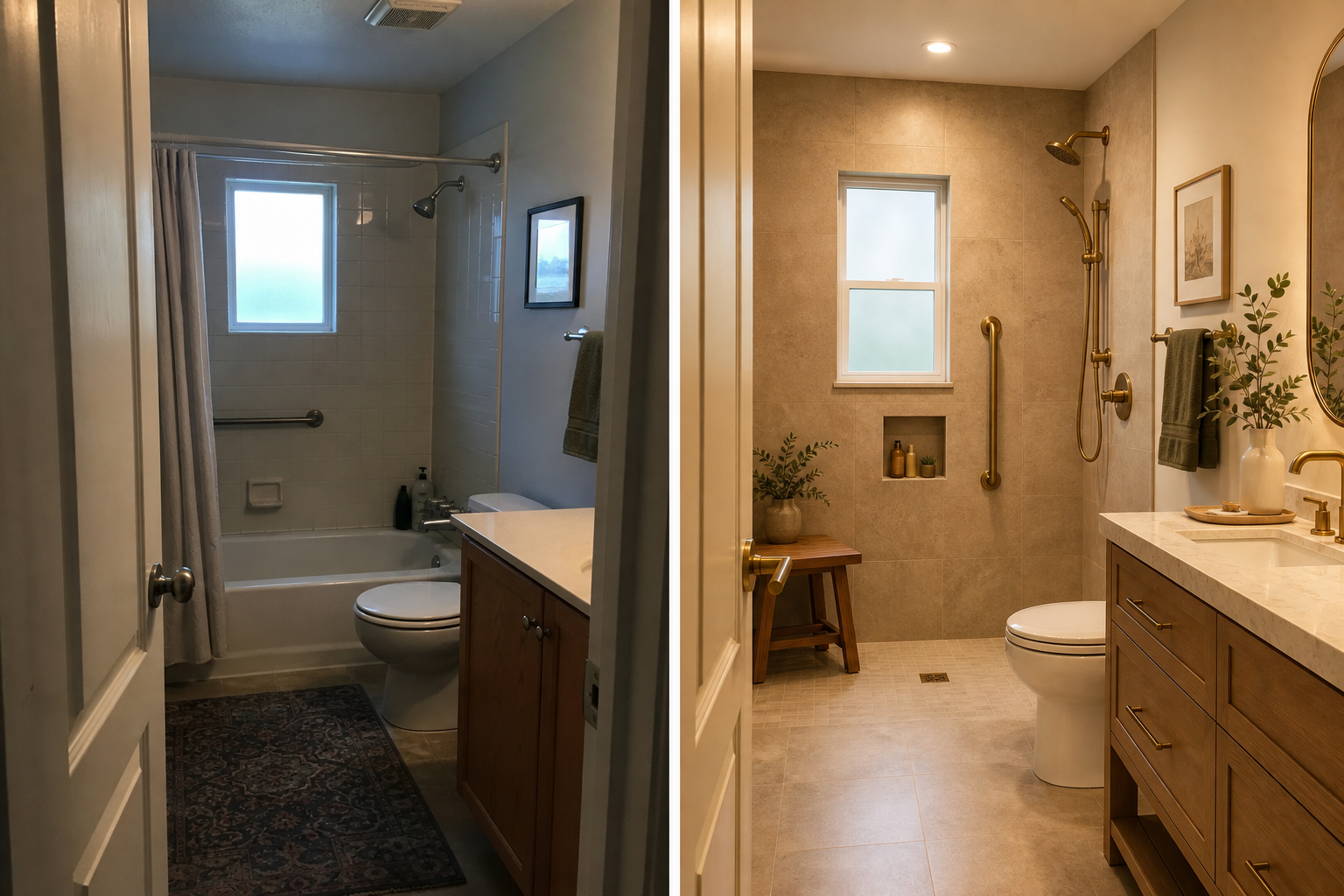
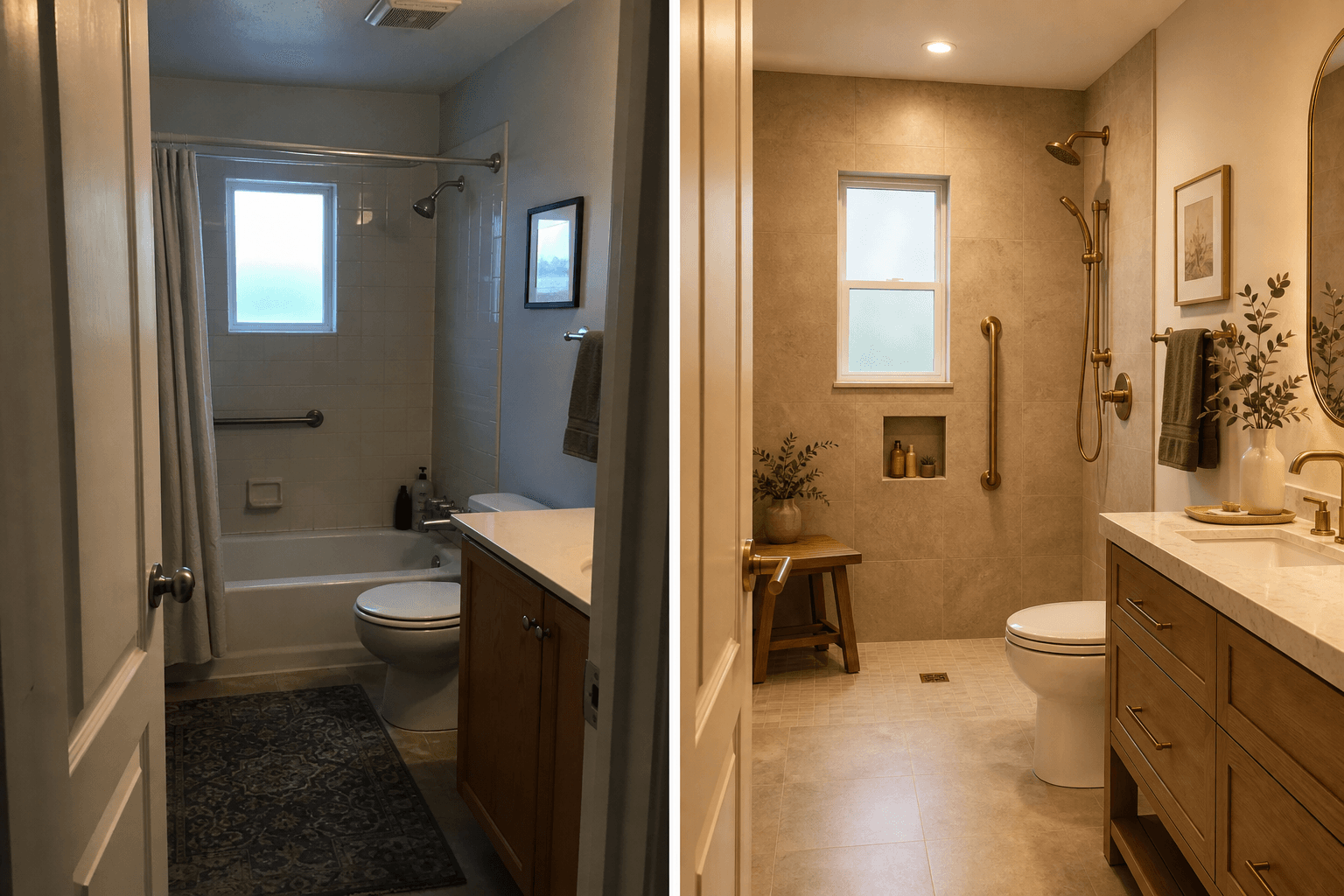
The difference between a standard bathroom and an evidence-based aging-in-place remodel. The right side incorporates the modifications with the strongest research backing: curbless entry, grab bar, lever fixtures, and improved lighting.
What the Research Actually Says About Home Modifications
If you are a family caregiver trying to decide which home renovations are worth the money and disruption, you have likely encountered a flood of conflicting advice. One website tells you to start with the bathroom. Another insists on stair lifts. A contractor recommends a full kitchen overhaul. The noise makes it nearly impossible to separate what actually works from what is merely marketed.
A 2025 systematic review published in Healthcare cuts through that noise. Researchers analyzed 20 studies from Sweden, the UK, Australia, the US, Japan, and Greece, and found that 13 of those 20 studies (65%) confirmed that home modifications are effective for reducing falls, maintaining functional independence, and generating cost savings. That is a strong signal — but the review also revealed a critical condition: effectiveness depends entirely on personalization, correct installation, and ongoing maintenance. A grab bar installed at the wrong height or a ramp built at the wrong slope does not just fail to help; it can create new hazards.
The PRISMA flow diagram from the 2025 systematic review (Cha, Healthcare). Of 3,014 initial records, only 20 studies met the inclusion criteria — underscoring how selective the evidence base for home modifications actually is.
The Strongest Evidence for Fall Prevention
Falls are the most immediate and measurable threat that home modifications aim to address. The evidence here is unusually robust for a non-clinical intervention, with multiple high-quality studies converging on the same conclusion: the right modifications significantly reduce fall risk.
Three Landmark Studies You Should Know
Three of the highest-quality studies on home modifications and fall prevention, drawn from the 2025 systematic review.
Study
Design
Key Finding
Significance
Stark et al. (2017)
Randomized controlled trial (n=300)
39% reduction in falls with 80% modification adherence
Gold-standard RCT evidence; effect size is large for a home-based intervention
Hawkins et al. (2024)
Pre-post intervention (Safe at Home program)
79% of participants reported no falls post-modification; fear of falling significantly reduced
p<0.001; shows both physical and psychological benefits
Hollinghurst et al. (2022)
Population cohort (n=657,536)
Home adaptations reduced fall-related emergency admissions by 3% per quarter
OR=0.97, p<0.001; population-level impact across a large, diverse sample
The Stark et al. 2017 randomized controlled trial is particularly important because it is the gold standard of clinical evidence. The 39% fall reduction was achieved through occupational therapist-led home hazard removal and modification — not a generic checklist. Participants received personalized assessments and modifications tailored to their specific mobility limitations and home layout. The 80% adherence rate tells us that when modifications are correctly matched to the person, people actually use them.
The Hawkins et al. 2024 study adds a critical dimension: fear of falling. Even when a fall does not cause injury, the psychological aftermath — reduced activity, social withdrawal, loss of confidence — can accelerate functional decline. The fact that fear of falling dropped significantly (p<0.001) after the Safe at Home program suggests that modifications restore not just physical safety but also the confidence to remain active.
The Bathroom: Where Most Falls Happen
The National Center for Injury Prevention and Control reports that 35.7% of fall injuries in older adults occur in the bathroom. This single statistic explains why bathroom modifications dominate the research literature. The combination of wet surfaces, hard fixtures, and the need to transfer on and off the toilet or into a tub creates a perfect storm of risk.
A 2021 study by Levine et al. published in Human Factors found that people who had a grab bar in their shower were 75% more likely to keep their balance when stepping from a slippery shower to a dry floor compared to those who did not have one. That is not a subtle effect — it is a fourfold improvement in the ability to prevent a fall during one of the most dangerous transitions in daily life.
How Modifications Reduce Caregiving Burden
For family caregivers — the primary audience of this site — the most personally relevant finding may be the impact on caregiving hours. The Carnemolla and Bridge 2019 study, included in the systematic review, documented that weekly care hours were reduced by 42% after home modifications were installed. Informal care — the unpaid help provided by family members — dropped by 46%.
The mechanism is straightforward but worth stating explicitly: when the home environment supports daily tasks — when a shower has a seat and a hand-held sprayer, when a toilet is at the right height, when a ramp replaces three steps — the older adult can perform more activities independently. Every task that does not require a caregiver's physical assistance is time and energy returned to the caregiver. For an adult child who is also working full-time or managing their own household, a 42% reduction in weekly care hours can mean the difference between sustainable caregiving and burnout.
Quality of Life Improvements You Can Measure
Reducing falls and care hours is important, but the ultimate goal of aging in place is maintaining a life worth living. The Schorderet et al. 2022 study, also part of the systematic review, provides some of the clearest quality-of-life data available:
Bathroom-related difficulties reduced by 93.4% after home adaptations
Overall quality of life improved by 9.8%
Fear of falling decreased by 12.5%
The 93.4% reduction in bathroom difficulties is striking but not surprising. The bathroom is where loss of independence is felt most acutely. Being unable to bathe independently is often the event that triggers a move to assisted living. When modifications restore the ability to shower, use the toilet, and transfer safely without assistance, the psychological impact is profound — it restores dignity and privacy, not just safety.
Lighting is another underappreciated quality-of-life factor. Natalia Pierce, CMKBD, notes that once we are over age 50, we require 50% more lighting to see as well as a younger person. She also points out that flat recessed pot lights can lose 50% to 70% of their light output by the time the light reaches a counter or tabletop. This means that a kitchen that felt adequately lit at age 45 may be dangerously dim at age 70 — increasing fall risk and making daily tasks like reading medication labels or cooking more difficult.
The Cost-Effectiveness Case: Why Modifications Pay for Themselves
Home modifications require upfront investment, and for many families, cost is the primary barrier. The evidence, however, suggests that modifications are not just effective — they are remarkably cost-effective compared to the alternatives.
The QALY Evidence
The Wilson et al. 2017 cost-utility analysis, cited in the systematic review, calculated the cost per quality-adjusted life year (QALY) for home modifications at NZD $5,480. In health economics, anything under NZD $50,000 per QALY is considered highly cost-effective. By that standard, home modifications are an extraordinary value — comparable to or better than many medical interventions that are routinely covered by insurance.
Comparing Costs: Modification vs. The Alternatives
Cost comparison of common home modifications versus facility-based care. Even a $15,000 bathroom remodel is a fraction of one year of assisted living.
Option
Typical Cost Range
Notes
Grab bars (installed)
$130–$460 per bar
NerdWallet Jan 2026: $30–$60 per bar + $100–$400 installation
Walk-in shower (custom)
$6,000–$12,000
NerdWallet Jan 2026; prefab options under $1,000
Stair lift
$2,300–$24,000
NerdWallet Jan 2026; average $7,000
Wheelchair ramp
$1,100–$3,600
NerdWallet Jan 2026; average $2,300
Universal design bathroom remodel
10–25% premium over standard
Custom Home 2025; ROI ~61% (2025 Cost vs. Value Report)
Assisted living (annual)
$88,200/year
Genworth 2024 (California); national median lower but still substantial
Nursing home (semi-private, annual)
$140,343–$182,135/year
Genworth 2024 (California)
The 2025 Cost vs. Value Report found that a universal design bathroom remodel has an ROI of approximately 61% — meaning that even if you sell the home, you recover more than half the investment. Compare that to the zero return on assisted living payments, and the financial case becomes even clearer.
What Works for Cognitive Decline: Modifications for Dementia Care
Home modifications for someone with dementia or another form of cognitive decline require a different approach than modifications for someone with purely physical limitations. The Yeni et al. 2022 study, included in the systematic review, provides the strongest evidence in this area: nurse-led home modifications significantly reduced falls in dementia patients (p=0.002). The study also found that gradual adjustments were preferred over abrupt changes.
This last point is crucial for caregivers. A person with dementia may become confused or agitated by sudden changes to their environment. A new grab bar in a different color than the wall might go unnoticed, but a completely remodeled bathroom with different fixtures, different tile, and a different layout can be disorienting. The evidence supports making changes incrementally and, where possible, maintaining visual cues that the person recognizes.
The broader context is sobering: the systematic review cites U.S. Census Bureau data showing that only 10% of American homes are adequately designed for aging populations. For the growing number of families caring for someone with dementia at home, this gap between need and existing housing stock represents a significant public health challenge.
What the Evidence Doesn't Yet Support: Smart Home Technology
Smart home technology — motion sensors, automatic lighting, voice-activated controls, medical alert systems — is frequently promoted as the future of aging in place. The 2025 systematic review, however, is honest about the current state of the evidence: smart home technology effectiveness still needs more research. The existing studies are too small, too short, or too heterogeneous to draw firm conclusions.
This does not mean smart technology has no value. Motion-sensor lighting can reduce fall risk during nighttime bathroom trips. Medical alert systems can provide peace of mind for family caregivers. But the evidence base for these technologies is not yet comparable to the evidence for grab bars, bathroom modifications, and stair railings.
Motion-sensor night lights: Low cost, low risk, and plausible benefit — but no large RCTs confirm fall reduction.
Automatic fall detection (wearables and sensors): Promising but high false-alarm rates in some studies; evidence is still emerging.
Voice-activated controls (lights, thermostats, doors): Convenient, but no direct evidence of fall prevention or independence maintenance.
Passive home monitoring systems: Useful for long-distance caregivers, but privacy and consent concerns remain unresolved, especially for cognitively impaired individuals.
5 Modifications to Start With Based on the Strongest Evidence
Based on the research synthesized above, here are the five modifications with the strongest evidence backing. If you are working with a limited budget or want to start with the highest-impact changes, begin here.
Grab bars in the bathroom. The Levine et al. 2021 study found a 75% improvement in balance during shower-to-floor transitions. Install them at the shower entry, next to the toilet, and inside the shower. Ensure walls have blocking that can support 250–300 pounds. Professional installation by a CAPS-certified contractor is strongly recommended.
Bathroom modifications: curbless shower, comfort-height toilet, non-slip flooring. Schorderet et al. 2022 found a 93.4% reduction in bathroom difficulties after adaptations. A curbless shower eliminates the step-over hazard. A toilet at 17–19 inches (comfort height) reduces fall risk during transfers. Non-slip flooring (vinyl, cork, rubber) provides stable footing even when wet.
Stair railings and improved lighting. The 50% increase in lighting needs after age 50 (Pierce, The Spruce) means that stairs, hallways, and entryways are often dangerously dim. Install handrails on both sides of staircases. Add motion-sensor lights in hallways and bathrooms. Replace recessed pot lights with fixtures that direct light downward.
Entryway ramps and widened doorways. The NAHB CAPS checklist recommends 36-inch wide hallways and 36-inch doors (32-inch clear width). Ramps at entry points eliminate the fall risk of steps. These modifications also future-proof the home for wheelchair or walker use.
Personalized OT-led home hazard removal. The Stark et al. 2017 RCT achieved a 39% fall reduction through occupational therapist-led assessment and modification. This is not a DIY checklist — it is a professional evaluation of the specific person's mobility, strength, balance, and daily routines, matched to their specific home environment.
The evidence is clear: home modifications work. They reduce falls, cut caregiving hours, improve quality of life, and are highly cost-effective. But they only work when they are personalized, professionally installed, and maintained over time. Use the research summarized here to make informed decisions — and always consult with a qualified professional before starting any modification project.


Comments
Join the discussion with an anonymous comment.