
Room checklist
How to Pay for a Senior Bathroom Remodel: Grants, Loans, and Assistance Programs in 2026
A practical guide for family caregivers and older adults on fixed incomes who need bathroom safety modifications but are blocked by cost. Covers federal grants (USDA, VA), state Medicaid waivers, nonprofit programs, HUD loans, and tax deductions — with step-by-step application guidance and scam warnings.
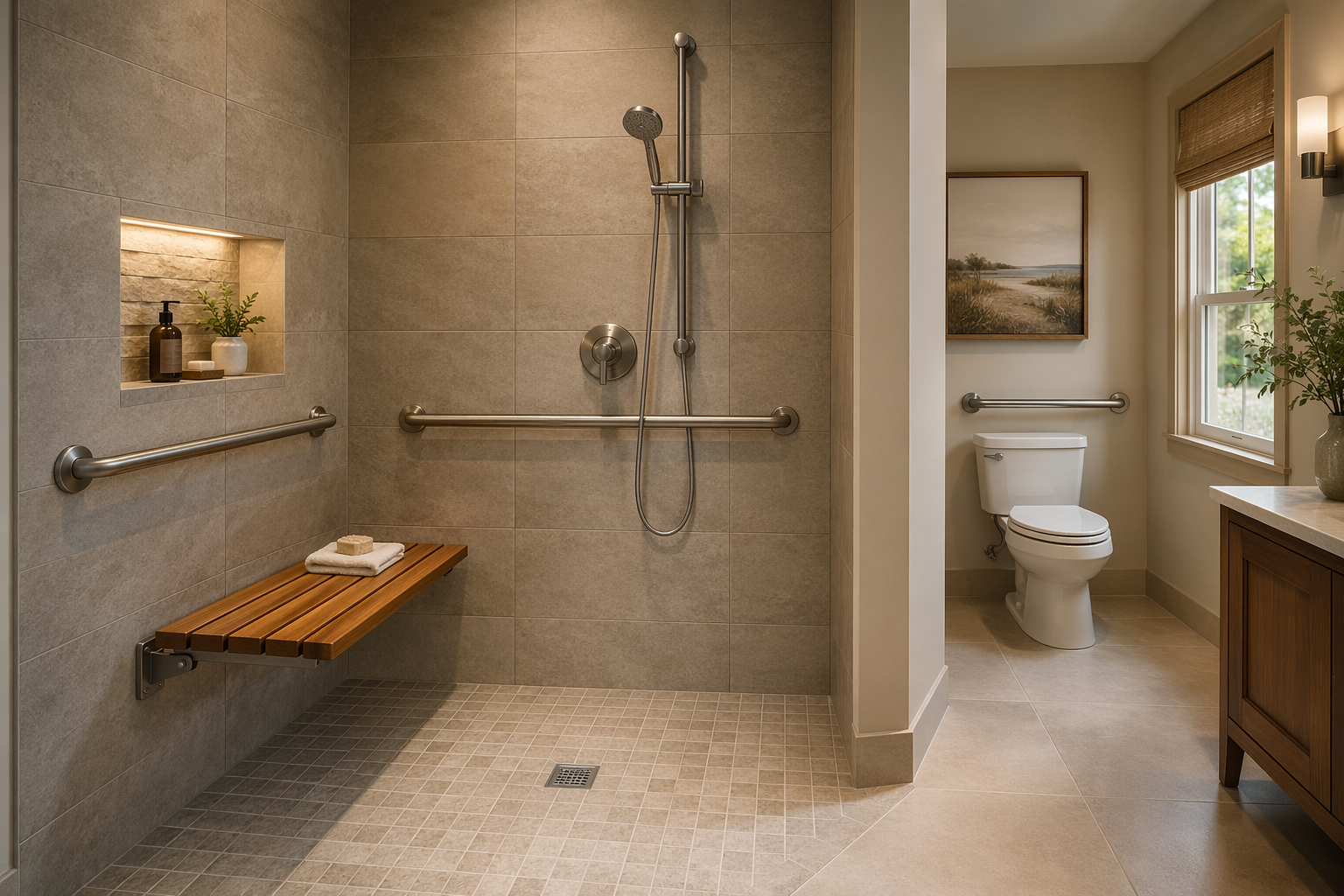
The Cost Barrier: What a Senior Bathroom Remodel Actually Costs in 2026
Before exploring funding options, it helps to understand the price range you are working with. Bathroom modification costs vary widely by region, scope, and contractor rates, but national averages from 2025–2026 sources give a useful baseline. The table below breaks down common modifications for a senior bathroom.
| Modification | National Cost Range (2025–2026) | Typical Lifespan |
|---|---|---|
| Grab bar installation (per bar, installed) | $200 – $600 | 10+ years |
| Comfort-height toilet (17–19 inch seat) | $300 – $1,200 | 10–15 years |
| Non-slip flooring (vinyl or tile, 40 sq ft) | $6,400 – $11,000 | 15–20 years |
| Walk-in tub | $2,000 – $20,000 | 15–20 years |
| Tub-to-shower conversion (curbless) | $3,000 – $15,000 | 15–20 years |
| Full bathroom remodel (senior-friendly) | $8,000 – $25,000 | 15–20 years |
To put these costs in perspective, consider the alternative. A $25,000 bathroom renovation that enables a parent to stay home independently for five additional years offsets an estimated $240,000–$480,000 in assisted living costs, according to industry analysis. The upfront investment is significant, but the long-term savings — both financial and emotional — are substantial.
If you are still deciding which modifications to prioritize, our room-by-room safety checklist and priority guide can help you plan a phased approach that matches your budget.
What Medicare Does and Doesn't Cover for Bathroom Modifications
This is the most common misconception we encounter. Original Medicare (Part B) covers 80% of the cost of grab bars — but only when a physician prescribes them as Durable Medical Equipment (DME) and the installation is deemed medically necessary. That is the extent of Medicare's bathroom modification coverage.
What Medicare does not cover:
- Structural modifications such as walk-in tubs, curbless showers, or widened doorways
- Non-slip flooring, comfort-height toilets, or lighting upgrades
- Labor costs for any modification not classified as DME
- Any modification deemed "elective" or for convenience rather than medical necessity
Because Medicare's coverage is so narrow, most families need to layer other funding sources to cover the full scope of a bathroom remodel. The programs below fill that gap.
Federal Programs: USDA, VA, and HUD Options
Three federal agencies offer the most substantial funding for bathroom modifications. Each serves a different population and has distinct eligibility rules. The table below provides a side-by-side comparison.
| Program | Who It Serves | Maximum Assistance (2026) | Key Details |
|---|---|---|---|
| USDA Section 504 Grant | Very-low-income homeowners age 62+ in rural areas | $10,000 (up to $15,000 in disaster areas) | Does not require repayment if home not sold within 3 years. Can be combined with a loan for up to $50,000 total. |
| USDA Section 504 Loan | Very-low-income homeowners in rural areas | $40,000 at 1% fixed for 20 years | Must be unable to obtain affordable credit elsewhere. Can be combined with grant. |
| VA Specially Adapted Housing (SAH) Grant | Veterans with specific severe service-connected disabilities | $117,014 (2026 adjusted) | For construction, purchase, or modification of an adapted home. Requires qualifying disability rating. |
| VA Home Improvements and Structural Alterations (HISA) Grant | Veterans with service-connected or non-service-connected disabilities | $6,800 (non-service-connected); higher for service-connected | Can be used in rentals or family members' homes. Covers bathroom modifications, ramps, doorway widening. |
| HUD Title 1 Property Improvement Loan | Homeowners regardless of age or income | Varies by property type (secured or unsecured) | Can be used for remodeling, repairs, or improvements. Loan amounts depend on property value. |
| HUD 203(k) Rehabilitation Mortgage | Homebuyers or owners financing a mortgage | Up to $35,000 financed into mortgage | Combines purchase price and renovation costs into one mortgage. Requires a mortgage. |
The USDA Section 504 program is particularly valuable for seniors on fixed incomes because the grant portion does not require repayment as long as you live in the home for at least three years after receiving the funds. If you sell the home within three years, the grant must be repaid. The loan portion carries a fixed 1% interest rate over 20 years — far below commercial rates.
For veterans, the HISA grant is often the most accessible option because it does not require a severe service-connected disability — it covers veterans with non-service-connected disabilities as well, up to $6,800. The SAH grant is more substantial but requires a specific, severe disability rating from the VA.
State Programs: Medicaid HCBS Waivers and Area Agencies on Aging
Medicaid Home and Community-Based Services (HCBS) waivers are one of the most underutilized funding sources for bathroom modifications. These waivers allow states to use Medicaid funds to pay for home modifications that enable seniors to remain in their homes rather than entering nursing facilities.
What HCBS waivers can cover:
- Full bathroom accessibility retrofits, including roll-in showers, grab bars, and widened doorways
- Ramp installation and stairlifts
- Any modification deemed necessary to avoid institutionalization
The Money Follows the Person (MFP) program, a related federal-state initiative, provides financial support for home modifications when a senior transitions from a nursing home back to community living. This can include bathroom modifications, ramps, stairlifts, and doorway widening.
Nonprofit Programs: Rebuilding Together and Habitat for Humanity
When federal and state programs are not an option, national nonprofits can fill the gap — often at no cost to the homeowner.
Rebuilding Together is a national nonprofit that provides home repairs at no cost to eligible homeowners, with a focus on health and safety hazards. Many of their projects serve seniors and people with disabilities. They use volunteer labor and donated materials to complete modifications such as grab bar installation, non-slip flooring, and bathroom accessibility upgrades. To apply, contact your local Rebuilding Together affiliate — eligibility is typically based on income, age, and homeownership status.
Habitat for Humanity's Aging-in-Place program offers a different model: homeowners contribute "sweat equity" (volunteer hours) and pay a reduced cost for modifications. Habitat affiliates in many communities now offer bathroom safety modifications, ramp construction, and other accessibility improvements.
For a detailed comparison of these two programs — including eligibility, costs, and how to choose between them — see our guide: Habitat for Humanity Aging in Place vs. Other Senior Home Repair Programs.
Tax Deductions for Medically Prescribed Modifications
If you itemize deductions on your federal income tax return, medically prescribed home modifications may qualify as deductible medical expenses under IRS rules. The threshold: medical expenses exceeding 7.5% of your Adjusted Gross Income (AGI) can be deducted.
Which modifications typically qualify:
- Grab bars installed with a physician's prescription
- Ramps for wheelchair or walker access
- Walk-in tubs or curbless showers prescribed for a specific medical condition
- Widened doorways to accommodate a wheelchair or walker
- Non-slip flooring when medically necessary to prevent falls
The key requirement is medical necessity. A doctor must document that the modification is needed to treat or manage a specific medical condition. Cosmetic or convenience upgrades — even if they improve safety — generally do not qualify.
How to Apply: A Step-by-Step Guide to Securing Funding
Securing funding for a bathroom remodel requires persistence, but the process is straightforward if you follow these steps in order.
- Assess needs and get a contractor estimate. Before applying for any program, you need a written estimate from a licensed contractor. The estimate should itemize each modification and its cost. If you are working with a CAPS-certified contractor, mention this — some programs look favorably on certified professionals. See our guide: What Does a CAPS Certified Aging-in-Place Contractor Do — and How to Find One.
- Gather income and medical documentation. Most programs require proof of income (tax returns, Social Security statements, pension letters) and medical documentation (physician's prescription, diagnosis, functional assessment). Have these ready before you apply.
- Contact your local Area Agency on Aging. Call 1-800-677-1116 or visit eldercare.acl.gov. Ask about state-specific programs, Medicaid HCBS waivers, and local grant opportunities. This single call can surface funding sources you would not find through online research alone.
- Apply to federal programs through official portals. For USDA Section 504, apply through your local USDA Rural Development office (rd.usda.gov). For VA SAH or HISA, apply through the VA's online portal or your local VA regional office. Never pay a third party to "help" you apply for federal grants — the application process is free.
- Explore nonprofit programs. Contact your local Rebuilding Together affiliate and Habitat for Humanity chapter. Be prepared for waitlists — apply as early as possible.
- Consult a tax professional about deductions. If you have a physician's prescription for the modifications, ask your tax preparer whether the costs exceed the 7.5% AGI threshold and whether itemizing makes sense for your situation.
Remember that bathroom modifications are one component of a broader fall prevention strategy. Our guide on building a complete aging-in-place safety system shows how modifications, community services, and the CDC STEADI model work together to reduce fall risk.
Scam Warnings: How to Avoid Fraud When Seeking Home Repair Funding
Wherever there is a need for funding, scammers follow. The bathroom modification space is no exception. Here is what to watch for.
- Websites or ads claiming "free government money" for home repairs. As USAGov explicitly warns, the federal government does not offer "free money" to individuals for home repairs. Any site promising this is a scam.
- Upfront fees for grant applications. Legitimate federal and state programs do not charge application fees. If someone asks for money to "process" or "guarantee" a grant, walk away.
- Pressure to sign contracts immediately. Scammers often create false urgency — "this grant expires today" or "only three spots left." Legitimate programs have published deadlines and do not use high-pressure tactics.
- Requests for personal financial information over the phone or email. Government agencies will not call you unsolicited to offer home repair funding. If someone calls claiming to be from a federal program, hang up and call the agency directly using the official number from its .gov website.
Related reading
Need a professional assessment?
Find a CAPS-credentialed professional or local aging services through our outbound resource list — we never name or rank individual contractors.
Find Local HelpNoticed something outdated or inaccurate on this page? Flag a correction. We review every report against CDC, NIA, and AARP HomeFit guidance before updating a page.