
Room checklist
Room-by-Room Earthquake Preparedness Checklist for Seniors
A room-by-room earthquake preparedness checklist for caregivers and older adults, built on the same hazard-securing fixes that prevent everyday falls. Each step targets the most common earthquake injuries — falling or flying objects and being knocked to the ground — so one walkthrough of a parent's home covers both fall prevention and seismic readiness.
- Room
- All rooms
- Modification type
- Furniture anchoring
- Reviewed by
- Editorial Team
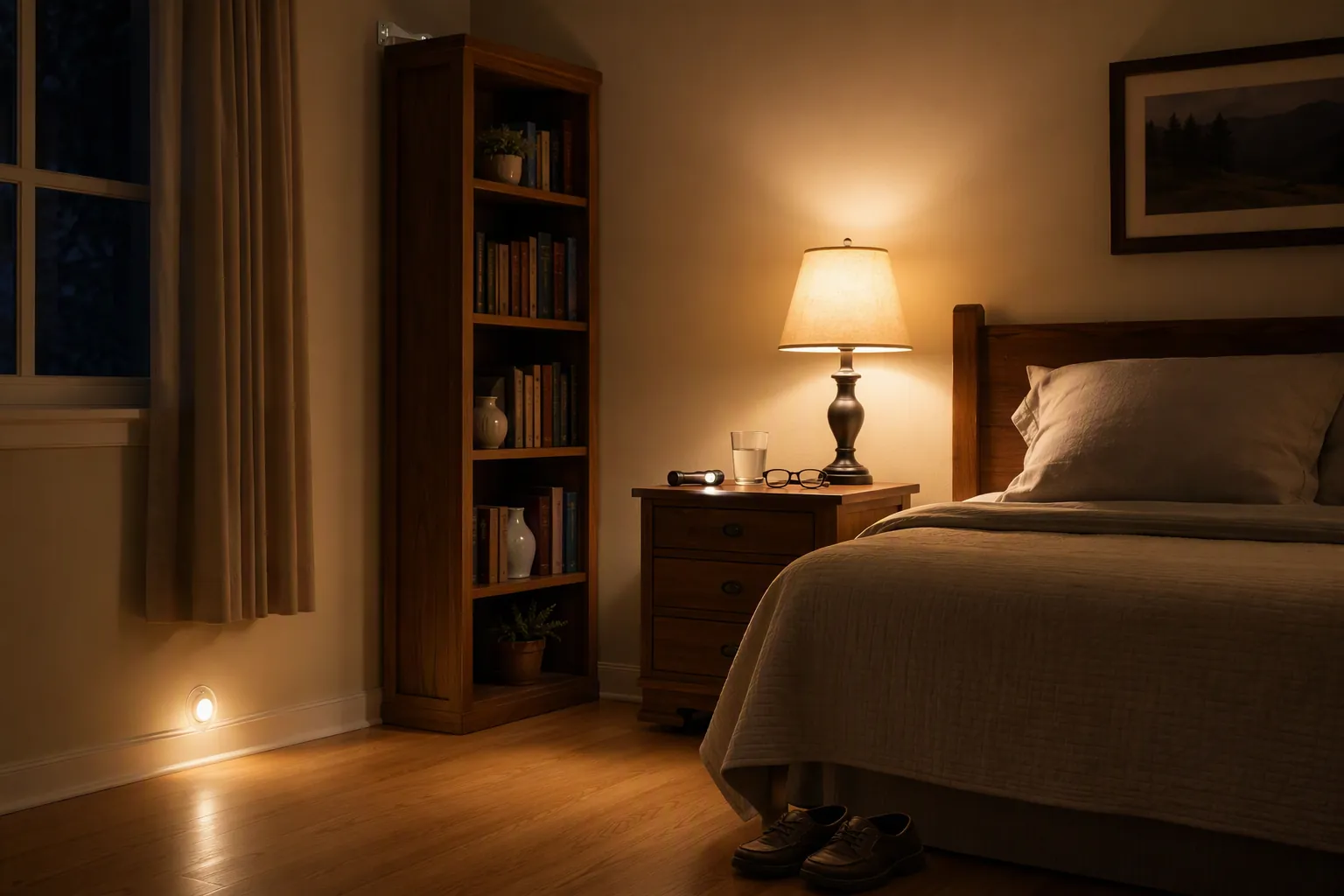
Start at the bedside, not with the emergency bin in the garage. If an older parent wakes up to shaking at 2 a.m., the first dangers are close: the bookcase beside the bed, the lamp cord across the path, the framed print over the headboard, the shoes tucked too far under the dresser, the glasses that may slide off the nightstand. That same bedroom walk-through is already familiar to anyone doing fall prevention at home. Earthquake preparedness for older adults simply raises the stakes.
The CDC’s earthquake guidance explains why this overlap matters: most earthquake-related injuries and deaths come from falling or flying objects or from being knocked to the ground.[1] For an older adult who uses a cane, walker, glasses, oxygen tubing, nighttime bathroom trips, or steady furniture for balance, those are not abstract hazards. They are the same objects and pathways that determine whether the person can stand, orient, and move after the shaking stops.
So this elderly earthquake preparedness checklist is built as a room-by-room home modification pass. Secure the space first. Then stock the kits. The point is not to make a perfect disaster room in one weekend; it is to remove one credible injury source after another before the room is tested.
This article is general home-safety education, not medical, legal, financial, structural-engineering, or emergency-management advice. If your parent has medical equipment, mobility restrictions, cognitive changes, rented housing limits, or gas/electrical concerns, confirm the plan with qualified local professionals and emergency authorities.
The whole-home pass before you slow down room by room
A useful first pass is not complicated. Walk the home at the height and speed your parent actually uses it: sitting on the bed, rising from a recliner, turning with a walker, reaching into cabinets, walking to the bathroom in low light. Then mark anything that can fall, slide, shatter, block a route, or remove a handhold.
| Check | What to do | Why it matters for older adults |
|---|---|---|
| Tall or heavy furniture | Anchor bookcases, dressers, cabinets, and entertainment units to wall studs. | A falling unit can injure someone directly or block the route to a door, bathroom, walker, or phone. |
| Televisions and appliances | Secure televisions, refrigerators, and heavy appliances so they cannot tip or slide. | Ready.gov includes heavy items such as bookcases, refrigerators, water heaters, televisions, and wall hangings among items to secure before an earthquake.[3] |
| High shelves | Move heavy and breakable objects to lower shelves or drawers. | Lower storage reduces the chance of impact injuries and broken glass across walking paths. |
| Cabinets | Install latches on cabinets that hold glassware, dishes, food jars, medication, cleaning products, or heavy cookware. | A latched cabinet is less likely to spill dangerous contents into the room. |
| Beds, sofas, and chairs | Move tall furniture, heavy wall art, mirrors, and shelves away from where someone sleeps or sits. | The safest furniture anchor still should not be asked to protect a person from a heavy object placed directly overhead. |
| Walking paths | Keep routes from bed to bathroom, bed to door, recliner to phone, and kitchen to exit free of clutter and cords. | After shaking, those paths may contain displaced furniture or broken items; they should start as clear as possible. |
| Lighting | Add nightlights or plug-in security lights, especially near beds, bathrooms, stairs, entries, and medical equipment. | Low vision, sudden waking, and floor debris make darkness a fall risk multiplier. |
| Mobility and sensory aids | Keep glasses, hearing aids, cane, walker, flashlight, shoes, and whistle where they can be reached without crossing the room. | The first safe movement after shaking may be simply sitting up, seeing, calling, and protecting the feet. |
The Earthquake Country Alliance’s “Secure Your Space” guidance, shared by CUSEC, is useful because it stays at this level of action: move bookcases away from beds and sofas, move heavy objects down, strap water heaters, latch cabinets, use closed hooks for hanging items, use museum putty for fragile objects, and secure at least one item every weekend.[2] CUSEC also repeats a commonly cited UCLA finding that, in the 1994 Northridge earthquake, 55% of injuries were from falling furniture or objects and 1% were from building damage; because the original study is not linked there, treat the figure as an attributed CUSEC/ECA claim rather than the main proof for the checklist.[2]
Bedroom: protect the first 10 feet of movement
The bedroom deserves more attention than almost any other room because it combines sleep, darkness, glasses off, shoes off, slower reaction time, and the first stand after shaking. The goal is not just “nothing falls on the bed.” The goal is that an older adult can sit up, cover their head and neck, wait, put on shoes, find glasses and a light, and reach the bathroom or phone without stepping into predictable hazards.
- Move tall furniture away from the bed. Bookcases, armoires, tall dressers, storage towers, and heavy shelving do not belong beside or behind the bed if they can fall toward the sleeper. If there is no better location, anchor them securely to studs and remove heavy objects from the upper shelves.[2]
- Take heavy wall items off the sleep zone. Mirrors, framed art, floating shelves, plants, clocks, and decorative plates over the headboard should be moved or secured with hardware appropriate to their weight. Use closed hooks where hanging items remain.[2]
- Clear the bed-to-bathroom path. Remove loose rugs, laundry baskets, storage bins, footstools, charging cords, and furniture corners that make a walker turn tight. This is the same route to inspect in a rainy-day home safety checklist, because water, darkness, and shaking all punish cluttered paths.
- Keep sturdy shoes within arm’s reach of the bed. They should not be under a dresser or across the room. Broken glass is common enough in earthquakes that the Red Cross includes sturdy shoes in its older-adult Bed-Kit guidance.[4]
- Place glasses, flashlight, whistle, phone, hearing aids, and a dust mask on a stable bedside surface. If the nightstand has open shelves, do not store glass or heavy items high enough to spill into the path.
- Add low, reliable lighting. A nightlight near the bed and bathroom path matters more than a bright lamp across the room. The California Department of Aging recommends one plug-in security light per room with 4–6 hours of lighting capacity.[5]
- Check the walker parking spot. A walker parked too far away is not an aid; it is a post-earthquake trip across debris. Keep the primary walking aid reachable from the bed, and plan a backup if the first one is blocked.
If your parent uses a CPAP, oxygen concentrator, hospital bed, lift chair, or other powered equipment, do not bury its cord path under temporary fixes. Secure nearby furniture and lighting, then make sure the equipment can still be reached and disconnected safely if local guidance requires evacuation.
Living room: anchor what people sit under, beside, and across from
Living rooms often look safer than bedrooms because they are brighter and more open. Then you notice the television on a narrow console, the bookcase behind the recliner, the ceramic lamp beside the sofa, the glass coffee table in the turning space, and the basket that narrows the walker route. A seated older adult may not be able to move quickly away from any of it.
- Anchor bookcases, curio cabinets, entertainment centers, and freestanding shelves to wall studs. Do not rely on the weight of the furniture or the fact that it has “never moved before.”
- Secure the television. A large television should be strapped or mounted so it cannot slide off a console toward a chair or across the main path. Ready.gov specifically includes televisions among heavy items to secure.[3]
- Move seating out from under tall storage and heavy wall decor. The favorite recliner is often the real center of the home; treat the space around it the way you treat the bed.
- Lower the weight. Books, ceramic pieces, photo albums, speakers, vases, and display items should be moved down, secured with museum putty where appropriate, or removed from unstable shelves.[2]
- Replace sharp or unstable furniture in mobility routes. A glass coffee table, lightweight plant stand, wheeled side table, or narrow console can become both a falling object and a fall obstacle.
- Keep a reachable light, phone, and whistle near the main chair. If your parent spends evenings in the living room, the bedside plan needs a living-room version.
For distant caregivers, a video call can catch some of this. Ask your parent to sit in the usual chair and slowly turn the phone camera in a full circle. Look upward as well as at the floor. The object that worries you is often not the clutter; it is the heavy thing placed above the place someone actually rests.
Kitchen: assume cabinets will open unless you stop them
The kitchen is where earthquake preparation becomes obvious. Glass, dishes, canned food, small appliances, knives, cleaning products, and medicine bottles are often stored high, close together, and behind doors that swing open easily. For an older adult, the danger is not only being hit during shaking. It is opening a cabinet afterward and having objects tumble out onto feet, hands, or a walker path.
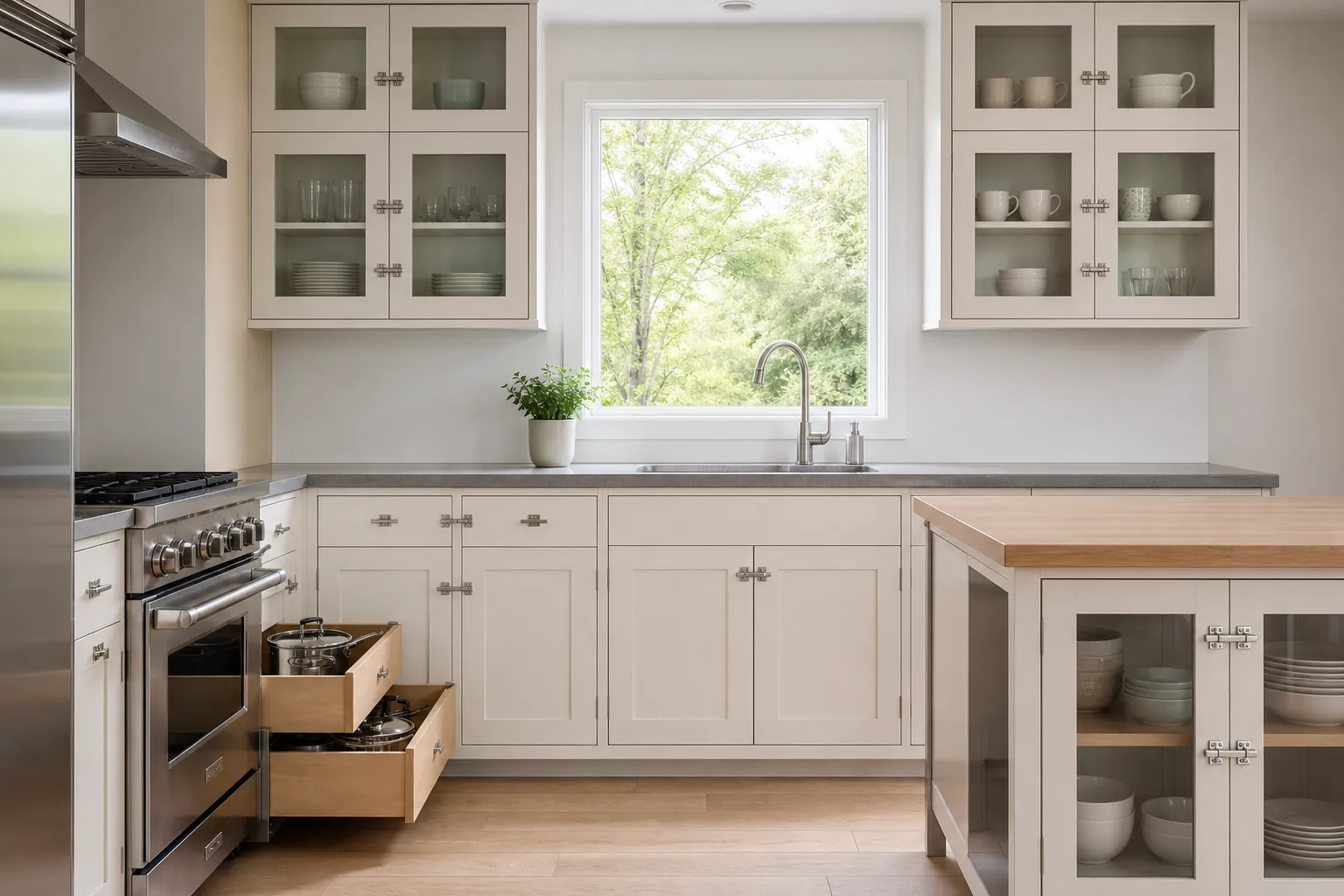
- Install cabinet latches where dishes, glassware, canned goods, oils, cleaning products, or appliances are stored. This is one of the clearest “secure your space” tasks in the ECA/CUSEC guidance.[2]
- Move heavy cookware down. Cast-iron pans, Dutch ovens, stockpots, mixers, slow cookers, and bulk food containers belong in lower drawers or shelves, not above shoulder height.
- Keep breakables low and latched. If glassware must stay in an upper cabinet, use latches and do not stack it loosely near the front edge.
- Clear counter edges. Coffee makers, knife blocks, jars, fruit bowls, air fryers, and decorative ceramics should not sit where a small slide sends them to the floor.
- Secure the refrigerator if it can move or tip. Ready.gov lists refrigerators among heavy items to secure before an earthquake.[3]
- Store a flashlight where it can be reached from the kitchen entrance, not only in a drawer behind a latch. A latched kitchen is safer only if the person can still find light without opening every cabinet.
- Check medicine storage. If medications are kept in the kitchen, move them away from glass shelves and unstable baskets. After shaking, spilled pills can be hard to identify and dangerous to step on, sweep, or accidentally mix.
After latches are installed, rehearse the motion. Arthritic hands, low grip strength, tremor, or vision changes can turn a safety latch into a daily frustration. The right latch is the one that keeps the cabinet closed during shaking and still lets the person use the kitchen safely on an ordinary Tuesday.
Utility spaces: strap the water heater and clear the shutoff area
A utility closet does not look like a fall-prevention room until something shifts into the path, leaks, breaks, or blocks access to a shutoff. The water heater is the priority. CUSEC’s “Secure Your Space” guidance calls for two metal straps around the water heater, secured into wall studs.[2]

- Confirm the water heater has two metal straps, not one loose band or old tape. If you are unsure whether the installation is correct, have a qualified professional inspect it.
- Do not store boxes, tools, mops, or bulk supplies where they block the water heater, electrical panel, gas shutoff, or main water shutoff.
- Move heavy supplies low. Paint cans, detergent jugs, pet food, tools, and emergency water should not be stacked high in a closet where they can fall into the doorway.
- Add lighting. A utility area used during an emergency should not depend on one pull-chain light behind stored items.
- Label shutoffs clearly for the support person, but do not ask an older adult to perform gas, electrical, or structural checks beyond what local authorities and professionals advise.
Bathroom, hallway, stairs, and entry: keep the escape routes boring
These spaces do not need decorative earthquake planning. They need predictable footing, reachable support, and light. If the bedroom, kitchen, and living room are where objects fall, the hallway, bathroom, stairs, and entry are where a shaken older adult may try to move before the home has settled.
Bathroom
- Keep the route from bed to toilet clear every night, not just after cleaning.
- Use secure grab bars where needed; do not count on towel bars, sliding shower doors, or sink edges as emergency handholds.
- Store shampoo bottles, glass jars, scales, and grooming appliances so they cannot scatter across the floor.
- Add a nightlight or plug-in security light where it will not create glare on tile.
- Keep slippers out of the bathroom path unless they have firm backs and non-slip soles. Sturdy shoes are better after shaking because of possible glass or debris.
Hallways and stairs
- Remove hallway tables, baskets, stacked packages, leaning artwork, and loose runners that narrow the path.
- Anchor tall hallway furniture and secure wall hangings that could fall into the walking route.
- Check both sides of stairways for usable rails where possible, strong lighting, and no stored items on steps.
- Put a plug-in security light near stair landings and turns. If power fails, the stair edge should not disappear.
- If your parent uses a walker on one floor and a cane on another, plan where each aid lives after shaking. The California Department of Aging advises keeping walking aids nearby and extra walking aids in different rooms.[5]
Entry and exit area
- Keep the entry free of shoes, umbrellas, packages, plant stands, and decorative objects that can tip into the doorway.
- Store a flashlight near the door, but not in a glass bowl or unstable tray.
- Make sure keys, medical ID, wallet, phone, and mobility aid can be reached without crossing a cluttered room.
- If evacuation may be difficult, connect this checklist with a broader mobility-and-medication disaster plan so personal needs are not improvised at the door.
Now build the kits around where the person actually is
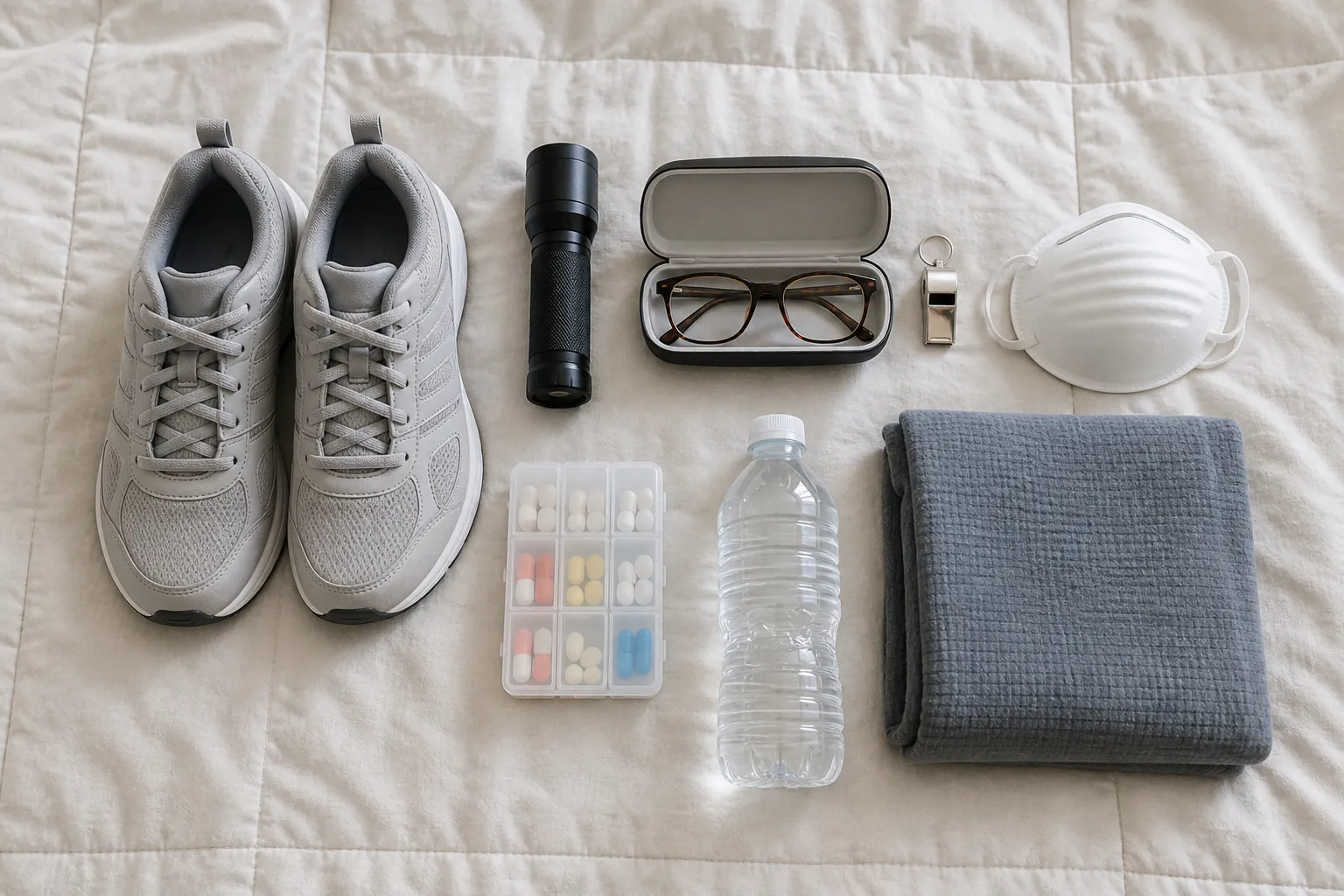
Once the main falling-object hazards are reduced, the emergency supplies make more sense. A kit in the hall closet is useful only if the person can reach it. The Red Cross older-adult preparedness guidance separates supplies into a Bed-Kit, Go-Kit, and Stay-at-Home Kit: the Bed-Kit includes items such as sturdy shoes, flashlight, glasses, dust mask, and whistle; the Go-Kit is built for 3 days; and the Stay-at-Home Kit is built for 2 weeks.[4]
Bed-Kit
- Sturdy shoes that can be put on before standing.
- Flashlight within arm’s reach, with batteries checked on a schedule.
- Eyeglasses in a case or a backup pair.
- Whistle for calling for help if voice volume is limited or doors are blocked.
- Dust mask.
- Phone, charger, and any hearing-aid or device supplies that can safely stay bedside.
- A reachable walking aid, plus a plan for a backup in another room if the primary aid is blocked.[5]
Go-Kit
The Go-Kit is the bag or container used if the person must leave. For older adults, it should not be so heavy that it creates another fall risk. Include copies of key documents, medication list, emergency contacts, water, food, flashlight, phone power, hygiene items, spare glasses, hearing-aid supplies if used, and mobility-related supplies. The Red Cross frames this as a 3-day kit.[4] The California Department of Aging also tells older adults to prepare to be self-sufficient for 3 days.[5]
Stay-at-Home Kit
The Stay-at-Home Kit covers the possibility that leaving is not safe or services are interrupted. The Red Cross describes this as a 2-week supply.[4] This is where supplies for hydration, food, sanitation, lighting, communication, backup power needs, and medical-device routines belong. If power loss would affect oxygen, refrigeration, charging, or stair access, connect the plan with a 72-hour power outage safety checklist rather than treating the earthquake kit as a separate pile of supplies.
Medication supply: use a source-attributed range, not one magic number
Medication guidance varies by authority. The Red Cross recommends a 30-day supply of prescription medication for older adults when possible.[4] NCOA advises keeping at least a 2-week supply of prescription medications and medical supplies.[6] The California Department of Aging includes extra medications with emergency supplies and separately references a 10-day supply in its disaster tip materials.[5] For a real household, the safest answer depends on refill rules, insurance limits, temperature needs, controlled-substance restrictions, prescriber advice, and whether the medication can be rotated before it expires.
Do not leave medication planning as “Mom knows where it is.” Keep an updated medication list in the kit, store emergency medication where it will not be crushed or scattered by cabinet contents, and make sure the support person knows what exists and what must stay cold.
The support network is part of the checklist, not a phone tree
Physical fixes are satisfying because you can see the strap, the latch, the clear floor. But older adults also need a person plan. Ready.gov’s older-adult guidance tells people to create a support network and identify someone with an extra key who knows where emergency supplies are kept and how to use lifesaving equipment.[7]
- Choose at least one nearby support person who can check in after shaking if phones are unreliable.
- Give that person a key or another legal, agreed-upon way to enter.
- Show them where the Bed-Kit, Go-Kit, Stay-at-Home Kit, medication list, shutoff labels, walker backup, and medical-equipment instructions are kept.
- Write down what your parent can and cannot safely do alone: get to the floor, crawl, stand from the floor, use stairs, carry a bag, turn off equipment, or leave without assistance.
- For distant caregivers, schedule a short video walk-through after any furniture rearrangement, new appliance, new mobility aid, or change in vision, balance, or medication.
This is also where neighbors matter. A support person does not need to manage the whole disaster. They need to know enough to check the real risks: whether your parent fell, whether the walker is reachable, whether glass blocks the bathroom path, whether medication spilled, and whether medical equipment is still working.
During shaking and the first minutes after
The room-by-room work happens before shaking because decision-making during shaking is limited. Standard guidance is to drop, cover, and hold on. The CDC adds an important adaptation for people who cannot get to the floor: get as low as possible, cover the head and neck, and hold on until shaking stops.[1]
- If in bed, stay there if it is safer than trying to walk during shaking; cover the head and neck with a pillow if possible.
- If seated in a recliner or chair and unable to get down, lock wheels if applicable, get low if possible, cover the head and neck, and hold on.
- If using a walker, do not try to cross the room while objects are moving. Get as low and stable as possible and protect the head and neck.
- After shaking stops, pause before standing. The Red Cross earthquake guidance advises waiting a minute before getting up because things may still fall.[8]
- Put on sturdy shoes before walking if there may be broken glass or debris.
- Open cabinets carefully. USGS warns that objects may tumble out when cabinets are opened after an earthquake, and it also notes hazards such as spilled medicines.[9]
- If a fall occurred, do not rush the person upright. Check for pain, head impact, confusion, weakness, bleeding, breathing trouble, or inability to bear weight, and use a post-fall warning-sign guide to decide when emergency care is needed.
If getting up from the floor is already difficult, practice the non-emergency plan with a clinician or therapist rather than discovering the problem after a quake. Some families also need a specific lift-assist or neighbor-call plan, similar to the planning used when a parent has a condition that affects transfers or floor recovery.
A weekend-by-weekend version
If the home feels overwhelming, do not start with the garage, the roof, or a shopping list. Start with the places where your parent sleeps, sits, cooks, and walks at night.
- Weekend 1: Move tall furniture and heavy wall items away from the bed and main chair.
- Weekend 2: Anchor the largest bookcase, dresser, cabinet, or television hazard.
- Weekend 3: Clear and light the bed-to-bathroom path.
- Weekend 4: Add cabinet latches in the kitchen and move heavy cookware down.
- Weekend 5: Check the water heater straps and utility-room access.
- Weekend 6: Build the Bed-Kit where the person can reach it.
- Weekend 7: Build or update the Go-Kit and Stay-at-Home Kit.
- Weekend 8: Give the support person a walk-through, a key plan, and the medication and equipment notes.
A safer parent’s home is built object by object, room by room, before shaking starts.
References
- Stay Safe During and After an Earthquake, CDC
- 1. Secure Your Space, CUSEC
- Earthquakes, Ready.gov
- Older Adults Emergency Preparedness, American Red Cross
- Disaster Tip Sheets, California Department of Aging
- Emergency Preparedness 101: What to Do Before, During and After a Disaster, NCOA
- Older Adults, Ready.gov
- Earthquake Safety, American Red Cross
- What do I do after an earthquake?, USGS
Related reading
Need a professional assessment?
Find a CAPS-credentialed professional or local aging services through our outbound resource list — we never name or rank individual contractors.
Find Local HelpNoticed something outdated or inaccurate on this page? Flag a correction. We review every report against CDC, NIA, and AARP HomeFit guidance before updating a page.