
Room checklist
Room-by-Room Extreme Heat Safety Tips for Seniors
Most heat-related deaths among older adults happen indoors, where "stay cool" is too vague to act on. This room-by-room checklist converts it into checkable home targets — evidence-based indoor temperature limits, window and fan rules, and AC guidance for auditing a senior's home before or during a heat wave.
- Room
- all rooms
- Reviewed by
- Editorial Team
When you walk into a parent’s home before a summer heat wave, the first useful question is not “Do you feel cool enough?” It is “What does this room read right now, and what will it read at 4 p.m.?” Extreme heat safety tips for seniors in summer have to start indoors because the dangerous room is often ordinary-looking: a sunny living room, a bedroom with the door closed, a kitchen that has been warmed by cooking, or an upstairs room that never releases the day’s heat.
The reason to be this concrete is not fussy household management. In the 2021 British Columbia heat event, Health Canada reports that 98% of heat-related deaths occurred indoors and 90% of those who died were age 60 or older; across studied North American and European cities, 54% to 98% of heat deaths occurred at home.[1] That changes the walkthrough. Shade outdoors matters, but the room thermometer on the side table may matter more.
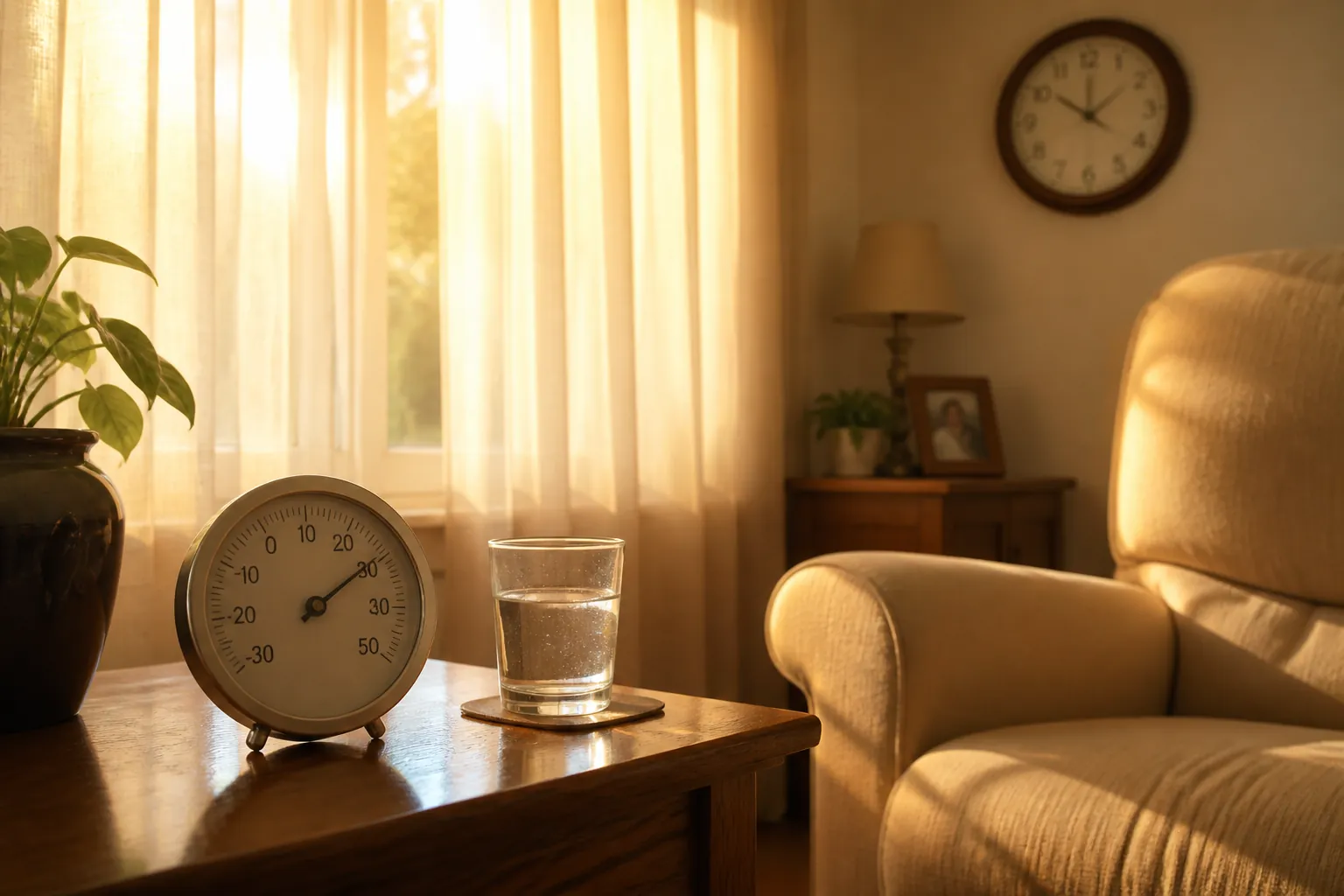
Start with numbers, not comfort language
Buy two or three inexpensive room thermometers before the heat wave if the home does not already have them. Put one in the main daytime room, one in the sleeping area, and one in the room most likely to become the fallback cooling space. Do not rely on the hallway thermostat alone; it may not reflect the bedroom behind a closed door or the west-facing room where the sun sits all afternoon.
Health Canada’s June 2026 guidance gives a strong reference point for this audit: for adults 60 and older, it identifies 26°C, or about 78.8°F, as an evidence-based upper indoor temperature limit, with risk increasing as indoor temperatures rise above 31°C, or about 88°F. It also warns that sustained exposure between 26°C and 31°C can be especially concerning overnight, when the body should be recovering from daytime heat.[1]
For U.S. households, treat that 78.8°F figure as a science-based Canadian federal reference, not as a U.S. legal rule. It is still a practical line to put on the clipboard because it tells a caregiver when the home plan is no longer just uncomfortable — it is drifting out of the range public-health guidance is trying to protect.
| What you see on the room thermometer | How to read it during a senior home heat audit |
|---|---|
| Near 78°F to 79°F in living areas | This is the neighborhood of Health Canada’s 26°C / 78.8°F upper indoor reference for adults 60+ and AARP’s living-space guidance of 78°F. Keep checking sun-exposed rooms, especially late afternoon.[1][2] |
| Above the mid-70s overnight | Do not dismiss this because it is cooler than daytime. Duke University climate researchers told PBS NewsHour that overnight lows above 75°F drive “extraordinary” heat illness and mortality because the body does not get relief.[3] |
| Climbing toward 88°F indoors | This is no longer a mild comfort problem. Health Canada describes escalating risk above 31°C / 88°F, particularly for older adults and with sustained exposure.[1] |
| Fan-only cooling in very hot rooms | Fans are conditional tools. WHO says electric fans are useful only when temperatures are below 40°C / 104°F; above that, they heat the body.[4] |
AARP also points readers toward a 78°F setting for living spaces and reports the CDC’s position that air conditioning is the single strongest protective factor against heat-related illness.[2] That does not mean every older adult has a fully air-conditioned house, or that the whole home can be kept at one even temperature. It means the walkthrough should identify the rooms where cooling actually works and the rooms where it only looks like it works.
The quick whole-home pass before you go room by room
Before you start adjusting furniture or arguing about the thermostat, do one pass through the home with the thermometers in mind. The point is to find heat patterns, not to take over the house.
- Find the hottest room after lunch and again in late afternoon.
- Find the coolest usable room, not just the room that feels nicest in the morning.
- Check whether bedroom doors, hallway doors, or unused rooms are trapping heat.
- Look for west- or south-facing windows, thin curtains, skylights, attic-adjacent rooms, and upper floors.
- Ask where the person actually sits, naps, cooks, watches TV, uses the bathroom, and sleeps.
- Write down the reading in each room. A number on paper is easier to act on than a family debate about whether the house “feels okay.”

This is the summer version of a measurable home safety walkthrough. If your family already uses checklists for winter hazards, falls, fire exits, or storm preparation, use the same tone here: observe first, change what is changeable, and decide in advance what number means the plan has failed.
Main daytime room: where the heat wave usually has the longest shift
Start where the older adult spends the most waking hours. In many homes that is the living room, den, recliner area, or kitchen table. Put the thermometer at sitting height, away from direct sun and away from the air conditioner’s immediate blast. You are trying to measure the air the person is living in.
If the room is near 78°F to 79°F and stable, keep watching it through the late afternoon. If it keeps climbing, the next job is not to ask the person to “take it easy.” The next job is to reduce heat gain.
- Close windows during daytime heat if the outdoor air is hotter than the indoor air.
- Close blinds, curtains, or shades on sun-facing windows before the room heats up.
- Move the regular chair out of direct sun, even if it has been “their spot” for years.
- Keep lamps, electronics, and other heat-producing items away from the main seating area when possible.
- If using a window AC unit, check that cool air reaches the actual seating area, not just the doorway.
WHO’s heat guidance supports the basic window rhythm: open windows at night when outdoor air is cooler, and close windows and coverings during the day to keep heat out.[4] The important detail is timing. A shaded room can be made worse by opening windows just because “air should move” when the air outside is hotter than the air inside.
Fans: useful in the right band, unsafe as a pretend air conditioner
A fan deserves its own check because it can make a room feel managed when the thermometer says otherwise. WHO’s rule is the clearest upper boundary: electric fans may help below 40°C / 104°F, but above that they heat the body.[4] The Red Cross gives a more cautious consumer warning, saying electric fans may not prevent heat-related illness when temperatures are in the high 90s and are not a substitute for air conditioning.[5]
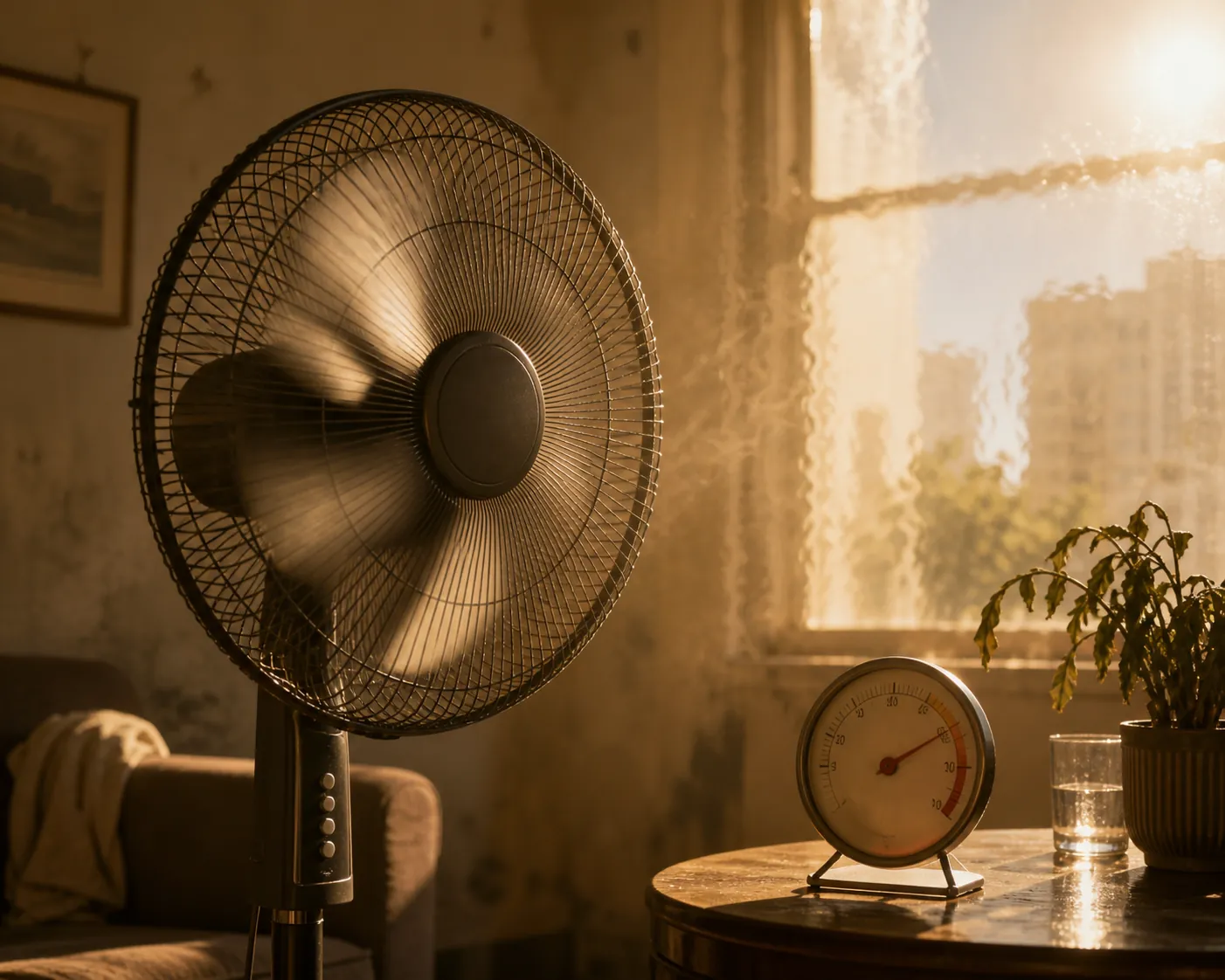
That difference in wording matters. Do not turn “fans can help” into “fans are cooling equipment.” A fan moves air. It does not lower the room temperature. If the room is hot and the person is depending on a fan alone, the audit should become more aggressive: find an air-conditioned room, create a cooler fallback area, or plan to leave for cooler air.
WHO also describes a higher-efficiency strategy when AC is available: setting air conditioning at 27°C / 81°F with a fan can feel about 4°C cooler and may save up to 70% on cooling power.[4] That is different from fan-only cooling. The fan is helping distribute and improve the feel of cooled air; it is not rescuing a dangerously hot room by itself.
Sleeping area: check where the person actually sleeps, not where the thermostat is
For a full bedside temperature discussion, use the site’s guide to AC temperature for seniors at night. For a heat-wave home audit, the first question is simpler: does the sleeping area release heat after sunset?
Put a thermometer in the sleeping room in the evening and check it again before bed. If the room remains above the mid-70s overnight, pay attention. The PBS NewsHour report cites Duke University climate researchers explaining that overnight lows above 75°F are especially dangerous because the body does not get a recovery period.[3]
The practical fix may be unglamorous: move sleep temporarily. A ground-floor room, shaded den, or interior room may be safer than the usual bedroom if that bedroom is upstairs, sun-exposed, or closed off from cooled air. This is not a permanent rearrangement unless the family chooses it; during a heat wave, it is a protective sleeping setup.
- Check the sleeping room temperature in the evening, not only in the morning.
- Keep the bedroom door open if closing it traps heat or blocks cooled air.
- If outdoor air is cooler at night and security allows, ventilate then; close the home again before daytime heat builds.
- Move the bed, recliner, or temporary sleeping surface to the coolest safe room if the usual bedroom does not cool down.
- Do not assume an upstairs room is acceptable because the central thermostat downstairs looks reasonable.
Kitchen: stop adding heat to a house that is already losing the contest
The kitchen can undo a careful cooling plan. The American Geriatrics Society’s Health in Aging Foundation advises older adults not to use the stove or oven to cook on hot days.[6] That one rule is worth putting directly into the heat-wave plan because it changes the room quickly and it is easy to forget at dinnertime.
Before the heat wave, stock foods that do not require baking or long stovetop cooking. During the heat wave, use cold meals, a microwave if it does not overheat the space, or food prepared earlier in the day. If the older adult has strong routines around cooking, keep the conversation practical rather than corrective: “Let’s save the oven meal for the cooler day; this room is already reading too high.”
Bathroom and laundry areas: small rooms can become heat traps
Bathrooms are often treated as quick-use rooms, but heat risk is not only about how long someone plans to be there. A hot shower, poor ventilation, a closed door, and a small room can create a short, intense heat load. During extreme heat, shorten hot showers, use cooler water when acceptable, run ventilation if it removes heat instead of pulling hotter air through the home, and leave the door open afterward if privacy and safety allow.
Laundry deserves the same suspicion. A dryer can warm a back hall or utility room, and that heat may drift toward the bedroom or main sitting area. If laundry can wait, let it wait. If it cannot, run it early, not during the late-afternoon peak.
Hallways, closed rooms, and the false comfort of one good thermostat reading
Closed rooms are easy to miss because no one is sitting in them when you visit. During a heat wave, they still matter. A shut spare bedroom can store heat. An upstairs hallway can stay warm long after the living room has cooled. A room over a garage or under an attic can become the hottest part of the house.
Walk these areas late in the day with the thermometer. If a closed room is much hotter than the rest of the home, decide whether to keep it closed off from the living area or ventilate it at night when outdoor air is cooler. Do not use it as a sleeping or resting room just because it is tidy, quiet, or has the familiar bed.
If the whole home cannot be cooled, build one realistic cool corner
Some homes cannot be brought near the target throughout the whole floor plan. That is not rare. The Center for American Progress notes that Maine has the nation’s highest share of residents age 65 and older, yet only about half of homes there have air conditioning, compared with roughly 90% nationally.[7] “Just use AC” is not a complete safety plan for households that do not have it, cannot afford to run it continuously, or have only one unit in one room.
The fallback is to choose one room that can plausibly stay safest: shaded, lower-level if possible, close to a bathroom, reachable without stairs if mobility is limited, and able to hold a chair or temporary sleeping surface. PBS NewsHour describes the idea of creating a “cool corner” as a more affordable way to concentrate cooling where a person can spend the most dangerous hours.[3]
- Put the best thermometer in this room and record readings during the hottest part of the day.
- Use the best available cooling here first, not in an unused guest room.
- Move medications, phone charger, water, glasses, hearing aids, mobility devices, and a chair into reach.
- Make sure the path to the bathroom is lit, uncluttered, and not routed through the hottest part of the house.
- If the person may sleep there, test the room at night before assuming it is safe.
A cool corner is not a decoration project. It either holds a safer temperature during the dangerous hours or it does not. If it cannot stay near the target range, the plan needs a cooler building, not another fan.
Entry, exit, and transportation: decide before the house fails
The exit plan belongs in the home audit, not in a panic call after the room reaches dangerous temperatures. Write down who can drive, who has a key, whether the older adult can manage stairs in heat, where a walker or cane is kept, and which cooler location is acceptable: a relative’s home, a library, a senior center, a medical facility if symptoms require it, or a public cooling center.
Cooling-center information changes by place, so do not rely on memory from last year. The National Center for Healthy Housing maintains state-by-state cooling-center information and directs people to 211 for local cooling-center help.[8] Put that number and the local link in the written plan before the heat wave arrives.
Power failure deserves a separate line on the clipboard. The Center for American Progress cites modeling of a five-day Phoenix blackout during extreme heat that projected about 13,000 deaths and estimated that half of residents would need emergency-room care.[7] Those are modeled outcomes, not observed deaths, but they show why a cooling plan that depends entirely on powered equipment needs a backup destination.
What not to spend this walkthrough on
Do not let this room-by-room audit become a general lecture on summer safety. Hydration, medication questions, heat exhaustion symptoms, and when to call 911 matter, but they belong in a crisis checklist. If cooling measures fail or symptoms appear, move to the site’s Heat Safety Checklist for Seniors During a Heat Advisory rather than trying to solve a medical emergency by adjusting curtains.
The same goes for outdoor exertion advice. It is sensible to avoid heat, sun, and unnecessary trips, but this walkthrough is about the place where many older adults are exposed for the longest time: home.
The escalation line
Keep adjusting the house only while the numbers say the house is responding. The plan changes when a safe room cannot stay near the target, overnight temperatures do not drop, the home is moving toward the high-risk range, fan-only cooling is being used in dangerously hot conditions, or the power fails.
At that point, the task is no longer to make the house feel better. It is to move the person to cooler air. “Stay cool” is not a mood or a promise. It is a set of room readings, window decisions, cooling choices, and exit plans that can be checked before the heat wave decides for you.
References
- Guidance on upper indoor temperature limits for protecting older adults — Health Canada, June 2026
- Extreme Heat Is More Dangerous Than You Think — AARP
- How to stay cool and safe in a heat wave, even without air conditioning — PBS NewsHour
- Climate change: Heat and health — World Health Organization
- Extreme Heat Safety — American Red Cross
- Tip Sheet: Hot Weather Safety Tips for Older Adults — Health in Aging Foundation
- Protecting Older Adults From the Growing Threats of Extreme Heat — Center for American Progress
- Cooling Centers by State — National Center for Healthy Housing
Related reading
Need a professional assessment?
Find a CAPS-credentialed professional or local aging services through our outbound resource list — we never name or rank individual contractors.
Find Local HelpNoticed something outdated or inaccurate on this page? Flag a correction. We review every report against CDC, NIA, and AARP HomeFit guidance before updating a page.