How Habitat for Humanity's Aging in Place Program Works: A Complete Guide for Families
exteriorstructural~Free to homeowner via forgivable grants or 0% loansReviewed: 2026-06-19
How Habitat for Humanity's Aging in Place Program Works: A Complete Guide for Families
A step-by-step guide for adult children whose aging parent needs home modifications after a fall or functional decline. Learn how Habitat for Humanity's Aging in Place program provides free or low-cost repairs through its Housing Plus model, who qualifies, what modifications are covered, and how to navigate the competitive application process.
Estimated cost range: Free to homeowner via forgivable grants or 0% loans
Potential funding: Habitat for Humanity Aging in Place program, forgivable grants, 0% interest loans
Cost ranges are estimates. Verify eligibility directly with each program.
By Editorial Team
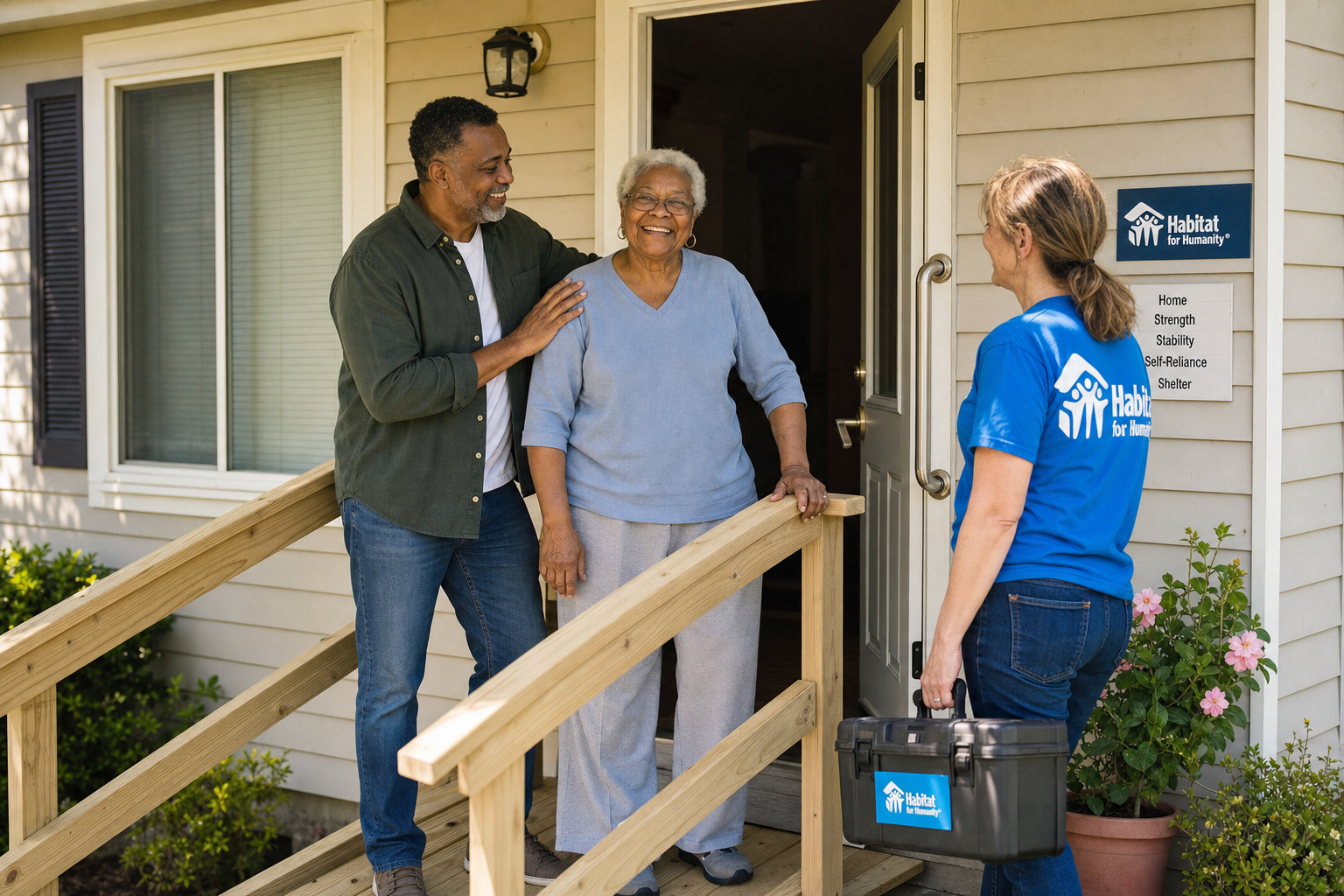
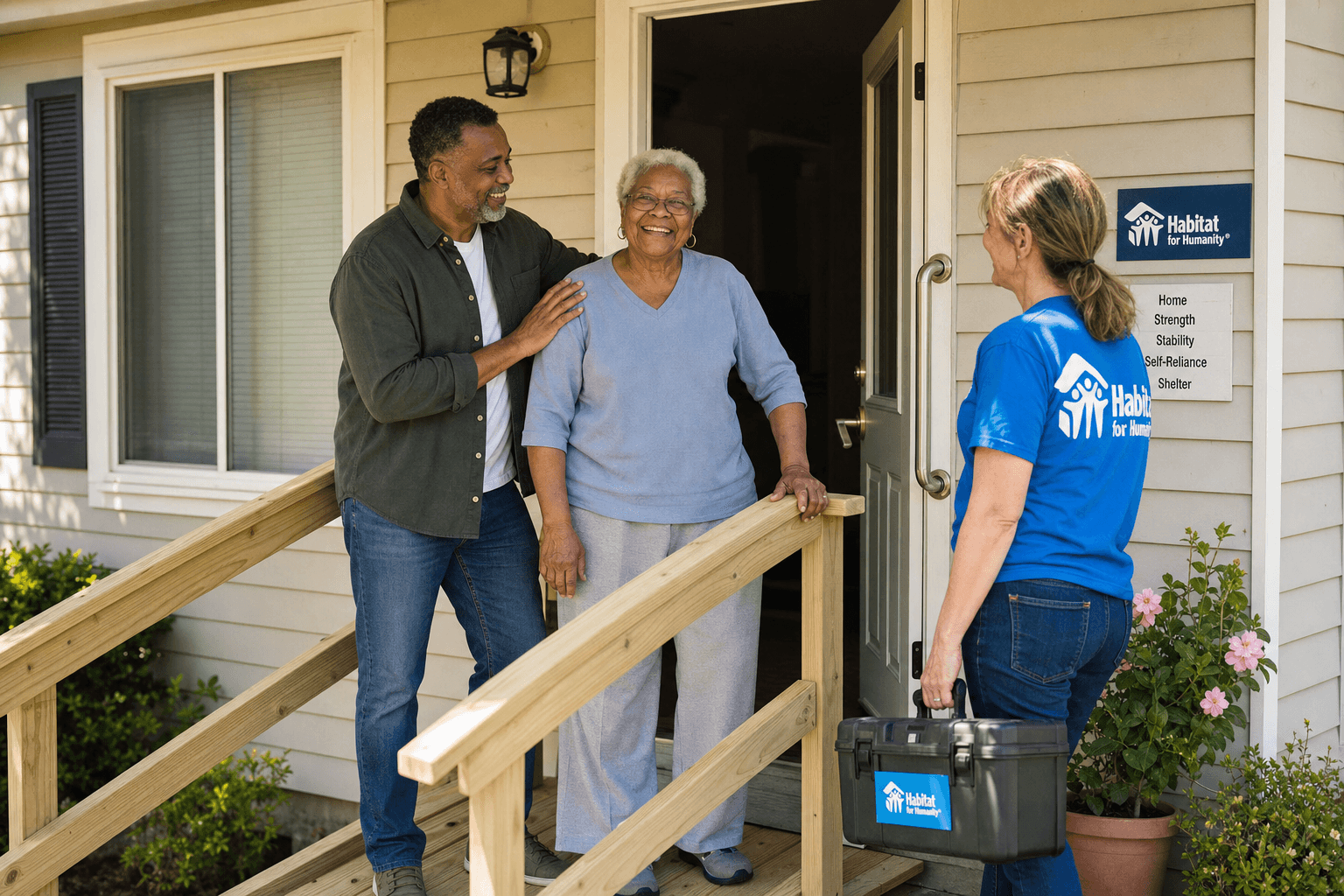
Habitat for Humanity's Aging in Place program helps families modify homes so older adults can continue living safely and independently.
What Is Habitat for Humanity's Aging in Place Program?
Habitat for Humanity's Aging in Place (AIP) program is a national initiative designed to help low-income older adults remain safely in their own homes as they age. Unlike Habitat's traditional homeownership model — which focuses on building new houses for first-time buyers — the AIP program provides critical home repairs and accessibility modifications at little to no cost to the homeowner. The program operates through local Habitat affiliates across the country, each tailoring its services to the specific needs of its community.
The scale of the need is significant. Habitat for Humanity reports that more than 19 million older adults in the United States live in homes that are in disrepair or ill-equipped to safely meet their needs. By 2030, 20% of the U.S. population will be 65 or older, making home modification programs like this one increasingly critical for public health and family stability.
For adult children who have just watched a parent struggle after a fall or cope with a new mobility limitation, the AIP program offers a structured, affordable path forward. It is not a handout — it is a partnership. Homeowners who complete the program report feeling mentally and physically healthier, safer in their homes, and more connected to family and friends, according to Habitat's own surveys.
The Housing Plus Model: Why It's Different from a Standard Home Repair Program
What sets Habitat's Aging in Place program apart from a typical home repair grant is its Housing Plus model. This approach recognizes that keeping an older adult safe at home requires more than just installing grab bars or building a ramp. It requires addressing the whole person — their health, their daily routines, and their connection to community services.
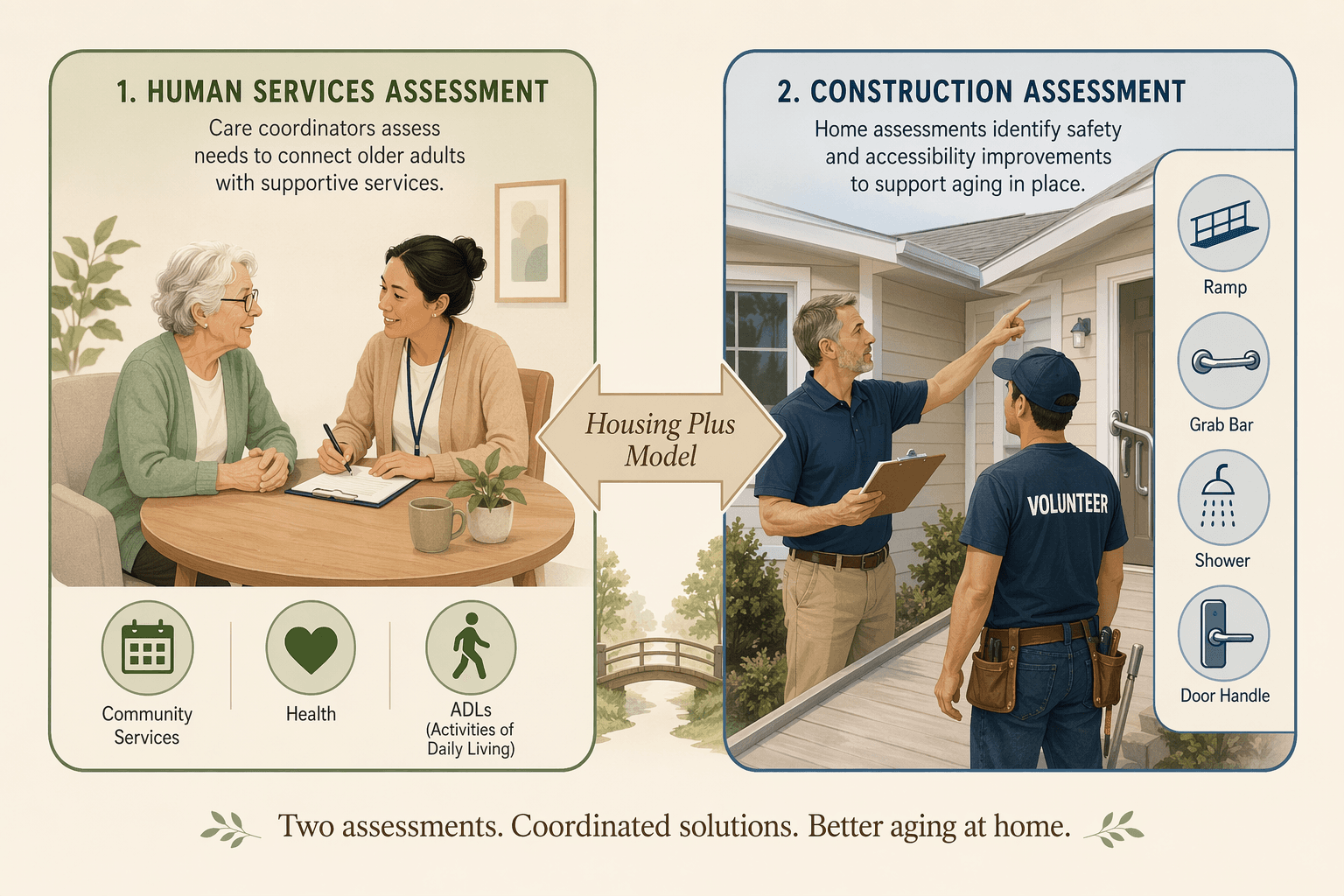
The Housing Plus model pairs a health and human services assessment with a construction evaluation, addressing both the person and the home.
The model works through two parallel assessments:
A health or human services assessment that evaluates the older adult's activities of daily living (ADLs) — how they pay bills, clean, communicate, run errands, shop, and manage their own care. This assessment identifies gaps in support and connects the homeowner to community-based services such as Meals on Wheels, transportation for doctor visits, food assistance, and even dog-walking or errand-running volunteers.
A construction assessment conducted by a Habitat construction specialist. This evaluation identifies the specific home modifications needed to make the home safer and more accessible — from grab bars and walk-in showers to ramps and roof repairs.
This dual-assessment structure means that a family might walk into the program expecting only a ramp and walk out with a ramp, a connection to a local senior center, a volunteer who helps with grocery shopping, and a referral to an occupational therapist. The program treats the home as part of a larger support ecosystem, not as an isolated problem.
Who Qualifies? Age, Income, and Homeownership Requirements
One of the most important things to understand about Habitat's Aging in Place program is that qualifications are set by each local affiliate, not by a single national standard. This means the eligibility criteria in Memphis, Tennessee, may differ from those in Portland, Oregon, or New York City. However, most affiliates follow a similar general framework.
Typical qualification requirements include:
Age: Most affiliates serve homeowners who are in their early- to mid-60s and older. The Memphis affiliate, for example, sets the minimum age at 62. Other affiliates may use 60 or 65 as their threshold.
Income: Habitat seeks to partner with low-income households, typically defined as earning up to 80% of the Area Median Income (AMI). In Memphis, as of April 2025, the HUD income limit for a 1-person household in Shelby County was $31,900 in gross annual income. For a 2-person household, the limit was $36,450; for 3-person, $41,000; and for 4-person, $45,550.
Homeownership: The homeowner must own and live in the home full-time. The home must be the primary residence.
Location: The home must be within the affiliate's service area. For Memphis, this means inside Memphis city limits. Other affiliates have their own geographic boundaries.
Financial standing: Homeowners must have current homeowners insurance and cannot be behind on property taxes or mortgage payments.
What Modifications Are Covered — and What's Not
Habitat's Aging in Place program covers a wide range of interior and exterior modifications designed to improve safety, accessibility, and energy efficiency. The specific scope of work is determined during the construction assessment and depends on the homeowner's needs, the condition of the home, and the affiliate's available resources.
Common modifications covered by Habitat's Aging in Place program. Actual coverage varies by affiliate and is determined during the in-home assessment.
Modification Category
Examples of Covered Work
Interior safety and accessibility
Grab bars in bathrooms and hallways; walk-in shower stalls with low thresholds; raised toilet seats; lever-style door handles; improved lighting in hallways, stairways, and entry points; non-slip flooring in bathrooms and kitchens; ADA-compliant toilets and sinks
Exterior access and structure
Wooden or metal ramps at entrances with handrails; new roof installation or repair; new siding and exterior paint; porch repairs and stabilization; stair railings and handrails
Energy efficiency and general repair
Energy-efficient lighting and appliances; window replacement; floor repairs; plumbing and electrical updates where needed for safety
It is equally important to understand what the program does not cover. The following are typically excluded:
Rental properties. The homeowner must own the home. Renters are not eligible for this program.
Cosmetic work. The program funds safety, accessibility, and structural repairs — not aesthetic upgrades like new countertops, paint colors, or landscaping.
Some attached homes. Depending on the affiliate, condominiums, townhomes, and mobile homes may not qualify. This is determined on a case-by-case basis.
The Application Process: Step by Step (and Why You Need to Act Fast)
The application process for Habitat's Aging in Place program varies by affiliate, but the Memphis model provides a clear illustration of how competitive and time-sensitive these programs can be. On January 15, 2026, the Memphis Habitat affiliate opened its pre-application call-in line at 9:00 a.m. All available slots filled within minutes.
Here is a typical step-by-step process based on the Memphis affiliate's model:
Call the hotline on the designated call-in date. Affiliates often announce specific dates and times when they will accept pre-applications by phone. These windows are narrow and competitive. Missing the call-in date means waiting for the next cycle, which may be months away.
Complete pre-qualification and consent. If you reach a representative during the call-in window, you will go through a brief pre-qualification screening. You will need to provide basic information about the homeowner's age, income, property location, and the nature of the needed repairs.
Schedule and complete the in-home assessment. If pre-qualified, a Habitat team will visit the home to conduct both the human services assessment and the construction assessment. This visit determines the full scope of work and identifies any community service connections that could benefit the homeowner.
Await approval and scope of work. After the assessment, the affiliate reviews the findings and determines whether the project moves forward. If approved, a detailed scope of work is developed.
Contractor assignment and construction. Habitat assigns a contractor or uses its own construction team to complete the work. The timeline depends on the complexity of the modifications and the affiliate's current workload.
Final inspection. Once construction is complete, a final inspection ensures all work meets safety and quality standards.
What It Costs the Homeowner: Forgivable Grants and 0% Loans
For most qualifying homeowners, the modifications provided through Habitat's Aging in Place program are free. The program is funded through a combination of grants, donations, and volunteer labor, which allows affiliates to pass the savings directly to the homeowner.
The Memphis affiliate's model is a good example of how the cost structure works:
Cost structure for Habitat for Humanity of Greater Memphis's Aging in Place program. Other affiliates may use different models, including 0% interest loans with flexible terms.
Cost Element
Details
Modifications themselves
Free to the homeowner. Funded through a grant provided by the affiliate.
Grant forgiveness schedule
The grant is forgiven at 20% per year over 5 years. If the homeowner remains in the home for the full 5 years after project completion, the entire grant is forgiven and no repayment is required.
Early sale or transfer
If the home is sold within 1 year of project completion, 100% of the grant must be repaid. After 5+ years, zero repayment is required. Partial forgiveness applies for years 2 through 4.
Out-of-pocket cost
A $19 fee is required to record the deed restriction that formalizes the grant agreement. This is typically the only out-of-pocket expense.
Other affiliates, such as Habitat Portland Region, offer 0% interest loans instead of forgivable grants. For example, a $4,500 loan at 80% AMI might require monthly payments of approximately $28 over 48 months, while a household at 50% AMI might pay around $21 per month. Some affiliates also offer deferred secured loans with no monthly payments, where the loan is forgiven after 15 years if the homeowner continues living in the home.
How to Find and Contact Your Local Habitat Affiliate
Because each Habitat affiliate operates independently, the first step for any family is to locate the affiliate that serves their parent's community and learn about that affiliate's specific Aging in Place program.
Here is how to get started:
Use Habitat for Humanity's national affiliate locator. The Habitat for Humanity website provides a searchable directory of local affiliates. Enter the city or zip code where your parent lives to find the nearest affiliate.
Call the affiliate directly. Ask specifically about their Aging in Place or Home Repair program. Not all affiliates use the same name for their services. Be prepared to ask about age requirements, income limits, service area boundaries, and the application process.
Ask about waitlists and call-in dates. If the affiliate uses a competitive call-in model, ask when the next application window opens. Some affiliates maintain waitlists; others operate on a first-come, first-served basis for each funding cycle.
Prepare documentation in advance. Have the homeowner's proof of age, income documentation, property tax and insurance records, and a clear description of the needed modifications ready before you call.
The Evidence Behind Home Modifications for Aging in Place
Habitat's Aging in Place program is not just a compassionate idea — it is backed by a growing body of research showing that home modifications are effective at preventing falls, maintaining functional independence, and reducing healthcare costs.
A 2025 systematic review published in the Journal of Housing and the Built Environment analyzed 20 studies on home modifications for aging in place. The review found that 65% of the studies confirmed the effectiveness of home modifications in three key areas: fall prevention, functional independence, and cost savings. Bathroom modifications, grab bars, and stair railings were identified as the most impactful individual interventions.
One study within the review reported that home modifications reduced weekly care hours by 42% — a combination of a 46% reduction in informal care (family members providing unpaid help) and a 16% reduction in formal care (paid home health aides). Another study found that fall odds decreased by 3% per quarter after home adaptations were completed.
For families weighing whether to modify a home or move to a different living arrangement, the evidence is clear: home modifications work. They reduce falls, keep older adults independent longer, and save families money on care costs. Habitat's program makes this evidence-based intervention accessible to families who might otherwise be priced out of the home modification market entirely.

Comments
Join the discussion with an anonymous comment.