
Room checklist
How to Pay for Aging in Place Home Modifications: A Complete Funding Navigator for Family Caregivers
Facing the cost of home modifications after a parent's fall or mobility decline? This guide walks you through every major funding source — VA grants, Medicaid waivers, USDA grants, HUD programs, and state resources — with a decision tree to match your situation, call scripts, and a stacking strategy to combine multiple sources.
You need about $8,000 to make your parent’s bathroom safe. Or you can pay $60,000 a year for assisted living. The math looks obvious — except you’re not choosing between those two numbers. You’re trying to figure out how to come up with the first one so your parent never needs the second.
I have sat with families who assumed the only option was to drain savings or take out a second mortgage. They did not know that the VA will grant up to $126,526 for a service‑connected veteran, that the USDA has grants for rural seniors, that Medicaid waivers in many states cover bathroom remodels, and that these programs can often be stacked together. They also did not know that a quarter of people over 65 fall each year, and that a simple grab bar helps three‑quarters of them recover their balance before they hit the floor.
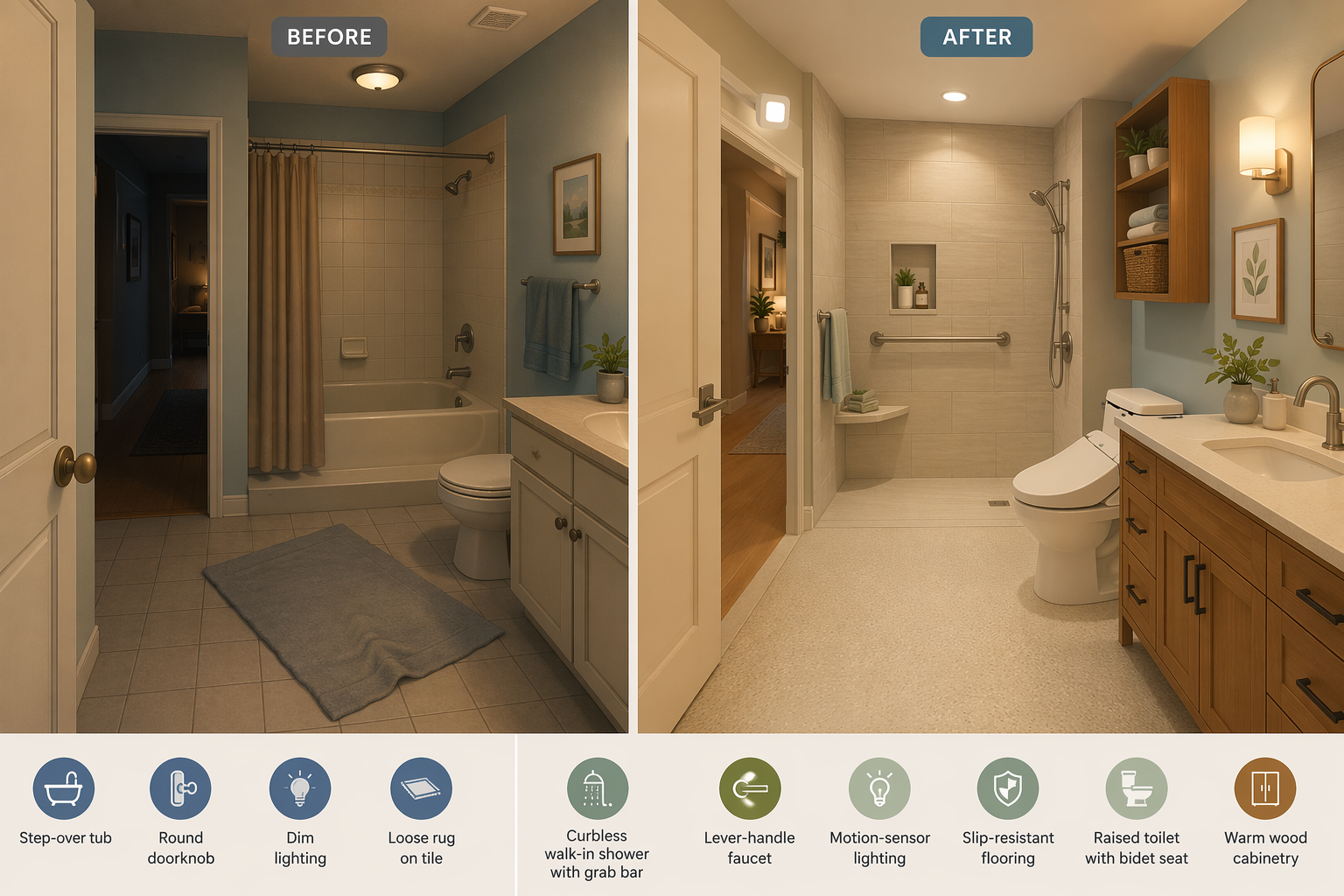
Let me give you a sense of the costs. Low‑cost upgrades — grab bars, lever handles, better lighting — run $25 to $500. Mid‑range projects like a walk‑in shower or stair lift fall between $1,000 and $10,000. Structural changes — widening doorways, adding a first‑floor bedroom, installing an elevator — can hit $10,000 to $50,000 or more. Most families I work with need something in the mid‑range. That is exactly the territory where grants and benefits can make the difference between doing it and skipping it.
Which Funding Path Fits Your Situation?
The worst way to start is to read a list of every program alphabetically — you’ll end up reading about the VA grant you don’t qualify for, get frustrated, and give up. Instead, answer one question that sends you down the right branch.
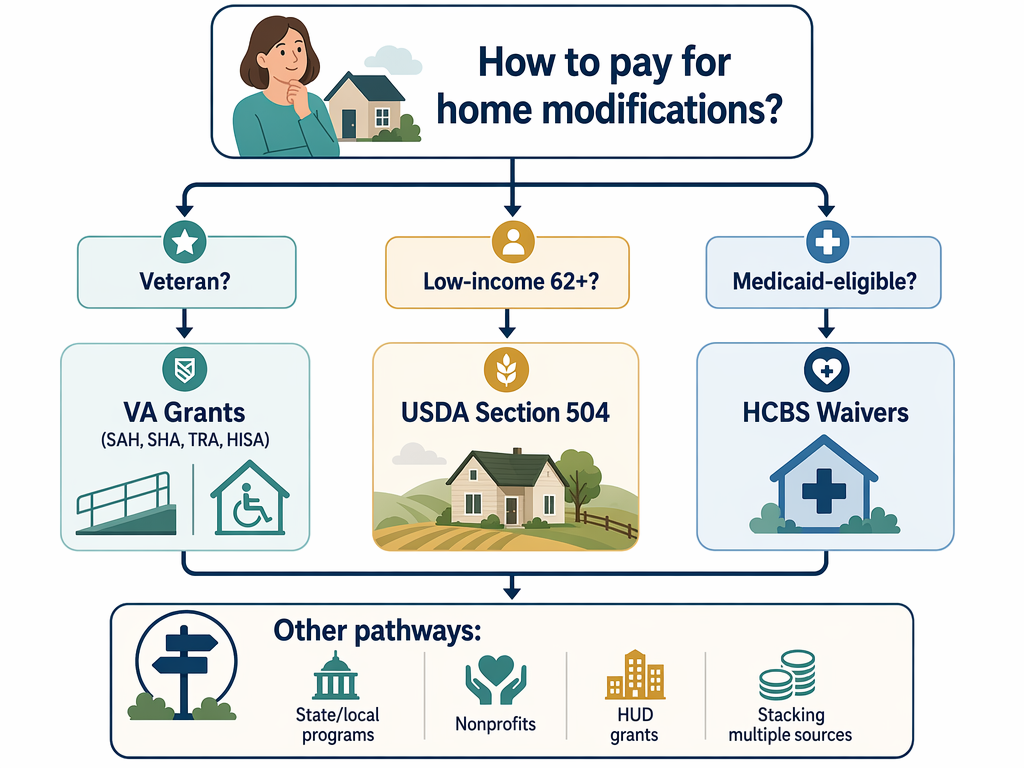
If the older adult is a veteran with a service‑connected disability: start with VA grants. If they are 62 or older, very‑low‑income, and live in a rural area: look at USDA Section 504. If they are on Medicaid (or will be soon): check home‑ and community‑based services (HCBS) waivers in your state. If none of those apply: do not panic — state programs, HUD grants, nonprofit help, and affordable financing are still on the table.
VA Grants: Big Money, Tight Rules
I have seen families light up when they hear the dollar figures. $126,526 for the Specially Adapted Housing (SAH) grant. $25,350 for the Special Home Adaptation (SHA) grant. $50,961 for Temporary Residence Adaptation (TRA). $6,800 for Home Improvements and Structural Alterations (HISA, service‑connected) or $2,000 if the disability is not service‑connected. Then frustration hits when they learn the eligibility gate is narrow.
Every VA grant requires the veteran to have a qualifying service‑connected disability, an honorable discharge, and to occupy (or plan to occupy) the home being modified. That is not the same as "any veteran." The SAH grant, for example, is for veterans with specific severe disabilities — loss or loss of use of both legs, blindness in both eyes, certain burns or respiratory conditions. The SHA grant covers a broader set of mobility limitations but still ties the eligibility tightly to service connection.
| Grant | FY2026 Amount | Eligibility At a Glance |
|---|---|---|
| SAH (Specially Adapted Housing) | $126,526 | Severe service‑connected disability; specific conditions |
| SHA (Special Home Adaptation) | $25,350 | Service‑connected disability; certain mobility/vision limitations |
| TRA (Temporary Residence Adaptation) | $50,961 | SAH-qualified veteran living temporarily with family |
| HISA (Home Improvements & Structural Alterations) | $6,800 service‑connected; $2,000 non‑service | Service‑connected or non‑service disability; medical need documented by VA physician |
The documentation requirements are concrete and non‑negotiable. You will need: VA Form 26‑4555 (application), a physician's letter documenting medical necessity for each requested modification, detailed contractor estimates for the work, and proof that the veteran owns or will occupy the home. I have watched families stumble hardest on the physician's letter — it must spell out why a grab bar in the shower is medically required, not just "recommended." I tell families to ask the doctor to write it as a prescription for the home environment.
Other Sources of Funding: Federal and State Programs
If the veteran path does not apply, there are still solid options — but they all require active inquiry and often a waiting list. I will walk through the main ones, starting with the most targeted.
USDA Section 504 – For Rural Seniors Only
This program provides grants up to $10,000 for very‑low‑income homeowners age 62 or older who live in a rural area (USDA defines rural loosely — check your address at rd.usda.gov). The money can be used only for health or safety repairs, which includes accessibility modifications like ramps, grab bars, and bathroom modifications. The grant is forgivable over time. The catch: it is first‑come, first‑served, and many rural offices have limited funds that run out early in the fiscal year. Call your local USDA Rural Development office and ask for the Section 504 grant packet before you do anything else.
HUD OAHMP Grants – $30 Million for Nonprofits
In 2025, HUD awarded $30 million in Older Adults Home Modification Program (OAHMP) grants to 32 nonprofits across the country. These organizations use the money to provide free or low‑cost modifications to low‑income older adults. The catch is you need to find the nonprofit that received the grant in your area. Start by searching "your county + OAHMP grant" or call your Area Agency on Aging and ask if they know about any local OAHMP‑funded programs.
Medicaid HCBS Waivers – State‑Dependent but Powerful
Medicaid's Home and Community‑Based Services waivers (1915(c) and 1115) can cover home modifications in many states, but the coverage varies wildly. Some states will pay for a full bathroom remodel; others only for a ramp and grab bars. The key is to ask specifically about "home modifications" in the waiver plan. You will need a physician's letter and often an occupational therapy home assessment to justify the need. Contact your state Medicaid office or the local Aging and Disability Resource Center and ask to speak with a waiver counselor. Have the diagnosis and a list of needed modifications ready.
Medicare Advantage – A Newer Option for Chronically Ill
Since January 2020, Medicare Advantage plans have been allowed to cover "structural home improvements" for chronically ill subscribers. This is still not widely advertised. You need to call the plan directly and ask: "Does my parent's plan cover home modifications for a chronic condition? What conditions qualify? What documentation do you need?" Many families miss this because they assume Medicare does not cover anything structural — but some Advantage plans do, especially for conditions like heart disease, COPD, or diabetes that are made worse by unsafe home conditions.
The Stacking Strategy: How to Combine Multiple Sources
This is where the real solution lives. Almost no grant or benefit covers 100% of the needed work. The solution is to layer multiple sources on top of each other. I have helped families use a VA grant for the ramp, a local nonprofit for bathroom grab bars, a state tax credit for the stair lift, and a low‑interest loan for the rest. The total felt impossible. The stack made it possible.
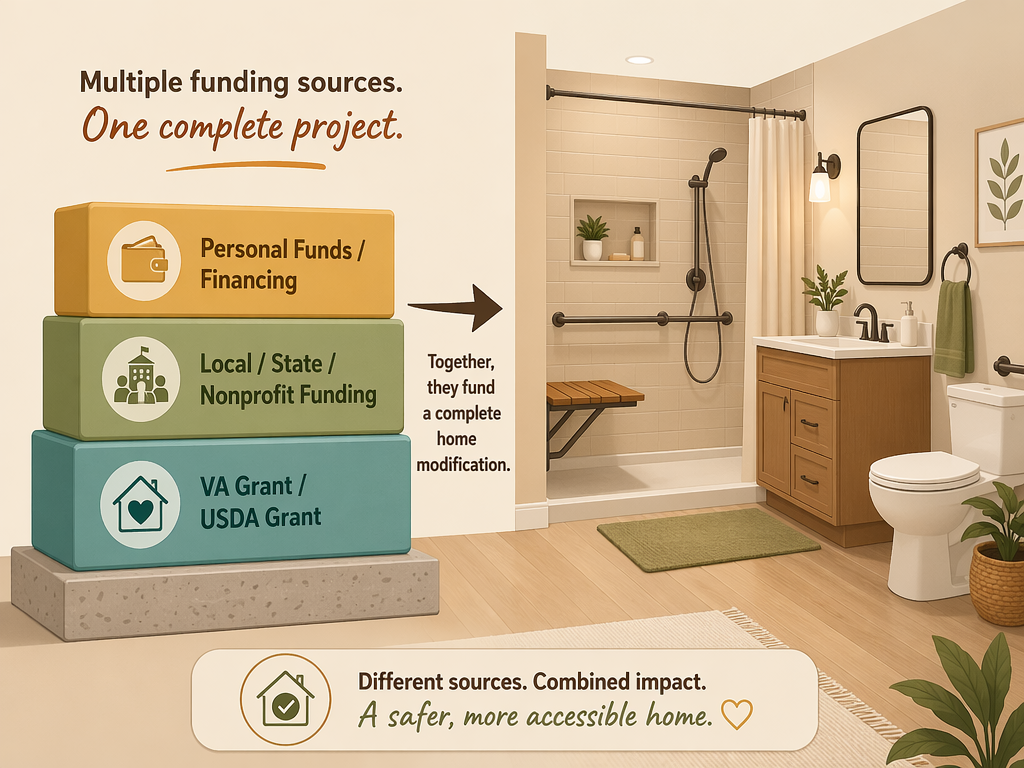
The rule of thumb: use grants for the big‑ticket items (ramps, bathroom modifications, stair lifts), use local or state programs for mid‑range items (grab bars, lever handles, door widening), and use personal funds or a low‑interest loan to close the gap. But you need to check for conflicts. The VA and Medicaid cannot both pay for the same grab bar — do not submit the same invoice to two sources. Some federal grants specify that no other federal funds may be used for the same modification. When in doubt, ask the grant administrator before you submit a bill.
For a concrete example of how stacking works for a bathroom remodel — the most common and expensive single project — read our article on how to pay for an elderly parent's bathroom remodel. It walks through a real family's project funded by three sources.
Call Scripts and Documentation Checklist
I have watched families freeze at the first phone call. They do not know what to ask, and when the person on the other end says "we do not cover that," they hang up. Here is what I have learned works.
Initial call to VA Home Improvement Coordinator
"My father is a veteran with a service‑connected disability affecting his mobility. We are looking into a HISA grant to modify his bathroom. Can you tell me exactly what forms you need and whether there is a preferred format for the physician's statement?"
Initial call to Medicaid HCBS waiver office
"I am calling about the HCBS waiver for my mother. She is on Medicaid and needs home modifications for safety — a ramp and a walk‑in shower. Does your waiver cover home modifications? What is the process for getting prior authorization? Do we need an occupational therapy assessment first?"
Escalation script (when told 'we do not cover that')
"I understand that is not the standard benefit. But I have read that there are exceptions or alternative programs — could you check if there is any flexibility, or refer me to someone who might be able to authorize a one‑time modification under a different budget code? If not, can you tell me the exact reason for the denial so I can look for alternative funding?"
This escalation script works because it does not argue — it asks for a specific path forward or a specific reason. I have seen it turn a "no" into a "let me check with my supervisor" and eventually a partial approval.
Documentation checklist
- VA Form 26‑4555 (for VA grants)
- Physician's letter of medical necessity (specific: 'patient requires a grab bar in the shower to safely transfer')
- Itemized contractor estimates (multiple, if required)
- Proof of income (for USDA, Medicaid, state programs)
- Proof of homeownership (deed, tax record)
- Proof of rural location (for USDA — check eligibility at rd.usda.gov)
- Occupational therapy home assessment (for HCBS waivers and some grants)
Get these documents together before you call. When a program says "send us the paperwork," having it ready can move you from the back of the line to the front.
What If You Do Not Qualify for Anything?
It happens. A veteran might not have a service‑connected disability. A rural senior might live in an area that is not eligible. A state's Medicaid waiver might not cover modifications. I do not want you to feel stuck. There are still paths.
- FHA Title I loans – Up to $25,000 for a single‑family home, fixed‑rate, for projects that improve "basic livability." No equity required.
- Low‑cost modifications – Start with the $25–$500 range: grab bars, lever handles, better lighting, non‑slip mats. These alone can reduce fall risk.
- Nonprofit help – Rebuilding Together and Habitat for Humanity run local programs that build ramps and modify bathrooms for low‑income seniors. Check their local affiliate pages.
- Phasing the project – Do the most critical modification this year (the bathroom), defer the stair lift to next year. Spread the cost over two tax years.
Your Next Move: From Funding to Construction
Once you have your funding lined up — or at least a plan for funding — the next step is to hire the right contractor. You need someone who understands aging‑in‑place modifications, not just a general handyman. Get three written bids. Check references. Verify insurance. Make sure the bids are itemized so you can submit them to your funding source.
We have a full guide on how to choose an aging‑in‑place contractor and avoid costly mistakes that covers what questions to ask, what red flags to watch for, and how to ensure the work meets building codes and ADA standards.
For now, do this: go back to the decision tree, find the branch that fits your parent's situation, gather the documents in the checklist, and make that first call. The money exists. The programs exist. The work is paperwork and a few phone calls — not a second mortgage.
After September 30, 2026, the VA grant amounts will change. If you are reading this after that date, check the VA's website for updated FY2027 figures. I will keep this guide reviewed and updated.
Related reading
Need a professional assessment?
Find a CAPS-credentialed professional or local aging services through our outbound resource list — we never name or rank individual contractors.
Find Local HelpNoticed something outdated or inaccurate on this page? Flag a correction. We review every report against CDC, NIA, and AARP HomeFit guidance before updating a page.