
Room checklist
How to Pay for an Elderly Parent's Bathroom Remodel: VA Grants, Medicaid Waivers, Tax Deductions, and More
A practical guide for adult children navigating the fragmented funding landscape for a parent's bathroom remodel. Learn how VA HISA/SAH grants, Medicaid HCBS waivers, the IRS medical-expense deduction, and other programs can offset costs — and why these resources are often underutilized, especially among Black and Hispanic families.
Why This Matters: The Bathroom Modification Gap
When an older parent falls in the bathroom, the immediate instinct is to fix the hazard — install a grab bar, add non-slip flooring, replace the tub with a curbless shower. But for millions of families, that instinct collides with a hard question: who pays for it?
The gap between need and action is stark. A 2016 study of 2,404 Medicare beneficiaries aged 65 and older who had experienced at least one fall found that roughly 40% of those with repeated falls — two or more — had no bathroom modifications at all. The same study revealed a deeper, less-discussed disparity: after adjusting for health status and demographics, non-Hispanic Black older adults had 62% lower odds of having bathroom modifications compared with non-Hispanic White older adults (odds ratio 0.38, p < 0.001). Hispanic older adults also had significantly lower odds (odds ratio 0.64, p = 0.039).
This gap is not about lack of concern. It is about a fragmented funding landscape that most families do not know how to navigate. Medicare, the default assumption for many, generally does not cover structural bathroom remodels. But a combination of VA grants, Medicaid waivers, USDA loans, tax deductions, and nonprofit programs can significantly offset costs — if you know where to look and how to apply.
This guide is written for adult children who are the decision-makers and information-seekers. It walks through each major funding pathway, explains eligibility, and provides a decision framework to match your parent's situation to the most promising source of support.
For a broader overview of funding options for modifications in other rooms, see our complete guide to paying for aging-in-place home modifications.
The Medicare Reality Check: What It Does and Doesn't Cover
Before exploring funding options, it is essential to understand what Medicare will and will not pay for. Many families assume Medicare covers bathroom remodels because it covers hospital stays and doctor visits. The reality is more limited.
Original Medicare (Part B) covers Durable Medical Equipment (DME) — items like a shower chair, a raised toilet seat, or a grab bar — but only when a doctor prescribes them as medically necessary and the supplier is Medicare-approved. Medicare pays 80% of the approved amount after you meet the Part B deductible. What it does not cover: structural modifications such as widening doorways, installing a roll-in shower, replacing a tub, or laying non-slip flooring. Those are considered home improvements, not medical equipment.
- Original Medicare covers DME only: shower chairs, grab bars, raised toilet seats, transfer benches — if prescribed by a doctor.
- Original Medicare does not cover structural modifications: tub-to-shower conversions, widened doorways, non-slip flooring, or any renovation labor.
- Medicare Part B may pay for an occupational therapist to evaluate the home and recommend modifications — but not the modifications themselves.
Medicare Advantage (Part C) plans are a different story — but only slightly. Starting in 2019–2020, the Centers for Medicare & Medicaid Services allowed Medicare Advantage plans to offer supplemental benefits, including some home modifications. However, uptake has been limited. In 2020, only 148 out of 3,148 Medicare Advantage plans offered any type of in-home support services. By 2026, that number has likely grown, but coverage still varies dramatically by state, insurer, and plan tier.
If your parent has a Medicare Advantage plan, call the plan directly and ask: "Does my plan cover home modifications for bathroom safety?" Get the answer in writing. If the answer is no — and for most families it will be — move on to the funding pathways that actually pay for structural work.
VA Benefits: The Most Generous Federal Funding for Veterans
If your parent is a veteran or the surviving spouse of a veteran, VA home modification grants are the single most generous federal funding source available for bathroom remodels. The key is knowing which grant applies and how to document medical necessity.
The VA offers three primary grant pathways for bathroom modifications. The table below summarizes the key differences.
| Grant Type | Maximum Amount (FY 2026) | Best For | Key Eligibility |
|---|---|---|---|
| HISA (Home Improvements and Structural Alterations) | $6,800 lifetime | Medically necessary modifications for any service-connected or non-service-connected disability | Doctor's prescription; medical need for the modification |
| SAH (Specially Adapted Housing) | $126,526 lifetime | Major structural changes for veterans with specific severe service-connected disabilities | Loss of use of more than one limb, blindness in both eyes, certain severe burns, etc. |
| SHA (Special Home Adaptation) | $25,350 lifetime | Modifications for veterans with specific service-connected disabilities affecting mobility or vision | Loss of use of both hands, certain severe burns, certain respiratory injuries |
For most veterans, the HISA grant is the most accessible option. It covers medically necessary modifications such as grab bars, roll-in showers, widened doorways, and non-slip flooring — exactly the kind of work a bathroom remodel requires. The lifetime maximum is $6,800, which may not cover a full gut renovation but can fund the highest-priority safety changes.
- A doctor's prescription stating the medical need for each modification.
- A detailed cost estimate from a licensed contractor.
- Completion of VA Form 10-0103 (for HISA) or the appropriate SAH/SHA application.
- Submission to the local VA medical center's Prosthetic and Sensory Aids Service.
For a deeper dive into VA grant specifics, see our complete guide to VA and other funding sources for home modifications.
Medicaid HCBS Waivers: State-by-State Coverage for Bathroom Modifications
Medicaid's Home and Community-Based Services (HCBS) waivers are another significant funding pathway, but they come with important caveats. Unlike VA grants, which are federal and consistent, Medicaid HCBS waivers are administered by individual states. Coverage, eligibility, and funding limits vary dramatically.
Many states' HCBS waivers include coverage for Environmental Accessibility Adaptations (EAAs) — structural changes to the home that enable the individual to remain safely in the community. Bathroom modifications such as roll-in showers, grab bars, widened doorways, and non-slip flooring often qualify as EAAs. However, the waiver must specifically list EAAs as a covered service, and the modification must be deemed medically necessary by a physician or occupational therapist.
- Prior authorization is almost always required. Do not start construction before receiving written approval.
- Waitlists for HCBS waivers can be long — months or even years in some states. Apply as early as possible.
- Coverage limits vary: some states cap EAA benefits at $5,000–$10,000 per year; others may cover up to $25,000 or more.
- The individual must be eligible for Medicaid and meet the level-of-care criteria for nursing home placement (even if they live at home).
USDA Section 504 Loans and Grants for Rural Homeowners
For very-low-income homeowners in rural areas, the USDA Section 504 Home Repair Program offers a combination of loans and grants that can be used for bathroom safety modifications. This program is specifically designed to remove health and safety hazards in the home.
- Loans: Up to $40,000 at a fixed 1% interest rate over 20 years.
- Grants: Up to $10,000 for homeowners aged 62 and older who cannot afford to repay a loan.
- Eligibility: The home must be located in a rural area (as defined by USDA), the homeowner must be very-low-income, and the property must be owner-occupied.
- Allowable uses: Grab bars, non-slip flooring, walk-in showers, widened doorways, ramps, and other modifications that remove health and safety hazards.
The USDA Section 504 program is one of the most underutilized funding sources for bathroom modifications. Many families do not realize their parent's home qualifies as "rural" under USDA definitions, which include many suburban and exurban areas. Check eligibility at the USDA Rural Development website.
The IRS Medical-Expense Deduction: Making Modifications Tax-Deductible
Even if no grant or waiver covers the full cost of a bathroom remodel, the IRS allows you to deduct medically necessary home modifications as capital medical expenses. This is not a grant — it reduces your taxable income — but for families paying out of pocket, it can provide meaningful relief at tax time.
Under IRS Publication 502, you can deduct medical and dental expenses that exceed 7.5% of your adjusted gross income (AGI). Qualifying bathroom modifications include:
- Widening doorways and hallways to accommodate a wheelchair or walker.
- Installing grab bars, railings, and support bars in the shower, tub, and toilet areas.
- Lowering electrical outlets, light switches, and fixtures for accessibility.
- Installing a roll-in shower or curbless shower base.
- Modifying stairways or installing a porch lift (if the bathroom is on a different level).
To claim the deduction, you need itemized records: the contractor's invoice, a doctor's prescription or letter stating the medical necessity of each modification, and documentation of the property's value before and after the modification (if applicable).
Nonprofit and Community Programs: Rebuilding Together and Habitat for Humanity
National nonprofit organizations offer free or low-cost bathroom modifications for qualifying low-income seniors. These programs are not as widely known as government grants, but they can cover significant costs for families who meet the income guidelines.
- Rebuilding Together: Their Safe at Home program provides free home safety modifications, including bathroom grab bars, non-slip flooring, and walk-in showers, for low-income older adults and veterans. They also have a Heroes at Home program specifically for veterans. Income limits apply, and waitlists can be long.
- Habitat for Humanity: Many local Habitat affiliates offer an Aging in Place program that includes bathroom modifications such as roll-in showers, grab bars, and widened doorways. Homeowners typically contribute "sweat equity" or a reduced-cost payment. Eligibility varies by local affiliate.
- Local Area Agencies on Aging: Many counties and cities have grant programs specifically for bathroom safety modifications for seniors. Contact your local Area Agency on Aging to ask about available programs.
These programs are most effective when combined with other funding sources. For example, a family might use a VA HISA grant to cover materials and a nonprofit program to cover labor.
Your Funding Pathway: A Decision Flow Chart by Eligibility
The most important step is matching your parent's eligibility profile to the right funding pathway. The decision flow chart below provides a clear starting point.
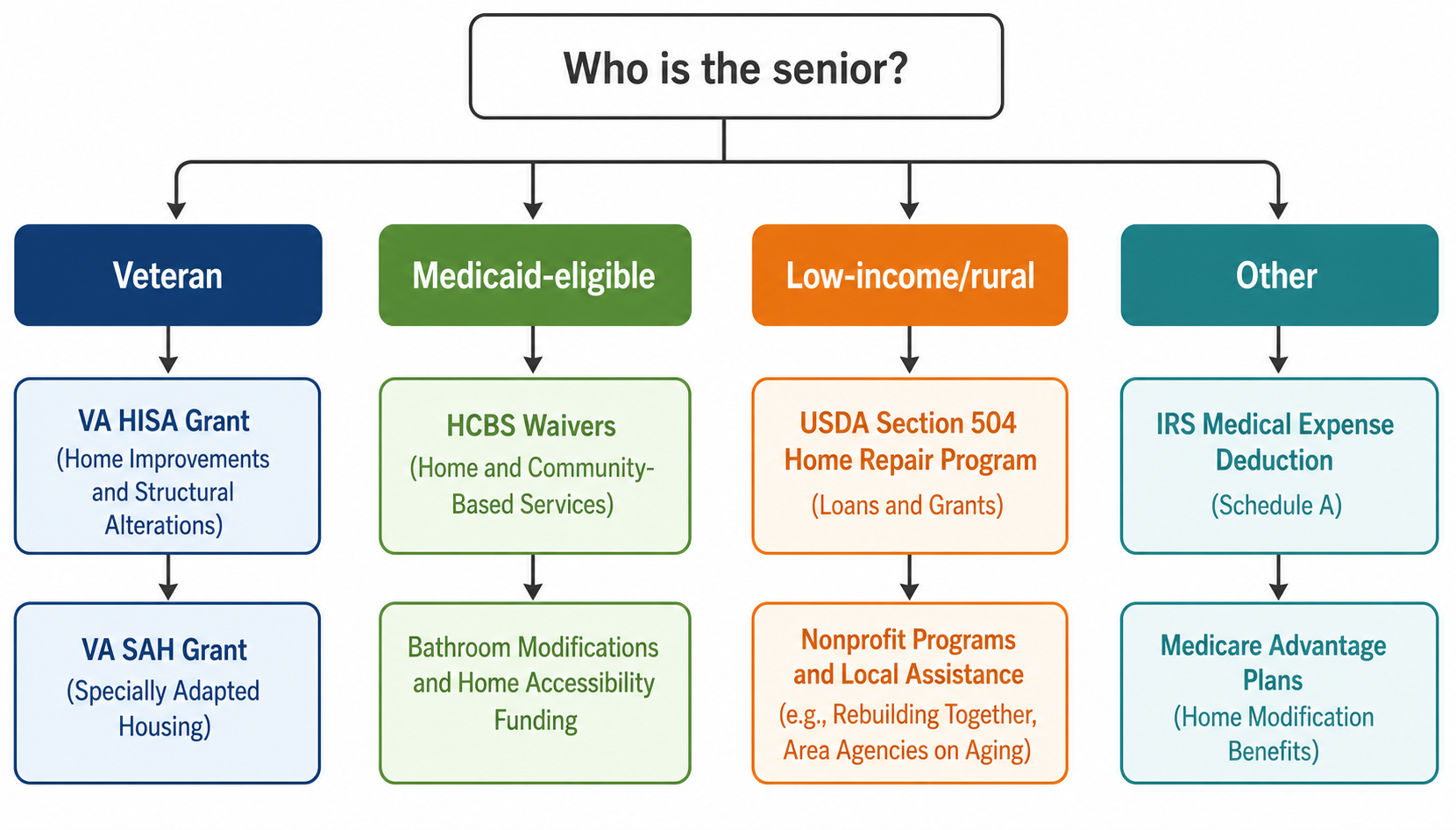
Here is the step-by-step decision framework:
- Is your parent a veteran or surviving spouse? Start with VA HISA grant (up to $6,800 lifetime). If they have a severe service-connected disability, explore SAH (up to $126,526) or SHA (up to $25,350).
- Is your parent eligible for Medicaid? Contact your state's Medicaid agency and ask about HCBS waiver coverage for Environmental Accessibility Adaptations. Be prepared for prior authorization and potential waitlists.
- Is your parent a very-low-income homeowner in a rural area? Apply for the USDA Section 504 loan (up to $40,000) or grant (up to $10,000 for seniors 62+).
- Is your parent low-income but not eligible for the above? Contact Rebuilding Together or your local Habitat for Humanity affiliate. Also check with your local Area Agency on Aging for county-specific grant programs.
- Paying out of pocket? Document all expenses and consult a tax professional about the IRS medical-expense deduction. If your parent has a Medicare Advantage plan, call the plan to ask about supplemental benefits for home modifications.
Once you have identified your funding pathway, the next step is deciding exactly what modifications to install. For a room-by-room checklist with cost ranges and installation guidance, see our bathroom remodel for elderly safety checklist.
The funding landscape for bathroom modifications is fragmented, but it is not empty. The key is knowing which door to knock on — and having the documentation ready when someone answers.
Related reading
- Hidden Disparities in Bathroom Safety: Why Non-Hispanic Black and Hispanic Seniors Are Far Less Likely to Have Bathroom Modifications — and What Caregivers Can Do
- Funding Sources for Home Modifications: A Complete Guide to VA, Medicaid, Grants, and More
- What Your Parent's Home Needs Now: A Caregiver's Decision Framework for Aging in Place Modifications
Need a professional assessment?
Find a CAPS-credentialed professional or local aging services through our outbound resource list — we never name or rank individual contractors.
Find Local HelpNoticed something outdated or inaccurate on this page? Flag a correction. We review every report against CDC, NIA, and AARP HomeFit guidance before updating a page.