
Room checklist
CAPS vs. OT vs. General Contractor: Who to Hire First for Aging-in-Place Home Modifications
Family caregivers often struggle to decide whether to call an occupational therapist, a CAPS-certified contractor, or a general contractor for home modifications. This article provides a clear, staged workflow — starting with a Medicare-covered OT assessment — to help you save time, money, and frustration.
The Confusion: Which Professional Do You Call First?
You've decided your parent needs home modifications to age safely in place. Then the questions start: Do you call an occupational therapist? A CAPS-certified contractor? A general contractor? Each title sounds plausible, but each one leads to a very different outcome — and a very different bill.
The confusion is understandable. The aging-in-place industry has grown rapidly, and the professional roles have blurred. A CAPS specialist can design a bathroom renovation. An occupational therapist can recommend grab bar placement. A general contractor can build a ramp. But none of them do all three jobs equally well, and hiring the wrong one first can cost you thousands in rework or, worse, leave your parent with modifications that don't actually help.
This article provides a clear, staged workflow — starting with a Medicare-covered OT assessment — to help you save time, money, and frustration. If you're unsure whether your parent even needs a CAPS specialist yet, start with our room-by-room self-assessment to identify the warning signs.
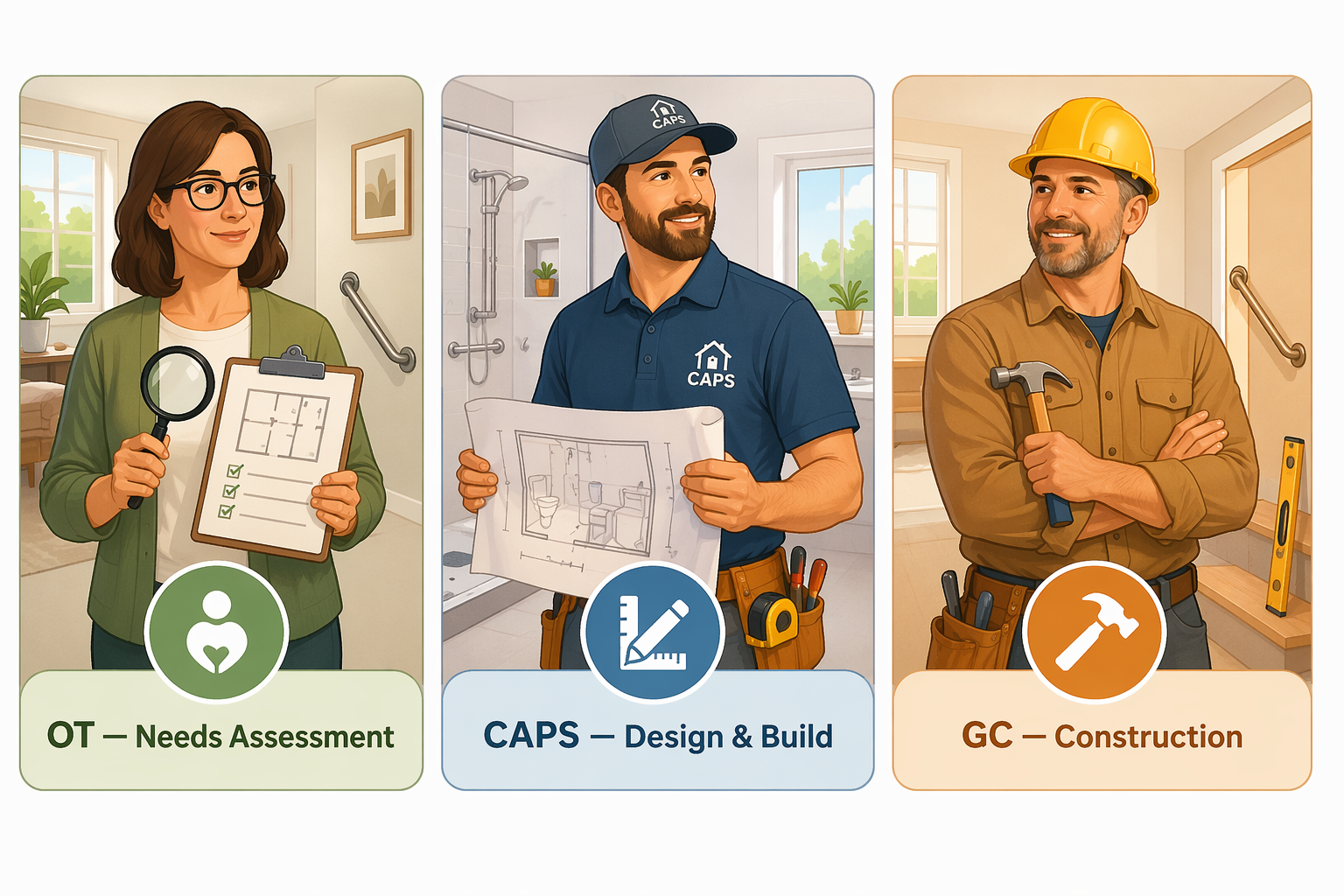
The Occupational Therapist (OT): The Clinical Needs Assessor
An occupational therapist is a clinically trained professional who specializes in how a person's specific condition — stroke recovery, arthritis, Parkinson's disease, post-hip-replacement recovery — interacts with their home environment. The OT's job is not to design or build anything. It is to identify the daily activity barriers your parent faces and recommend precise modifications to overcome them.
During a home evaluation, an OT will watch your parent attempt real tasks: getting in and out of the shower, standing from the toilet, navigating the kitchen, moving from bed to wheelchair. They measure joint angles, observe balance strategies, and identify the exact height, angle, and location where a grab bar or handrail would be most effective. This is fundamentally different from a contractor walking through and saying, "We could put a grab bar here." The OT's recommendation is based on your parent's specific body mechanics, not a generic checklist.
Here is what an OT typically does and does not do:
- Does: Perform a comprehensive functional assessment of the individual
- Does: Identify specific environmental barriers and recommend modifications
- Does: Provide a written report with prioritized recommendations
- Does not: Design the renovation or create construction drawings
- Does not: Hire contractors or manage the construction project
- Does not: Oversee installation or perform a post-construction quality check (unless separately contracted)
For a practical tool you can use alongside an OT evaluation, see our CDC STEADI-aligned room-by-room fall prevention checklist. It covers the same environmental hazards an OT would flag and helps you prepare for the evaluation.
The CAPS-Certified Aging-in-Place Specialist: The Design and Build Expert
The Certified Aging-in-Place Specialist (CAPS) credential was created jointly by the National Association of Home Builders (NAHB) and AARP in 2002. It is a professional designation — not a license — that signifies specialized training in aging-in-place design and construction. CAPS professionals come from diverse backgrounds: construction, occupational therapy, physical therapy, nursing, interior design, real estate, and public services. There are no prerequisites to take the CAPS course — no industry experience, education, or licensing is required.
What sets a CAPS specialist apart from a general contractor is their training in the full scope of aging-in-place work:
- Home assessment: Evaluating the home's current accessibility and identifying structural barriers
- Design: Creating a modification plan that addresses the specific needs identified by an OT or family
- Contractor coordination: Obtaining quotes, hiring subcontractors, and managing the construction timeline
- Project management: Overseeing the entire renovation from start to finish
- Post-renovation walk-through: Ensuring the modifications were installed correctly and function as intended
A CAPS home evaluation that includes a full written report typically costs around $500, according to CAPS professional Gina Knight. The overall project fee varies by location and scope. For a more detailed breakdown of what a CAPS does and how to find one, read our full guide: What Does a CAPS Certified Aging-in-Place Contractor Do — and How to Find One.
The General Contractor (GC): The Construction Executor
A general contractor is licensed to manage construction projects. They handle permits, subcontractors, materials, and scheduling. For a straightforward project like building a ramp or installing a stair lift, a good GC can execute the work competently — provided they have clear specifications to follow.
The risk with hiring a GC first is that they may lack specialized aging-in-place knowledge. A GC might recommend standard solutions — a 36-inch-wide door instead of a 32-inch, a standard grab bar at 33 inches high — that do not address your parent's actual functional needs. The result can be modifications that look correct but fail to reduce fall risk or improve independence.
The GC is best positioned as the execution arm of a project that has already been assessed by an OT and designed by a CAPS specialist. When the GC receives a detailed plan with specific measurements, materials, and installation instructions, they can execute efficiently. Without that plan, they are guessing — and your parent's safety is not a guessing game.
The Ideal Workflow: OT Assessment → CAPS Design & Build → GC Execution
The most effective and cost-efficient approach follows a staged workflow that layers each professional's expertise in the correct order. Here is the sequence that saves families time, money, and frustration:
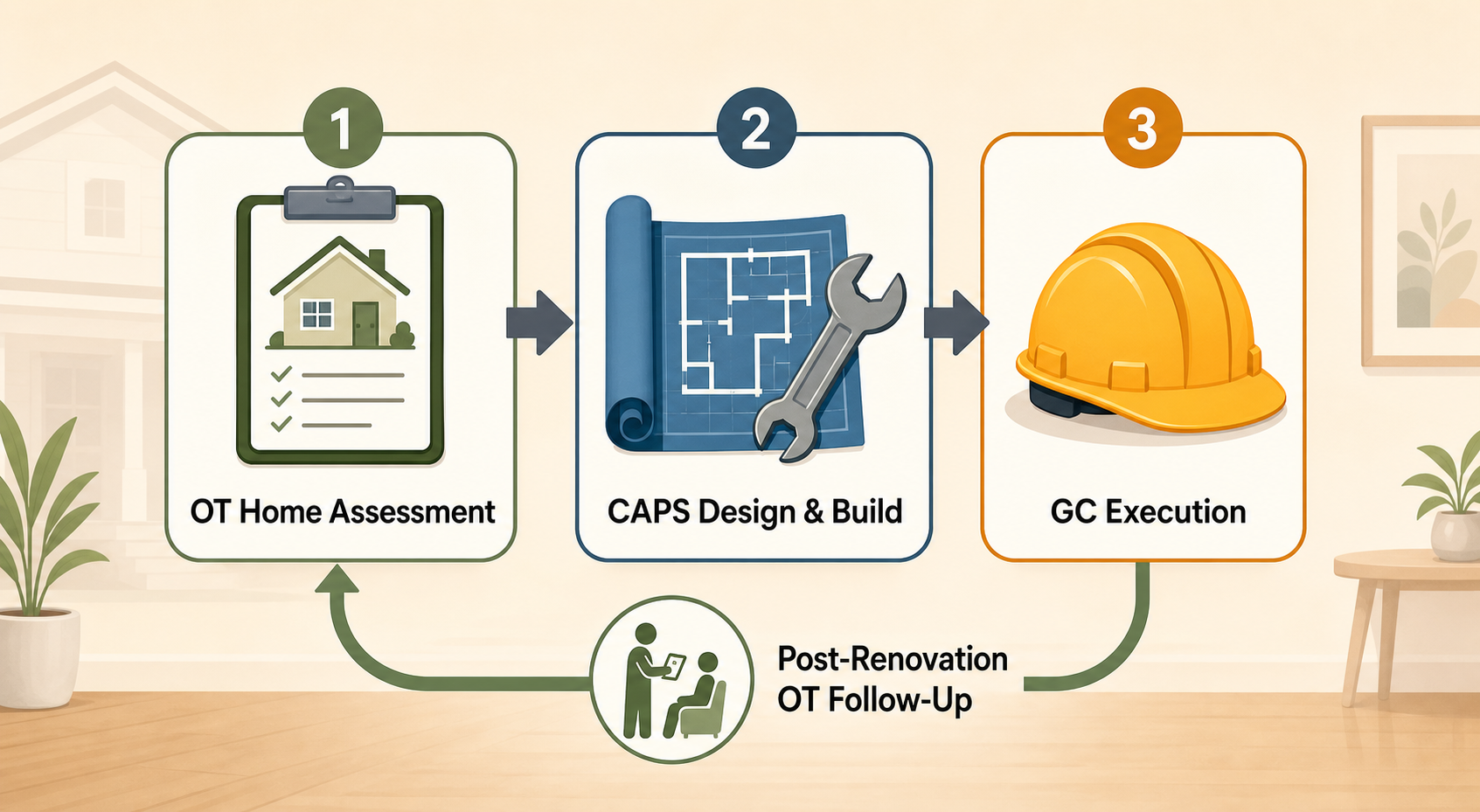
- Start with an OT home assessment. Schedule an evaluation through your parent's primary care provider. Check Medicare Part B coverage — the OT evaluation is often covered with no copay. The OT will produce a written report identifying specific functional barriers and recommending precise modifications.
- Engage a CAPS specialist to design and manage the modifications. Share the OT's report with the CAPS professional. The CAPS will translate the clinical recommendations into a construction plan, obtain quotes, hire subcontractors, and manage the project. The CAPS handles the design and build phase.
- If needed, a general contractor executes the construction under the CAPS specialist's oversight. For complex projects, the CAPS may subcontract the actual construction to a GC while retaining project management responsibility. For simpler projects, the CAPS may do the work directly.
- Conclude with a post-renovation OT follow-up. After the modifications are installed, schedule a follow-up OT visit to ensure the changes actually meet your parent's needs. The OT can identify adjustments — a grab bar that is two inches too high, a shower bench that is the wrong depth — that the CAPS or GC can correct before the project is closed.
This sequence ensures that clinical expertise drives the design, construction expertise executes the build, and clinical expertise validates the outcome. Skipping any step increases the risk of costly mistakes.
Why This Sequence Saves Time, Money, and Frustration
The evidence supporting a professional-first approach is substantial. The CAPABLE program — a federally funded model that combines OT home assessments with home modifications — spent approximately $1,300 per person on home improvements and achieved nearly 10 times that amount in net medical cost savings, according to a study published in the Journal of the American Geriatrics Society (Szanton et al.).
Starting with an OT assessment prevents the most common and costly mistake: installing modifications in the wrong location. A grab bar installed at the wrong height is not just useless — it can create a false sense of security that increases fall risk. An OT's clinical assessment eliminates this guesswork.
Consider the current state of the housing stock:
| Statistic | Source | Implication |
|---|---|---|
| Only 10% of U.S. homes are 'aging ready' | ChoiceMutual / AARP | 90% of homes need at least some modifications |
| Less than 4% of homes are aging-in-place ready | Amy Roberts, CAPS (Care.com) | Industry estimate; most homes lack basic accessibility features |
| Nearly 80% of older adults need bathroom modifications | AARP survey | Bathroom is the highest-priority room for modifications |
| Only 18% of adults 50+ have made any modifications | University of Michigan National Poll on Healthy Aging | Most families have not started the process |
For a deeper look at the research supporting home modifications, including fall reduction data and cost-effectiveness studies, see our article: The Evidence Behind Aging-in-Place Home Modifications.
How to Find a CAPS Specialist and What to Ask
Once you have the OT's recommendations in hand, the next step is finding a CAPS-certified professional to design and manage the project. The NAHB maintains a searchable directory of CAPS professionals on its website. You can search by location and verify current certification status.
When interviewing potential CAPS specialists, ask these questions:
- How long have you held your CAPS certification, and what continuing education have you completed?
- Have you worked with clients who have my parent's specific condition (e.g., Parkinson's, stroke recovery, dementia)?
- Can you provide references from three recent aging-in-place projects similar in scope to ours?
- Do you typically work with an occupational therapist's recommendations, or do you do your own assessment?
- Will you manage the entire project, including hiring and overseeing subcontractors?
- What is your process for handling unexpected issues during construction (e.g., finding mold behind a wall, discovering outdated wiring)?
- Do you provide a written contract with a detailed scope of work, timeline, and payment schedule?
For a more detailed explanation of the CAPS certification process and directory search, see our guide: What Does a CAPS Certified Aging-in-Place Contractor Do — and How to Find One.
Your Next Steps: A Clear Action Plan for Families
You now have a clear roadmap. Here is your action plan:
- Schedule an OT home evaluation. Contact your parent's primary care provider and ask for a referral to an occupational therapist for a home safety assessment. Check Medicare Part B coverage — the evaluation is often covered.
- Use the OT's recommendations to brief a CAPS specialist. Share the written report with one or more CAPS professionals. Let the clinical assessment guide the design, not the other way around.
- Hire the CAPS to design and manage the project. The CAPS will handle the construction plan, contractor coordination, and project oversight. Ensure you have a written contract with a clear scope of work.
- Follow up with the OT after modifications are complete. Schedule a post-renovation visit to confirm the modifications meet your parent's needs. Address any adjustments before the project is closed.
For a broader planning framework that integrates this professional choice into your overall home modification strategy, see our decision framework for adult children. And for a complete guide to funding your project — including VA grants, Medicaid waivers, and USDA loans — see How to Pay for Aging in Place Home Modifications.
If you are still unsure which acronym applies to your situation, our caregiver's cheat sheet for POA, CAPS, and PERS provides a quick reference for the three acronyms that determine where your parent lives.
Related reading
- CAPS vs. Occupational Therapist vs. General Contractor: Who Should You Hire for Aging-in-Place Home Modifications?
- CAPS vs General Contractor: Which Professional Should You Hire for Aging-in-Place Home Modifications?
- CAPS vs. General Contractor vs. OT: Who Should You Hire for Aging-in-Place Home Modifications?
Need a professional assessment?
Find a CAPS-credentialed professional or local aging services through our outbound resource list — we never name or rank individual contractors.
Find Local HelpNoticed something outdated or inaccurate on this page? Flag a correction. We review every report against CDC, NIA, and AARP HomeFit guidance before updating a page.