11 Signs It's Time for Assisted Living: An Evidence-Based Guide for Families
By Editorial Team
assisted living
caregiver burnout
medication management
ADLs
dementia communication
safety planning
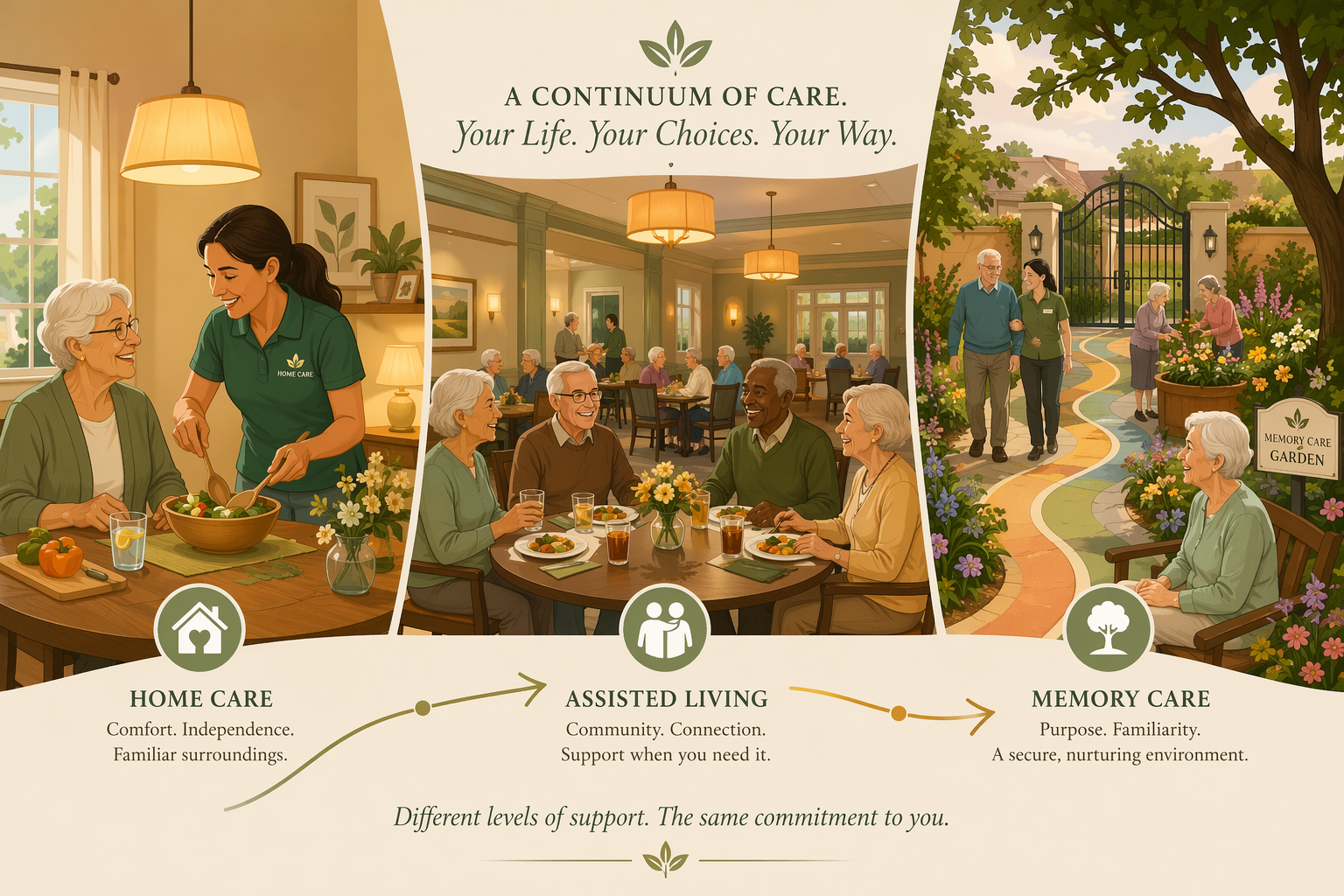
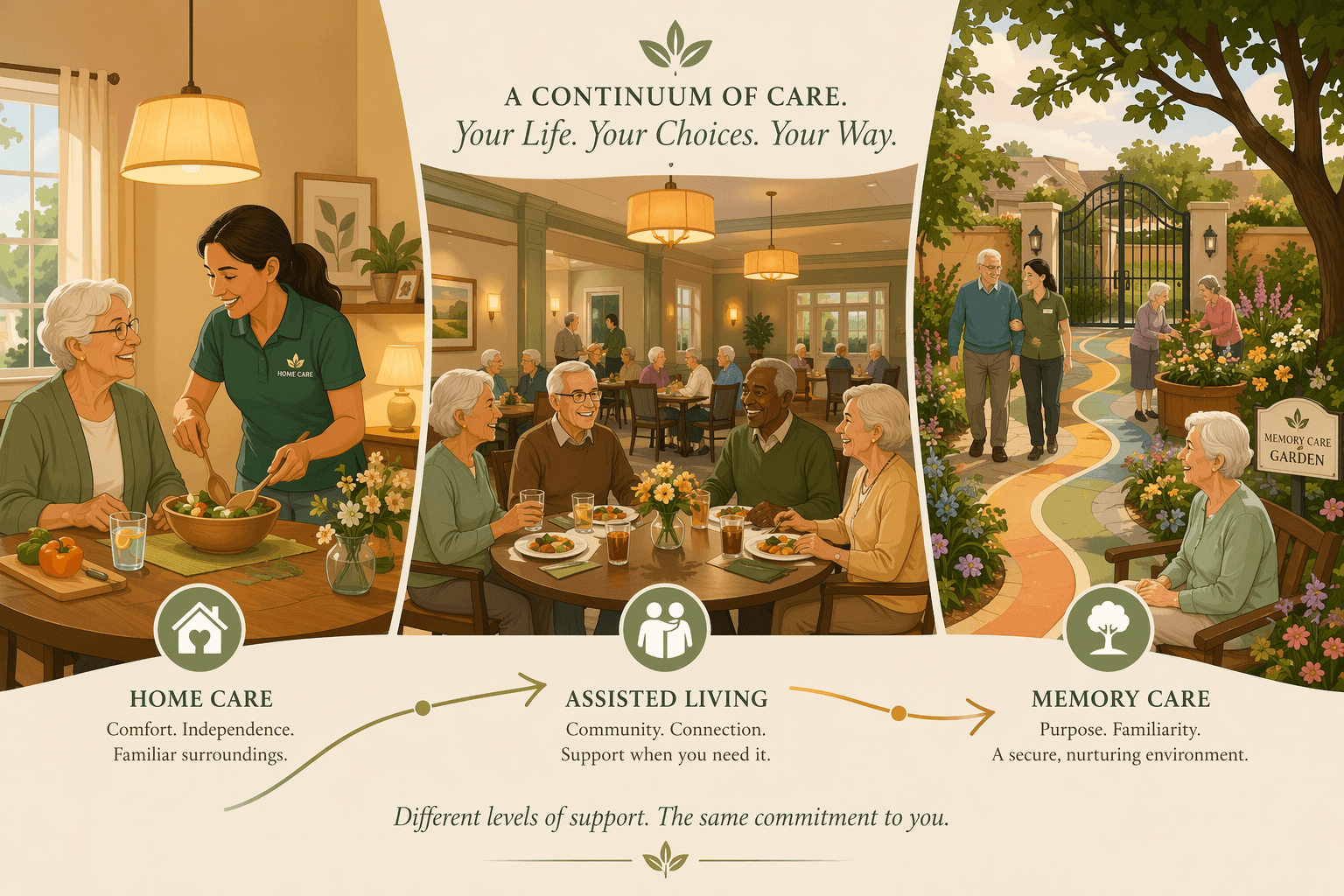
The care continuum from in-home support to assisted living to memory care — understanding where your parent falls on this spectrum is the first step toward making an informed decision.
Why Families Miss the Signs — and Why Earlier Recognition Matters
Most families do not ignore the warning signs out of neglect. They miss them because decline happens incrementally. A parent who has always been independent does not suddenly become unable to bathe or manage medications. The change unfolds in small, deniable steps: a missed pill here, a forgotten meal there, a bruise that might have come from bumping into a table. Each incident, viewed in isolation, seems manageable. It is only when you step back and see the pattern — or when a crisis like a fall or a hospitalization forces the issue — that the full picture emerges.
This normalization of decline is compounded by guilt. Adult children often feel they should be able to handle the situation themselves, especially if they promised a parent they would never "put them in a home." That promise, made years earlier when both parties imagined a different future, becomes a barrier to recognizing that assisted living is not abandonment — it is a different form of care that may be safer and more sustainable than what family caregiving alone can provide.
This guide presents 11 evidence-based signs that it is time to consider assisted living. Each sign is tied to a specific, observable behavior or situation — not a vague feeling that something is wrong. The data behind each sign comes from the CDC, the National Institute on Aging, and peer-reviewed research. If you recognize three or more of these signs in your parent's situation, it is worth having a serious conversation about whether assisted living is the right next step.
If you are still in the earlier stages of recognizing that your parent needs more help, you may find our guide on when it is time for in-home help useful for understanding the step before assisted living.
The 11 Evidence-Based Signs It's Time for Assisted Living
The following signs are organized by domain — activities of daily living, health and safety, social and emotional wellbeing, and caregiver capacity. Each sign includes what to look for, the data that supports it, and how assisted living specifically addresses that challenge.
Domain 1: Activities of Daily Living (ADLs)
Activities of daily living — bathing, dressing, toileting, transferring, and eating — are the fundamental tasks of personal care. When a senior cannot perform these tasks safely or consistently, it is the strongest signal that a higher level of support is needed.
Sign #1: Difficulty bathing or showering
Bathing is often the first ADL to become difficult. It requires balance, flexibility, and the ability to get in and out of a tub or shower safely. Look for: a noticeable decline in personal hygiene, a parent who has stopped bathing regularly, or visible fear or hesitation when entering the bathroom. According to the CDC, approximately 13.8% of adults aged 75 and older needed personal care assistance in 2024, and bathing is consistently the most common ADL that requires help.
Assisted living communities provide scheduled bathing assistance with grab bars, shower chairs, and trained staff who can help safely. This is one of the most common services residents use — most communities categorize residents into care levels based on how many ADLs they need help with, and bathing assistance typically places a resident at Level 2 or higher.
Sign #2: Difficulty dressing or choosing appropriate clothing
Dressing involves fine motor skills (buttons, zippers), cognitive function (choosing weather-appropriate clothing), and physical stamina. Signs include: wearing the same clothes repeatedly, dressing inappropriately for the weather (a heavy coat in summer, a thin shirt in winter), or struggling with buttons and zippers to the point of frustration or giving up.
In assisted living, staff provide verbal reminders or hands-on assistance with dressing as needed. This is typically included in the base care level or available as a low-cost add-on — the median monthly fee for low-level care across A Place for Mom's partner communities is approximately $600, with medium-level care (which includes dressing assistance) at about $1,500 per month.
Sign #3: Toileting accidents or incontinence
Incontinence is one of the most common reasons families decide assisted living is necessary. It is also one of the most difficult topics to discuss. Look for: soiled clothing, the smell of urine in the home, a parent who avoids leaving the house due to fear of accidents, or soiled linens hidden in the laundry.
Assisted living communities are equipped to manage incontinence with scheduled toileting assistance, incontinence products, and laundry services. This is a routine part of care at Level 2 and Level 3, and staff are trained to handle it with dignity. At home, managing incontinence alone or with family help is exhausting and often leads to social isolation for the senior.
Sign #4: Unintentional weight loss or poor nutrition
Weight loss in older adults is often attributed to aging itself, but it is usually a sign that a senior cannot shop for, prepare, or remember to eat nutritious meals. Look for: clothes that are noticeably looser, an empty refrigerator or one filled with expired food, a parent who eats the same convenience food every day, or a significant drop in weight between doctor visits.
Assisted living communities provide three meals a day, often with dietician-designed menus and the ability to accommodate dietary restrictions. For seniors who forget to eat or lack the energy to cook, this alone can reverse weight loss and improve overall health. The social aspect of dining in a communal setting also encourages better eating habits.
Domain 2: Health and Safety
Sign #5: Medication errors
Medication errors are the leading cause of emergency room visits among adults over 65, sending more than 600,000 seniors to the ER each year, according to the CDC. This is not a minor issue — a missed dose of a heart medication, a double dose of a blood thinner, or taking the wrong pill can have serious consequences.
Signs include: pill organizers that are not being used correctly, multiple half-empty prescription bottles, confusion about which medications to take when, or a parent who says they "don't need" their medications anymore. If your parent takes five or more medications — which is common for older adults — the risk of error increases significantly.
Assisted living communities offer medication management as a standard service. Staff administer medications on schedule, track refills, and coordinate with physicians and pharmacies. The median monthly fee for medication management across A Place for Mom's partner communities is approximately $550 — often less than the cost of one ER visit.
Sign #6: Frequent falls or near-falls
A single fall can change everything. For an older adult, a fall can mean a broken hip, a traumatic brain injury, a loss of confidence, and a cascade of decline that leads to permanent loss of independence. But falls are not inevitable — they are predictable and preventable with the right environment and support.
Look for: bruises that your parent cannot explain, a sudden reluctance to walk without holding onto furniture, or a parent who has stopped going to certain rooms in the house because they are afraid of falling. Also look for environmental hazards: loose rugs, poor lighting, clutter on the floor, or the absence of grab bars in the bathroom.
Assisted living communities are designed for safety: grab bars in bathrooms, non-slip flooring, handrails in hallways, emergency call systems in every room, and 24-hour staff availability. The average age of an assisted living resident is 87, and half of all residents are 85 or older — these communities are built for the specific fall risks of this age group.
Sign #7: Wandering or getting lost
Wandering is a common behavior in dementia, but it can also occur in seniors with mild cognitive impairment who become disoriented in familiar environments. Signs include: a parent who gets lost while driving to familiar places, who leaves the house at odd hours, or who cannot find their way back from a walk around the neighborhood.
Wandering is dangerous because it exposes seniors to traffic, weather, and the risk of falling in an unfamiliar location. In assisted living communities with memory care services, wandering is managed through secure environments, door alarms, and staff supervision. About 88% of memory care communities have secure facilities, and 41% have dedicated wandering management systems.
Domain 3: Social and Emotional Wellbeing
Sign #8: Social isolation and withdrawal
Social isolation is not just sad — it is dangerous. Studies have linked loneliness in older adults to higher rates of depression, cognitive decline, cardiovascular disease, and premature death. A study from the University of Chicago (NORC) suggests that seniors living in a community setting may actually outlive those who age in place, partly because of the social engagement and structured activities that communities provide.
Signs include: a parent who has stopped attending church, club meetings, or family gatherings; who spends most of the day watching television alone; who has lost interest in hobbies; or who says they are "fine" but seems withdrawn and flat. If your parent lives alone and does not have regular visitors, isolation is almost certain.
Assisted living communities offer built-in social opportunities: group meals, exercise classes, game nights, outings, and common areas where residents naturally interact. For a senior who has been isolated at home, the shift to a community setting can be transformative — not just for safety, but for quality of life.
Sign #9: Depression or anxiety
Depression is not a normal part of aging, but it is common — and often undiagnosed. In seniors, depression can look like irritability, fatigue, withdrawal, or a preoccupation with physical complaints rather than sadness. Anxiety often manifests as excessive worry about health, finances, or safety.
Look for: a parent who has stopped taking care of their appearance, who sleeps excessively or not at all, who expresses hopelessness or says they are a burden, or who has lost interest in activities they once enjoyed. Depression in older adults is treatable, but it often goes untreated because families attribute the symptoms to aging.
Assisted living communities can help by providing structure, social engagement, and access to mental health resources. Many communities have relationships with geriatric psychiatrists or social workers who can provide counseling on-site. The simple act of being around other people, eating meals on a schedule, and having a reason to get dressed in the morning can have a significant antidepressant effect.
Domain 4: Caregiver Capacity
Sign #10: Caregiver burnout
Caregiver burnout is often the last thing families notice — and the first sign that a professional solution is needed. Family caregivers — especially adult children in their 40s and 50s who are balancing jobs, their own families, and caregiving — frequently push through exhaustion, irritability, and declining health for months or years before acknowledging that they cannot continue.
Signs of burnout include: feeling resentful toward the person you are caring for, snapping at your parent or other family members, neglecting your own health (skipping doctor appointments, poor sleep, poor diet), feeling constantly exhausted even after rest, or secretly wishing something would happen so the caregiving would end. These feelings are normal, but they are also a signal that the current arrangement is not sustainable.
If you recognize these signs in yourself, we encourage you to read our caregiver burnout self-assessment checklist and our guide to the four stages of caregiver burnout. Recognizing your own limits is not a failure — it is a necessary step toward finding a sustainable solution for everyone involved.
Sign #11: Your parent needs more help than you can provide
This is the most honest and often the hardest sign to acknowledge. You may be doing everything you can — visiting daily, managing medications, coordinating doctor appointments, handling finances — and it is still not enough. Your parent may need care that requires two people to transfer them safely, or 24-hour supervision, or skilled nursing that you are not trained to provide.
Assisted living communities have staff-to-resident ratios that allow for multiple caregivers to assist with transfers, bathing, and other physically demanding tasks. They have nurses on staff or on call. They have systems in place for medication management, fall response, and emergency care. What you are trying to do alone — or with a small group of family members — is what an entire team of trained professionals does every day.
If you are a working caregiver struggling to balance job and eldercare, our working caregiver survival system offers practical strategies for managing both responsibilities while you evaluate longer-term care options.
What the Data Says: The Doctor-Recommended Threshold
While every situation is unique, clinicians and researchers have identified a general threshold that signals a move to assisted living is warranted. When a senior needs help with two or more activities of daily living — such as bathing, dressing, or medication management — assisted living is typically the appropriate level of care.
This threshold is supported by the data on who actually lives in assisted living communities. The average age of an assisted living resident is 87, and half of all residents are 85 or older. These are not people who need a little extra help — they are people who need consistent, daily support with multiple aspects of personal care.
The CDC reports that approximately 13.8% of adults aged 75 and older needed personal care assistance in 2024. That number rises sharply with age. If your parent is in their mid-80s and showing signs of difficulty with two or more ADLs, they are in the demographic that assisted living is designed to serve.
How to Start the Conversation and Take the Next Steps
Once you have recognized the signs, the next step is the hardest: talking to your parent about it. Here is a practical, non-prescriptive approach to starting that conversation and moving forward.
1. Start with a specific concern, not a conclusion
Do not begin the conversation by saying "I think you need to move to assisted living." That is a conclusion, and it will trigger defensiveness. Instead, start with a specific, observable concern: "Mom, I noticed you've lost some weight recently. I'm worried you're not eating enough. Can we talk about what's going on?" This keeps the conversation focused on a problem you can solve together, rather than a decision you are making for them.
2. Gather the right documents
Before you tour any communities, gather the following information:
Medical records, including a list of current diagnoses, medications, and recent hospitalizations
Financial information: income (Social Security, pensions, retirement accounts), assets, and long-term care insurance if applicable
Legal documents: power of attorney, healthcare proxy, and any advance directives
A list of preferred doctors and specialists, and whether they accept Medicare or Medicaid
3. Tour communities together
When you have narrowed down a few options, visit them together. Pay attention to how the staff interacts with residents, whether the environment feels clean and safe, and whether the activities and meals seem appealing. Ask about the care level system — how does the community assess a new resident's needs, and how does the cost change as needs increase?
4. Plan for a gradual transition
If possible, plan for a gradual move rather than an immediate one. Some communities offer short-term respite stays (a few weeks) that allow your parent to try the environment before committing. Others allow residents to start with a lower level of care and increase services as needs change. A gradual transition reduces the shock of the move and gives everyone time to adjust.
When Assisted Living Is Not Enough: Signs You Need Memory Care or Skilled Nursing
Assisted living is the right level of care for many seniors, but it is not the right level for everyone. Some situations require a higher level of support — either memory care for advanced dementia or skilled nursing for complex medical needs. Understanding the difference is critical to making the right choice.
When memory care is the right choice
Memory care is a specialized form of residential care for seniors with Alzheimer's disease or other forms of dementia. It is appropriate when a senior's cognitive decline has progressed to the point where they need a secure environment, specialized programming, and staff trained in dementia care. About 80% of A Place for Mom's partner assisted living communities also offer memory care services, often in a separate wing or building on the same campus.
Signs that memory care is needed include:
Wandering or attempting to leave the home unsupervised
Aggression, agitation, or paranoia that puts the senior or others at risk
Inability to recognize familiar people, including family members
Frequent falls or injuries related to disorientation
Sleep disturbances that lead to nighttime wandering or unsafe behavior
Memory care communities provide additional security features: locked entrances, secure outdoor courtyards (78% of communities have enclosed courtyards), color-coded walls to help residents navigate, and specialized therapies like music, art, and reminiscence therapy. Staff receive specialized dementia training in 79% of partner memory care communities.
When skilled nursing is the right choice
Skilled nursing facilities (nursing homes) provide 24-hour nursing care for seniors with complex medical needs. This is the appropriate level of care when a senior requires daily medical monitoring, wound care, IV medications, or rehabilitation after a hospitalization.
Signs that skilled nursing is needed include:
A recent hospitalization or surgery that requires ongoing medical monitoring
Chronic conditions that require daily nursing care (e.g., diabetes management, wound care, feeding tubes)
Inability to transfer or move without mechanical assistance or two-person help
Advanced dementia with significant behavioral symptoms that cannot be managed in a less restrictive setting
Cost comparison across care types
Cost is a significant factor in choosing the right level of care. The following table compares national median monthly costs across care types. Note that costs vary significantly by state and by the specific services needed.
National median monthly costs for senior care types. Multiple sources are cited where methodology differs.
Care Type
National Median Monthly Cost
Source and Methodology
Assisted Living
$5,419
A Place for Mom (2026, based on 24,000+ residents in partner network)
Assisted Living
$6,313
SeniorLiving.org (May 2026, based on community pricing surveys)
Memory Care
$6,690
A Place for Mom (2026, partner network data)
Skilled Nursing (semi-private room)
$8,200
FLTCIP (2021 survey); also $104,025/year per Alzheimer's Association via Harvard Health (2024)
Skilled Nursing (private room)
$9,277–$10,646
CareScout (2026); also $116,800/year per Alzheimer's Association via Harvard Health (2024)

Comments
Join the discussion with an anonymous comment.