
Caregiver decision guide
When Is It Time for In-Home Help? Recognizing the Signs and Overcoming Caregiver Guilt
This article helps family caregivers recognize the functional and emotional milestones that signal it's time to bring paid help into the home. It addresses the guilt, financial anxiety, and difficulty identifying decline that often delay this decision, and offers a practical framework for acting earlier and avoiding crisis-driven choices.

The Emotional Barrier: Why We Wait Too Long to Ask for Help
The hardest part of caregiving is rarely the physical work. It is the moment you realize you cannot do it all alone and must ask for help. That realization often arrives wrapped in guilt — guilt that you are failing your parent or spouse, guilt that you are abandoning a promise, guilt that you are spending money on something you feel you should be able to provide yourself.
What many family caregivers do not realize is that the person they are caring for is likely feeling the same way. Johns Hopkins Medicine describes this as mirrored guilt: the caregiver feels guilty for needing a break, while the older adult feels guilty about being a burden. Both sides suffer in silence, and the decision to get help gets postponed until a crisis — a fall, a hospitalization, a missed medication — forces the issue.
The data bears this out. According to the Family Caregiver Alliance, 66% of older people with disabilities who receive long-term services and supports at home get all their care exclusively from family — mostly wives and daughters. Only 9% rely on paid help alone. That means millions of families are operating at the very edge of their capacity, often for years, before they even consider bringing in support.
Reframing the decision is essential. Bringing in home help is not a sign of failure. It is a strategy for sustainability. It allows you to focus on being a daughter or a son rather than a nurse or a home health aide. And it gives the person you care for the chance to receive professional support while staying in the place they want to be: their own home.
For a deeper exploration of how to set boundaries without guilt, see our guide on Setting Caregiving Boundaries Without the Guilt.
Functional Red Flags: When Daily Life Starts to Slip
The decline that signals a need for help is rarely dramatic. It is a slow accumulation of small failures — the missed shower, the unopened mail, the half-eaten meal. These are not character flaws or signs of laziness. They are functional breakdowns that indicate the person can no longer safely manage their daily life without assistance.
Here are the most common red flags that suggest it is time to consider in-home help:
- Missed meals and unexplained weight loss. The refrigerator is full of expired food. The person has lost interest in cooking or forgets to eat entirely.
- Declining personal hygiene. Unwashed clothes, body odor, unbrushed teeth, or the same outfit worn for days. Bathing has become too difficult or frightening.
- Medication mismanagement. Missed doses, double doses, or expired prescriptions piling up. The pill organizer is untouched or incorrectly filled.
- Fall incidents or near-misses. Bruises the person cannot explain, a new fear of stairs, or a recent fall that did not require a hospital visit but should not be ignored.
- Social withdrawal. Cancelled plans, unanswered phone calls, and a shrinking world. Isolation accelerates both physical and cognitive decline.
- Unpaid bills and disorganized finances. Late notices, unopened bank statements, or confusion about basic financial tasks that were once routine.
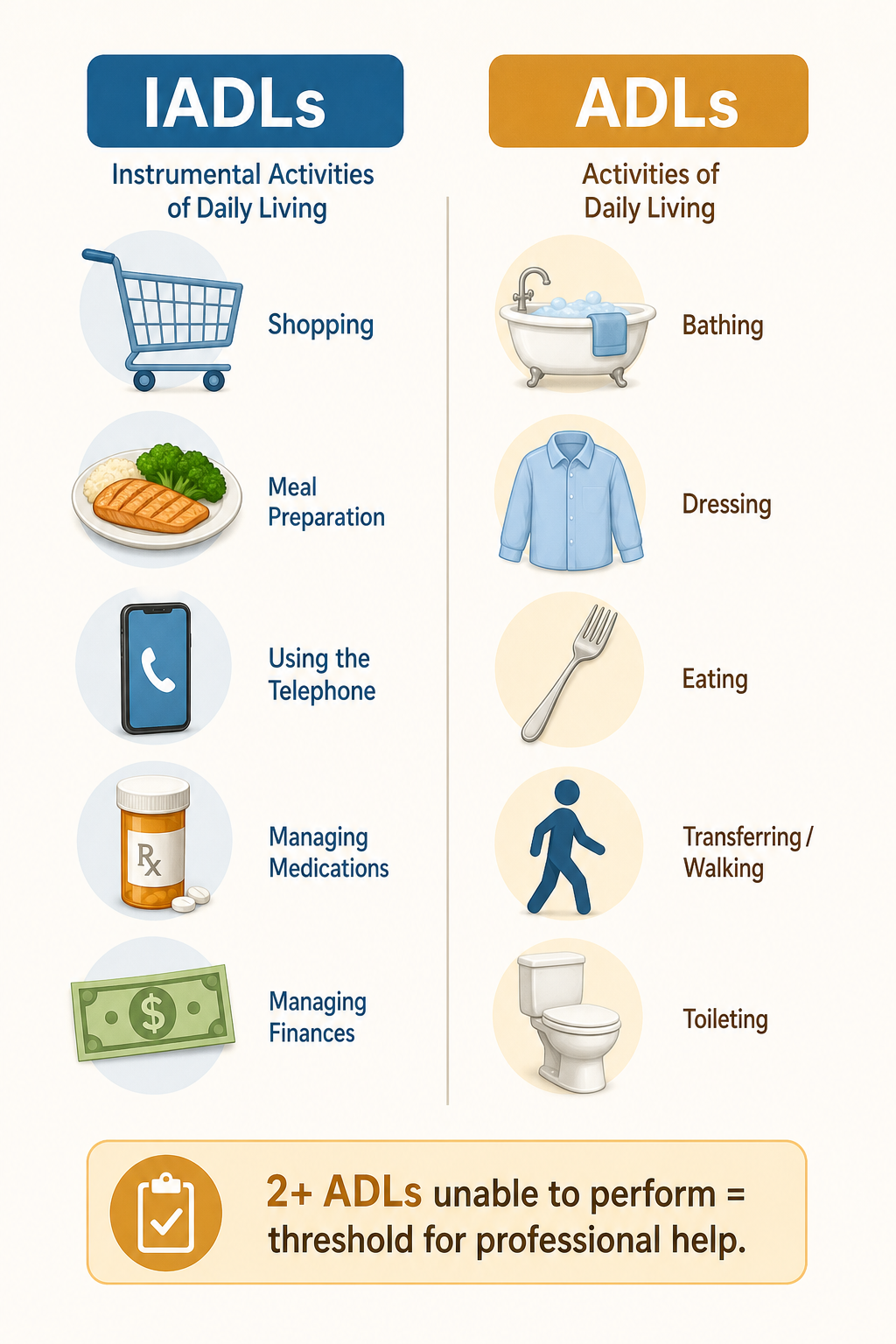
These signs map directly to the two frameworks clinicians use to assess functional independence: Activities of Daily Living (ADLs) and Instrumental Activities of Daily Living (IADLs). When a person begins to struggle with IADLs — the complex tasks like managing money and preparing meals — it is often the earliest warning. When ADLs — the basic physical tasks like bathing and dressing — start to slip, the need for hands-on help has arrived.
The Burnout Equation: Your Health and Their Health Are Connected
There is a persistent myth in caregiving that sacrificing your own health is a sign of devotion. The research tells a different story. Johns Hopkins Medicine has documented that when caregivers neglect their own well-being, the well-being of their loved one is likely to suffer as well. The two are not in competition. They are linked.
The scale of the caregiving population has grown dramatically. A 2025 study published in Health Affairs and led by the Johns Hopkins Bloomberg School of Public Health found that the number of family caregivers supporting older adults increased 32% between 2011 and 2022 — from 18.2 million to 24.1 million. For those caring for someone with dementia, the weekly care hours jumped by nearly 50%, from an average of 21.4 hours per week to 31.0 hours. That is nearly a full-time job on top of a full-time job.
When you are running on empty, the quality of care you provide degrades. You become shorter-tempered. You miss subtle changes in your parent's condition. You make mistakes with medications. You stop noticing the small things — the new bruise, the untouched plate, the confusion that seems a little worse than yesterday.
Bringing in help is not an admission that you have failed. It is an acknowledgment that the equation is unsustainable. If you are unsure where you stand, our Caregiver Burnout Signs and Symptoms self-assessment checklist can help you evaluate your current state. For a deeper understanding of how burnout progresses, see The 4 Stages of Caregiver Burnout.
Concrete Thresholds: When the Numbers Say It's Time
Emotional readiness is important, but concrete functional thresholds provide an objective benchmark. These are the points at which professional home help is no longer optional — it is necessary for safety and quality of life.
| Domain | Examples | Threshold for In-Home Help |
|---|---|---|
| ADLs (Activities of Daily Living) | Bathing, dressing, eating, toileting, transferring (getting in/out of bed or chair) | Inability to perform 2 or more ADLs independently |
| IADLs (Instrumental Activities of Daily Living) | Meal preparation, medication management, money management, transportation, phone use | Inability to perform 3 or more IADLs; this often precedes ADL decline |
| Dementia Progression | Wandering, sundowning, difficulty recognizing familiar people, safety risks (stove, driving) | Any stage beyond early-stage where supervision becomes necessary for safety |
| Post-Hospitalization Gap | Recovery from surgery, stroke, or fracture; temporary mobility loss; new medication regimen | Any period where the person cannot safely manage alone during recovery |
A key distinction: these thresholds point to bringing help into the home, not to moving the person to a facility. The 2026 Pew Research Center survey found that 93% of U.S. adults aged 65 and older live in their own home or apartment. Among those who do not yet have a caregiver, 60% said that if they could no longer live alone, they would want to stay in their home and have someone care for them there. Only 37% of that group believed this outcome was extremely or very likely to happen. The gap between desire and expectation is precisely where in-home help can make the difference.
The Trial Period Approach: Reducing the Fear of Commitment
One of the most effective strategies for overcoming the emotional barrier is to stop thinking of home help as a permanent, all-or-nothing decision. A trial period — a few hours a week for a set number of weeks — reduces the perceived risk for everyone involved.
Here is how a trial period approach works in practice:
- Start small. Arrange for a caregiver to come for 3–4 hours, twice a week. Use that time for specific tasks: meal preparation, light housekeeping, or companionship while you run errands.
- Frame it as an experiment. Tell your parent: "Let's try this for two weeks and see how it feels. If it doesn't work, we can stop." This lowers the stakes for both of you.
- Use respite care as an entry point. Respite care is explicitly temporary and designed to give family caregivers a break. If the idea of ongoing help feels too big, start with a single respite visit. Our guide on Respite Care Options for Family Caregivers covers how to find and fund short-term care.
- Evaluate together. After the trial period, sit down with your parent and discuss what worked and what did not. Often, the resistance fades once the person experiences the actual benefit — a hot meal, a clean kitchen, a friendly conversation with someone new.
The National Council on Aging (NCOA) recommends this same approach in its step-by-step guide to hiring a caregiver: arrange a trial period before committing to a long-term arrangement. It allows both the family and the caregiver to assess fit without pressure.
Cost Reality Check: Part-Time Help vs. the Full-Time Burden
Cost is often the first objection families raise, and it is a legitimate concern. But the financial picture changes when you compare the cost of part-time help against the long-term financial toll of uncompensated caregiving.
| Cost Factor | Estimated Amount | Source Notes |
|---|---|---|
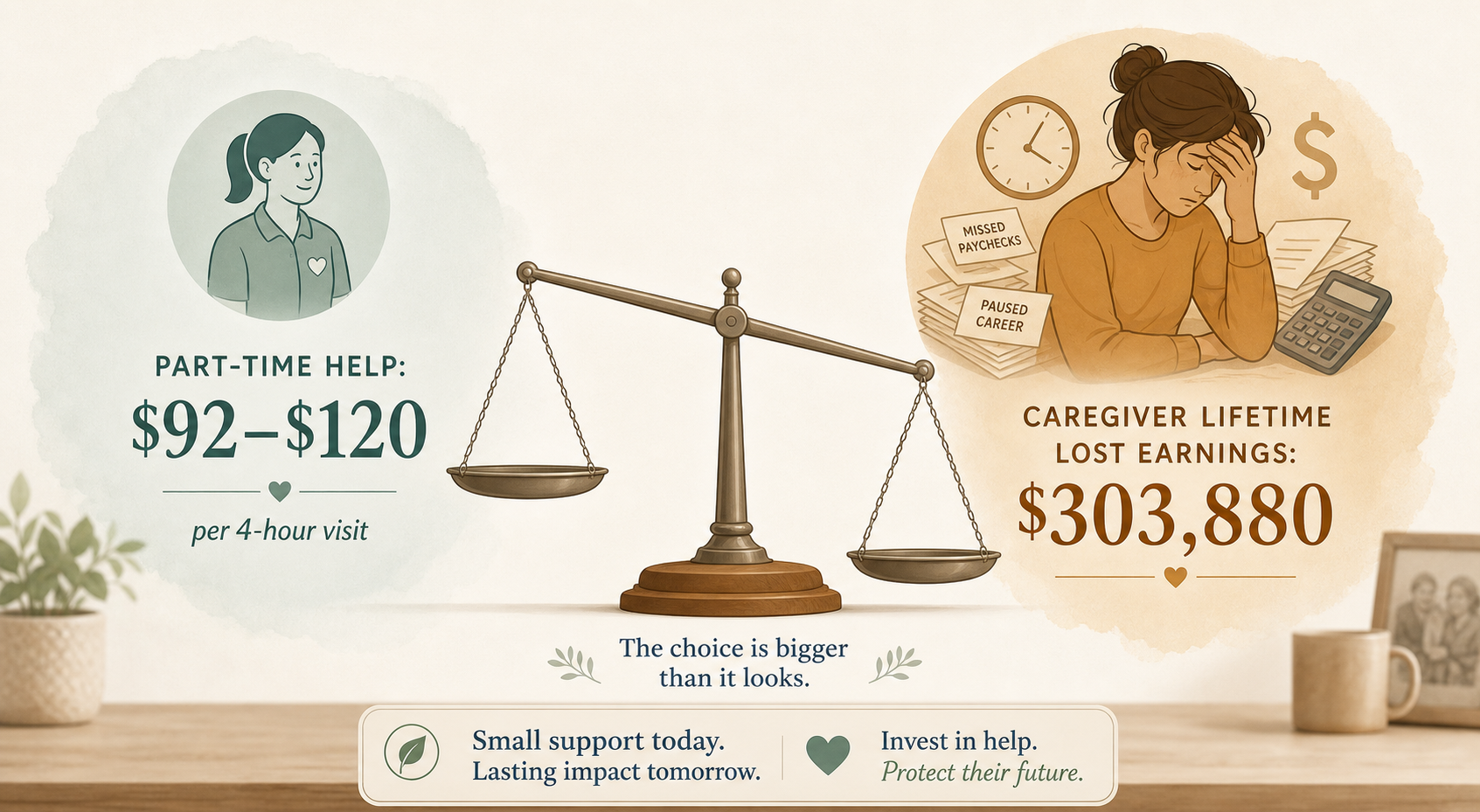
| Part-time home help (4-hour visit) | $92 – $120 per visit ($23–$30/hour) | CareLink (current); many agencies require a 4-hour minimum |
| Full-time home care (40 hours/week) | $3,680 – $4,800 per month | Based on $23–$30/hour rate |
| Average lifetime lost income for family caregivers | $303,880 | Family Caregiver Alliance / AARP (2011 data); ranges from $283,716 (men) to $324,044 (women) |
| Annual value of unpaid family caregiving (national) | $450 billion | Family Caregiver Alliance (2009 estimate) |
The point is not to induce guilt. It is to reframe the calculation. Paying $92 to $120 for a 4-hour visit may feel expensive in the moment, but it is a fraction of what you lose over time in reduced work hours, missed promotions, and depleted retirement savings. And that is before accounting for the health costs of burnout — your own doctor visits, medications, and lost quality of life.
For those with limited income, options exist. Medicaid covers personal and skilled care for eligible seniors, though benefits vary by state. The National Institute on Aging notes that long-term care insurance may cover companion visits or respite. Programs like Consumer-Directed Attendant Support Services (CDASS) allow seniors to hire family members as paid caregivers in some states. Only 21% of adults 65 and older have long-term care insurance, according to the 2026 Pew survey, so most families will need to explore Medicaid, veterans' benefits, or community-based programs.
How to Have the Conversation with a Resistant Parent
The conversation about bringing in help is often harder than the decision itself. Many older adults hear "you need a caregiver" as "you are a burden" or "you are losing your independence." The way you frame the discussion determines whether it becomes a collaborative plan or a battle.
Here are strategies that can help:
- Lead with your own needs, not their deficits. Say "I need help taking care of you so I can be a better daughter/son" rather than "You cannot manage on your own." This frames the help as something you need, not something they have failed at.
- Focus on preserving independence. Emphasize that a home aide handles the tasks that have become frustrating or difficult — cleaning, cooking, bathing — so your parent can focus on the things they still enjoy. The goal is to keep them at home longer, not to take over their life.
- Use the doctor as an ally. A recommendation from a primary care physician or geriatrician carries weight that a family member's suggestion often does not. Ask the doctor to raise the topic during a routine visit.
- Involve a neutral third party. A social worker, care manager, or trusted clergy member can facilitate the conversation without the emotional baggage that parent-child dynamics carry. The Institute on Aging recommends asking potential agencies how they match caregivers to clients based on communication style, personality, and cultural values — the same principle applies to the initial conversation.
- Start with one task. Instead of proposing a full care plan, suggest help with one specific thing: "What if someone came by twice a week to help with the laundry and grocery shopping?" A small entry point is less threatening than a comprehensive overhaul.
If you are new to the caregiving role entirely, our Getting Started as a Family Caregiver guide provides a broader orientation to the responsibilities and decisions ahead.
Resources for the Next Step
Once you have recognized the need and begun the conversation, the next step is finding the right help. These authoritative resources can guide you:
- National Institute on Aging (NIA) — Offers detailed information on home health care, companion services, meal programs, and transportation. Their Services for Older Adults Living at Home page is a comprehensive starting point.
- National Council on Aging (NCOA) — Their step-by-step guide on how to find a good caregiver covers assessing needs, creating a job description, and screening candidates.
- Family Caregiver Alliance (FCA) — Provides state-by-state fact sheets, support groups, and a caregiving statistics page with data on costs and demographics.
- Eldercare Locator (1-800-677-1116) — A public service of the U.S. Administration on Aging that connects families to local Area Agencies on Aging for home care referrals, meal programs, and transportation.
- Institute on Aging — Offers five essential questions to ask before choosing a home care provider, covering caregiver matching, backup plans, and family communication systems.
When evaluating a home care agency or independent caregiver, the NCOA recommends asking for multiple references, conducting criminal background checks, verifying certifications (HHA, CNA, LVN), and always arranging a trial period before committing to a long-term arrangement. These steps protect both your family and the person you are hiring.
Questions to bring to a clinician or OT
This is not medical, legal, or a family's final decision — only a framework. Bring these questions to a clinician, occupational therapist, or your local Area Agency on Aging.
Find Local HelpRelated reading
Noticed something outdated or inaccurate on this page? Flag a correction. We review every report against CDC, NIA, and AARP HomeFit guidance before updating a page.