24/7 Home Care vs. Live-In Care vs. Memory Care: How to Choose the Right Level of Round-the-Clock Support
Reviewed: 2026-06-24
24/7 Home Care vs. Live-In Care vs. Memory Care: How to Choose the Right Level of Round-the-Clock Support
Many families confuse 24/7 home care, live-in care, and memory care — but each has a different cost, staffing structure, and level of overnight supervision. This guide breaks down the differences and provides a decision framework based on your loved one’s nighttime needs, fall risk, and budget.
By Editorial Team
24/7 home care
live-in care
memory care
nighttime safety
caregiver decision
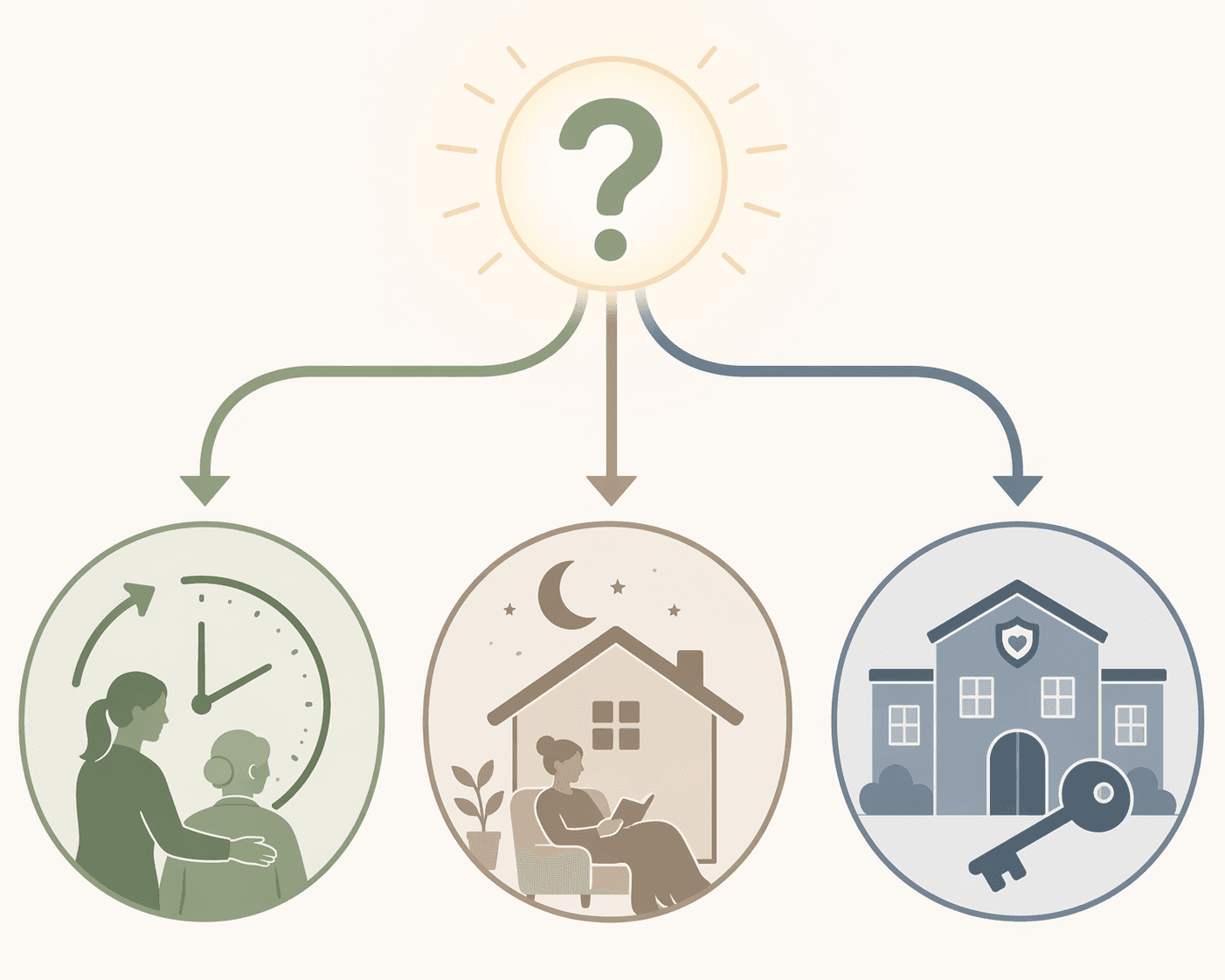
Start with One Question
Before you call an agency, before you look at a single monthly figure, before you tour a memory care facility, answer this: does your loved one need awake overnight supervision?
If the answer is yes, live-in care is off the table. If the answer is no, live-in care might be the most cost-effective and least disruptive option. Everything else — cost, diagnosis, daytime needs — is secondary.
I have watched too many families choose live-in care because it costs half as much as 24/7 care, only to discover after a fall or a wandering episode that the senior was alone for eight hours every night. The term “live-in” implies constant presence, but the caregiver is not awake. The care agency is required to give them a sleeping break — and during those eight hours, no one is monitoring your loved one.
The Three Models — and the Detail That Every Family Misses
Families use the terms 24/7 home care, live-in care, and memory care as though they were interchangeable. They are not. The staffing structure, the cost, and — most importantly — what happens overnight are completely different.
24/7 home care means two or more caregivers rotate awake shifts, typically eight or twelve hours, so someone is always present and alert. The caregiver on the night shift is awake and available to respond to a fall, redirect wandering, or help with a bathroom trip. This is continuous active supervision, and it costs accordingly.
Live-in care is different. One caregiver lives in the home and works a long shift, but labor regulations require that the live-in caregiver receive an eight-hour sleep break and a bed to rest in. During that period the senior is unsupervised. The caregiver is present in the home but not awake and not available. This is the detail that families routinely miss.
Memory care is a secured facility. Staff are trained in dementia care, the unit is locked to manage wandering, and overnight staffing is designed for the cognitive and behavioral needs of residents. The cost bundles housing, meals, activities, and care into a single monthly figure. The trade-off is that the senior leaves home.
The three models differ fundamentally in staffing, overnight coverage, and cost.
24/7 Home Care
Live‑In Care
Memory Care
Staffing structure
2+ caregivers rotating awake shifts
1 caregiver with an 8‑hour sleep break
Facility staff (trained in dementia care)
Overnight coverage
Awake caregiver throughout the night
Senior is unsupervised during sleep break
Staffed overnight, but not one‑on‑one
Typical monthly cost
~$24,733 (2026 national median)
~$10,646 (proprietary data)
$5,500–$8,000 (composite range)
Best fit
High fall risk, wandering, frequent overnight needs
Sleeps through the night with minimal assistance
Advanced dementia, unsafe wandering, need for social engagement
24/7 home care uses rotating awake shifts, ensuring someone is always alert and available.
Why Cost and Diagnosis Are Dangerous Starting Points
Most articles begin with cost, and most families begin with diagnosis. Both can lead to a dangerous mismatch.
The cheapest option — live-in care at roughly $10,646 per month — looks like a clear win over 24/7 care at $24,733 per month (2026 national median from A Place for Mom). But that saving disappears entirely if the senior falls one night and no one is there to respond. A single hospitalization can cost more than the difference between the two models for an entire year.
Cost figures vary by source and geography. A Place for Mom’s 2026 data puts 24/7 home care at $24,733 per month; AgingCare, using Genworth’s 2025 survey, reports $19,656. The difference reflects different hourly rates and survey years. The reality is that rates range from $25 per hour in Mississippi to $44 per hour in South Dakota, so your local cost could be far from either national median. Treat these numbers as directional, not fixed.
Leading with diagnosis is equally misleading. Dementia does not automatically mean 24/7 care is required. Many people with dementia sleep through the night with minimal disturbance. Conversely, a post-surgery senior with a hip replacement and no cognitive impairment may need repositioning and bathroom help every two hours — and will be unsafe with a sleeping caregiver. The deciding factor is not the diagnosis; it is the observable nighttime behavior.
What to Look for at Night — the Real Decision Signals
You do not need a clinical assessment. You need to observe a few specific behaviors over a few nights and report them honestly.
Does she get up at night? If yes, how often? If she gets up and wanders or tries to walk without help, she needs awake supervision — 24/7 home care or memory care. Live-in care is out.
Does she call out or seem confused after waking? Sundowning behavior often peaks between 4 p.m. and midnight. If a senior is agitated during those hours, a single live-in caregiver who started at 8 a.m. may be exhausted and less effective. A rotating awake shift structure suits this pattern better.
Does she need help with bathroom trips or repositioning? Even if she stays in bed, if she needs physical assistance to turn or use a bedside commode, an awake caregiver must be there. Live-in care cannot provide that.
Can she call for help if something goes wrong? If she cannot use a call button or make a phone call, then being alone for eight hours is dangerous regardless of mobility.
Is she safe to be left alone at home during the day? If home modifications and long-distance monitoring can manage daytime risks but overnight needs are minimal, live-in care might still work — provided the nighttime checklist is clear.
Scenario one: Margaret, 82, has moderate dementia but sleeps soundly from 9 p.m. to 6 a.m. She uses a walker during the day but stays in bed at night. Her daughter lives nearby and visits daily. Margaret uses a call button on a lanyard and answers the phone. She needs help with meals and bathing but not overnight. Live-in care at roughly $10,646 per month is appropriate and safe. The trade-off is that the caregiver — not Margaret — controls the schedule. Margaret’s daughter should also plan for the possibility that overnight needs may appear as the dementia progresses. The average service duration for in-home care is 15 to 20 months, according to A Place for Mom, and many families escalate during that window.
Scenario two: James, 78, has vascular dementia. He is mobile but disoriented at night. He wanders, tries to leave the house, and has fallen twice in the past month. He does not sleep through. Live-in care is not an option — he would be unsupervised for eight hours every night. The choice is between 24/7 home care, with two caregivers rotating awake shifts, at around $24,733 per month, or memory care in a secured facility, at roughly $5,500 to $8,000 per month. If James’s home can be made reasonably safe and the family can afford the 24/7 cost, many families choose to keep him home. If the wandering escalates or the caregiver burden becomes unsustainable, memory care is the safer fallback.
Scenario three: Ellen, 70, is recovering from a hip replacement. She has no cognitive impairment but cannot get out of bed without help. She needs repositioning every two hours and help with a bedside commode during the night. Even though she is alert, her physical needs are too high for a sleeping caregiver. Live-in care is unsafe. Ellen needs 24/7 home care with awake overnight shifts, at $24,733 per month. Because her need is short-term (likely 3–6 months), some families negotiate a temporary rate with the agency or explore whether Medicare covers a portion through a home health aide under specific conditions. For payment options, see How to Pay for Elderly Home Care: Medicare, Medicaid, VA Benefits, and Out-of-Pocket Options Explained.
When and How to Switch Models
Most families start with one model and escalate as needs change. The key is to recognize concrete triggers — not vague “when the time comes” language.
If a senior on live-in care starts getting up twice or more during the night, or begins wandering, call the agency immediately. They can restructure to 24/7 by adding a second caregiver for overnight awake coverage. Do not wait for a fall.
If wandering becomes frequent despite door alarms, locks, and home safety measures, memory care becomes the safer option. The secured setting removes the risk altogether.
If a caregiver shows signs of burnout — fatigue, irritability, calling in sick — that is also a trigger. The arrangement may no longer be sustainable even if the senior’s needs have not changed dramatically.
If a senior who was stable after a hospitalization develops new nighttime confusion or mobility decline, reassess within days. Temporary needs can turn permanent quickly.
The framework is simple: start with what happens at night.
The One Question You Should Answer First
Before you call an agency, before you crunch the numbers, before you tour a single memory care facility, answer this question: does my loved one need awake overnight supervision? If the answer is yes, live-in care is off the table. If the answer is no, live-in care may be the most cost-effective and least disruptive option.
Call a home care agency tonight and ask: what happens if my loved one wakes up during the caregiver’s sleep break? How is the overnight shift staffed? If they cannot give a clear answer, move on to an agency that can. The right choice for your family is the one that matches the actual needs of the night — not the label on the brochure.


Comments
Join the discussion with an anonymous comment.