
Assisted Living vs. Memory Care: A Decision Framework for Dementia Caregivers
A head-to-head comparison of assisted living and memory care for families navigating a dementia diagnosis. Learn the key differences in safety, staff training, cost, and therapies, plus how to plan a staged transition when both options are available on the same campus.
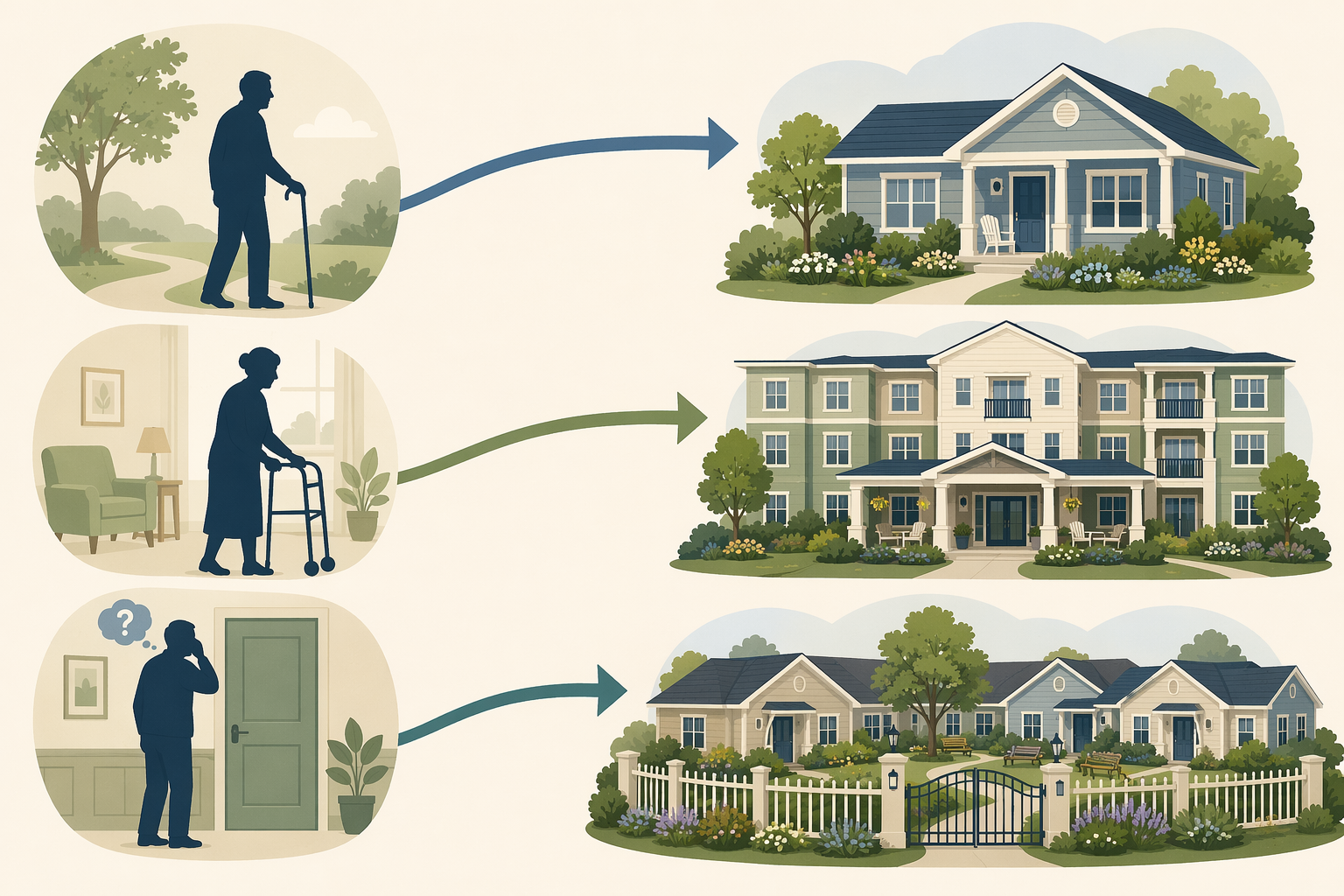
The Core Difference: ADL Support vs. Dementia-Specialized Care
The most common mistake families make is treating assisted living and memory care as interchangeable options with different price tags. They are not. The two care types are built on fundamentally different operating models, and the choice between them should be driven by the specific needs of the person with dementia, not by cost or convenience alone.
Assisted living is designed for older adults who need help with activities of daily living (ADLs) — bathing, dressing, medication management, and meal preparation — but who are otherwise cognitively intact and can navigate their environment safely. Staff are trained in personal care assistance, not in managing the behavioral and psychological symptoms of dementia. The physical environment is typically open: residents come and go, doors are unlocked, and the community relies on residents being able to find their own way to the dining room and back to their apartment.
Memory care, by contrast, is a secured, dementia-specific environment. Its entire design — from locked entrances and keypad exits to enclosed courtyards and color-coded hallways — exists to prevent wandering and reduce disorientation. Staff receive specialized training in dementia care, including how to respond to agitation, exit-seeking, and repetitive behaviors without escalating the situation. Programming is not just social; it is therapeutic, using approaches like reminiscence therapy, sensory stimulation, and structured routines to maintain cognitive function and reduce distress.
Five Key Comparison Dimensions
When evaluating assisted living versus memory care, families should assess five critical dimensions. Each dimension maps to a specific risk or need that changes as dementia progresses.
| Dimension | Assisted Living | Memory Care | Why It Matters |
|---|---|---|---|
| Safety & Security | Open environment; unlocked exits; residents come and go freely | Secured facility (88% of communities); locked entrances, keypad exits, enclosed courtyards (78%); wandering management systems (41%) | 6 in 10 people with dementia will wander (Alzheimer's Association). An unlocked exit in assisted living is a life-threatening risk for someone who wanders. |
| Staff Training | General personal care training (ADL assistance, medication management) | Specialized dementia care training (79% of communities); training in managing agitation, exit-seeking, and communication challenges | Staff who lack dementia-specific training may inadvertently escalate behaviors like aggression or sundowning, leading to unnecessary hospitalizations or chemical restraints. |
| Cost (National Median, 2026) | $5,419/month (A Place for Mom) | $6,690/month (A Place for Mom); $8,399/month average (NIC/AARP, 2023) | Memory care typically costs 20–30% more than assisted living due to higher staffing ratios, specialized training, and secured environments. |
| Amenities & Activities | General social programs: fitness classes, movie nights, group outings, communal dining | Dementia-specific therapies: reminiscence programs (62%), art classes (76%), sensory-based programs (60%), music therapy, structured daily routines | A person with dementia cannot meaningfully participate in standard assisted living activities. Without appropriate programming, they may become isolated, agitated, or depressed. |
| Specialized Therapies | Typically none beyond basic wellness offerings | Light therapy (33%), fitness classes designed for cognitive impairment (80%), anxiety/agitation management programs (52%), restlessness/wandering programs (89%), exit-seeking behavior programs (82%) | Specialized therapies can reduce behavioral symptoms, delay functional decline, and improve quality of life for both the resident and the caregiver. |
Cost Comparison: Assisted Living vs. Memory Care in 2026
Cost is often the first question families ask, and the answer is rarely straightforward. The national median cost of assisted living is $5,419 per month, while memory care costs $6,690 per month (A Place for Mom, 2026). That $1,271 monthly difference — roughly $15,250 per year — reflects real structural differences: memory care communities maintain higher staff-to-resident ratios, employ staff with specialized training, operate secured physical plants, and offer therapeutic programming that assisted living does not.
However, the gap narrows significantly when you consider that many assisted living residents with dementia eventually require the level of supervision that memory care provides. A family that chooses assisted living for a parent with early-stage dementia may find themselves paying for assisted living plus additional private-duty caregivers or wandering-prevention devices — costs that can easily exceed the memory care premium.
| Cost Factor | Assisted Living | Memory Care |
|---|---|---|
| National median monthly cost (2026) | $5,419 (A Place for Mom) | $6,690 (A Place for Mom) |
| National average monthly cost (2023) | ~$5,900 (Genworth, 2024 survey) | $8,399 (NIC/AARP) |
| Typical pricing model | All-inclusive, tiered (by ADL needs), or à la carte | Usually all-inclusive with tiered pricing for higher behavioral needs |
| What's included | Room, meals, housekeeping, basic activities, medication management | Room, meals, secured environment, specialized therapies, wandering management, higher staff ratio |
| What's extra | Personal care hours beyond base, specialty therapies, transportation | Some therapies (e.g., light therapy) may be extra; varies by community |
| State variation | From $3,983/month (Louisiana) to $8,960/month (Washington D.C.) | Varies similarly; memory care typically 20–30% above AL in the same region |
When Assisted Living Still Works for Someone With Dementia
Not every person with dementia needs memory care immediately. In early-stage dementia, when cognitive decline is mild and the person retains the ability to navigate their environment, participate in group activities with minimal redirection, and manage basic safety awareness, assisted living can be an appropriate and more affordable option.
The key criteria for assisted living being a safe choice for someone with dementia include:
- No wandering behavior or exit-seeking. The person does not attempt to leave the building unaccompanied and can find their way back to their apartment.
- No aggression or agitation that staff without dementia-specific training can manage. Occasional frustration or confusion is acceptable; physical aggression or sustained agitation is not.
- Ability to participate in group activities with minimal redirection. The person can follow simple instructions, sit through a meal, and engage in conversation without becoming distressed.
- ADL needs that do not exceed what assisted living staff are trained to provide. Most assisted living communities can manage bathing, dressing, medication, and toileting assistance, but they are not equipped for complex behavioral or medical needs.
- The family is prepared to monitor for changes and plan for a future transition. Dementia is progressive. What works today may not work in six months. Families must have a contingency plan and be willing to act on it.
When Memory Care Becomes Necessary: Wandering, Safety, and Specialized Needs
Memory care becomes the safer and more appropriate setting when dementia progresses to the point where the person's cognitive impairment creates risks that assisted living cannot manage. The most common triggers are behavioral and safety-related, not ADL-related.
- Wandering: 6 in 10 people with dementia will wander (Alzheimer's Association). Wandering is not aimless movement; it is often purposeful — the person may be looking for a childhood home, a deceased spouse, or a bathroom they no longer recognize. In an unlocked assisted living environment, wandering can lead to falls, exposure, traffic accidents, or death.
- Exit-seeking behavior: 82% of memory care communities have programs specifically designed to address exit-seeking (A Place for Mom, 2026). This behavior — repeatedly trying to leave, insisting on going home, or attempting to unlock doors — is a hallmark of moderate-stage dementia and cannot be safely managed in an open setting.
- Aggression or agitation that cannot be redirected: 52% of memory care communities offer services to address anxiety and agitation (A Place for Mom, 2026). When a person with dementia becomes physically or verbally aggressive, staff without specialized training may respond in ways that escalate the behavior, leading to injury or the use of antipsychotic medications.
- Significant cognitive decline that makes standard activities inaccessible: When the person can no longer follow a movie, participate in a card game, or eat in a communal dining room without becoming overwhelmed, the general programming of assisted living becomes isolating rather than enriching.
- Caregiver burnout: The family caregiver's health is a valid and critical factor. When the emotional and physical toll of managing a parent's dementia becomes unsustainable — even with assisted living support — memory care provides the 24-hour specialized supervision that allows the family to return to being family rather than round-the-clock care managers.
The Staged-Transition Option: Staying on Campus as Needs Change
One of the most valuable insights for families navigating this decision is that approximately 80% of assisted living communities also offer memory care services on the same campus (A Place for Mom, 2026). This means that a family can choose assisted living for a parent in early-stage dementia, knowing that when the disease progresses — and it will — the parent can move to a secured memory care neighborhood within the same community rather than being uprooted to an entirely new facility.
The staged-transition model offers several advantages:
- Continuity of relationships: The resident already knows the dining staff, the activities director, and some of the caregivers. Moving to a memory care neighborhood on the same campus means familiar faces remain part of daily life.
- Reduced disorientation: The person with dementia does not have to learn an entirely new environment. The memory care neighborhood may be in a different wing or building, but the campus layout, landscaping, and overall atmosphere are already familiar.
- Simplified logistics for the family: One move, one set of paperwork, one billing relationship. The family does not have to conduct a second facility search, negotiate a new contract, or coordinate a second move.
- Priority access: Many communities give current assisted living residents priority access to memory care openings, reducing wait times and the risk of being placed on a months-long list.
For families who are also considering in-home care as an initial step before facility-based care, the Home Care, Assisted Living, or Memory Care? A Staged Decision Guide for Dementia Caregivers provides a broader framework for staging care as dementia progresses.
A Practical Touring Checklist for Assisted Living and Memory Care
When you tour communities — and you should tour both types even if you think you know which one you need — use this checklist to evaluate each dimension systematically. Take notes during the tour, not after. Ask the same questions at every community so you can compare apples to apples.
| Category | Questions to Ask | What to Look For |
|---|---|---|
| Safety & Security | Is the facility secured? How are exits monitored? Is there a wandering management system? Is the courtyard enclosed? | Locked or keypad exits; alarmed doors; enclosed outdoor space; staff who can describe the wandering protocol without hesitation |
| Staff Training | What dementia-specific training do staff receive? How often is it updated? What is the staff-to-resident ratio during day, evening, and night shifts? | 79% of memory care communities provide specialized training (A Place for Mom, 2026). Ask for specific examples: How do staff respond to exit-seeking? To sundowning? To repetitive questioning? |
| Care Planning | How is the initial assessment done? How often is the care plan updated? Who participates in care plan meetings? How are family members involved? | A written care plan that is reviewed at least quarterly; evidence that the plan is updated after any significant change in behavior or health |
| Therapies & Activities | What dementia-specific therapies are offered? Are there reminiscence programs, art classes, music therapy, light therapy, sensory programs? How are activities adapted for different stages? | 62% offer reminiscence programs, 76% offer art classes, 33% offer light therapy, 80% offer fitness classes (A Place for Mom, 2026). Look for a posted daily schedule that shows structured, stage-appropriate activities |
| Cost Structure | What is included in the base monthly fee? What costs extra? Is pricing all-inclusive, tiered, or à la carte? Are there community fees or second-person fees? | A clear, written breakdown of costs. Ask about the median second-person fee (~$1,200/month) and median community fee (~$3,000) (A Place for Mom, 2026) |
| Transition Process | If this community offers both assisted living and memory care, what is the process for transitioning? Is there priority access for current residents? What is the typical wait time? | A written transition policy; evidence that current residents receive priority; a clear timeline and fee structure for the move |
For a more detailed checklist specific to memory care, see the Questions to Ask Memory Care Facilities: Essential Checklist from A Place for Mom, which includes additional questions about assessment, care plans, and therapies.
Making the Decision: A Step-by-Step Framework for Families
The decision between assisted living and memory care is not a single event — it is a process that should unfold over weeks, not days. Use this step-by-step framework to move from confusion to clarity.
- Assess current dementia stage and behaviors. Use the At What Point Does a Person With Dementia Need 24-Hour Care? A Stage-Based Guide to understand where your parent is in the disease progression. Document specific behaviors: wandering, exit-seeking, agitation, sundowning, repetitive questioning, sleep disturbances.
- Evaluate wandering risk and safety needs. If the person has wandered even once, or shows signs of exit-seeking, memory care is the safer choice. If they have never wandered and can reliably find their way back to their apartment, assisted living may still be appropriate — but monitor closely.
- Determine ADL dependency level. Can the person bathe, dress, eat, and toilet independently or with minimal assistance? Assisted living can manage moderate ADL needs. If the person needs extensive assistance with multiple ADLs, or if they have incontinence that requires frequent changing, memory care's higher staff ratio may be necessary.
- Compare costs and financial resources. Get the current rate sheet from each community. Factor in potential additional costs: second-person fees, community fees, therapy add-ons, and the cost of private-duty caregivers if needed. Compare the total monthly cost against your parent's income, savings, long-term care insurance, and any VA or Medicaid benefits.
- Tour both types of communities using the checklist above. Tour at least two assisted living communities and two memory care communities — even if you are leaning toward one type. Seeing the alternatives in person will clarify what matters most to your family.
- Consider the staged-transition option. If the person is in early-stage dementia and an assisted living community on your list also offers memory care on the same campus, this may be the optimal path. You can start in assisted living with a clear plan for transitioning to memory care when the time comes.
- Make the decision with input from the person's doctor and the family. Involve the primary care physician or geriatrician, who can provide objective guidance on the person's current and anticipated needs. Hold a family meeting to discuss the decision, the financial plan, and each family member's role in the transition.
The choice between assisted living and memory care is one of the most consequential decisions a family will make during the dementia journey. It is also one of the most reversible — if you choose assisted living and it becomes clear that memory care is needed, the staged-transition model means you can make that move without starting over. The key is to make the decision with open eyes, current data, and a clear understanding of what each care type can and cannot provide.
Related reading
- Senior Retirement Homes: A Complete Decision Framework for Family Caregivers
- Is ProMedica Senior Care Stable? A Guide to Their Financial Turnaround and What It Means for Families Considering Arden Courts Memory Care
- Is D'Youville Senior Care a Good Nursing Home? A Data-Driven Review for Families (2026)
Noticed something outdated or inaccurate on this page? Flag a correction. We review every report against CDC, NIA, and AARP HomeFit guidance before updating a page.
Part of the Fall Prevention section.