How Habitat for Humanity's Aging in Place Program Works: A Complete Guide for Family Caregivers
stage guideReviewed: 2026-06-17
How Habitat for Humanity's Aging in Place Program Works: A Complete Guide for Family Caregivers
This guide explains Habitat for Humanity's free or subsidized Aging in Place program for low-income older adults. Learn about the Housing Plus model, covered modifications, eligibility, the step-by-step application process, and how it compares to other funding sources.
By Editorial Team
home modification cost
funding sources
aging in place
Habitat for Humanity
low-income seniors
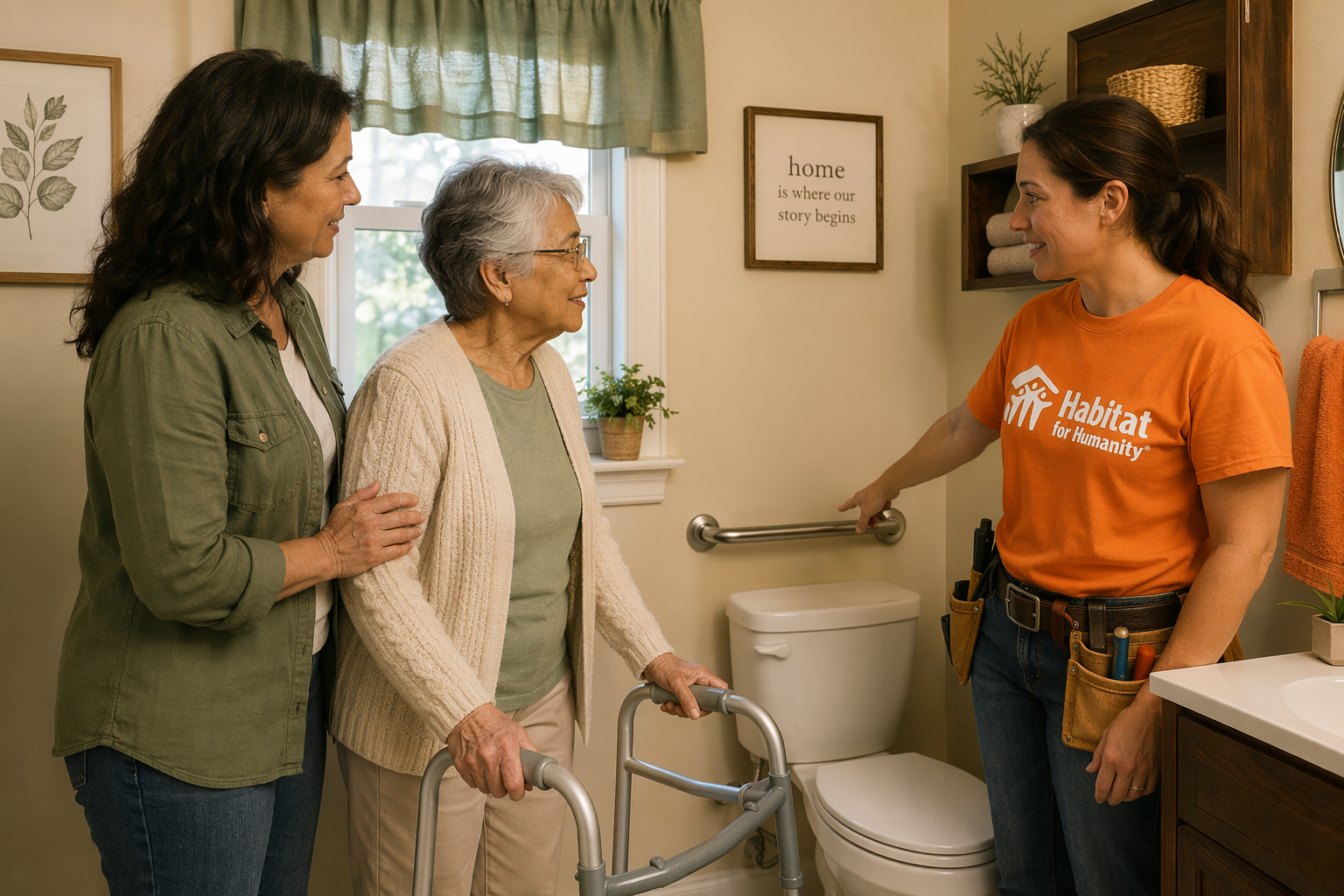
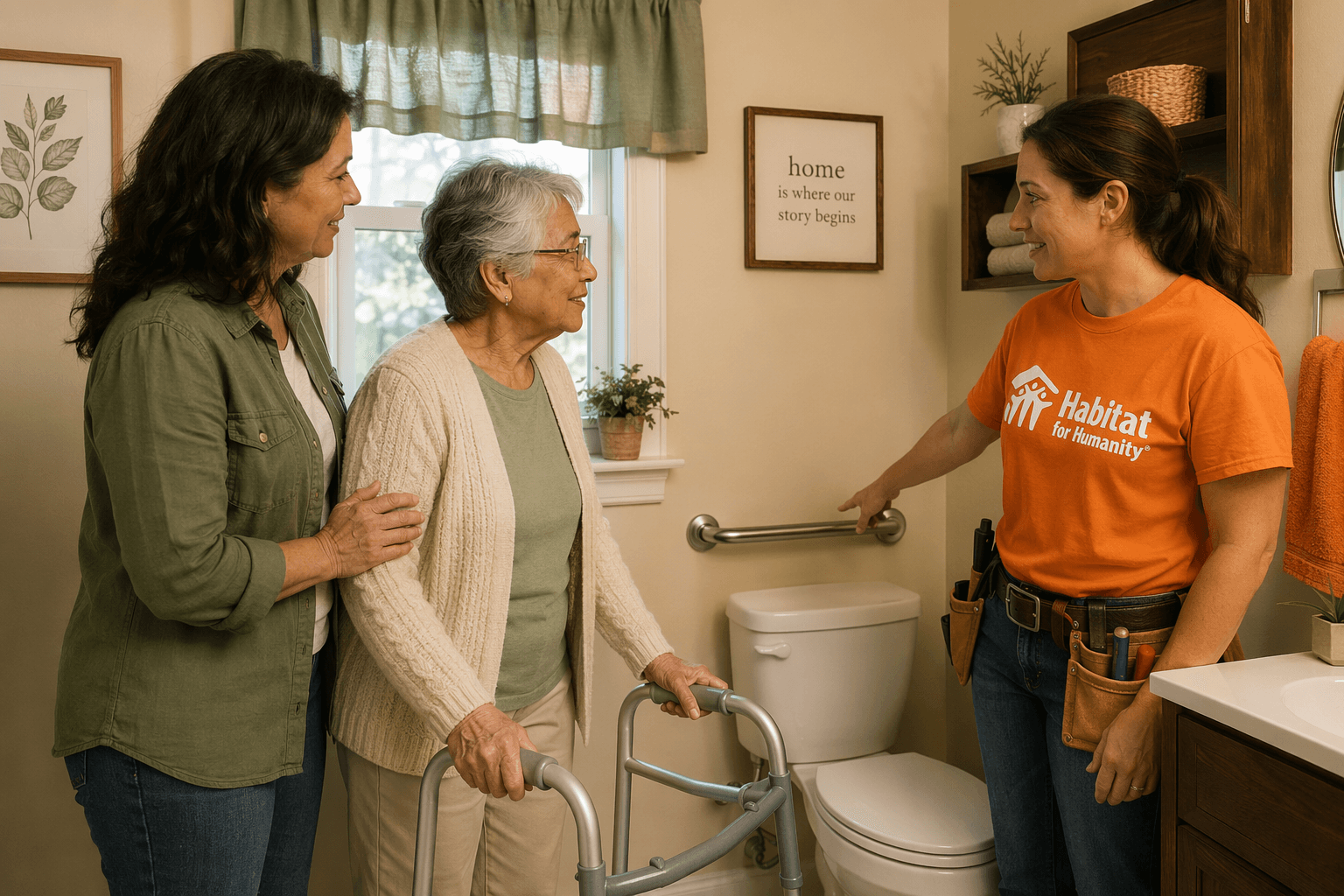
Habitat for Humanity's Aging in Place program pairs construction upgrades with health assessments to help low-income older adults remain safely at home.
The Crisis: 19 Million Older Adults Living in Unsafe Homes
By 2030, 20% of the U.S. population will be 65 or older. Yet the nation's housing stock is not ready. According to Habitat for Humanity, more than 19 million older adults currently live in homes that are in disrepair or simply ill-equipped to safely meet their needs. A U.S. Census Bureau report found that about 4 million households with an adult over 65 have difficulty living in or using features of their own home, and only 40% of homes have basic aging-ready features like a step-free entry or a bedroom and full bathroom on the first floor.
For family caregivers, this statistic is not abstract. It is the parent navigating a dark hallway to reach a bathroom, the spouse avoiding the shower because the tub edge is too high, or the older adult who has stopped leaving the house because the front steps are no longer safe. The emotional and financial cost of inaction is steep: falls, injuries, loss of independence, and ultimately, the pressure to move into assisted living or a nursing home — a transition most families want to avoid and can rarely afford.
This is where Habitat for Humanity's Aging in Place program enters the picture. It is a free or heavily subsidized home modification and repair program designed specifically for low-income older adults. Most family caregivers have never heard of it.
What Is Habitat for Humanity's Aging in Place Program?
Habitat for Humanity's Aging in Place program is a national initiative that helps low-income older adults remain safely in their homes by providing free or low-cost home repairs and accessibility modifications. Unlike a typical home repair grant, the program uses a distinctive approach called the Housing Plus model.
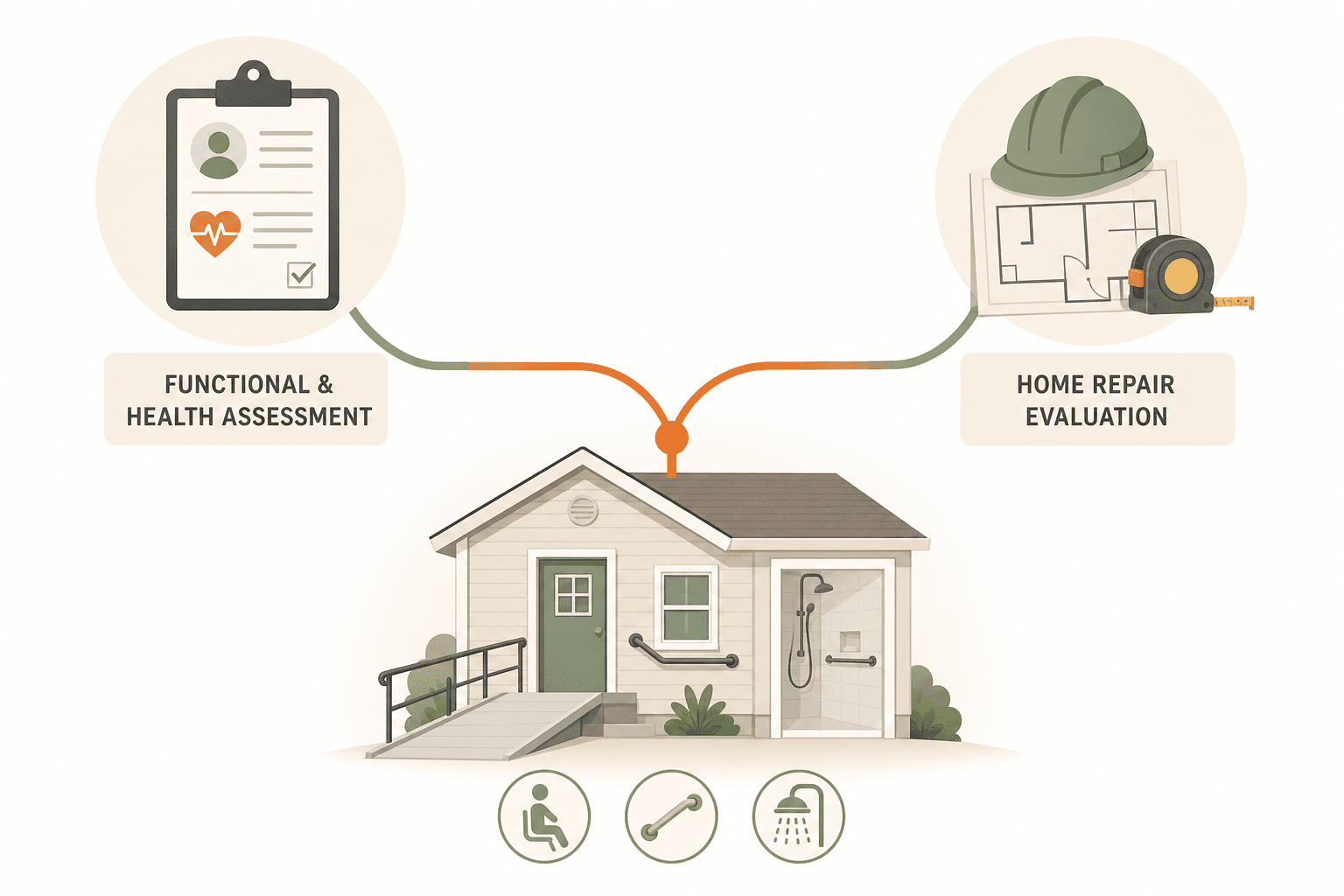
The Housing Plus model involves two parallel assessments:
A health and human services assessment: A professional — often an occupational therapist or a social worker — evaluates the homeowner's ability to perform activities of daily living (ADLs) such as bathing, cooking, paying bills, cleaning, and communicating. This assessment identifies the functional barriers the person faces in their own home.
A construction assessment: A Habitat construction specialist conducts a home repair evaluation to identify structural and safety issues. This assessment determines which modifications — grab bars, ramps, walk-in showers, roof repairs, lighting upgrades — will address the specific needs identified in the health assessment.
The two assessments are then combined into a single work plan. This is what makes the program different from a simple repair grant: it is not just about fixing a leaky roof or installing a grab bar. It is about understanding how the homeowner actually lives in the space and tailoring the modifications to their specific functional limitations.
Habitat reports that homeowners who go through the program say they feel mentally and physically healthier, safer at home, and more engaged with family and friends. The program is administered locally by individual Habitat affiliates, which means the specific details — eligibility, covered modifications, and application process — vary from one community to the next.
The Housing Plus model combines a functional health assessment with a construction evaluation to create a tailored modification plan.
What Modifications Does the Program Cover?
The modifications covered by Habitat's Aging in Place program are determined by the dual assessment process. They fall into two broad categories: interior and exterior. The list below is drawn from the national program FAQ and several local affiliate pages, including Memphis, Summit County (Ohio), and Douglas County (Minnesota).
Interior Modifications
Grab bars and safety bars in bathrooms and hallways
Walk-in shower stalls with grab bars and shower seats
ADA-compliant comfort-height toilets
Lever-style door handles and faucet handles (easier to operate than round knobs)
Improved lighting in hallways, stairways, and bathrooms
New roofing to prevent leaks and structural damage
New siding and exterior paint
Porch repairs and railing installation
Foundation repairs
The Memphis affiliate explicitly excludes cosmetic work such as interior paint, new cabinets, appliances, and window treatments. The focus is on safety, accessibility, and structural integrity — not aesthetics.
Who Qualifies? Eligibility Requirements by Affiliate
Eligibility for Habitat's Aging in Place program is not uniform. Each local affiliate sets its own criteria within broad national guidelines. This is the single most important thing for family caregivers to understand: what qualifies in one city may not qualify in the next county over.
General eligibility requirements across affiliates:
Age: Typically 62 or older, though some affiliates set the minimum at 60 or 65. The national FAQ notes that age qualifications are determined locally and are "typically early- to mid-60s and older."
Income: Generally below 80% of the Area Median Income (AMI). Many affiliates set the bar lower. The Memphis affiliate, for example, uses HUD guidelines: as of April 2025, a 1-person household cannot exceed $31,900 annually; a 2-person household cannot exceed $36,450.
Homeownership: The applicant must own and live in the home full-time. Rental properties, townhomes, condos, and mobile homes are typically excluded.
Residency: The home must be within the affiliate's service area. The Douglas County (Minnesota) affiliate requires the homeowner to have lived in the county for at least 12 months.
Property status: The homeowner must be current on property taxes and have proof of homeowner's insurance. Some affiliates also require the homeowner to be willing to partner — contributing "sweat equity" hours where physically able.
Eligibility examples from three Habitat affiliates. Always check your local affiliate's current requirements.
Affiliate
Minimum Age
Income Limit (1-person)
Service Area
Memphis, TN
62
$31,900
Memphis city limits
Summit County, OH
62
<80% AMI (2026 HUD guidelines)
Summit County
Douglas County, MN
62
<80% AMI
Douglas County (12-month residency)
How to Apply: A Step-by-Step Walkthrough
The application process for Habitat's Aging in Place program is not something you can complete online in five minutes. It requires persistence, timing, and patience. Based on the processes described by the Memphis, Summit County, and Douglas County affiliates, here is what to expect.
Find your local affiliate. Go to habitat.org and use the affiliate locator. Not every affiliate offers an Aging in Place program. You need to find the one that serves your parent's address and confirm they have an active program.
Watch for call-in dates. Many affiliates do not accept applications on a rolling basis. The Memphis affiliate, for example, opens a call-in hotline on specific dates. Slots fill within minutes. The Memphis page referenced a January 15, 2026 call-in date that has already passed. You need to monitor the affiliate's website or call their office to find out when the next window opens.
Complete a pre-assessment. Once you secure a slot, the affiliate will schedule an in-home pre-assessment. In Summit County, this is a 1–2 hour visit with a contracted occupational therapist who evaluates the homeowner's functional needs and home environment.
Undergo the dual Housing Plus assessment. If the pre-assessment indicates eligibility, a Habitat construction specialist conducts a home repair evaluation. The two assessments are combined into a single work plan that specifies which modifications will be made.
Receive approval and schedule construction. After the assessments are reviewed and funding is confirmed, the affiliate approves the work plan and schedules the construction. Timelines vary widely depending on the affiliate's capacity, the complexity of the work, and the availability of volunteers and materials.
Post-assessment follow-up. Some affiliates, like Summit County, conduct a post-assessment with the occupational therapist to ensure the modifications are working as intended.
What It Actually Costs the Homeowner
For qualified homeowners, the program is typically free. The Memphis affiliate describes it as a "grant with no cost" to the homeowner. The only out-of-pocket expense is a small recording fee — in Memphis, that is $19 paid to the Shelby County Register of Deeds.
In exchange for the grant, the homeowner agrees to a deed restriction. The restriction is forgiven at a rate of 20% per year over five years. If the homeowner sells the property or moves out within those five years, they may be required to repay a prorated portion of the grant. If they remain in the home for the full five years, the restriction is fully removed and no repayment is required.
This structure is designed to ensure that the public investment in the home benefits the intended recipient for a reasonable period. For family caregivers, the key takeaway is that the program is not a loan. It is a grant with a time-based retention requirement.
The CAPABLE Model: How Habitat Partners With Health Professionals
Some Habitat affiliates integrate the CAPABLE model (Community Aging in Place, Advancing Better Living for Elders) into their Aging in Place program. CAPABLE was developed by researchers at Johns Hopkins University and is now implemented across five Habitat affiliates.
The model goes beyond construction. It brings an occupational therapist and a nurse into the home to work with the older adult on setting functional goals — things like being able to bathe safely, cook a meal, or get in and out of bed without help. The construction modifications are then targeted to support those specific goals.
The data from the CAPABLE model is striking:
Participants' confidence in not falling increased by 15%.
Depressive symptoms were reduced by 30%.
Average savings per CAPABLE participant when followed up at 24 months was $22,120 — largely from reduced healthcare utilization and delayed institutional care.
Participants could more easily complete daily tasks (eating, dressing, using the phone, shopping), safely leave their homes, and engage with their community.
For family caregivers, the CAPABLE model is worth understanding because it represents the gold standard of aging-in-place support: clinical expertise paired with structural intervention. Not every Habitat affiliate offers CAPABLE, but those that do provide a level of holistic care that goes far beyond a simple home repair.
How Habitat Compares to Other Funding Sources
Habitat's Aging in Place program is not the only option, but it occupies a unique niche. The table below compares it to other common funding sources so you can determine which path is best for your situation.
Comparison of major funding sources for aging-in-place home modifications. Habitat is often the best fit for low-income non-veterans who need significant structural work.
Real Stories: Walter's Bathroom, Anna's Ramp, Gus and Janet's Ramp
The numbers tell one story. The homeowners tell another. Here are three real examples from Habitat's published stories that illustrate what the program means in practice.
Walter's Bathroom: From Outhouse to Indoor Safety
Walter, 81, lived in a 520-square-foot house in Georgia that was built by his father. He had no bathroom. For his entire adult life, he used an outhouse — even in bad weather, even at night. He raised eight children in that house.
Through the Southern Crescent Habitat for Humanity, the Aging in Place program turned a room into a full bathroom with a shower, grab bars, and a shower seat. The project also replaced kitchen countertops, cabinets, and the stove, underpinned the foundation, and painted the exterior. The work was funded by the MOMS Club of Fayetteville, North Georgia United Methodist Church, and the Coweta-Fayette Trust.
Walter's daughter Francine had been worried sick about her father going to the outhouse at night and in bad weather. After the bathroom was installed, Walter said: "Now, I am so proud. And man, do I feel just great."
Anna's Ramp: A Lifeline After a Fall
Anna Bowlby, 92, lived in a home in Portland, Oregon that she had occupied for 65 years. Habitat Portland Region installed a wheelchair ramp in 2022 so that Anna, who used a wheelchair, could safely enter and exit her home.
After her mother Evelyn passed away, Anna fell and broke her pelvis and five ribs. She could not afford physical therapy. Instead, she used the ramp as her rehabilitation tool, walking up and down it 50 times a day. The ramp — originally installed for wheelchair access — became the device that helped her regain her mobility after a devastating injury.
Gus and Janet's Ramp: Enabling Connection
Gus Hayes lives with Lewy body dementia. He and his wife Janet live in Tacoma, Washington. Before Habitat installed a ramp, Gus could not safely leave the house. After the ramp was installed, he was able to go on two-hour walks.
Janet described the impact: "Having the ramp installed was a feeling of relief and hope." The repair coordinator for the affiliate, Virginia Phelps, noted that the program serves "a lot of homeowners that get caught in the middle — maybe they can't afford all of the repairs themselves, but they don't qualify for other social services."
Tips for Caregivers: What to Prepare and What to Expect
If you are an adult child exploring Habitat's Aging in Place program for a parent, here is what you can do now to prepare.
Gather documentation early. Most affiliates require proof of income (tax returns, Social Security statements, pension letters), proof of homeownership (deed or property tax statement), proof of homeowner's insurance, and proof that property taxes are current. Having these ready before the application window opens saves precious time.
Understand the deed restriction. The grant is not free money. It comes with a requirement that the homeowner stay in the home for a set period — typically five years, with the restriction forgiven at 20% per year. If your parent's health is declining rapidly and a move to assisted living is likely within that window, the program may not be the right fit.
Prepare for waitlists. Demand for the program far exceeds capacity. The Memphis affiliate's call-in slots fill within minutes. Do not assume you will get in on the first try. Have a backup plan — whether that is a different funding source or interim safety measures like those in our Home Fall Prevention Checklist.
Follow up regularly. Affiliates are small organizations with limited staff. A polite phone call every few weeks to check on the status of your application can keep it from being forgotten.
Be realistic about scope. The program focuses on safety and accessibility, not full home renovations. Cosmetic upgrades like new paint or new cabinets are generally not covered. If your parent's home needs a complete bathroom remodel, the program may cover the safety elements (grab bars, walk-in shower) but not the tile or vanity. For a deeper look at bathroom modifications, see our Bathroom Remodel for Elderly with Dementia guide.
Habitat for Humanity's Aging in Place program is one of the most underutilized resources in senior care. It is not perfect — the eligibility varies, the waitlists are long, and the application process requires persistence. But for low-income older adults who own their homes and need safety modifications, it may be the only realistic path to aging in place with dignity. For family caregivers, knowing that this program exists — and understanding how to navigate it — is the first step toward getting a parent the help they need.

Comments
Join the discussion with an anonymous comment.