
The Real Cost of Long-Term Senior Care: Why Most Families Get It Wrong and How to Plan
Most families dramatically underestimate long-term care costs and overestimate what Medicare covers. This guide exposes the true cost landscape, the 60-day Medicare blind spot, and the three payment pathways to help you avoid a financial crisis mid-care.

The Cost Reality: What Long-Term Senior Care Actually Costs in 2026
Most families begin planning for long-term care with a number in mind that bears little resemblance to reality. According to a 2024 SingleCare survey, 56% of respondents mistakenly believed assisted living costs less than $4,000 per month. The actual 2026 national median for assisted living is $5,419 per month — and that figure climbs sharply depending on where you live and what level of care is needed.
The table below shows the 2026 national median monthly costs across the most common care types, based on data from A Place for Mom's analysis of over 48,000 move-ins and 3,215 home care agencies.
| Care Type | Monthly Median Cost (2026) | Annual Median Cost | Year-Over-Year Change (2024–2025) |
|---|---|---|---|
| Home Care (non-medical, 44 hrs/wk) | $5,984 | $71,808 | +3.0% |
| Assisted Living | $5,419 | $65,028 | +4.4% |
| Memory Care | $6,690 | $80,280 | +3.7% |
| Independent Living | $3,200 | $38,400 | +1.75% |
| Nursing Home (semi-private room) | $9,581 | $114,972 | Varies by region |
| Nursing Home (private room) | $10,798 | $129,576 | Varies by region |
State-by-state variation is dramatic. Assisted living ranges from a median of $3,983 per month in Louisiana to $8,960 per month in Washington, D.C.. A family in Louisiana might reasonably budget $48,000 annually for assisted living, while a family in D.C. faces nearly $108,000 — more than double. This geographic spread means national averages are only a starting point; your actual costs depend heavily on your state and even your specific metro area.
For a deeper look at how these costs compare across home care, assisted living, and nursing homes, see our detailed comparison: Home Care vs. Assisted Living vs. Nursing Home: Which Is Actually Cheaper in 2026?.
The Medicare Myth: What It Covers, What It Doesn't, and the 60-Day Blind Spot
This is the single most dangerous misconception in senior care planning. A KFF survey cited in the AARP June 2026 affordability report found that 56% of adults aged 65 and older incorrectly believe Medicare would pay for a long nursing home stay. Medicare.gov is unambiguous: "Medicare doesn't pay for long-term care." The program covers only short-term skilled nursing or rehabilitation care under very specific conditions.
Here is exactly how Medicare's skilled nursing facility (SNF) coverage works — and where it ends:
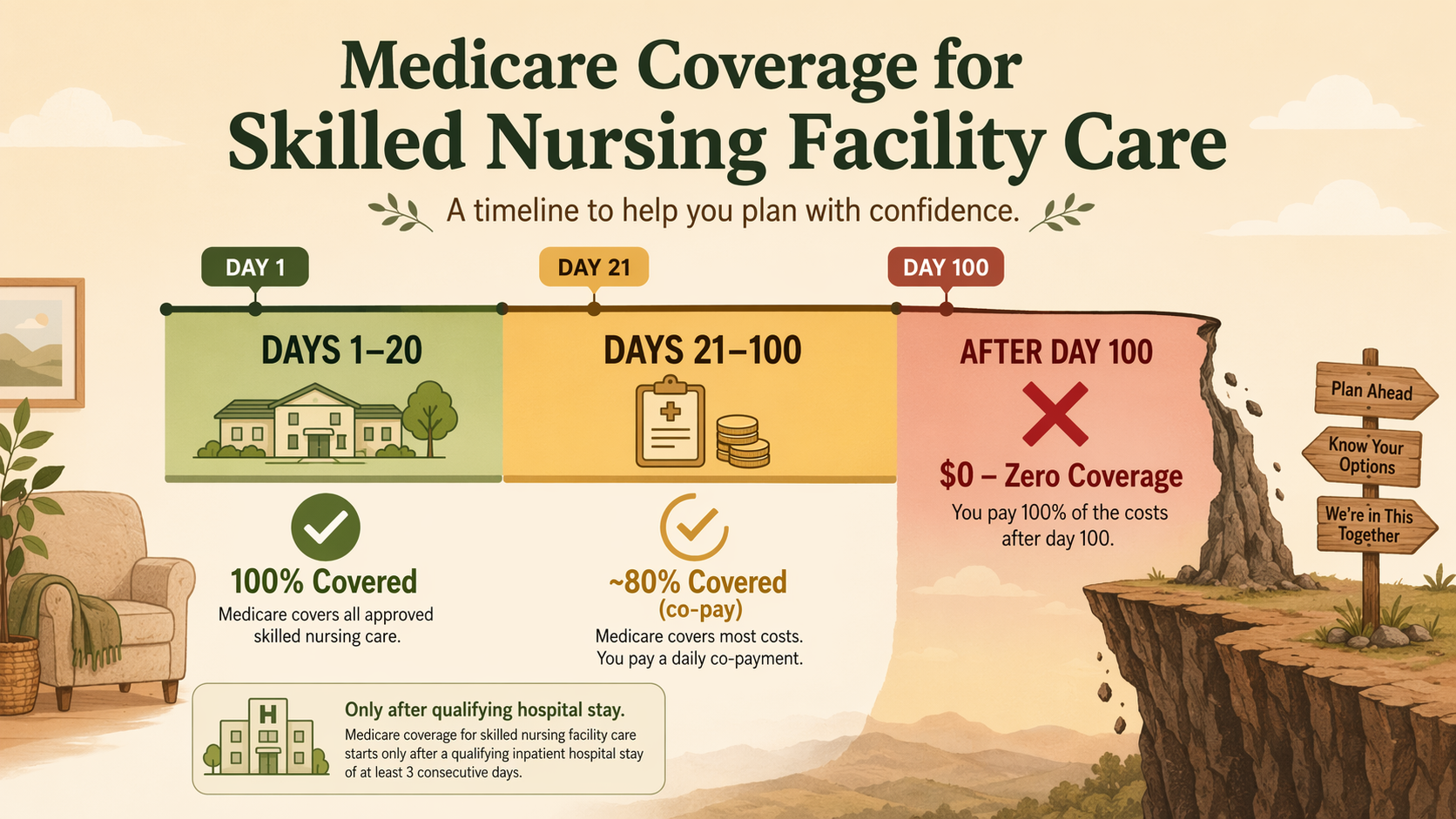
- Days 1–20: Medicare pays 100% of the covered costs. No copay.
- Days 21–100: Medicare pays approximately 80% of covered costs. You are responsible for the daily coinsurance amount ($204 per day in 2026).
- Day 101 and beyond: Medicare pays $0. Zero coverage. You are responsible for the full cost of care.
Even this limited coverage has strict gatekeeping requirements. To qualify, the patient must have a qualifying hospital stay of at least three consecutive days, be admitted to a Medicare-certified SNF within 30 days of that hospital discharge, and need skilled nursing or therapy services on a daily basis. Custodial care — help with bathing, dressing, eating, or toileting — does not qualify, even if the patient cannot perform these tasks independently.
The Alzheimer's Association confirms that Medicare does not cover residential care costs for dementia patients either. Only short-term skilled care after a hospital stay is covered. For families managing Alzheimer's or other progressive dementias, the care trajectory almost always extends well beyond 100 days, making the Medicare cliff a near-certainty.
The Three Payment Pathways: Self-Pay, Medicaid, and Long-Term Care Insurance
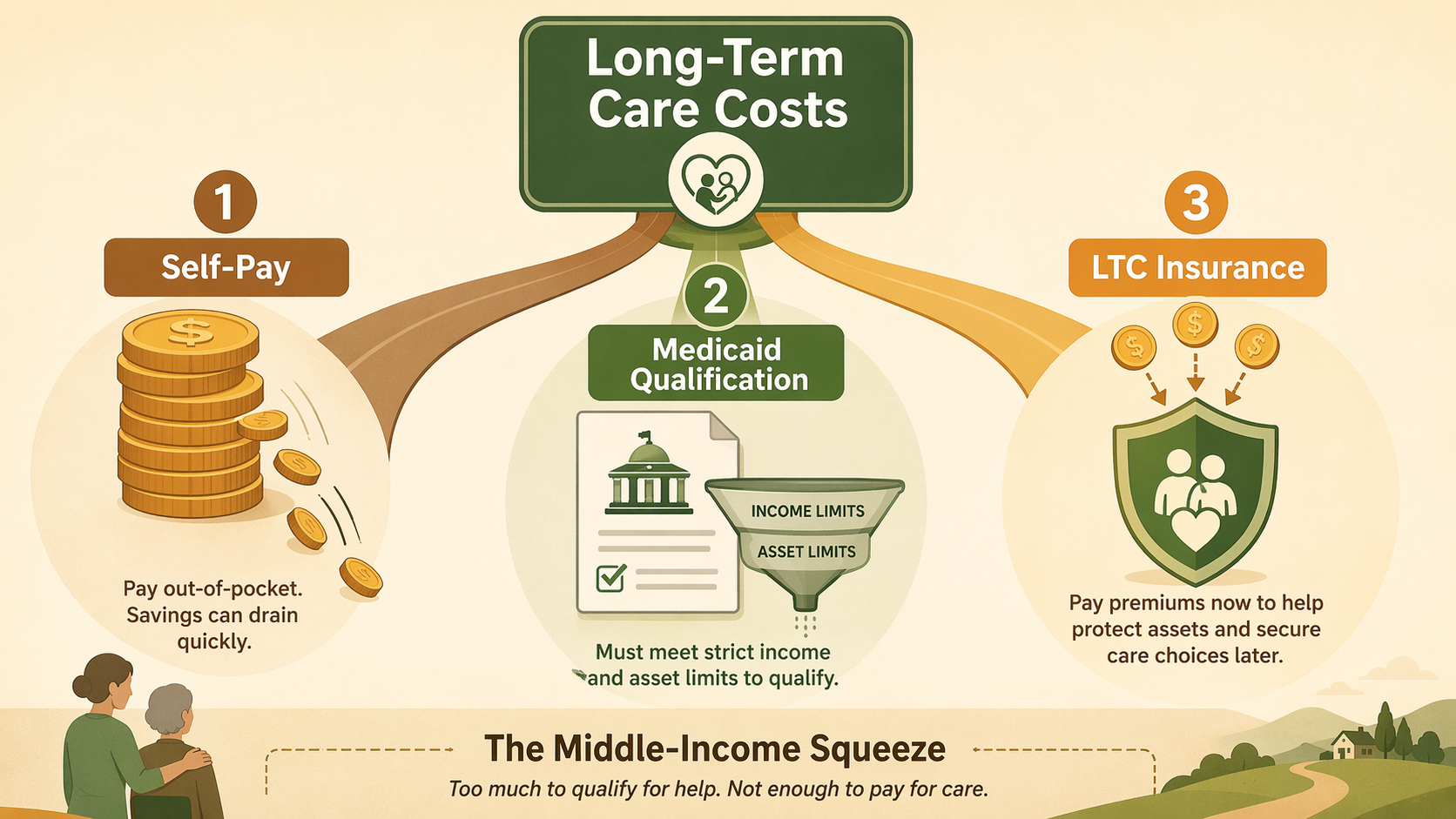
Once you accept that Medicare will not cover long-term custodial care, the question becomes: who will pay? There are essentially three pathways, and most families end up using a combination of them. Understanding how each works — and where each falls short — is the foundation of any realistic financial plan.
| Payment Pathway | Who It Serves | What It Covers | Key Limitation | Typical Monthly Cost to Family |
|---|---|---|---|---|
| Self-Pay (Out of Pocket) | Households with significant savings or home equity | Any care type: home care, assisted living, memory care, nursing home | Median financial assets for 75+ households is only ~$50K; costs can exhaust savings rapidly | Full cost: $3,200–$10,798/mo depending on care type |
| Medicaid (after qualification) | Low-income individuals who meet state income and asset limits | Nursing home care (mandatory); home and community-based services (state-dependent) | Strict income/asset limits; spend-down required; facility choice may be limited | Minimal after qualification, but requires near-total asset depletion |
| Long-Term Care Insurance | Middle- and upper-income individuals who purchase a policy in their 50s or early 60s | Varies by policy: daily benefit amount, benefit period, elimination period, inflation protection | Only ~1 in 10 adults have it; premiums $900–$7,225/yr; 70–80% of policyholders have seen premium increases | Policy pays daily benefit; family covers any gap between benefit and actual cost |
Self-pay is the default for most families, but it is also the most dangerous assumption. The National Institute on Aging notes that people often rely on a combination of personal funds, federal and state programs, and private financing. The median household income for adults 65 and older is approximately $60,000 per year (AARP June 2026 report). Compare that to the annual cost of assisted living at $65,028 — already above median income — and the gap becomes stark.
Medicaid is a critical safety net, but it requires meeting strict income and asset limits that vary by state. The spend-down process — depleting assets to qualify — can be emotionally and financially devastating. And not all facilities accept Medicaid, which can limit options at the moment when choices matter most.
Long-term care insurance is the most proactive option, but the window to purchase it affordably is narrow. According to AARP, the best time to buy is in your 50s or late 40s. Premiums range from $900 to $7,225 per year depending on age, health, and coverage level (2023 AALTCI data cited by SingleCare). Only about 1 in 10 adults have long-term care insurance, and 70–80% of policyholders have experienced premium increases.
The Middle-Income Squeeze: Earning Too Much for Medicaid, Too Little to Self-Fund
The most financially vulnerable group in the long-term care landscape is not the poor or the wealthy — it is the middle. These are households that earn too much to qualify for Medicaid but lack the assets to cover $5,000–$10,000+ in monthly care costs. The AARP June 2026 report identifies this group explicitly: middle-income older adults are hit hardest because they earn too much for Medicaid but not enough to afford care.
Consider the math. The median household income for adults 65 and older is about $60,000 per year. The median financial assets for households aged 75 and older are approximately $50,000 (AARP). A single year of assisted living at $65,028 would consume more than the entire annual income and drain half of the median assets. A year of memory care at $80,280 would consume 134% of annual income. A year in a private nursing home room at $129,576 would require nearly 2.2 times the median household income.
The squeeze is compounded by the fact that 60% of households headed by someone 65 or older include more than one person. The costs of care affect the entire household's financial stability, not just the individual receiving care.
Hidden Costs That Derail Even Good Plans: Inflation, Floor Plans, and Care Escalation
Even families who budget carefully often miss three cost drivers that can silently double their expenses over time.
1. Home Care Inflation Is Outpacing Everything Else
According to the AARP June 2026 report, home care costs have risen 39% since 2021, compared to 27% for general services and 26% for day care and preschool over the same period. This means a family paying $25 per hour for home care in 2021 would now be paying nearly $35 per hour for the same service. At 44 hours per week (the typical level for moderate care needs), that is an additional $5,720 per year in costs — every year.
2. Floor-Plan Premiums in Assisted Living
The median assisted living cost of $5,419 per month assumes a studio apartment. According to A Place for Mom's 2026 data, a one-bedroom apartment in assisted living typically costs $900 to $1,200 more per month than a studio. That is an additional $10,800 to $14,400 per year for the same care services — just for a separate bedroom. Many families do not discover this premium until they are touring facilities and comparing price sheets.
3. Care Escalation Over Time
Long-term care is not a static expense. A person who enters assisted living at a base rate may need additional services — medication management, incontinence care, mobility assistance, or transfer to a memory care unit — within 12 to 24 months. Each escalation adds $500 to $2,000 per month to the bill. The Alzheimer's Association notes that memory care units can exist within assisted living or skilled nursing settings, and the cost difference between standard assisted living and memory care is approximately $1,271 per month nationally.
- Home care inflation: 39% since 2021 (AARP)
- Floor-plan premium: $900–$1,200/mo more for a one-bedroom vs. studio in assisted living
- Care escalation: $500–$2,000/mo additional as needs increase
- Memory care premium: ~$1,271/mo above standard assisted living
Annual Costs vs. Median Senior Income: Putting the Numbers in Perspective
The most useful way to understand these costs is to compare them directly to what the typical older household earns. The table below shows each care type's annual cost alongside the median senior household income of approximately $60,000 per year (AARP June 2026 report).
| Care Type | Annual Cost (2026) | As % of Median Senior Income ($60K) | Monthly Social Security Benefit Needed to Cover |
|---|---|---|---|
| Independent Living | $38,400 | 64% | $3,200/mo (1.6x avg SS benefit) |
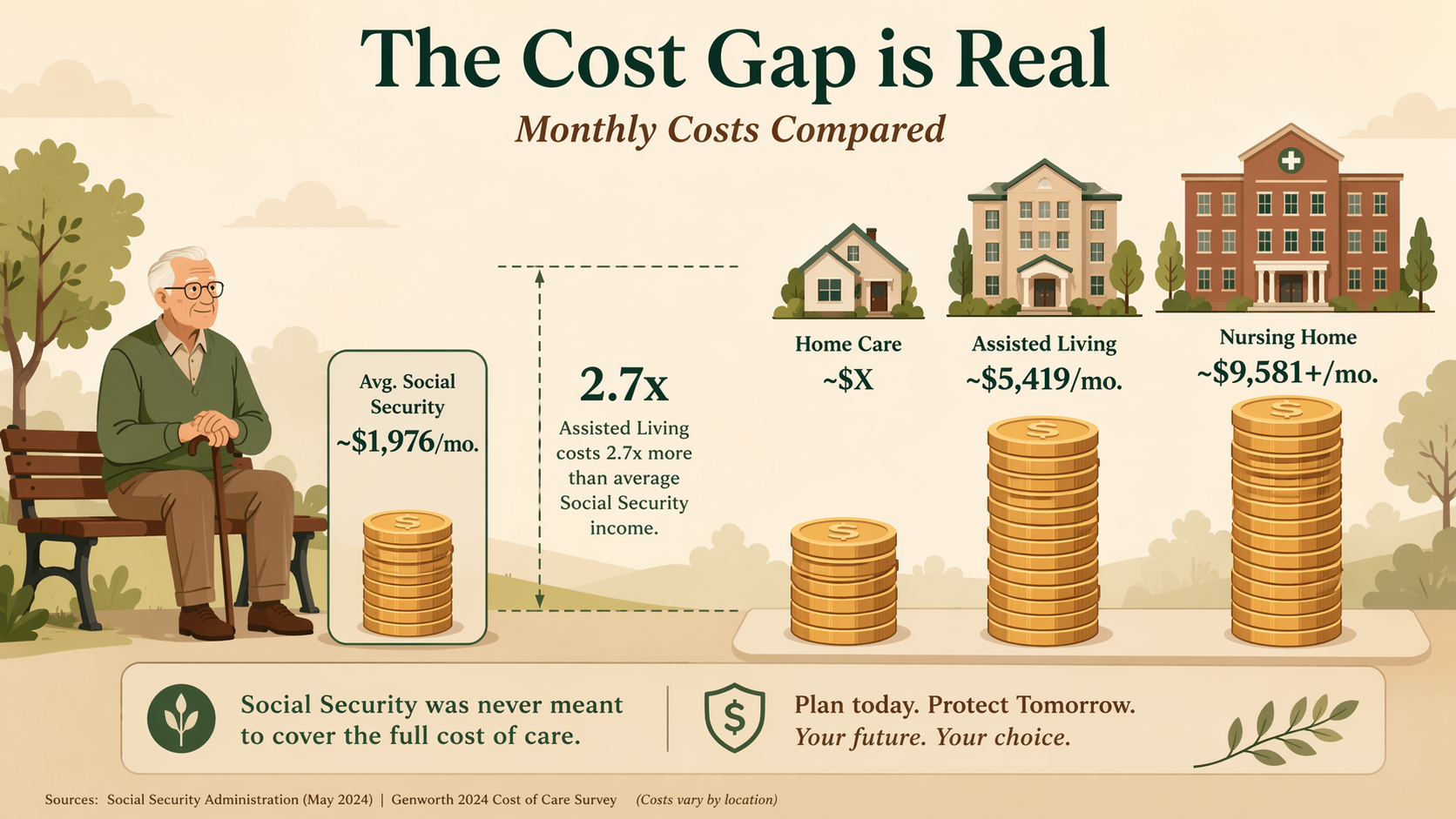
| Assisted Living | $65,028 | 108% | $5,419/mo (2.7x avg SS benefit) |
| Memory Care | $80,280 | 134% | $6,690/mo (3.4x avg SS benefit) |
| Home Care (44 hrs/wk) | $71,808 | 120% | $5,984/mo (3.0x avg SS benefit) |
| Nursing Home (semi-private) | $114,972 | 192% | $9,581/mo (4.8x avg SS benefit) |
| Nursing Home (private) | $129,576 | 216% | $10,798/mo (5.5x avg SS benefit) |
The picture is sobering. Even independent living — the least expensive option — consumes nearly two-thirds of the median senior household's annual income. Assisted living exceeds it. Nursing home care nearly doubles it. These are not hypothetical scenarios; they are the actual numbers families face today.
The AARP report also notes that median long-term care costs increased significantly from 2019 to 2024: home care and assisted living saw nearly a 50% increase, adult day services rose 33%, and nursing homes rose 25%. Meanwhile, household income for adults 65 and older grew only 22%. Costs are outpacing income by a wide margin, and that gap is widening every year.
Practical Planning Steps: What Families Can Do Right Now
The numbers are daunting, but knowing them is the first step toward a plan that does not collapse under the weight of unexpected costs. Here are actionable steps families can take today — not next year, not after a crisis.
- Start the conversation early. The National Institute on Aging recommends planning before care is needed. Have the financial conversation with your parent or spouse now, while everyone can participate in decisions calmly.
- Get a realistic cost estimate for your state. National averages are useful for context, but your actual costs depend on your state and metro area. Use the A Place for Mom cost data or your state's Department of Aging to get local figures.
- Review your Medicare coverage assumptions. If you or your family member believes Medicare will cover long-term care, correct that assumption today. Understand the 100-day skilled nursing limit and the qualifying hospital stay requirement.
- Explore long-term care insurance in your 50s or early 60s. Premiums increase with age and health changes. AARP recommends that premiums should not exceed 7% of income, and that you should have at least $75,000 in assets (excluding your home) to benefit from a policy.
- Understand Medicaid eligibility rules in your state. Medicaid is state-administered, and rules vary significantly. Know the income and asset limits, the look-back period, and whether your state offers home and community-based services waivers.
- Create a layered funding plan. Most families use a combination of savings, insurance, and public benefits. Do not assume a single source will cover everything. Plan for the gap between what insurance or benefits pay and what care actually costs.
For a deeper dive into the full range of payment options — including VA benefits, reverse mortgages, and trusts — see our comprehensive guide: How to Pay for Senior Health Care Services: A Family Guide to Medicare, Medicaid, Private Pay, and Everything in Between.
Related reading
Noticed something outdated or inaccurate on this page? Flag a correction. We review every report against CDC, NIA, and AARP HomeFit guidance before updating a page.
Part of the Fall Prevention section.