Sunrise Senior Living Memory Care: What the Reminiscence Program Actually Offers Families
stage guideearly, middle, late stagewandering, sundowning, agitationReviewed: 2026-06-19
Sunrise Senior Living Memory Care: What the Reminiscence Program Actually Offers Families
By Editorial Team
memory care
Alzheimer's care
dementia care
Sunrise Senior Living
Reminiscence program
Introduction: When Memory Care Becomes the Right Next Step
If you are reading this, you have likely crossed a threshold that no amount of research fully prepares you for: your parent has received an Alzheimer's or dementia diagnosis, and the question is no longer whether they need more support, but what kind of support — and from whom. The search for a memory care community carries an emotional weight that is hard to separate from the practical decisions that need to be made. You need to know what a program actually delivers, not just what it promises.
Sunrise Senior Living is one of the largest and most recognized names in senior care, operating over 270 communities across the United States and Canada. But for families specifically evaluating memory care, the question is not whether Sunrise is a reputable company — it is whether its Reminiscence program is the right fit for your parent's current stage of dementia and their future needs. This guide focuses exclusively on that question. We will walk through what the Reminiscence program actually looks like in daily practice: the design of the neighborhoods, the communication method that guides every interaction, the role of the Life Enrichment Manager, and the two-tier system that allows residents to age in place within the same community.
What 'Reminiscence' Actually Means: Neighborhood Design and Daily Life
The term 'Reminiscence' is easy to dismiss as marketing language, but at Sunrise it refers to a specific, purpose-built environment designed around the cognitive and sensory needs of people living with Alzheimer's and other dementias. These are not standard assisted living wings with a locked door. The neighborhoods are constructed from the ground up to reduce confusion, encourage safe movement, and create opportunities for meaningful engagement.
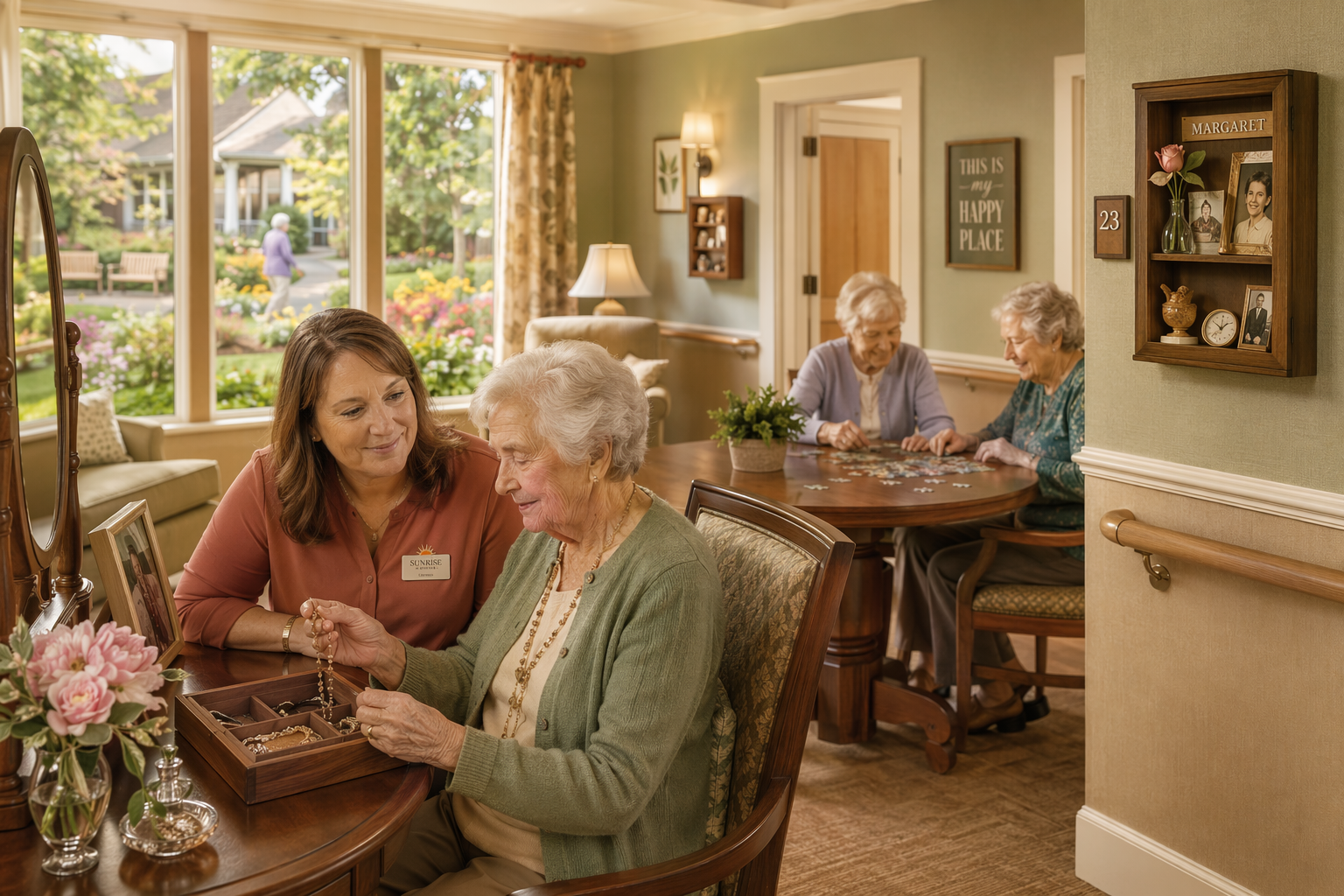
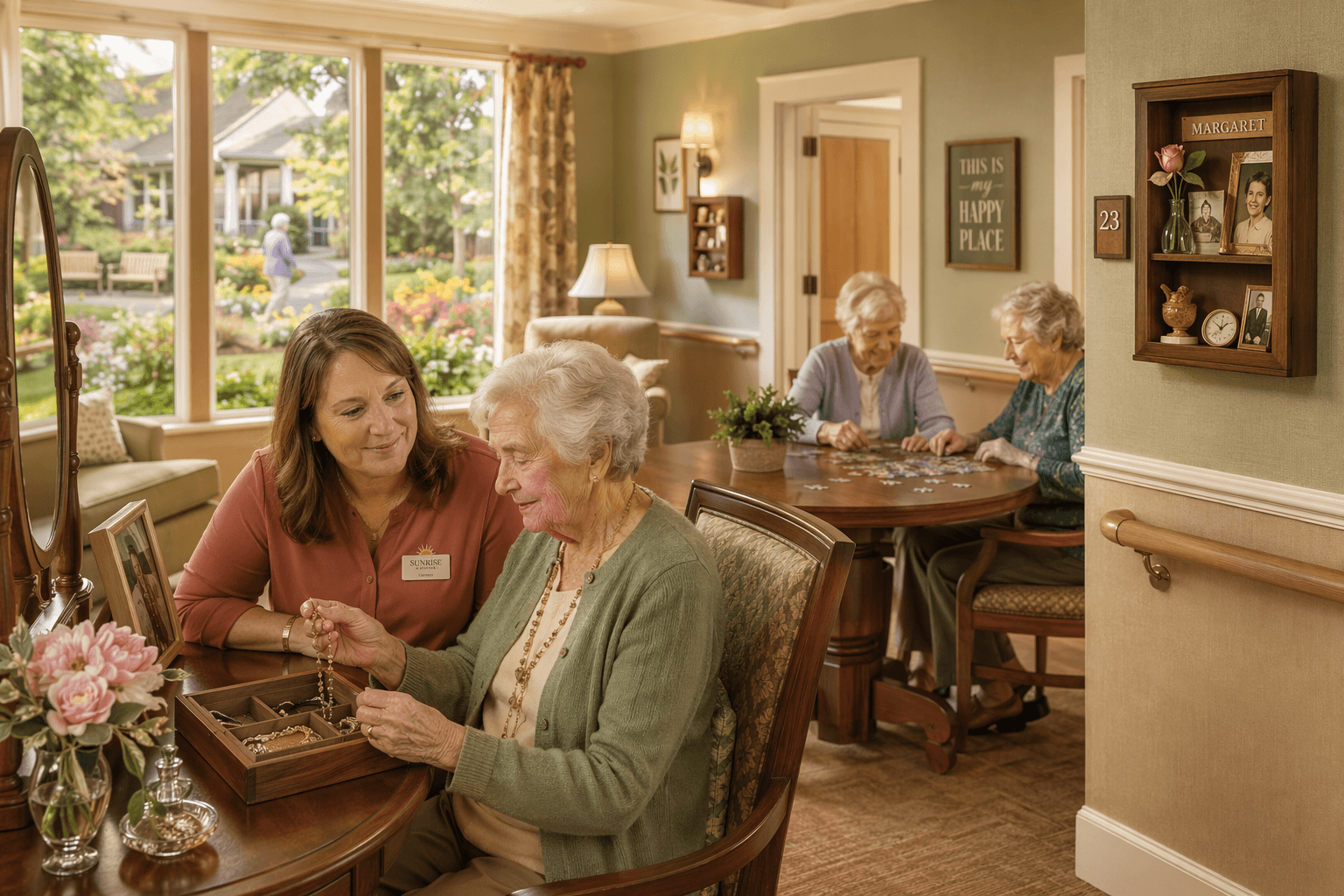
Sunrise Reminiscence neighborhoods are designed to feel residential and purposeful, with life skills stations and secure outdoor access as standard features.
Here is what you can expect to see in a Reminiscence neighborhood, and why each feature matters:
Centralized suites around common living and dining areas. Rather than long, institutional hallways, suites are arranged around shared spaces. This layout makes it easier for residents to navigate independently and increases the likelihood of spontaneous social interaction.
Muted, contrasting colors and motion sensors. Color is used deliberately to help residents distinguish walls from floors and to identify key areas like the dining room or restroom. Motion sensors allow staff to monitor movement without being intrusive, supporting both safety and independence.
Personalized shadow boxes outside every suite. These display items that are meaningful to the resident — a favorite hat, a photo, a souvenir. They serve as a visual cue that helps residents identify their own door and provides a conversation starter for staff and visitors.
Life skills stations placed in open areas. These are not decorations. You will find vanities with jewelry and mirrors, desks with typewriters, and accessories related to caring for a child. They are designed to trigger muscle memory and encourage residents to engage in familiar, purposeful activities without being directed.
Secure outdoor spaces. Access to fresh air and nature is a standard feature, not an exception. These spaces are enclosed and monitored, allowing residents to walk freely without risk of wandering off.
Reflection rooms with soft lighting and soothing music. These are quiet spaces where a resident who is feeling agitated or overwhelmed can be gently redirected. The environment is intentionally calming, with no overstimulating elements.
The cumulative effect of these design choices is a neighborhood that feels more like a home than a facility. For a resident with dementia, the reduction in environmental stress can mean fewer episodes of agitation, better sleep, and a greater sense of security. For you as a family member, it means visiting a place that does not feel clinical or depressing.
The Validation Method: A Communication Approach, Not Just a Buzzword
Sunrise is an Authorized Validation Organization, which means its memory care staff are trained in the Validation Method — a specific, evidence-informed communication technique developed by gerontological social worker Naomi Feil. This is not a vague commitment to 'being nice' to residents. It is a structured approach to interacting with people who have dementia, and it is worth understanding because it directly shapes how your parent will be treated every day.
The Validation Method focuses on emotional connection rather than correcting confusion or disorientation.
The core principle of Validation is simple: instead of trying to orient a resident to 'reality' — which can cause anxiety, frustration, and withdrawal — the caregiver meets the resident in their own reality. If your parent believes they are waiting for their mother to pick them up from school, the caregiver does not correct them. Instead, they ask open-ended questions about what the resident is feeling: 'Tell me about your mother. What do you miss most about her?'
The techniques used in the Validation Method include:
Rephrasing: Repeating back what the resident has said to show they have been heard.
Asking open questions: Using 'who,' 'what,' 'when,' and 'where' to encourage the resident to express themselves.
Matching the emotion: Identifying the feeling behind the words — fear, loneliness, joy — and reflecting it back.
Using touch and eye contact: Gentle, respectful physical connection to build trust and reduce anxiety.
The goal is not to win an argument or to 'fix' the resident's confusion. The goal is to make an emotional connection, restore a sense of self-worth, reduce anxiety, and enhance dignity. When done well, Validation can dramatically reduce the behavioral symptoms of dementia — agitation, aggression, withdrawal — because the resident feels understood rather than corrected.
The Life Enrichment Manager: The Person Behind the Programming
If there is one role at Sunrise that most directly determines whether the Reminiscence program feels genuine or generic, it is the Life Enrichment Manager. This is not a typical activities director who runs bingo and hands out a monthly calendar. The Life Enrichment Manager is responsible for designing one-on-one and small-group activities that are based on each resident's personal history, passions, and interests.
Before a new resident moves in, the Life Enrichment Manager is supposed to learn who they are at their core: What did they do for a living? What hobbies did they enjoy? What music did they love? What kind of humor did they have? This information is then used to create activities that feel familiar and meaningful. A former teacher might be given a stack of books to organize. A former gardener might be invited to water plants in the secure outdoor space. A person who loved classical music might be offered a headphone session with a curated playlist.
The types of activities you can expect to see include painting, music therapy, gardening, fitness classes, and life skills stations — but the key is that they are personalized. The same activity will look different for different residents because the Life Enrichment Manager adapts it to the individual.
When you tour a Sunrise community, ask to meet the Life Enrichment Manager for the memory care neighborhood. Ask them how they learn about new residents, how many residents they are responsible for, and what a typical day looks like for them. The quality of the answer will tell you a great deal about whether the program is truly person-centered in practice or whether it is a well-marketed checklist.
Terrace Club vs. Full Reminiscence: Matching Care to Disease Stage
One of the most practical features of Sunrise's memory care offering is the two-tier system: Terrace Club for early-to-moderate memory loss, and full Reminiscence for moderate-to-advanced stages. This structure allows a resident to move into the community at an earlier stage of dementia and transition to a higher level of care within the same building as the disease progresses — without the trauma of relocating to an entirely new facility.
Understanding the difference between these two tiers is critical for making the right decision. Here is how they compare:
Comparison of Terrace Club and full Reminiscence memory care tiers at Sunrise Senior Living.
Feature
Terrace Club
Full Reminiscence
Target stage
Early-to-moderate memory loss
Moderate-to-advanced dementia
Environment
Less secure, more independent; residents may have more freedom to move about the community
Fully secure neighborhood; all doors are locked and monitored
Programming
Group activities with some individual support; focus on maintaining existing skills
One-on-one and small-group activities with hands-on support; focus on sensory engagement and emotional connection
Staffing
Lower staff-to-resident ratio; staff trained in memory care but not necessarily Validation-certified
Higher staff-to-resident ratio; all staff trained in the Validation Method
Daily assistance
Minimal hands-on care; residents may need reminders but not full assistance
Full assistance with activities of daily living (ADLs): bathing, dressing, toileting, eating
Best for
A parent who is forgetful but still able to dress themselves, feed themselves, and navigate with minimal cues
A parent who needs help with most daily tasks, may wander, and benefits from a highly structured, secure environment
If your parent is in the early stages of dementia — still able to manage most daily activities independently but showing clear signs of memory decline — Terrace Club may be the appropriate entry point. It offers a less restrictive environment that preserves a sense of autonomy while providing the safety net of memory-trained staff. As the disease progresses and your parent requires more hands-on support, they can move into the full Reminiscence neighborhood without leaving the community.
What Memory Care Costs at Sunrise and What's Included
Memory care at Sunrise is priced at a national estimate of $5,900 to $7,500 per month, according to data from meetbeagle.com. This is a significant investment, and actual costs will vary depending on your location and the specific care needs of your parent. Communities in high-cost-of-living areas will be at the upper end of this range, while those in more affordable regions may be lower.
The base monthly rate typically includes:
Three meals a day, served in a communal dining setting
Housekeeping servicesOne load of personal laundry and fresh linens each week
An emergency safety alert system in each suiteWellness checks every 30 days performed by a nurse
Transportation to community programs and appointmentsAll in-house activities and programming
Sunrise also offers companion living — a shared suite option — at a more affordable rate. Residents are matched based on common background or interests, which can also provide a built-in social connection.
One important financial detail: Sunrise does not require a long-term commitment. Families can give 30 days written notice for move-out, which provides flexibility if your parent's needs change or if the community turns out not to be the right fit.
Potential Financial Assistance
Two potential sources of financial assistance are worth exploring:
VA Aid & Attendance: This pension benefit can provide over $2,700 per month in additional tax-free income for qualifying veterans and their surviving spouses. Sunrise's own cost page references this figure, but you should verify eligibility and current benefit amounts against official VA sources.
ElderLife Bridge Loans: Sunrise partners with ElderLife Financial Services to offer short-term bridge loans that can potentially be funded within 24 hours. These are designed to cover the gap between moving in and the start of long-term funding (e.g., from a home sale or insurance payout).
Questions to Ask on a Sunrise Memory Care Tour
A tour is your best opportunity to see whether the Reminiscence program is being delivered as promised. Go beyond the standard questions about cleanliness and staff friendliness. Ask questions that reveal whether the program is truly person-centered in practice.
How is the Validation Method trained and practiced daily? Ask how often staff receive training, who conducts it, and how adherence is evaluated. A vague answer like 'all staff are trained' is not sufficient. You want specifics about frequency and accountability.
What does a typical day look like for a resident in Terrace Club versus full Reminiscence? The answer should be concrete: what time do they wake up, what activities are offered, how much choice do they have, what does mealtime look like?
How does the Life Enrichment Manager learn about new residents' personal histories? Is there a formal intake process? Do they speak with family members before move-in? How is this information documented and shared with the care team?
What is the staff-to-resident ratio in the memory care neighborhood during the day and overnight? Ratios matter more in memory care than in assisted living because residents require more hands-on support and supervision.
What is the staff turnover rate in the memory care neighborhood? High turnover is a red flag. Consistent staff means residents can form trusting relationships, which is essential for the Validation Method to work.
How does the community handle behavioral symptoms like wandering, sundowning, and agitation? Ask for specific protocols, not general assurances. What happens when a resident becomes agitated at 3 a.m.?
What happens when a resident's needs progress beyond the current tier? If your parent is in Terrace Club and their dementia advances, what is the process for moving them to full Reminiscence? Is there a waitlist? Does the cost change?
How are families kept informed about their parent's daily life? Do you receive regular updates? Is there a family communication app? How are changes in condition communicated?
Verdict: Who Is Sunrise Memory Care Best Suited For?
Sunrise's memory care programming is strongest for families whose parent is in the early-to-moderate stages of dementia and who value a structured, person-centered approach that emphasizes emotional connection over clinical efficiency. The Terrace Club tier is a genuine differentiator — few national providers offer a dedicated early-stage memory care program that allows residents to transition within the same community.
The full Reminiscence program is well-suited for residents with moderate-to-advanced dementia who benefit from a secure, sensory-rich environment with a higher staff-to-resident ratio. The Validation Method, when practiced consistently, can make a meaningful difference in reducing anxiety and behavioral symptoms.
However, families should be aware of the limitations. Sunrise's programming is designed for the middle stages of the disease. If your parent is in the late stages of dementia or requires end-of-life care, you may need to look further — either within Sunrise's own care continuum (some communities offer hospice partnerships) or at a dedicated memory care provider that specializes in advanced-stage support.
As a quality signal, 166 of Sunrise's 223+ communities earned U.S. News 2025 Best Senior Living awards — a record-breaking year with a 27-community increase over 2024. The Caregiving and Feels Like Home categories were the most awarded across the portfolio. These awards suggest that many Sunrise communities deliver on their core promises, but individual community ratings vary, and an award for one location does not guarantee the same experience at another.
Here is a summary of who Sunrise memory care is best suited for:
Best for: Families seeking a national provider with a structured, person-centered memory care program that includes a dedicated early-stage option (Terrace Club) and a secure advanced-stage neighborhood (Reminiscence).
Good for: Residents who benefit from the Validation Method's empathetic communication approach and a Life Enrichment Manager who designs activities around personal history.
Less ideal for: Families whose parent is in the late stages of dementia and requires intensive end-of-life care, or those who prefer a smaller, locally owned memory care community over a large national chain.
Consider alternatives if: The specific Sunrise community you tour has high staff turnover, a Life Enrichment Manager who cannot articulate how they personalize activities, or a Reminiscence neighborhood that feels generic rather than purpose-built.
Choosing a memory care community is one of the most consequential decisions you will make as a caregiver. Sunrise's Reminiscence program offers a thoughtful, well-researched approach to dementia care — but the quality of that care ultimately depends on the people delivering it at the community level. Tour with your questions in hand, trust what you observe, and do not settle for a program that feels like a checklist rather than a genuine commitment to your parent's dignity and well-being.


Comments
Join the discussion with an anonymous comment.