
Caregiver decision guide
Is Arnold Schwarzenegger's Fitness Challenge Safe for Seniors?
Trying to decide whether the Arnold Schwarzenegger fitness challenge is safe for a senior? This guide checks the challenge's real components against CDC and NIA recommendations, identifies who needs medical clearance before starting, and explains which exercises to modify and why balance work must be added.
If you searched for an “Arnold Schwarzenegger fitness challenge for seniors,” the first thing to know is that there is no single official senior-only plan by that name. What people usually mean is a mix of Pump Club app programming, the Foundation program, challenge-style or AMRAP workouts, Arnold’s Step Challenge, and Iron Ticket eligibility language that has included scaled movements such as chair squats. The app’s line that it does not matter whether someone is “32 or 92 years old” is motivating, but it is also where the safety question starts, because those ages should not enter the same workout without a gate in between.[1][2][3]
The plain answer: the strength-training idea is evidence-aligned for many older adults, but the default challenge is not automatically safe for seniors. A senior can participate more safely only after medical clearance when needed, with exercise substitutions, controlled pacing, and added balance work. This article is not personal medical advice; it is a safety check for older adults and caregivers deciding whether this kind of challenge belongs in the home routine.
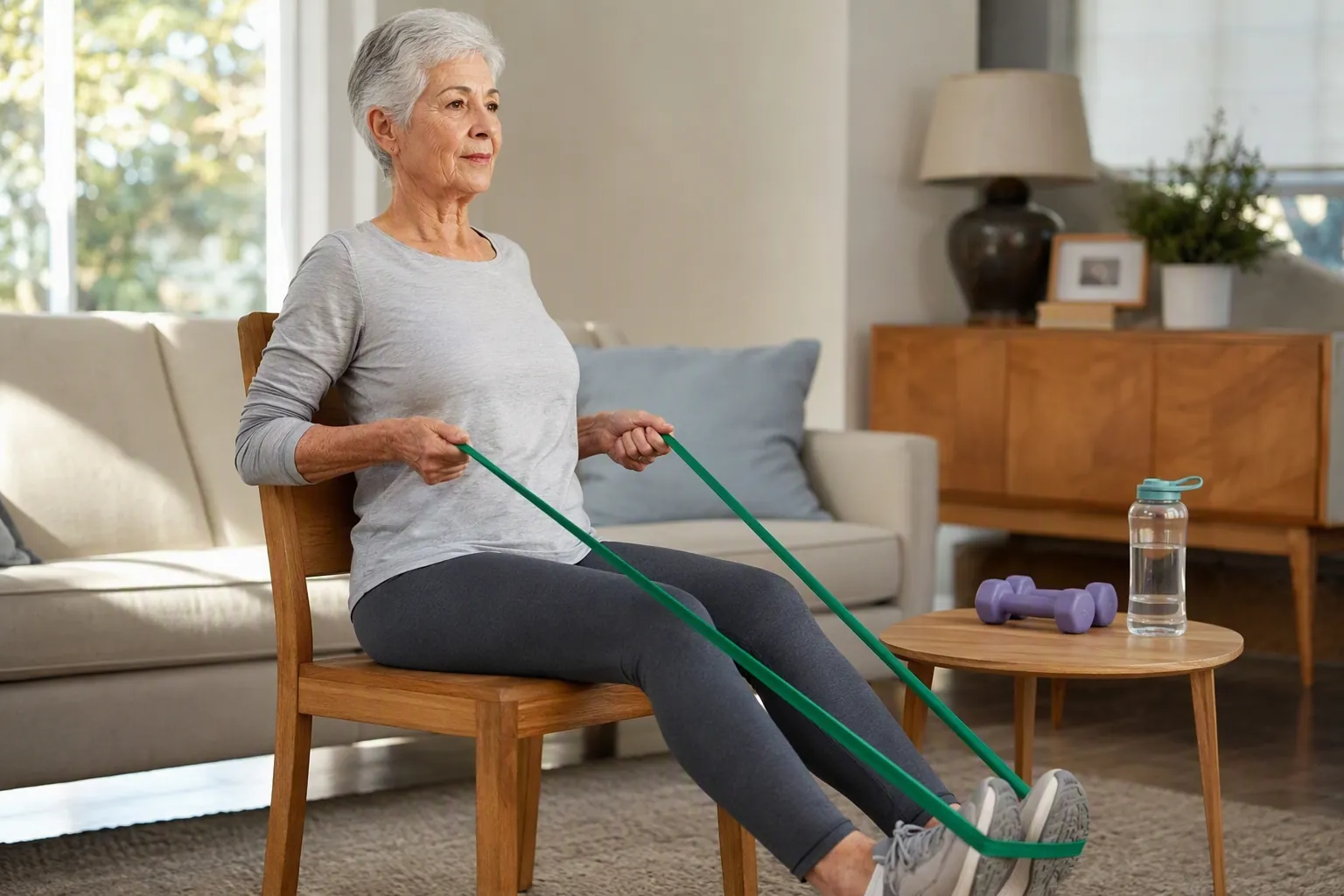
The part worth keeping: seniors are not too old to build strength
The best case for taking Arnold’s message seriously is not celebrity willpower. It is that current older-adult activity guidance already includes muscle-strengthening work. CDC guidance for adults 65 and older calls for 150 minutes a week of moderate-intensity aerobic activity, muscle-strengthening activities on 2 days a week, and balance activities.[4] A strength program can fit that standard. A strength-only challenge cannot replace the whole standard.
The “too old” assumption also does not hold up well. Arnold’s Pump Club summarized a 12-week resistance-training study in adults 85 and older in which quadriceps size increased 11% and leg strength increased 46%, with gains described as matching those seen in a 65-to-75-year-old cohort.[5] That does not mean every 85-year-old should deadlift this week. It does mean age alone is too crude a reason to write off progressive strengthening.
A broader review points in the same direction. Fit&Well covered a 102-RCT meta-analysis of adults ages 63 to 87 reporting that machine training, free weights, resistance bands, bodyweight training, and mixed methods all produced large positive strength effects; the coverage noted machine training had the greatest effect, while consistency predicted outcomes more than equipment choice.[6] That last point matters in a living room. The safest plan is usually the one an older adult can repeat without pain, panic, or a fall scare.
The safety gate comes before the first AMRAP
The challenge language becomes riskier when it moves from “train consistently” to “do as many rounds or reps as possible.” AMRAP pacing rewards speed, fatigue tolerance, and competitiveness. In a senior who has not been screened, that can turn a useful movement into a dizziness problem, a breath-holding problem, a joint-irritation problem, or a floor-transfer problem.
A safer entry point starts with fall-risk thinking. CDC’s STEADI framework is built around screening, assessing, and intervening for fall risk before a problem becomes a fall.[7] For a caregiver, that means the question is not only “Can Mom do a squat?” It is also “Can she stand up, turn, recover her balance, and stop when she gets lightheaded?”
At minimum, an older adult should discuss exercise goals with a health care provider when an injury or health condition affects mobility, which aligns with federal physical-activity advice cited in Fortune’s reporting on Schwarzenegger’s exercise guidance.[8] For this particular challenge, clearance is especially important before AMRAP circuits, deadlifts, floor push-ups, or rapid step increases if any of the following are present:
- A heart history, pacemaker, chest discomfort with exertion, unexplained shortness of breath, dizziness, fainting, or untreated high blood pressure.
- A recent fall, near-fall, fear of falling, unsteady walking, or use of a cane, walker, furniture, or a caregiver’s arm to move safely.
- Hip, knee, shoulder, wrist, neck, or back pain that could make deadlifts, push-ups, bear crawls, or floor transitions unsafe.
- Difficulty getting down to the floor and back up without help.
- Uncertainty about form, breathing, safe loading, or how hard the workout should feel.
For families already using Medicare preventive visits, the fall-risk conversation can start before any challenge begins. A Medicare Annual Wellness Visit fall-prevention check is a practical place to name the concern: “We want to try a strength challenge, but we need to know what movements are safe.”
How to scale the actual challenge pieces
The strongest argument for modification comes from Arnold himself. Business Insider and Men’s Health have reported that he shifted toward machines rather than free weights as he aged, with the change described as dating back to 2012.[9][10] Healthline reported that after heart surgery he used lighter weights and more reps.[11] His Step Challenge also describes a plus-1,000-step method that came out of pacemaker recovery.[2] That is the useful lesson: modification is not quitting. It is how training survives real knees, real shoulders, real hearts, and real recovery.
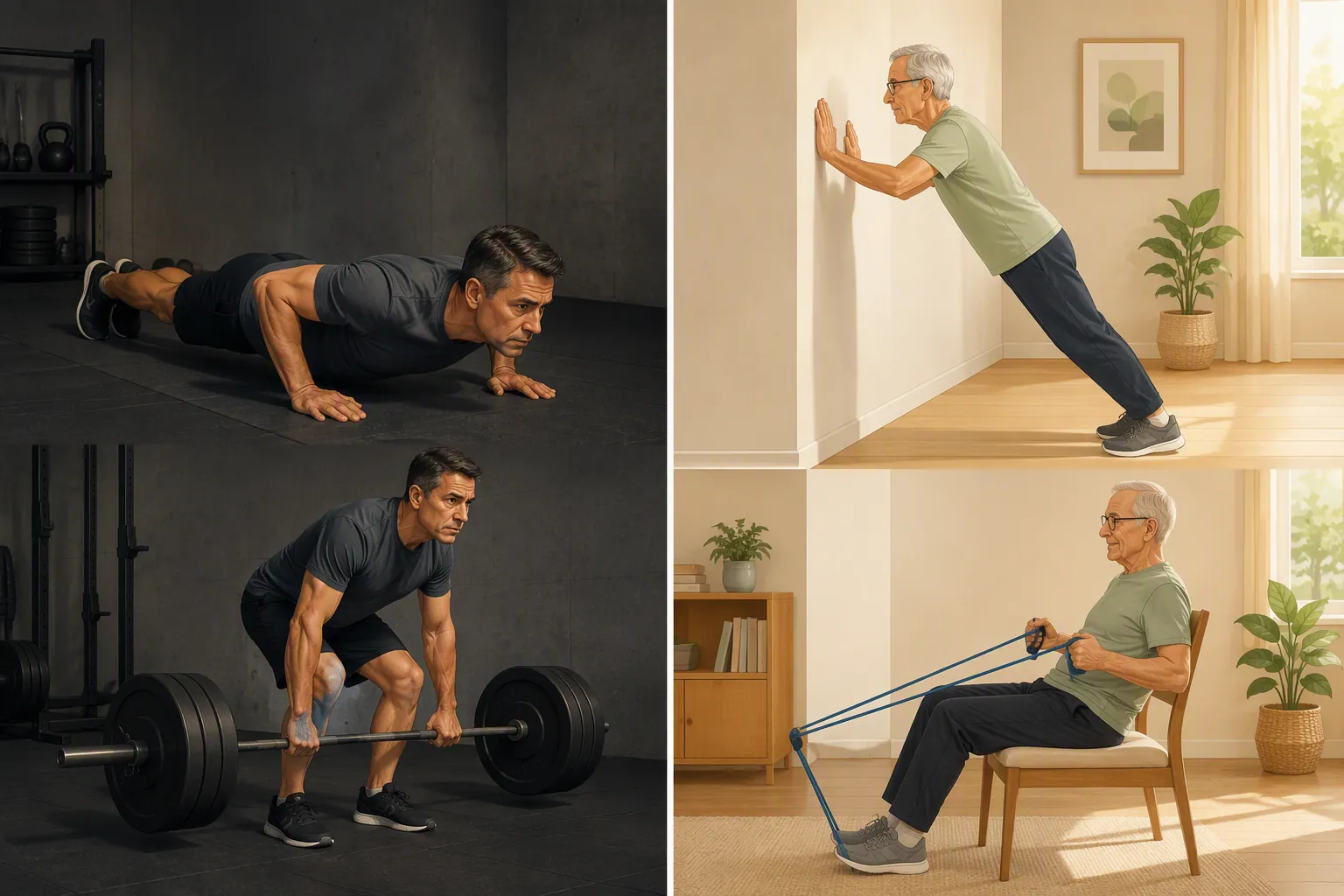
| Challenge element | Safer senior filter |
|---|---|
| AMRAP circuits | Change “as many as possible” into controlled sets with rest. Stop before form breaks, and keep the effort conversational rather than competitive. |
| Deadlifts | Use a hip-hinge lesson first. Start with a light object from an elevated surface, a resistance band, or a supervised machine alternative before any heavy free-weight pull. |
| Floor push-ups | Use wall push-ups, counter push-ups, or an incline surface. Skip floor versions if getting down and up is difficult or shoulder, wrist, neck, or back pain appears. |
| Bear crawls or floor-based work | Replace with standing or seated core and upper-body work. The floor transfer is part of the exercise risk, not just the exercise setup. |
| Squats | Use chair squats to a stable chair, with a countertop or sturdy support nearby if balance is uncertain. |
| Bands and machines | Prefer these when form, joint tolerance, or balance makes free weights harder to control. A seated row or machine press can be a legitimate strength exercise. |
| Four-program commitment | Do not stack every option at once. Choose one entry route, watch symptoms and recovery, then progress only if the senior is tolerating it. |
Chair squats deserve special attention because they are not a consolation prize. Fox News reported that Iron Ticket eligibility explicitly included “first-ever chair squats,” which is a meaningful signal that the challenge ecosystem can accept scaled movements.[3] For many older adults, the chair squat is also closer to the movement that protects independence: standing up from the toilet, getting out of a dining chair, and rising from the edge of the bed.
If pain is the reason someone has stopped moving, the answer is not automatically “avoid exercise forever.” CNBC reported Schwarzenegger’s view that surgery should not be the first choice when therapy can be effective, while also warning against stopping movement solely out of joint fear.[12] In practical terms, a painful joint is a reason to choose a clinician-guided route, not a reason to turn a fast challenge into self-treatment. For many families, that route may involve asking about PT or OT; this Medicare Part B PT and OT coverage guide explains the supervised-exercise alternative.
The Step Challenge is the easiest piece to like, with one condition
Among the challenge pieces, the Step Challenge is often the most senior-friendly because it can be adjusted without equipment and without getting on the floor. The plus-1,000-step method is more sensible than telling every older adult to chase the same daily total, because it starts from the person’s own baseline.[2]
The condition is that walking progressions still count as training. A senior with fall risk, dizziness, heart history, new shortness of breath, or unsafe outdoor walking conditions should not treat a step target as automatically harmless. The safer version may be shorter indoor walks, a hallway loop, a supervised route, or several small walking blocks rather than one long push.
This is also where a safe challenge can interrupt the mobility-decline spiral. When an older adult moves less, weakness can build, confidence can shrink, and fall risk can rise. A careful entry program is useful because it keeps the person active without pretending that every ambitious target is safe on day one. Caregivers seeing that pattern can use this guide to helping aging parents maintain mobility and independence alongside any exercise plan.
The missing piece is balance work
Strength training helps, but it does not erase the need for balance training. CDC’s older-adult guidance names balance activities separately for adults 65 and older.[4] That matters because the challenge materials are centered on strength, conditioning, steps, and motivation. None of that automatically trains the specific skill of recovering from a sway, turning safely, stepping around a pet, or staying steady while reaching into a cabinet.
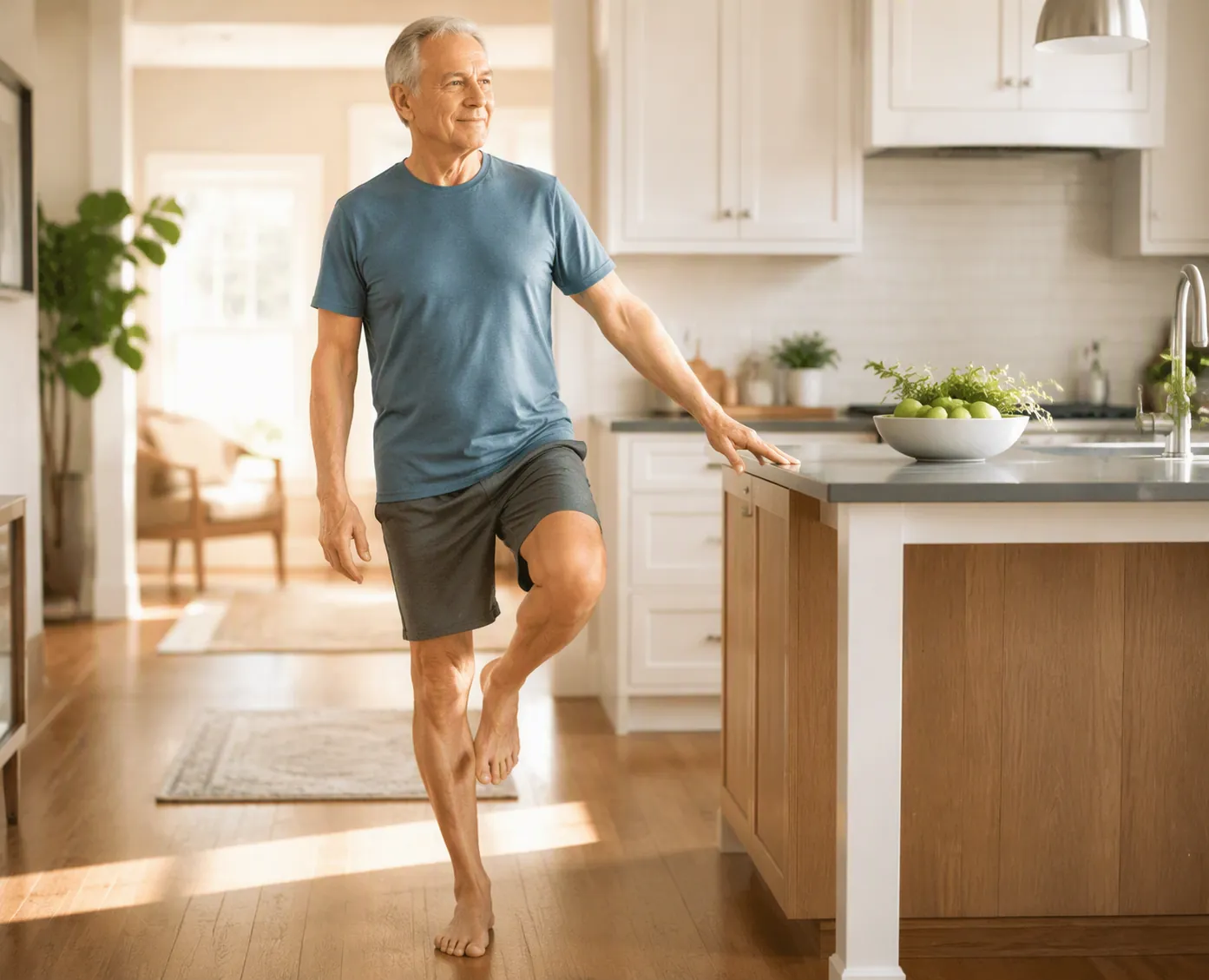
The add-on does not need to be dramatic. It does need to be deliberate. Balance practice should happen near a stable support, with footwear and flooring that do not add risk, and with a clinician’s help when the person has already fallen, feels unsteady, or cannot safely practice alone. For some seniors, a countertop-supported balance drill is more relevant to fall prevention than another faster round of push-ups.
So the safe version of the Arnold Schwarzenegger fitness challenge for seniors is conditional: pass the clearance gate when health conditions, fall risk, pain, or mobility limits are present; choose the scaled version of every movement; keep intensity controlled enough to talk; progress walking from the current baseline; and add balance work on purpose. If form, symptoms, or fear of falling are uncertain, the safer challenge is the one built with a physician, physical therapist, or occupational therapist before the app timer starts.
References
- The Pump Club App — Arnold's Pump Club
- Arnold's Step Challenge — Arnold's Pump Club
- Arnold Schwarzenegger offers new fitness challenge after helping presidents, US military shape up — Fox News — Jan. 6, 2025
- Older Adult Activity Guidelines — Centers for Disease Control and Prevention — Dec. 4, 2025
- Arnold Says Age Is Not an Excuse. Research Explains Why He's Right — Arnold's Pump Club
- Arnold Schwarzenegger says you can build strength at any age — all you need is his versatile full-body workout — Fit&Well
- STEADI — Older Adult Fall Prevention — Centers for Disease Control and Prevention — Apr. 22, 2024
- Arnold Schwarzenegger fitness exercise workout tips — Fortune — Nov. 2024
- Arnold Schwarzenegger new longevity workout regimen — Business Insider — Oct. 10, 2025
- Arnold Schwarzenegger Workout Weight Machine Aging — Men's Health
- Arnold Schwarzenegger Talks Joint and Mobility Health — Healthline — Mar. 15, 2025
- Arnold Schwarzenegger on how to stay healthy age 50s, 60s, older — CNBC — May 20, 2025
Questions to bring to a clinician or OT
This is not medical, legal, or a family's final decision — only a framework. Bring these questions to a clinician, occupational therapist, or your local Area Agency on Aging.
Find Local HelpRelated reading
Noticed something outdated or inaccurate on this page? Flag a correction. We review every report against CDC, NIA, and AARP HomeFit guidance before updating a page.