
Equipment comparison
Adapt Arnold Schwarzenegger's Gym Workout for Older Adults
Arnold Schwarzenegger's current routine — machines, lighter loads, high-rep warm-ups — matches the strength-training evidence for adults 65 and older far better than his classic bodybuilding splits. You get a concrete two-day-per-week adaptation with warm-up sets, progression steps, and safety guardrails, including when to get medical clearance first.
| Equipment category | resistance-training machines |
|---|---|
| Comparison criteria | fit, joint comfort, movement control, recovery |
| Best fit for | Older adults beginning strength training who want a joint-friendly, machine-supported routine |
The Arnold Schwarzenegger gym workout for older adults worth studying is not the old high-volume bodybuilding split. It is the newer version: more machines, lighter loads, high-rep warm-up sets, and substitutions made because shoulders and knees eventually get a vote.
In a 2023 Men’s Health look at Schwarzenegger’s routine at age 75, the notable pattern was not just that he still trained. It was how repeatable the work looked: machine preacher curls and machine dips started with a 30-rep warm-up set before 4 working sets of 10 to 12 reps, followed by shoulder-focused machine work such as lateral raises and rear-delt flys in the 10-to-12-rep range [1]. In an October 2025 Business Insider report, at age 78, he described a nearly daily routine of about 90 minutes, including roughly 25 weightlifting sets and about 45 minutes of biking, and said he had moved many movements to machines because of shoulder and knee problems [2].
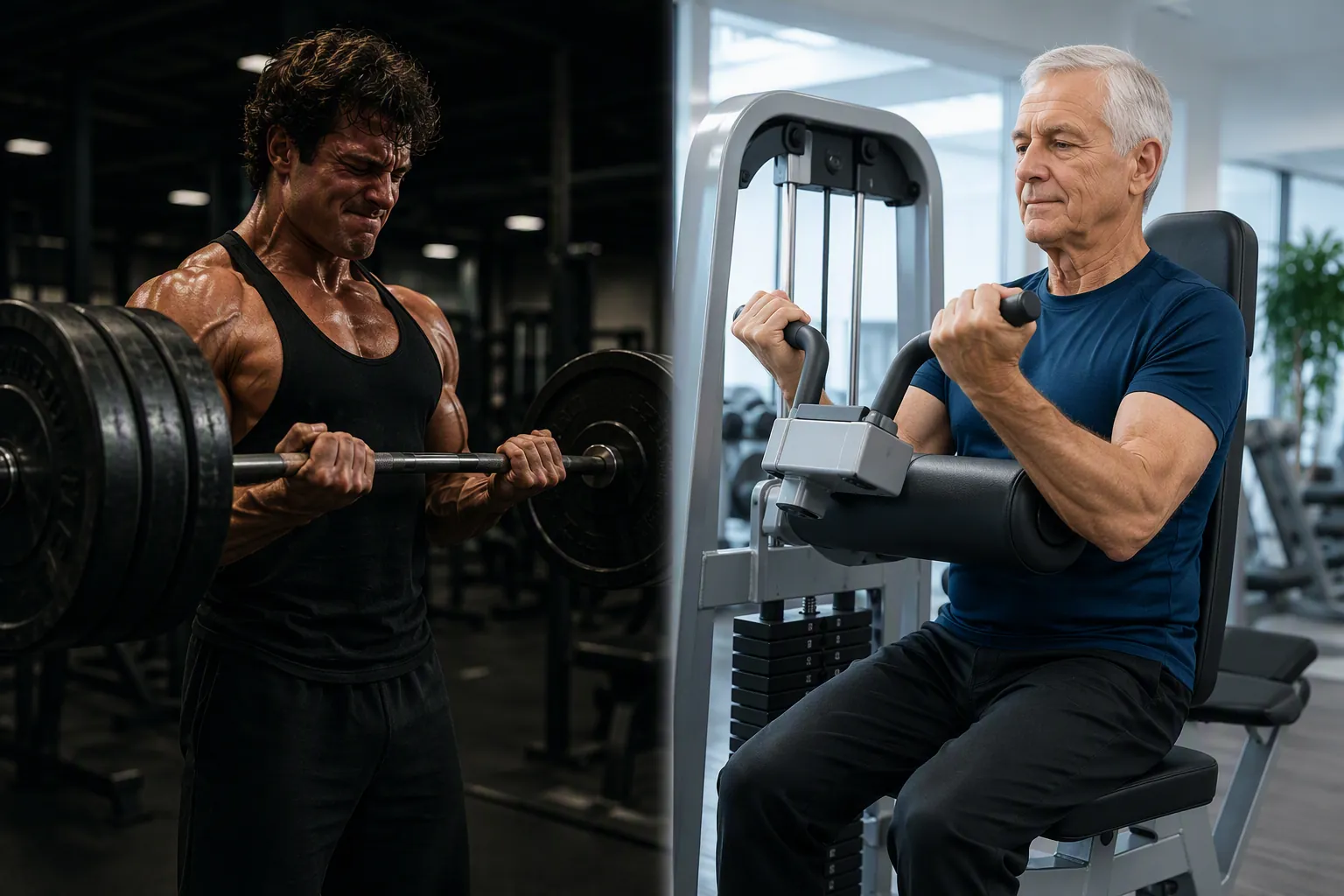
That distinction matters. A 68-year-old who wants to feel strong again does not need a nostalgic six-day split. An adult child trying to help a parent start lifting does not need to turn into a trainer. The useful lesson is narrower and more practical: take the joint-protective shape of Schwarzenegger’s current gym work, reduce the volume, slow the progression, and put safety rules around it.
This is an adaptation template, not an Arnold-endorsed senior program and not a medical prescription. CareWise clinical safety note: use this article for education, and ask your own clinician, physical therapist, or qualified exercise professional to review it if you have health conditions, pain, balance concerns, or uncertainty about gym machines.
Why machines make sense here
Machines are sometimes treated as the timid option. For many older beginners, they are the option that makes the first month possible. A pin-loaded chest press or leg press tells you where to sit, where the handles or platform go, and how much weight is on the stack. That reduces the number of things a new lifter has to solve at once.
The evidence does not require older adults to prove themselves with barbells first. A 2025 network meta-analysis of 102 trials involving 4,754 community-dwelling adults aged 63 to 87 found moderate-to-large muscular fitness gains across resistance-training modalities, with machine training ranked highest for effect size in that analysis (SMD 1.34) [3]. That does not mean machines are magically superior for every person. It does mean a machine-supported plan is a serious starting point, not a watered-down consolation prize.
ACSM guidance also fits a modest start: resistance training at least 2 days per week, 1 to 3 sets, 6 to 15 repetitions, and moderate-to-vigorous loading ranges depending on the goal and ability level [4][5]. That is the lane this plan stays in. Schwarzenegger’s nearly daily volume is celebrity context, not the target dose for an older beginner.
| Schwarzenegger detail | What an older beginner can borrow | What not to copy |
|---|---|---|
| Machine preacher curls, machine dips, shoulder machines | Use supported, repeatable machine patterns when free weights feel intimidating or joints need more control | Do not copy every exercise if a machine causes shoulder, elbow, wrist, back, hip, or knee pain |
| 30-rep warm-up sets before working sets | Use a very light first set to rehearse the movement and check how the joint feels that day | Do not turn warm-ups into exhausting sets |
| Multiple sets per exercise | Start with 1 working set, then build to 2, and only later consider 3 | Do not start with bodybuilding volume |
| Nearly daily training reported in 2025 | Train strength 2 nonconsecutive days per week at first | Do not assume more days are safer or more effective |
Before you start: clearance and stopping rules
If you are already active, have no unstable health concerns, and can walk into the gym without dizziness, chest symptoms, or unusual shortness of breath, a gentle two-day machine plan may be a reasonable conversation to have with your doctor or trainer. If any of the items below apply, do not make the first workout the screening test.
- Get medical clearance first if you have heart disease, chest pain, unexplained shortness of breath, fainting, uncontrolled blood pressure, recent surgery, a recent fall, new or worsening dizziness, severe osteoporosis, a recent fracture, or a neurological condition affecting movement.
- Ask for professional help if you cannot get on or off machines safely, cannot adjust the seat or pin without strain, or feel unsure about balance while walking between stations.
- Stop the session immediately for chest pain, pressure, faintness, sudden severe headache, unusual shortness of breath, new confusion, loss of coordination, or pain that feels sharp, electric, or joint-deep.
- Stop that exercise, even if you continue the session, if the movement causes joint pain that changes your form, increases rep by rep, or lingers after you unload the machine.
- Reduce the next workout if soreness, fatigue, or joint irritation makes normal walking, stairs, sleep, or daily tasks noticeably worse.
The CDC’s older-adult activity guidance gives a useful tone for this: adults 65 and older who cannot fully meet the recommendations should be as active as their abilities and conditions allow, and “some activity is better than none” [6]. That is not permission to ignore symptoms. It is permission to start smaller than the person on the next machine.
The two-day Arnold-inspired machine workout
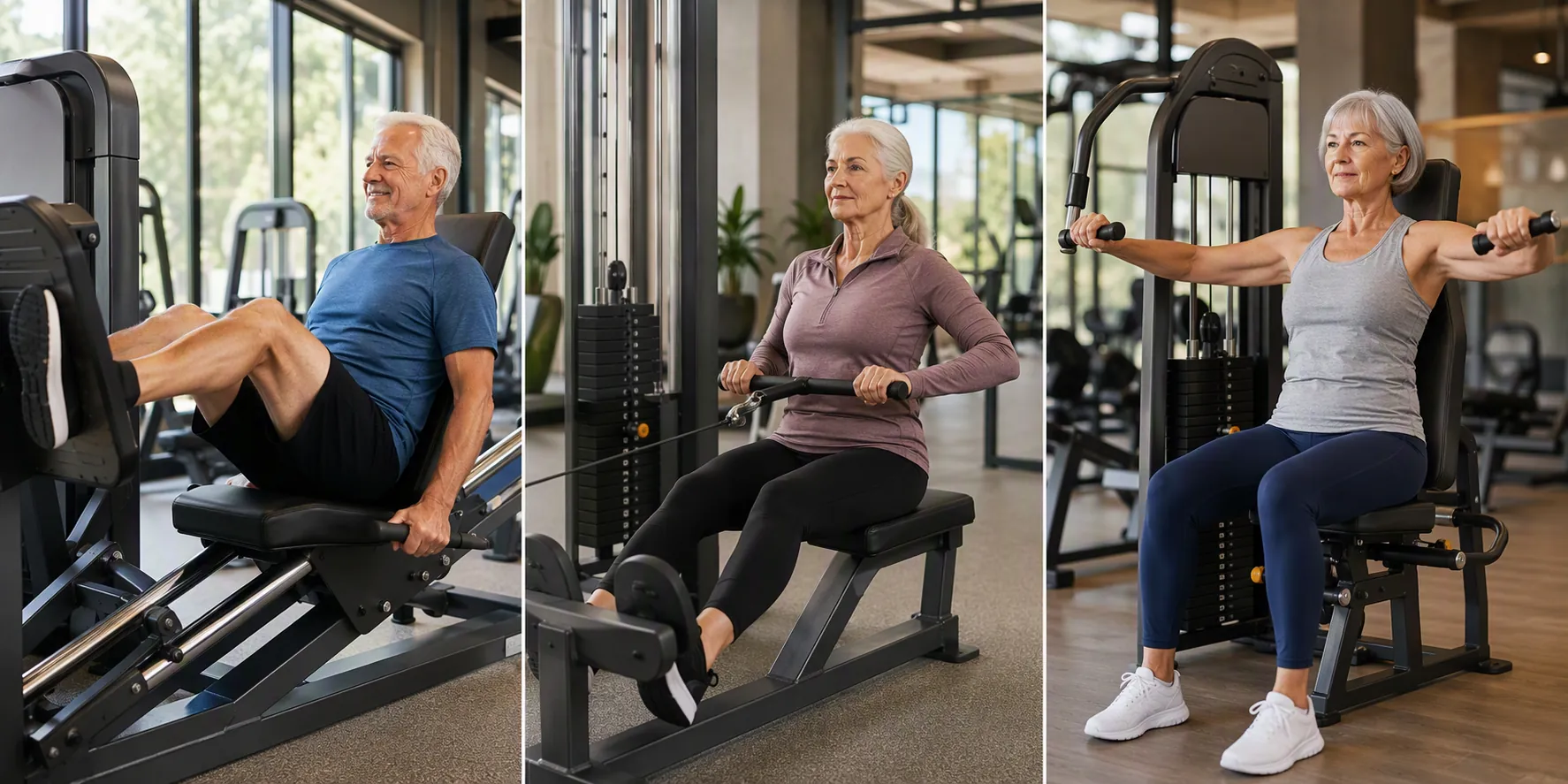
Train on 2 nonconsecutive days, such as Monday and Thursday or Tuesday and Friday. Keep at least 1 day between sessions. The first goal is not to feel crushed afterward; it is to leave knowing you could come back and repeat the plan.
Use this effort boundary: finish most working sets with about 2 to 4 good repetitions still in reserve. Breathing should be steady enough that you are not holding your breath or bracing as if attempting a max lift. Each repetition should look similar to the one before it.
| Part of session | What to do | How hard |
|---|---|---|
| General warm-up | 5 to 10 minutes of easy cycling, treadmill walking, or another comfortable cardio machine | Easy enough to talk |
| Machine setup | Adjust the seat, back pad, handles, and range of motion before adding effort | No reaching, twisting, or joint pinching |
| Light rehearsal set | For the first few exercises, do 1 light set of 15 to 30 reps before the working set | Very easy; this is practice, not a test |
| Working sets | Start with 1 working set per exercise for 2 to 4 weeks, then move to 2 if recovery is good | Moderate effort with 2 to 4 reps in reserve |
| Cool-down | Walk slowly or cycle easily for a few minutes before leaving | Let breathing settle |
Day 1: supported push, pull, and legs
| Exercise | Warm-up | Working sets | Notes |
|---|---|---|---|
| Seated leg press | 1 light set of 15 to 30 reps | 1 to 2 sets of 8 to 12 reps | Keep the range comfortable; do not let knees collapse inward |
| Seated chest press | 1 light set of 15 to 30 reps | 1 to 2 sets of 8 to 12 reps | Use handles that let shoulders stay low and comfortable |
| Seated row | 1 light set of 15 to 20 reps | 1 to 2 sets of 8 to 12 reps | Pull elbows back without leaning or yanking |
| Seated or lying leg curl | Optional light set of 12 to 15 reps | 1 to 2 sets of 10 to 15 reps | Move slowly; avoid cramping by using a conservative load |
| Machine lateral raise | Optional light set of 12 to 15 reps | 1 set of 10 to 15 reps | Stop below shoulder height if higher range pinches |
| Cable or machine core press | Practice with very light resistance | 1 set of 8 to 12 reps per side | Stand only if balance is steady; otherwise choose a seated core machine |
Day 2: legs again, back again, arms optional
| Exercise | Warm-up | Working sets | Notes |
|---|---|---|---|
| Leg press or sit-to-stand from a stable bench | 1 light set of 10 to 20 reps | 1 to 2 sets of 8 to 12 reps | Choose the option that feels most controlled on knees and hips |
| Lat pulldown | 1 light set of 12 to 15 reps | 1 to 2 sets of 8 to 12 reps | Pull to upper chest; avoid pulling behind the neck |
| Machine reverse fly or rear-delt fly | Optional light set of 12 to 15 reps | 1 set of 10 to 15 reps | Small controlled range is fine |
| Hip abduction machine | Optional light set of 12 to 15 reps | 1 to 2 sets of 10 to 15 reps | Use this for hip support work, not maximum loading |
| Cable triceps pressdown or assisted dip machine | 1 light set of 12 to 20 reps | 1 set of 10 to 15 reps | Skip assisted dips if shoulders object |
| Machine preacher curl | 1 light set of 15 to 30 reps | 1 set of 10 to 15 reps | Keep wrists neutral and elbows comfortable |
| Supported calf raise or seated calf machine | Optional light set of 12 to 15 reps | 1 set of 10 to 15 reps | Hold the machine or handles for stability |
The arm work is intentionally last. It is the most Arnold-looking part of the plan, and the least important if time, energy, or joints are limited. If a workout is running long, keep the leg press, chest press or pulldown, row, and one hip or hamstring movement. Curls can wait.
How to choose the first weight
Ignore the weight stack number at first. Pin positions vary by machine, and the same number can feel different across brands. Your first job is to find a load that lets you move slowly, breathe, and stop without strain.
- Start lighter than you think you need. On a new machine, the first set is a rehearsal.
- Use a smooth tempo: lift without jerking, pause briefly, and return under control.
- If you cannot reach the low end of the rep range with steady form, reduce the weight.
- If you reach the high end and feel as if you could do many more reps, add only the smallest available increase next time.
- Do not test a one-rep max. It is unnecessary for this plan.
Schwarzenegger’s 30-rep warm-up sets are useful because they make the first set diagnostic. On a good day, the joint feels smoother by the end. On a bad day, the warm-up tells you to lower the weight, shorten the range, switch machines, or leave that movement out.
Progress without guessing
For the first 2 to 4 weeks, keep the plan almost boring: 1 working set per exercise, 2 days per week, no extra finishers. If recovery is good, add a second working set to the main movements. Later, if you still recover well, a third set on selected exercises can fit within ACSM’s 1-to-3-set range [4][5].
| If this happens | Next workout |
|---|---|
| You completed every rep with clean form and no joint flare afterward | Keep the same weight or add the smallest available increase on that exercise |
| You completed the reps but form became rushed or breath-holding appeared | Keep the same weight and slow the movement down |
| You felt sharp pain, pinching, or nerve-like symptoms | Skip that machine and ask a qualified professional to assess the setup or choose a substitute |
| You were unusually sore, tired, or unsteady the next day | Reduce sets or load; do not add weight |
| You missed workouts because of illness, travel, or a flare-up | Restart with fewer sets and lighter weights for the first session back |
A simple rule works well: increase only one variable at a time. Add weight, add a set, or add a new exercise—not all three in the same week. That keeps the source of soreness or irritation easier to identify.
Substitutions for common problem spots
Machines help, but they do not make every movement right for every joint. The best machine is the one you can adjust well and repeat without symptoms. If your gym has several versions of the same exercise, choose comfort and control over the one that looks most intense.
| If this bothers you | Try this instead | Keep this boundary |
|---|---|---|
| Shoulder discomfort on overhead press | Machine chest press with neutral handles, machine lateral raise below shoulder height, or rear-delt fly | No pinching, no forced overhead range |
| Knee discomfort on leg press | Shorter leg-press range, higher foot placement, sit-to-stand from a stable bench, or hip abduction work | Knees track comfortably; pain does not increase rep by rep |
| Low-back discomfort on seated row | Chest-supported row, lighter cable row, or pulldown | Torso stays supported; no leaning back to finish reps |
| Elbow or wrist discomfort on curls | Cable curl with a neutral grip or skip curls temporarily | Wrists stay neutral; no tendon pain |
| Balance uncertainty between machines | Use machines near each other, ask staff for setup help, or work with a trainer or physical therapist | No rushing across the weight room while fatigued |
If arthritis, balance concerns, or fear of falling are part of the picture, the gym plan should sit inside a broader mobility conversation. CareWise readers may also want to review joint-pain and balance considerations for seniors with arthritis and the site’s fall-prevention resources before adding load.
Where cardio, balance, and flexibility fit
Strength training is one part of aging well, not the whole assignment. An NIH MedlinePlus article drawing on National Institute on Aging guidance groups physical activity for older adults into four types: endurance, strength, balance, and flexibility [7]. Schwarzenegger’s reported routine includes biking, but an older beginner does not need to attach 45 minutes of cycling to every lift to make the gym worthwhile.
- Endurance: easy walking, cycling, swimming, or water exercise on non-lifting days or after a shorter strength session.
- Strength: the two-day machine plan above.
- Balance: clinician-approved balance drills, tai chi, or supervised work if unsteadiness is present.
- Flexibility: gentle range-of-motion work after warming up, not aggressive stretching into pain.
Gym access is sometimes already hiding in a health plan or community benefit. If cost or transportation is the barrier, check whether a Medicare plan includes fitness, pool, or wellness access; senior swimming benefits can also be a gentler way to build confidence before or alongside machine training.
If you are helping a parent start
The adult child’s job is not to count every rep forever. It is to remove the first obstacles: pick a calm gym time, help locate the machines, ask staff to demonstrate adjustments, write down the starting weights, and make it normal to stop early.
- Do not compare today’s workout with what they did decades ago.
- Do not add exercises because the first session looked “too easy.” Easy is often why the second session happens.
- Do ask what felt confident, what felt confusing, and what felt painful.
- Do keep a simple log: date, machines used, weight pin, reps, and any next-day symptoms.
- Do step back once the routine feels familiar, unless they ask for help.
Strength training often matters most because of ordinary independence: rising from a chair, carrying groceries, climbing steps, catching balance, and feeling less fragile in public spaces. For a broader look at activity, nutrition, and independence, see CareWise’s guide to healthy aging habits for seniors.
The responsible Arnold lesson
Schwarzenegger’s current routine is inspiring because it shows adaptation in public. Machines replaced some movements. Warm-up sets became visible. The work still looks disciplined, but less interested in proving that nothing changed.
For older adults, that is the lesson to keep. Use the machine-supported structure, the light rehearsal sets, the steady repetition ranges, and the willingness to modify around joints. Leave behind the nearly daily volume, the bodybuilding-era splits, and any routine that makes recovery an afterthought.
The safer version is the two-day plan with progression and guardrails. That is enough to begin.
References
- Arnold Schwarzenegger Shares His Current Workout Routine at 75 — Men’s Health, 2023
- Arnold Schwarzenegger’s New Longevity Workout Regimen — Business Insider, October 2025
- PubMed record PMID: 40452461 — PubMed, 2025
- Resistance Training Guidelines Update 2026 — American College of Sports Medicine, 2026
- Older Adults Strength Training — American College of Sports Medicine
- Older Adults — Centers for Disease Control and Prevention
- 4 physical activity tips for older adults — NIH MedlinePlus Magazine
Questions to ask your clinician or OT
This comparison doesn't decide final medical fit — bring it to a clinician or occupational therapist conversation, not a purchase decision.
Find Local HelpRelated reading
Noticed something outdated or inaccurate on this page? Flag a correction. We review every report against CDC, NIA, and AARP HomeFit guidance before updating a page.