
Caregiver decision guide
Cell Service Down? 5 Steps Caregivers Must Take Right Now
A crisis checklist for caregivers who cannot reach an aging parent because cell service has failed. These five ordered steps — from texting through neighbor dispatch — help you reconnect fast, based on FCC emergency guidance and Red Cross caregiver protocols.
You have called twice. The call will not complete, or it rings and drops. Before you keep redialing, switch to a sequence that uses the least fragile option first and moves toward local human help. This is crisis-response guidance, not medical or legal advice; if you already believe your parent is in immediate danger, call 911 or the local emergency number now.

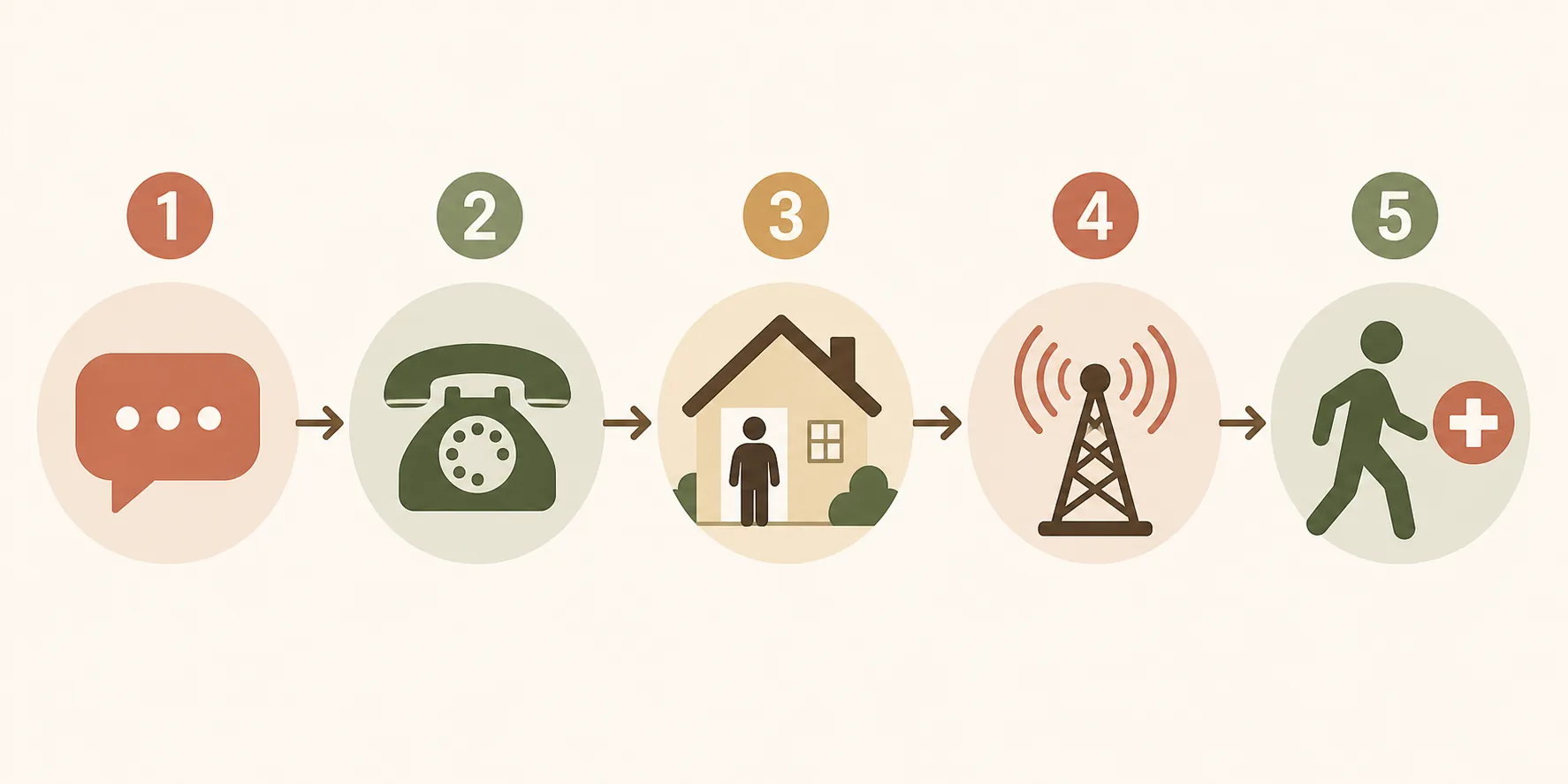
The five-step order to follow right now
| Step | What to do | Why it comes here |
|---|---|---|
| 1 | Send a short text message. | Texts use less bandwidth than voice calls and may go through when calls cannot. |
| 2 | Try the home landline, if there is one. | A true copper landline may still work when cell service or household power is disrupted; VoIP may not. |
| 3 | Contact the local check-in person. | A neighbor, building manager, nearby relative, or friend with permission to knock is the most technology-independent backup. |
| 4 | Check outage scope through official alerts. | FEMA, NOAA, and local emergency alerts can help you tell whether this is a broad outage, severe weather, or a local problem. |
| 5 | Send in-person help or contact local emergency management. | If there is still no response and risk factors are present, stop treating this as a phone problem. |
1. Send a text before you call again
The first action is not another call. Send a plain, short text: “Cell calls may be down. Please reply OK. If you need help, reply HELP.” The FCC recommends texting instead of calling during network congestion when the matter is not an emergency, because text messages use significantly less bandwidth than voice calls and may get through when calls do not. [1]
Keep it simple. Do not send a long explanation, photo, group message, or anything that asks your parent to read three paragraphs while anxious. If they use an iPhone, send the message normally; if it does not send as iMessage, make sure it can fall back to SMS. If you have more than one number for them, send the same short message to each one.
If your parent has hearing trouble, memory changes, low vision, or hand tremor, assume the message may be seen but not answered quickly. A missing reply is information, but it is not proof that they are hurt. It is the reason you keep moving through the chain.
2. Try the landline, but know what kind it is
Many families say “landline” when they mean any home phone with a handset. In an outage, that distinction matters. A traditional copper POTS line may keep working during a power outage because it is powered through the telephone line. A VoIP home phone depends on household power and internet equipment, so it can fail with the router, modem, backup battery, or broadband service. The FCC advises keeping one corded phone that plugs directly into the wall jack for emergency use. [1]
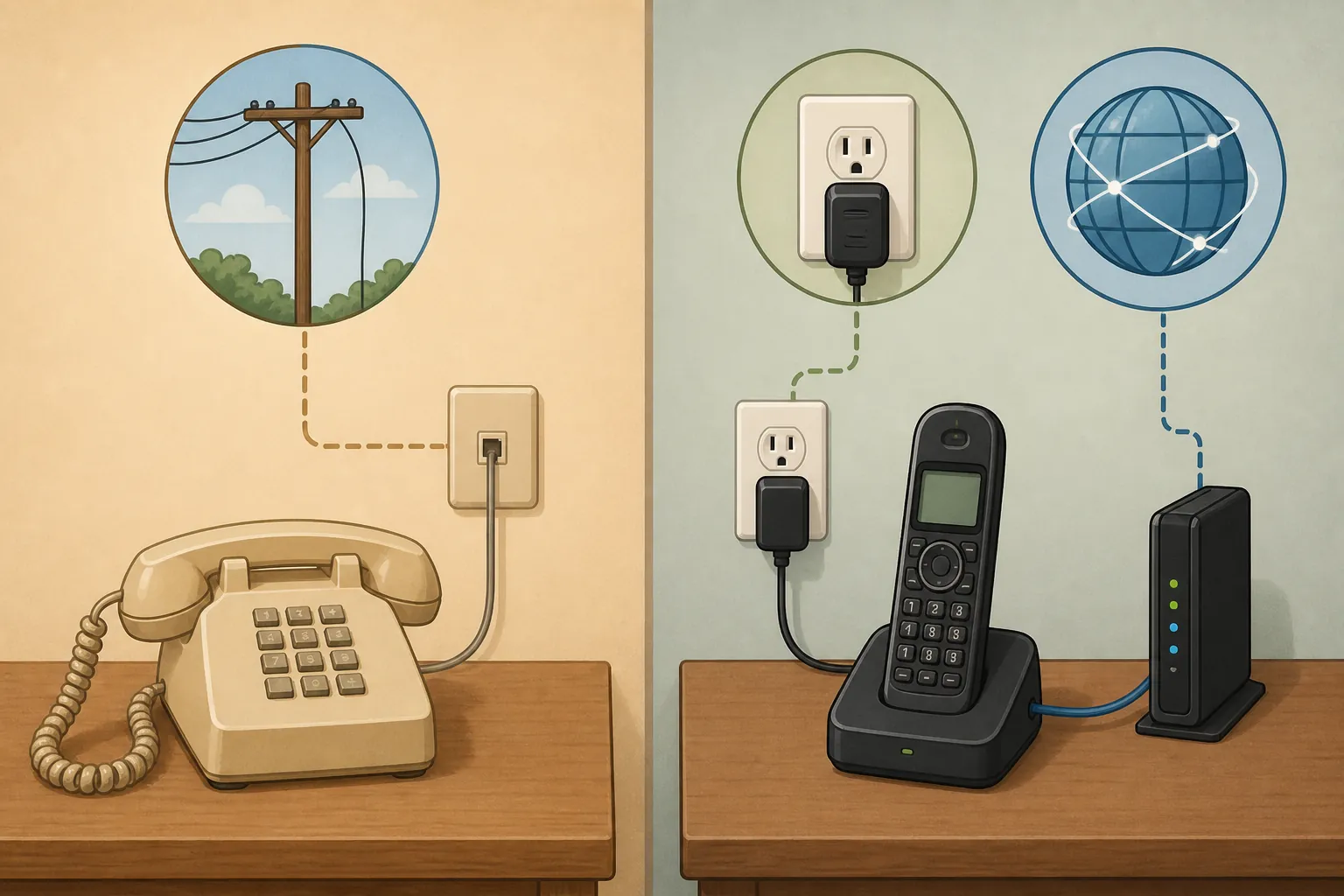
Right now, you may not be standing in your parent’s kitchen to inspect the phone. Use what you know. If the phone plugs into a modem, router, cable box, fiber terminal, or cordless base station, treat it as dependent on power and internet unless you know there is working backup power. If there is an old-style corded phone plugged straight into a wall jack, it is more likely to be a separate path.
- Call the home number once from your cell phone if your own signal allows it.
- If your cell call will not complete, try from a different network: another household phone, work phone, neighbor’s phone, or internet calling service if available.
- If the home phone is VoIP and the internet or power is out at your parent’s home, do not keep treating it as a backup.
- If your parent relies on a cellular medical alert pendant, remember that it depends on the same general cellular path as a mobile phone; it is not a guaranteed workaround when towers are down.
This is the moment when a written list near the phone earns its place. Smartphone contacts are useful until the phone is dead, locked, misplaced, or in the hands of someone too frightened to search. After this incident, build or update an emergency contact binder for your aging parents with the home phone type, backup power notes, neighbor contacts, medication list, medical equipment, and who has a key.
3. Activate the local check-in person
If text and phone attempts have not worked, call the person who can physically check. The Red Cross recommends that older adults identify people in their support network who can help during emergencies, and Ready.gov’s older-adult guidance also emphasizes planning with a support network and communication options before an emergency. [2][3]
This person does not have to be a medical expert. They need to be close, willing, and already authorized. The best choices are a trusted neighbor, nearby relative, building manager, front desk staff, faith community contact, or friend who has been told in advance: “If my daughter cannot reach me during an outage, she may call you and ask you to knock.”
Give the local person a specific assignment, not a worried monologue. For example: “Cell service appears to be down. I have not reached my mother by text or phone. Could you knock, look for obvious signs of trouble, and call me back from any working phone? If she seems ill, confused, injured, or does not answer and you see something concerning, call emergency services.”
- Tell them whether your parent lives alone.
- Tell them whether anyone has a spare key or building access.
- Tell them about visible risks: oxygen equipment, mobility problems, dementia, recent falls, or severe weather nearby.
- Ask them to report what they actually observe: lights on, car present, door answered, voice heard, medical alarm sounding, water running, or no answer.
A neighbor with permission to knock is not a nice extra. It is the part of the plan that still works when the phone, pendant, app, router, and tower all have excuses.
4. Check whether the outage is wider than your family
While the local contact is trying to check, look for official information. Use the FEMA app, NOAA Weather Radio if you have access to one, local emergency management alerts, utility outage maps, local government social media, or local broadcast news. Ready.gov recommends older adults plan for alerts, communication needs, and emergency supplies as part of preparedness. [3]
You are trying to answer a practical question: is this likely a broad communications or weather problem, or is your parent unusually unreachable? A broad outage may explain dropped calls, but it does not remove the need to check on someone who lives alone, uses powered medical equipment, or is in the path of severe weather.
If your parent depends on oxygen concentrators, powered beds, refrigerated medication, dialysis-related equipment, stair lifts, or other powered devices, treat a communications outage and power outage as linked risks until you know otherwise. Utility medical priority registries can help before an outage, but they do not replace an immediate check during one. For planning after the immediate crisis, use a power-outage medical equipment guide to document backup power, supplier contacts, and escalation instructions.
5. Escalate when silence becomes a safety problem
Do not wait for a perfect amount of time if the risk is already high. If your parent is alone, medically fragile, dependent on powered equipment, in severe weather, recovering from a fall or procedure, cognitively impaired, or usually quick to respond and now completely unreachable, move from communication attempts to an in-person welfare check.
If the local contact reaches your parent and they are safe, keep the call short and get the next check-in time set before everyone hangs up. If the local contact cannot get access, sees something concerning, or cannot safely travel, contact local emergency services, local emergency management, or the non-emergency public safety number if there is no immediate life-threatening sign. If there is any sign of urgent danger, call 911.
Long-distance caregivers need one extra discipline here: write down each attempt as it happens. Time called, number used, text sent, neighbor contacted, answer received, official alert checked. In a stressful first hour, that record keeps you from repeating the same failed action and helps responders understand what has already been tried. A separate long-distance caregiver emergency response plan can make those calls less chaotic.
What not to rely on as the only backup
Medical alert devices, smart speakers, cameras, watches, and caregiver apps can be useful, but they are not the whole plan. Some depend on cellular service. Some depend on Wi-Fi. Some depend on household power. Some depend on your parent wearing, charging, hearing, or understanding the device at the right moment.
Two-way radios are also not a simple long-distance answer. Family and GMRS-style radio range depends heavily on terrain, buildings, antenna height, power, and whether both people know how to use the device. They may help close neighbors in some settings; they should not be the only bridge between an adult child miles away and a parent sitting alone at home.
AARP has reported that nearly half of adults age 50 and older do not own an emergency phone charger, which is a useful reminder that “I’ll just call their cell” is not a complete plan. [4]
After this incident, repair the weak link
When you have reconnected or sent help, make the plan less dependent on memory. FCC emergency guidance includes keeping emergency contact information and ICE contacts available, and caregiver preparedness guidance from AARP, Red Cross, and Ready.gov all points toward written plans, support networks, and backup communication options. [1][2][3][4]
- Label the home phone setup: copper landline, VoIP, cordless only, or unknown.
- Put a printed contact list by the phone and in a visible emergency binder.
- Choose at least one local check-in person and confirm they are willing to knock.
- Write who has a key, gate code, building access, or permission to enter.
- Record medical equipment, backup power limits, utility contacts, and whether the utility offers a medical priority registry.
- Practice the plan once, before the next storm, outage, or fall scare.
If cell outages in your area usually come with storms, also prepare the home itself: lighting, clear walking paths, charged flashlights, shoes near the bed, and a plan for safe movement in the dark. A storm and fall-prevention checklist for elderly adults belongs beside the communication plan, not in a separate mental drawer.
Communication resilience is not one perfect device. It is a rehearsed chain: low-bandwidth text, a known home phone path, a local person who can knock, official outage information, and emergency management when silence becomes a safety problem.
References
- Emergency Communications Tips, FCC
- Older Adults Emergency Preparedness, American Red Cross
- Older Adults, Ready.gov/FEMA
- How Caregivers Can Build Emergency Plans for Loved Ones, AARP
Questions to bring to a clinician or OT
This is not medical, legal, or a family's final decision — only a framework. Bring these questions to a clinician, occupational therapist, or your local Area Agency on Aging.
Find Local HelpRelated reading
Noticed something outdated or inaccurate on this page? Flag a correction. We review every report against CDC, NIA, and AARP HomeFit guidance before updating a page.