
Caregiver decision guide
Which Lightweight Cordless Vacuum Is Safest for Seniors?
For seniors with mobility issues, the safest lightweight cordless vacuum is the one that removes the three real fall hazards — tripping cords, awkward lifting, and bending to empty — not the lightest spec-sheet number. Readers come away with a criteria-first checklist for comparing in-hand weight, power controls, no-bend emptying, and real runtime, plus a five-step test-before-you-buy routine and an honest look at ultra-light model tradeoffs.
The first trouble often appears before the vacuum even starts. An older adult reaches for a machine in the hallway, and now there is a cord across the walking path, a handle that pulls weight into the wrist, and a dustbin or charging base low enough to require bending. That is the real shopping problem behind the phrase “best lightweight cordless vacuum for seniors with mobility issues.” The safest choice is not simply the vacuum with the smallest number on the box. It is the one a specific person can lift, steer, pause, empty, and store without turning cleaning into a balance test.
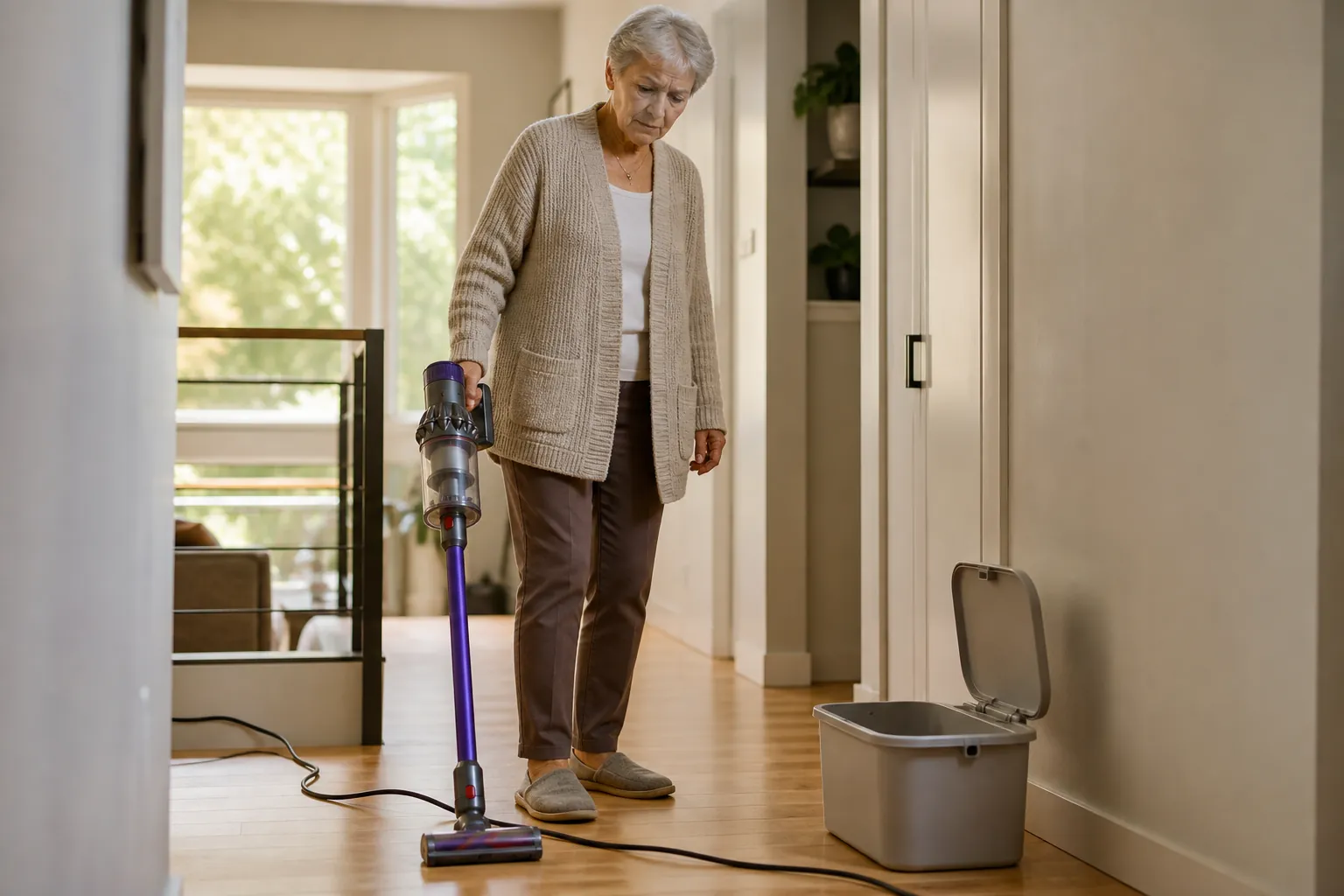
Falls are common enough that a vacuum purchase deserves to be treated as a home-safety decision, not just an appliance upgrade. As of this August 5, 2026 review, the CDC reports that more than 1 in 4 older adults falls each year, with about 3 million fall-related emergency department visits and about 1 million hospitalizations; cords, throw rugs, and clutter are among the modifiable hazards commonly addressed in home fall-prevention work.[1] A cordless vacuum can remove one hazard immediately: the cord dragged “just for a minute” through a doorway or across a hall.
That does not mean buying a cordless vacuum guarantees fewer falls. A 2023 systematic review and meta-analysis of home hazard modification programs found a modest fall reduction across 10 randomized controlled trials with 1,960 participants, with a risk ratio of 0.93 and a 95% confidence interval of 0.86 to 1.00.[2] Those were mixed programs, not vacuum studies. The useful lesson is narrower: changing the home task and the home environment can matter, and small hazards should not be waved away.
Reviewed: August 5, 2026. This guide is for mobility and daily-independence planning, not medical advice. If a person has recent falls, dizziness, new weakness, neuropathy, vision changes, or worsening balance, the vacuum decision belongs alongside a broader fall-risk review with a clinician, occupational therapist, or physical therapist.
Start with the hazards the vacuum must remove
A cordless stick vacuum helps only if it reduces the job placed on the body. For a senior with mobility issues, the core questions are plain: does it remove the cord from the walking path, reduce awkward weight in the hand, and avoid bending or bracing the machine during ordinary use?
- Cord hazard: a cordless vacuum removes the active power cord, but the charging setup still matters. A charger cable stretched across a bedroom or hallway simply moves the tripping hazard to storage time.
- Weight and steering hazard: a machine can be light overall and still feel nose-heavy, wrist-heavy, or hard to turn around furniture.
- Bending hazard: a dustbin that must be opened near the floor, a vacuum that will not stand when paused, or a wall mount placed too low can turn emptying and storage into the riskiest part of the chore.
If the real goal is to avoid vacuuming sessions almost entirely, a stick vacuum may be the wrong tool. A robot vacuum can reduce how often someone has to push, carry, and bend; that choice is covered separately in robot vacuum benefits for elderly parents. For someone who still wants or needs to clean a room by hand, a cordless vacuum should be judged by handling before brand.
The senior-safe vacuum checklist
Product pages usually lead with total weight, battery time, and suction language. Those are not useless, but they are easy to misread. The safer checklist starts with what the person’s hand, back, feet, and balance system will actually have to do.
| Criterion | What to check | Why it matters for mobility |
|---|---|---|
| In-hand weight, not just total weight | Lift the vacuum in normal floor-cleaning position and in handheld mode if attachments will be used. | The wrist and shoulder feel the weight differently than the spec sheet does. |
| Power control | Look for a button or lock-on setting rather than a trigger that must be held continuously. | Continuous gripping can fatigue the hand and forearm before the room is done. |
| Self-standing or safe pause | See whether the vacuum stands on its own or has a stable place to rest. | A machine that must be leaned against a counter can slide, fall, or force a rushed reach. |
| Dustbin emptying | Open, empty, and close the bin at a comfortable height if possible. | Low bending over a trash can is a balance and back-strain problem. |
| Swivel and head size | Walk it through a doorway, around a chair leg, and along a wall. | Hard steering increases twisting, stepping backward, and bracing. |
| Filtration | Consider sealed filtration or HEPA-style filtration when dust sensitivity, asthma, or allergies are part of the household picture. | Fine dust escaping from the machine can make cleaning feel physically harder for some people. |
| Realistic runtime | Ask whether the battery comfortably covers one or two rooms, not a whole-house fantasy. | A tired user is more likely to rush, leave items out, or stretch beyond a safe stopping point. |
Weight: separate total weight from in-hand weight
Weight figures are one of the easiest places to get fooled. Some reviews report total machine weight. Others report handheld or in-hand weight. Manufacturers may state one version, while independent testers measure another. For mobility issues, the number that matters most is the weight felt while cleaning in the position the person will actually use.
Wirecutter’s 2026 cordless stick vacuum testing is useful here because it separates examples by how they feel in hand: it reports the Dyson V12 at about 4 pounds in hand and just over 5 pounds total, while the Tineco GO Pet is described as 4 pounds in hand and 6.8 pounds total.[3] Those are different comparisons. A caregiver shopping from a total-weight filter alone could miss the machine that actually feels better during use—or choose one that looks light but pulls awkwardly at the wrist.
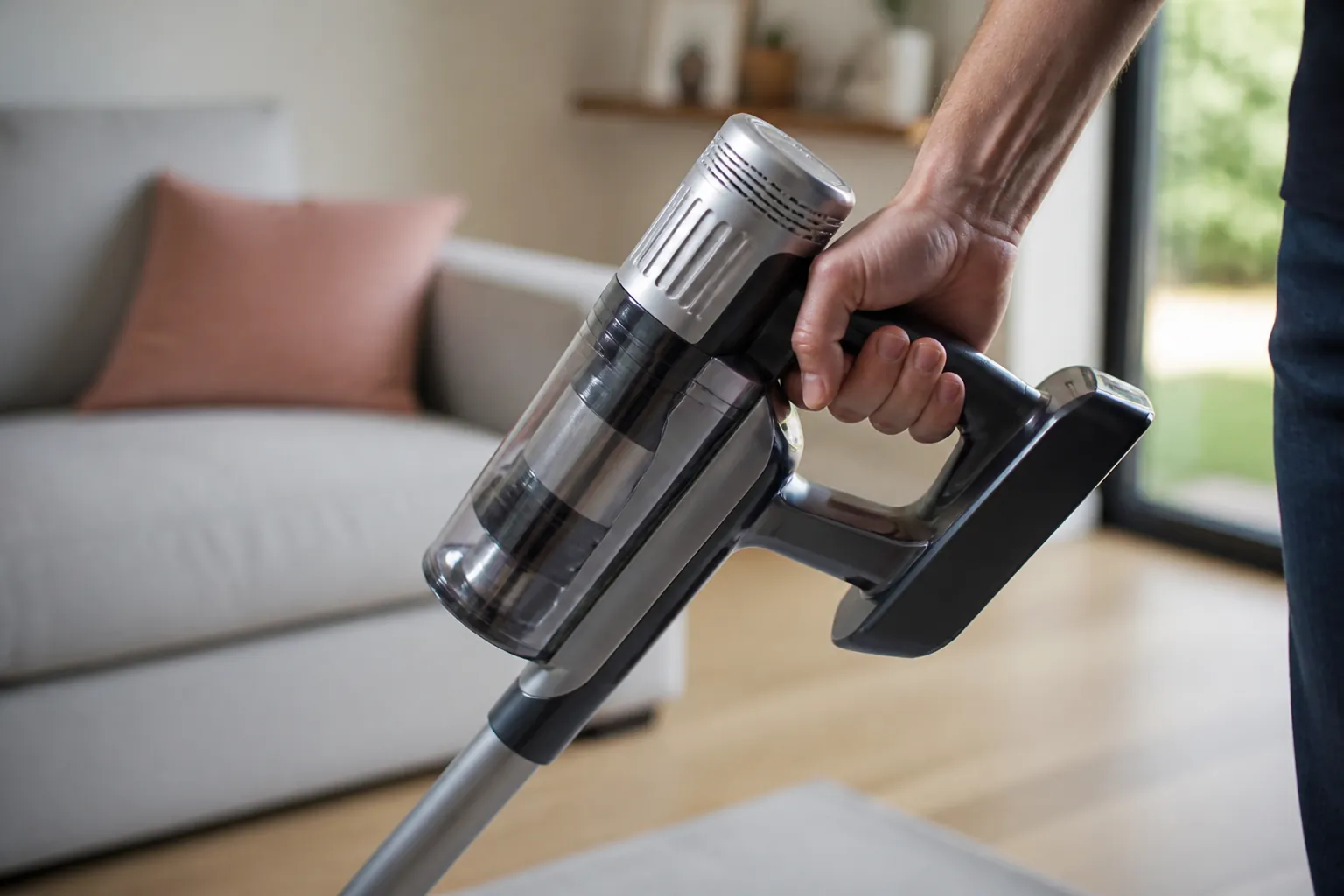
TechGearLab’s lab-tested cordless stick vacuum comparison shows how wide the handling range can be, reporting handheld weights from 2.0 to 5.6 pounds across 21 models.[4] That spread is large enough to matter for someone with arthritis, shoulder pain, reduced grip strength, or a walker waiting nearby.
Power controls: a button can be safer than a trigger
A trigger that must be held down sounds like a small design detail until someone has to squeeze it through a bedroom, hallway, and kitchen. Grip fatigue changes posture. The elbow locks, the shoulder rises, and the person starts steering with the whole upper body instead of the wrist.
This is where a named model can illustrate the criterion without becoming a universal recommendation. Wirecutter notes Dyson’s move away from fatiguing trigger switches to a button on the Dyson V12.[3] TechGearLab, by contrast, calls the trigger-on function on the Dyson V15 “fatiguing.”[4] That does not make one model automatically right and the other wrong for every home. It means the power control deserves a real hand test before purchase.
Self-standing and storage: watch what happens when the user pauses
A senior rarely vacuums in one uninterrupted line. The phone rings. A pet crosses the room. A chair needs to be moved. Someone needs both hands for a moment. If the vacuum cannot stand safely, the person may lean it against a counter, hook it over a chair, or bend to lay it on the floor. None of those is ideal for someone already guarding balance.
In a store or during a return window, pause the vacuum exactly where it would be paused at home: beside the bed, next to a kitchen counter, near a doorway. If it falls, slides, or blocks the walking path, that is not a minor annoyance. It is part of the safety decision.
Emptying the bin may be the most overlooked strain test
Dustbin design decides how much bending and wrestling happens after the floor looks clean. A small bin may need to be emptied mid-clean. A stiff latch may require two hands and a tug. A bottom-release bin can be pleasant at waist height and awkward over a low bathroom trash can.
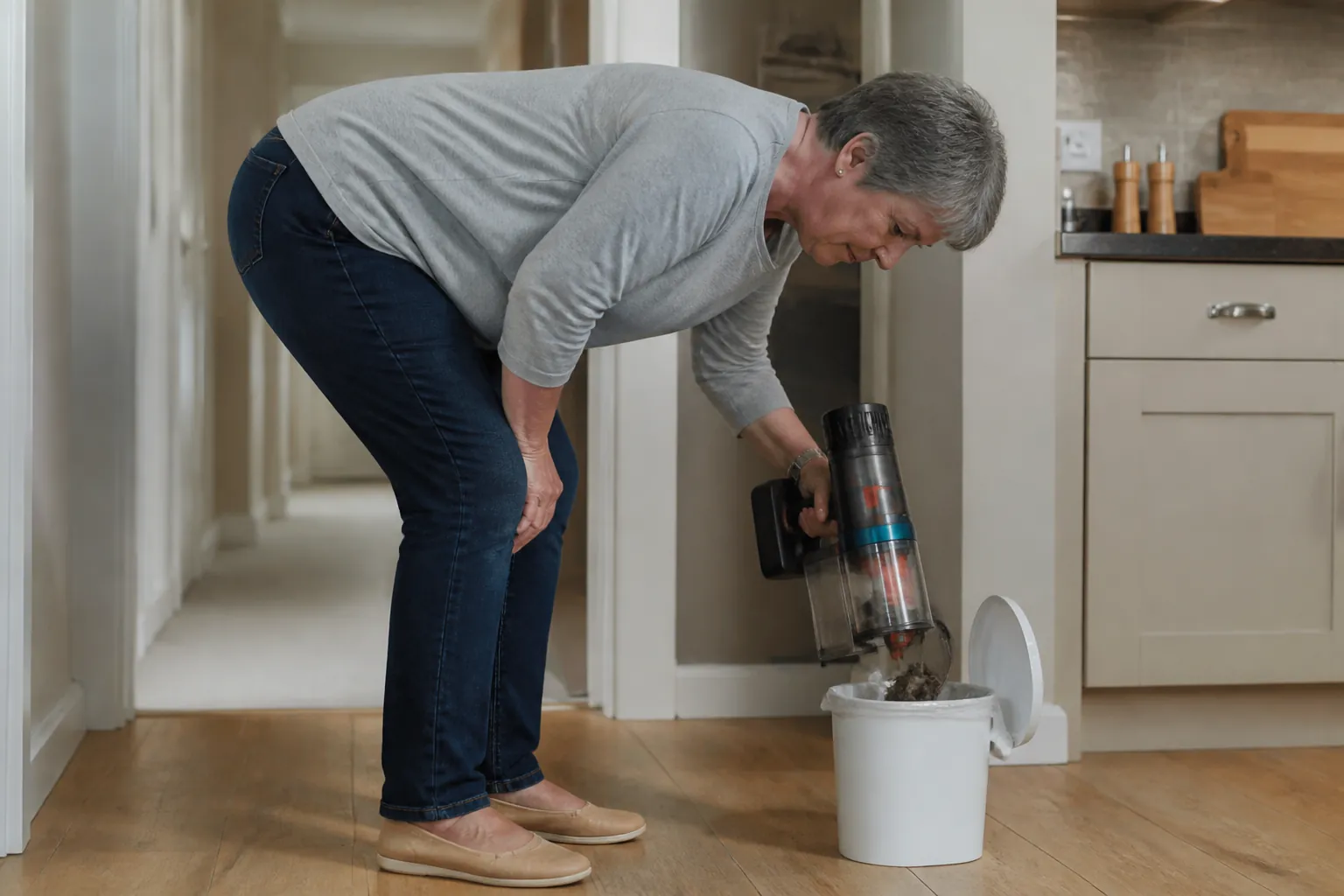
TechGearLab reports dustbin capacities ranging from 0.2 to 1.9 liters across tested cordless stick vacuums.[4] Capacity is not automatically better if the larger bin makes the machine heavier or bulkier, but a tiny bin can force repeated stops. Wirecutter’s Shark PowerDetect example shows a different solution: a self-emptying dock that may reduce emptying to every other week or monthly, compared with a 24-ounce bin that can need attention mid-clean.[3] For a senior who bends poorly, a dock that removes frequent emptying can be more meaningful than shaving a few ounces off the handle.
Runtime: enough for the safe session, not the whole house
Runtime claims are another place where shopping language gets ahead of real use. Low-power runtime may not match the mode a person needs for rugs, pet hair, or tracked-in grit. TechGearLab measured low-mode runtimes of about 24 to 67 minutes in its tested cordless stick vacuums.[4] That range sounds generous until the vacuum must be used on higher power, or until the user tires before the battery does.
For mobility issues, the better question is whether the vacuum can complete one or two planned rooms with reserve left. A battery that encourages “I’ll just finish the whole house while it’s charged” can work against safe pacing.
Cleaning performance still matters
Ultra-light machines can be genuinely helpful, especially for hand, shoulder, or wrist problems. They can also be too weak to be worth using on the floors a person actually has. Wirecutter describes the 3.2-pound Levoit LVAC-200 as a possible fit for people with hand, shoulder, or wrist issues, while also flagging its performance as “middling.”[3] That is the kind of tradeoff worth saying plainly.
Weak cleaning is not harmless if it makes someone repeat the same area, push harder, or pull out a heavier backup vacuum. Consumer Reports’ stick-vacuum testing is a reminder that cleaning claims need discipline: its protocol includes embedding 100 grams of sand in carpet, using a clean-emissions lab, and factoring member-survey predicted reliability into its evaluations.[5] Marketing language about suction should not outrank controlled performance testing when the user has limited energy to spend.
The five-step test before you buy
The best comparison happens with the actual person, the actual hand, and ideally the actual home. If a store visit is possible, do this there. If ordering online, treat the return window as a safety trial, not as a formality.
- Lift it with one hand. Hold the vacuum in normal cleaning position for a short moment without bracing against a counter. Notice wrist pull, shoulder elevation, and whether the user immediately changes posture.
- Use the power control. Press the button or hold the trigger long enough to feel whether the hand relaxes or tires. If the user has arthritis, tremor, numbness, or weak grip, this step matters more than a small weight difference.
- Stand it upright or pause it safely. Let go as the person would during a real interruption. If the machine must be leaned, decide where it will safely rest at home.
- Empty the bin. Do not just look at the latch. Open it, empty it into the intended trash can, close it, and put the vacuum back. Watch for bending, dust puffing, stuck debris, and two-handed wrestling.
- Walk it through a doorway. Turn into a bedroom, pass a chair, and steer along a wall. A vacuum that feels fine in a straight aisle may become awkward in a furnished room.
This test also helps avoid family arguments. Instead of debating whether a parent “needs” the lighter model or whether an adult child is being overprotective, everyone can watch the same five actions. The machine either reduces strain in those actions or it does not.
A few model examples, used only as criteria checks
Model lineups and prices change quickly, so these examples should not be read as a fixed ranking. They show how the criteria can point in different directions.
| Example | What it illustrates | What to verify in person |
|---|---|---|
| Dyson V12 | Lower reported in-hand weight and button power control in Wirecutter’s testing. | Whether the user can lift, steer, and empty it comfortably in the home. |
| Dyson V15 | A higher-performance style of machine where TechGearLab flags trigger-on use as fatiguing. | Whether continuous trigger use is tolerable for the intended cleaning session. |
| Levoit LVAC-200 | Very low weight and a possible fit for hand, shoulder, or wrist issues, with middling performance noted by Wirecutter. | Whether it cleans the actual rugs and debris well enough to avoid rework. |
| Shark PowerDetect with self-emptying dock | A dock can reduce the number of times the user empties the bin. | Where the dock cable sits, whether the dock is easy to reach, and whether the user can manage maintenance. |
The pattern matters more than the names. A lighter vacuum with a tiring trigger may lose to a slightly heavier one with a button. A tiny ultra-light model may be right for a low-pile bedroom and wrong for thick rugs. A self-emptying dock may be valuable in a home where bending is the main problem, but unhelpful if the dock creates a cord hazard in a narrow hallway.
Set up the cleaning session so the vacuum does not create new risks
Even a well-chosen cordless vacuum needs a safer routine around it. Before cleaning, move charging cords, pet toys, laundry, and loose throw rugs out of the walking path. The CDC’s STEADI patient resources are a useful starting point for thinking through fall risks at home, and a fuller home review can use a CDC STEADI home fall-prevention checklist or a room-by-room fall-prevention checklist.[6]
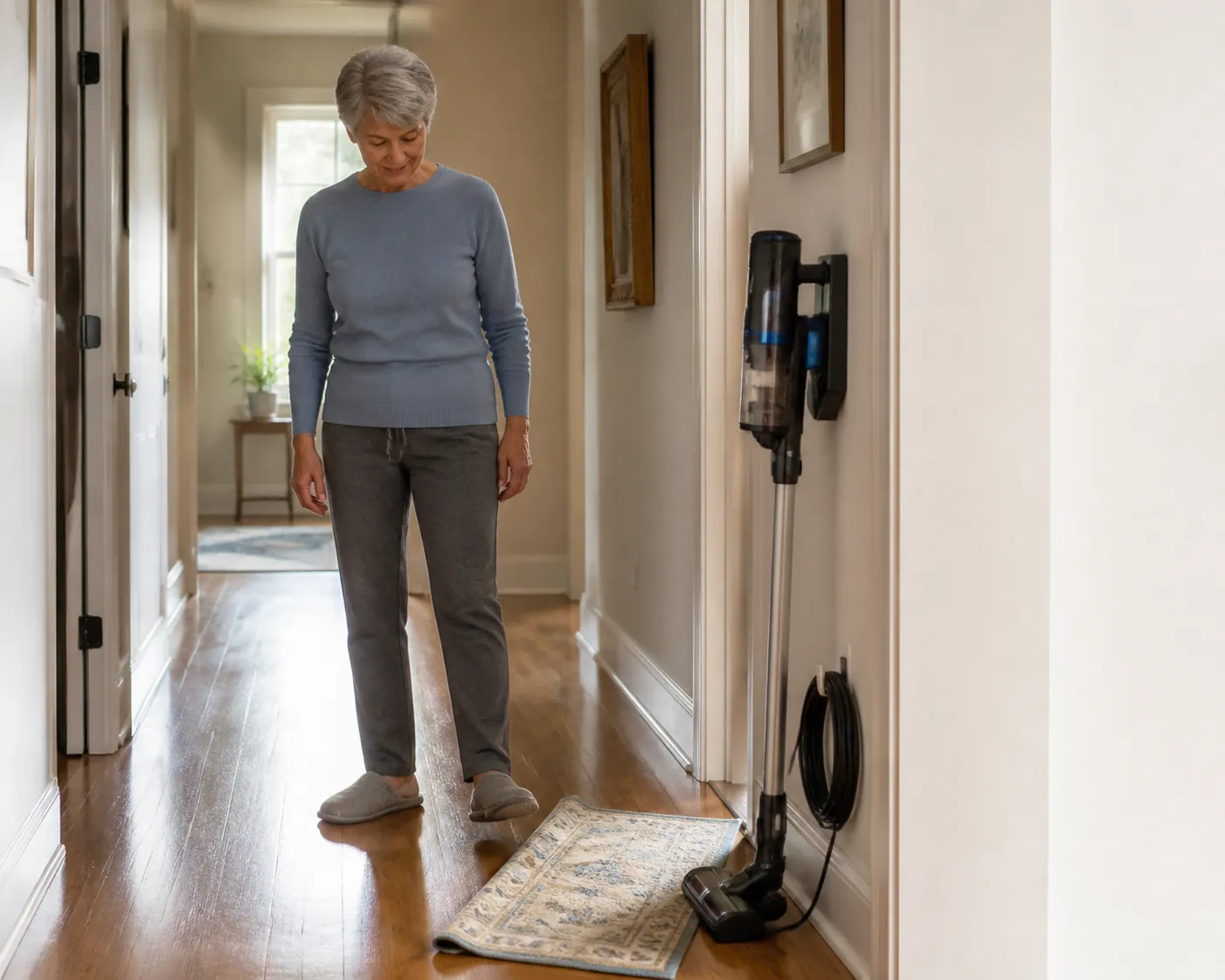
- Wear non-slip footwear rather than socks on smooth floors.
- Vacuum one or two rooms per session instead of trying to finish the whole home.
- Keep the vacuum stored at easy reach, not high in a closet or low behind other items.
- Charge it where the cable does not cross a walking route.
- Stop if the user starts bracing on furniture, rushing, bending low, or holding the vacuum away from the body to control it.
If vacuuming has already become unsafe, do not try to solve that with a better shopping filter alone. Use a broader fall-prevention action plan and basic fall-prevention FAQ guidance to decide whether the task should be changed, shared, or avoided.
The safest lightweight cordless vacuum for a senior with mobility issues is the one that removes the cord from the path, feels manageable in the hand, pauses safely, empties without low bending, and cleans well enough that the person does not have to redo the same floor. If the “lightweight” model still requires unsafe gripping, bending, rushing, or balancing, it has failed the chore.
References
- Facts About Falls — CDC
- Home hazard modification programs for reducing falls in older adults: a systematic review and meta-analysis — PeerJ, 2023
- The 4 Best Cordless Stick Vacuums of 2026 — Wirecutter
- Best Cordless Stick Vacuums, Lab Tested & Ranked — TechGearLab
- 8 Best Stick Vacuums of 2026, Lab-Tested and Reviewed — Consumer Reports
- STEADI Patient Resources — CDC
Questions to bring to a clinician or OT
This is not medical, legal, or a family's final decision — only a framework. Bring these questions to a clinician, occupational therapist, or your local Area Agency on Aging.
Find Local HelpRelated reading
Noticed something outdated or inaccurate on this page? Flag a correction. We review every report against CDC, NIA, and AARP HomeFit guidance before updating a page.