
Caregiver decision guide
Food Safety Tips for Seniors Every Caregiver Should Follow
Seniors are up to four times more likely to be hospitalized from foodborne illness than younger adults. This guide explains why aging changes food safety risks and gives caregivers practical, senior-specific steps for safer meal preparation.
Cooking for an aging parent changes the standard. The soup cooling on the counter, the deli turkey saved for “one more sandwich,” the chicken that “looks done” in the pan — these are ordinary kitchen moments. For adults 65 and older, they can carry a much higher cost.
Nearly half of seniors with lab-confirmed illness from Salmonella, Campylobacter, Listeria, or E. coli are hospitalized. Adults 65 and older are also four times more likely than the general population to get a Listeria infection, and more than half of Listeria cases occur in this age group.[1] That is the reason food safety tips for seniors need to be stricter than the habits many families grew up with.
The goal is not to make every meal feel medically supervised. It is to take a few judgment calls out of the kitchen: use a thermometer, keep cold food cold, move leftovers fast, and choose safer versions of foods that are known to cause more serious illness in older adults.
Why the Same Meal Can Be Riskier After 65
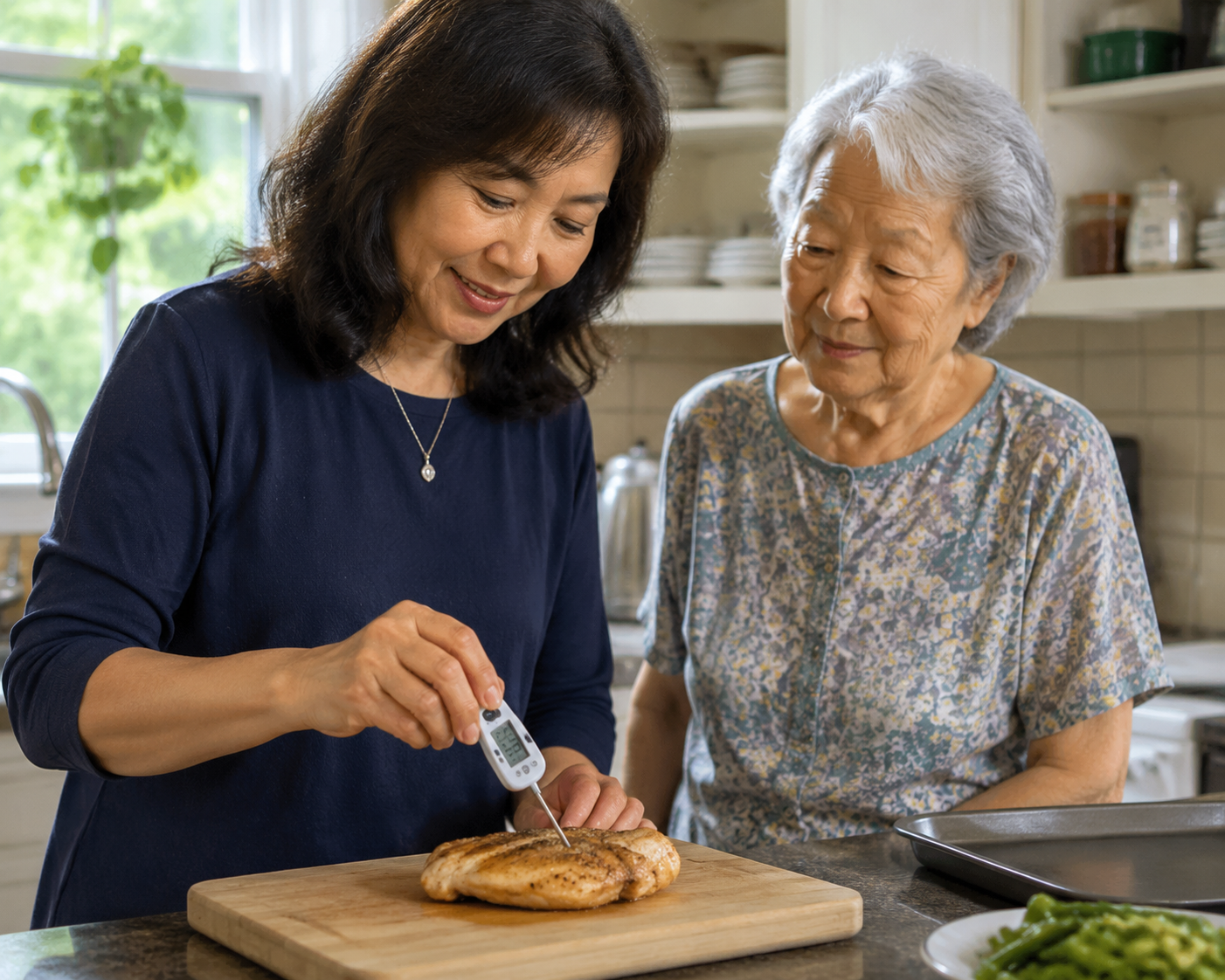
Older adults are not simply “more delicate.” Their bodies handle foodborne germs differently. USDA’s Food Safety and Inspection Service explains that age-related immune system decline begins around age 60, and the digestive tract can hold food longer, giving bacteria more time to grow.[2] That combination makes a contaminated bite more likely to become a serious illness.
Smell and taste can also become less reliable with age. That matters because many households still use the sniff test to decide whether leftovers, milk, deli meat, or cooked food are “probably fine.” For a senior household, the safer rule is blunt: if a food needed refrigeration and has been sitting too long, smelling normal does not rescue it.
This is also why the caregiver often carries the consequence after the fact: cleaning out the refrigerator, replacing groceries, calling the doctor, tracking symptoms, and replaying every meal from the last few days. A tighter kitchen routine is not about blame. It is about giving the person in charge of food fewer ambiguous decisions to make when tired.
The Senior-Safe Kitchen Routine
The basic food safety framework is still Clean, Separate, Cook, and Chill.[3] For seniors, the difference is where the line gets drawn. “Cook thoroughly” becomes a temperature. “Put it away soon” becomes a two-hour limit. “Looks fine” is no longer evidence.
| Step | Caregiver rule that matters most |
|---|---|
| Clean | Wash hands, surfaces, and produce; do not let dirty towels and sponges move germs around the kitchen. |
| Separate | Keep raw meat, poultry, seafood, and eggs away from ready-to-eat food from cart to cutting board to refrigerator. |
| Cook | Use a food thermometer for meat, poultry, casseroles, and reheated leftovers. |
| Chill | Refrigerate perishable food within 2 hours, or within 1 hour if the temperature is above 90°F. |
Clean: Control the Things Hands Touch Most
Handwashing is still the first step, but in a caregiving kitchen the weak spots are often the repeat-touch items: refrigerator handles, faucet knobs, microwave buttons, the pill organizer area, dish towels, and the cutting board that gets reused because lunch is being made in a hurry.
- Wash hands before cooking, after handling raw meat, after using the bathroom, after helping with toileting, and after touching pets.
- Use separate clean towels for hands and dishes, or use paper towels when cleaning up raw meat juices.
- Rinse produce under running water before cutting, even if the peel will be removed.
- Sanitize cutting boards and counters after raw meat, poultry, seafood, or eggs touch them.
Do not spend all your energy decoding date labels while missing the obvious mess on the counter. Expiration and “best by” dates can matter, but they are a separate problem from whether bacteria were moved from raw chicken to tomorrow’s sandwich.
Separate: Stop Raw Food From Touching Ready-to-Eat Food
Separation starts before food reaches the kitchen. Put raw meat, poultry, and seafood in separate bags at the store or in the delivery order notes when possible. At home, store them in containers or sealed bags on the lowest refrigerator shelf so juices cannot drip onto fruit, salad greens, leftovers, or open containers.
A color-coded cutting board system helps only if everyone in the house actually follows it. If an older spouse or rotating helper is also preparing food, simpler is better: one board for raw meat, one board for everything else, and no exceptions during cleanup.
Cook: A Thermometer Is Not Optional
This is the rule most likely to prevent false confidence. USDA has reported that 88% of people own a food thermometer, but only 55% use one. Color and texture are not reliable ways to tell whether meat is safely cooked.[4]
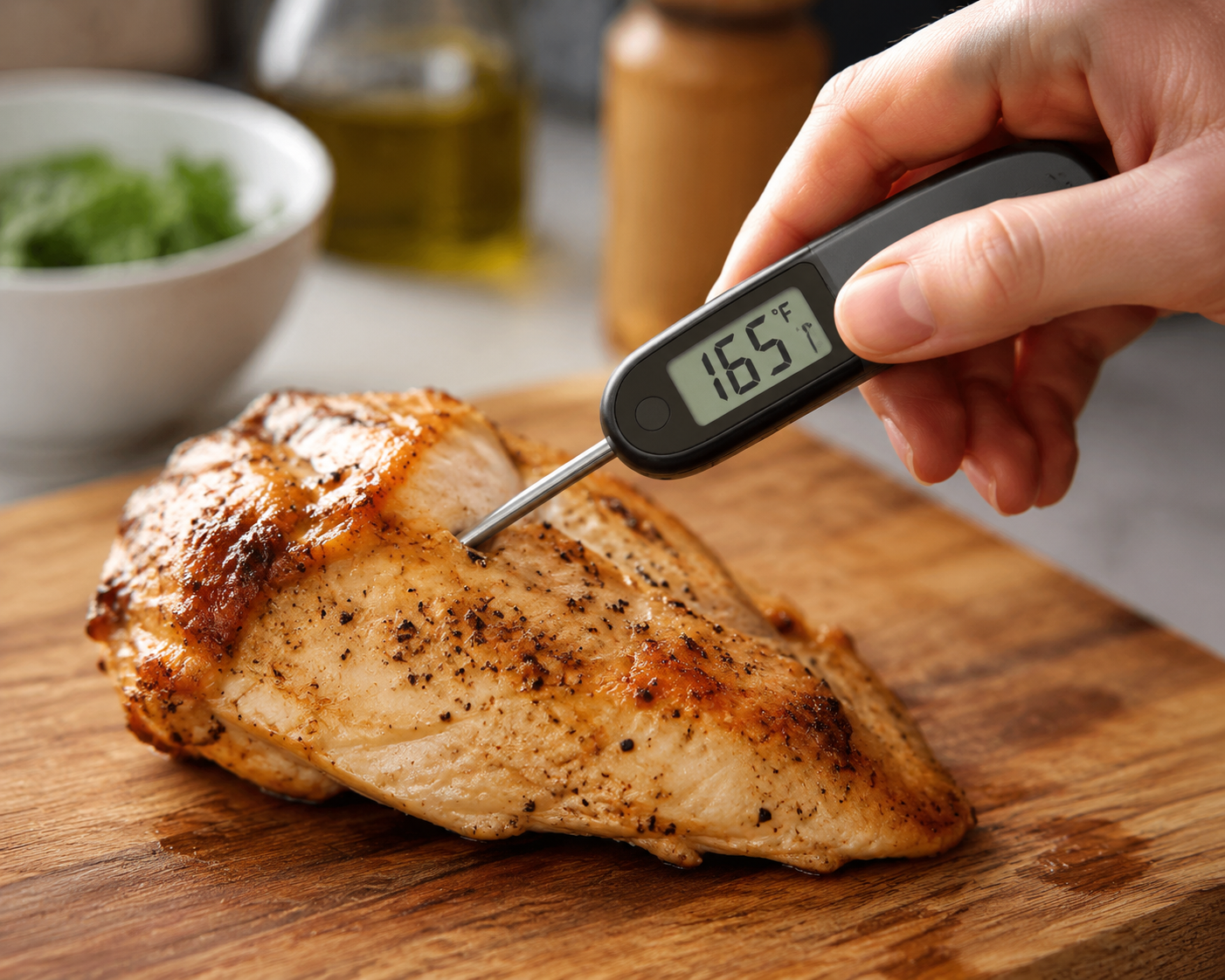
For a senior, the thermometer should live where the spoons live, not in a drawer with holiday gadgets. Use it for weeknight chicken, burgers, meatloaf, casseroles with meat, and leftovers. Insert it into the thickest part of the food and avoid touching bone, fat, or the pan.
| Food | Minimum internal temperature |
|---|---|
| Poultry, including chicken and turkey | 165°F |
| Ground meats | 160°F |
| Whole cuts of meat | 145°F |
| Leftovers and casseroles | 165°F |
The senior-specific change is not buying a fancy thermometer. It is making its use automatic. If a parent dislikes “dry” chicken, the answer is not to stop checking; it is to use the thermometer earlier, remove the food when it reaches the safe temperature, and avoid cooking far past it.
Chill: The Clock Matters as Much as the Fridge
Perishable food should go into the refrigerator within 2 hours, or within 1 hour if the temperature is above 90°F. The refrigerator should be kept at 40°F or below, and the freezer at 0°F or below.[3] A refrigerator thermometer is cheap compared with a spoiled week of groceries or a hospital visit.
Large pots of soup, stew, rice, or pasta should not sit on the stove until someone remembers them after a phone call. Divide large batches into shallow containers so they cool faster, label them if more than one caregiver uses the refrigerator, and put them away while the meal is still part of the evening routine.
- Do not leave takeout, cooked food, deli trays, cut fruit, or dairy on the counter for grazing.
- Reheat leftovers to 165°F before serving them to an older adult.
- Throw away perishable food that missed the safe time window; do not negotiate with smell, taste, or appearance.
- Check that the refrigerator is 40°F or below after power outages, heavy grocery loading, or a door left ajar.
Delivered groceries and prepared meals follow the same clock. If groceries, meal kits, or Meals on Wheels-style deliveries arrive while nobody is home, the caregiver needs a plan for insulated storage, a neighbor pickup, or a delivery time someone can meet. If grocery access is the harder problem, a delivery setup can help, but it still has to protect cold food; this guide to grocery delivery for seniors is a useful next read.
Safer Food Choices for Senior Households
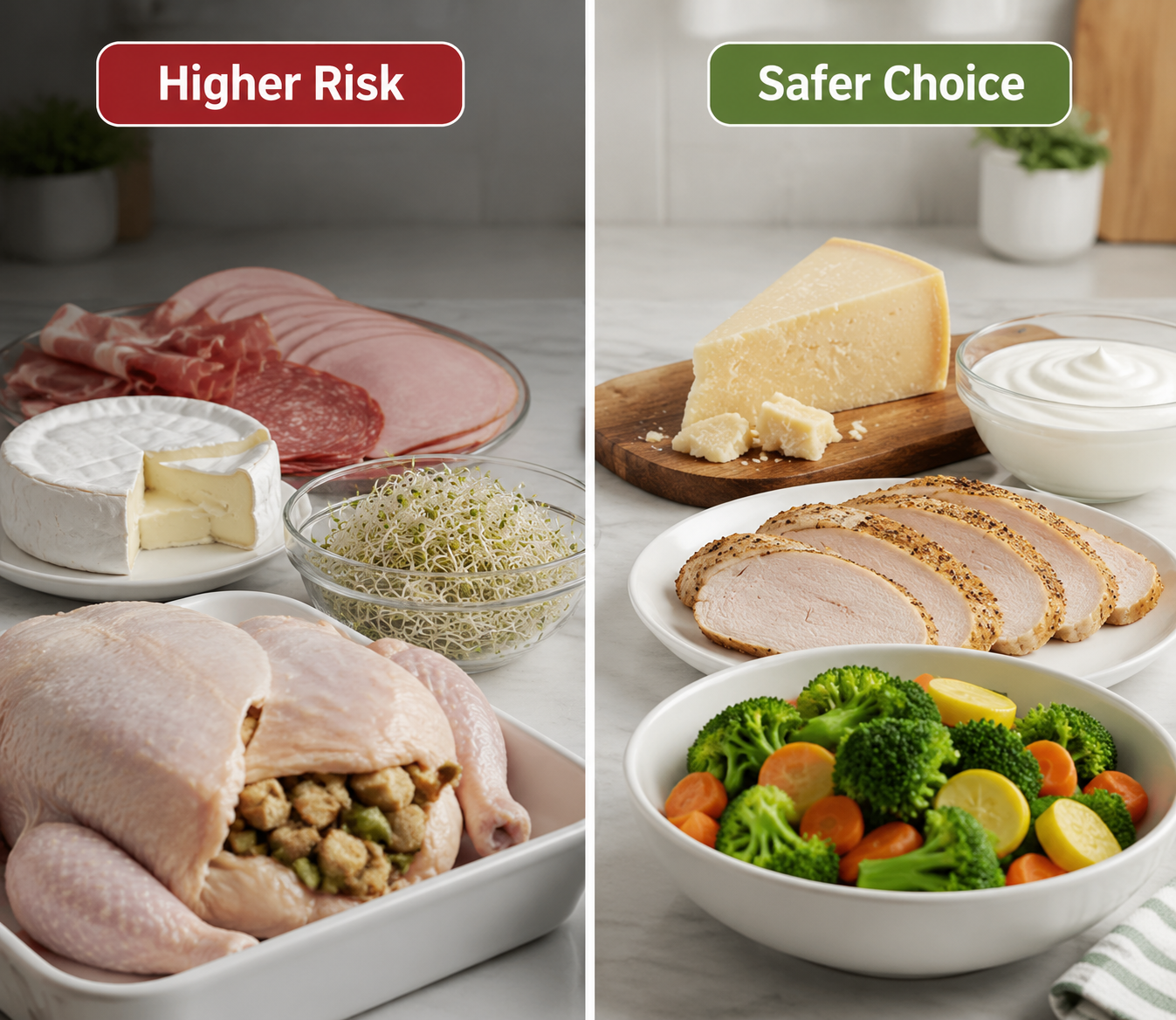
Some foods are riskier for adults 65 and older because they are more likely to carry germs that can cause severe illness, especially if they are raw, undercooked, unpasteurized, or held too long after preparation. CDC’s guidance for adults 65 and older is practical: choose safer versions, not perfect diets.[5]
| Food category | Higher-risk choice | Safer choice for an older adult |
|---|---|---|
| Meat and poultry | Raw or undercooked meat, poultry, or pre-stuffed raw poultry | Meat and poultry cooked to a safe internal temperature; stuffing cooked separately |
| Seafood | Raw oysters, raw sushi, refrigerated smoked seafood unless cooked in a dish | Fully cooked seafood; shelf-stable smoked seafood when appropriate |
| Eggs | Runny eggs, raw dough or batter, homemade foods with raw eggs | Eggs cooked until firm; pasteurized eggs for recipes that are not fully cooked |
| Dairy | Raw milk, unpasteurized soft cheeses, unpasteurized juices | Pasteurized milk, pasteurized juices, hard cheeses, or soft cheeses clearly made with pasteurized milk |
| Deli meats and hot dogs | Cold deli meat, cold hot dogs, refrigerated pâté or meat spreads | Deli meat and hot dogs reheated until steaming hot; shelf-stable pâté or meat spreads |
| Produce | Raw sprouts, unwashed produce, cut fruit left out too long | Washed produce; cooked sprouts; cut fruit refrigerated promptly |
The deli meat rule is a common source of resistance because sandwiches are convenient and familiar. The safer version is not mysterious: heat deli meat until steaming hot before serving it, especially for an older adult at higher risk. If that ruins the lunch your parent will actually eat, switch the pattern rather than arguing every day — cooked chicken, egg salad made with fully cooked eggs and refrigerated promptly, tuna from a shelf-stable can, or a hot sandwich can be easier than trying to make cold deli meat safe by wishful thinking.
Raw sprouts deserve special treatment because rinsing does not reliably remove the risk. For a senior, choose cooked sprouts or skip them. The same practical standard applies to unpasteurized dairy and juice: if the label does not make pasteurization clear, pick another product.
What to Do About Recalls Without Turning the Kitchen Into a Newsroom
Prevention handles the daily routine; recalls handle the exceptions. A recalled food should not be tasted to see whether it seems fine. Check the product name, lot code, and date information against the recall notice, then discard it or return it according to the notice.
If you manage groceries for a parent in more than one home, recalls are where a shared note or photo log helps. Keep a quick record of brands used often, especially deli items, frozen meals, bagged salads, and supplements kept near food. For a more detailed recall process, use this guide on keeping an aging parent safe from food recalls.
When a Caregiver Should Call a Doctor
Even a careful kitchen cannot prevent every illness. Call a doctor or seek medical advice promptly when an older adult has symptoms that are severe, persistent, or paired with dehydration risk. Do not wait for certainty that food caused it.
- Repeated vomiting or diarrhea that makes it hard to keep fluids down
- Signs of dehydration, such as dizziness, very little urination, unusual sleepiness, or confusion
- Bloody diarrhea, high fever, severe abdominal pain, or worsening weakness
- Symptoms after eating a recalled food, raw seafood, undercooked meat, unpasteurized dairy, or a food known to be higher risk for seniors
- Any illness in a senior who is also immunocompromised or medically fragile
Dehydration can become the immediate danger while the underlying illness is still being sorted out. If diarrhea is the main issue, this home-care guide to preventing dehydration in older adults is relevant even when the germ is not yet known. For longer symptom tracking, see Cyclospora recovery in older adults.
Food-medication interactions are outside the scope of kitchen food safety and need their own medication review with a clinician or pharmacist. Do not treat a clean refrigerator or a careful cooking routine as a substitute for that separate check.
For seniors, safer food handling is not a personality trait and it is not a performance of anxiety. It is a working standard: measure temperatures, respect the two-hour clock, keep the refrigerator cold, reheat leftovers to 165°F, and replace high-risk foods with safer choices before someone gets sick.
References
- The Importance of Food Safety for Older Adults — FoodSafety.gov
- Adults 65 and Older: An At-Risk Population, but Why? — USDA FSIS
- 4 Steps to Food Safety — FoodSafety.gov
- Cooking Meat: Is It Done Yet? — USDA, October 3, 2022
- Safer Food Choices for Adults 65 and Older — CDC
Questions to bring to a clinician or OT
This is not medical, legal, or a family's final decision — only a framework. Bring these questions to a clinician, occupational therapist, or your local Area Agency on Aging.
Find Local HelpRelated reading
Noticed something outdated or inaccurate on this page? Flag a correction. We review every report against CDC, NIA, and AARP HomeFit guidance before updating a page.