
Caregiver decision guide
Will You Lose Your Money If You Cancel a River Cruise After a Fall?
This guide explains what financial penalties apply when a fall or health issue forces a river cruise cancellation, and which travel insurance provisions—like pre-existing condition waivers and Cancel for Any Reason upgrades—can protect your investment. Learn the steps to take immediately after a health event to maximize your refund and navigate medical documentation requirements.
Yes, you can lose a large share of your river cruise money after a fall, and if the fall happens close enough to departure, the cruise line may owe you nothing back. That is the hard answer families need before they spend two days calling the wrong office. The cruise line’s cancellation penalty decides how much of the fare becomes non-refundable. Travel insurance decides whether some of that non-refundable money can be reimbursed. Those are two separate questions.
This is general information, not medical, legal, financial, or insurance advice. Policy wording, state rules, fare type, and the physician’s documentation can all change the outcome. If a fall has already happened, keep every document and ask the insurer exactly what it needs before you assume the claim will be paid.
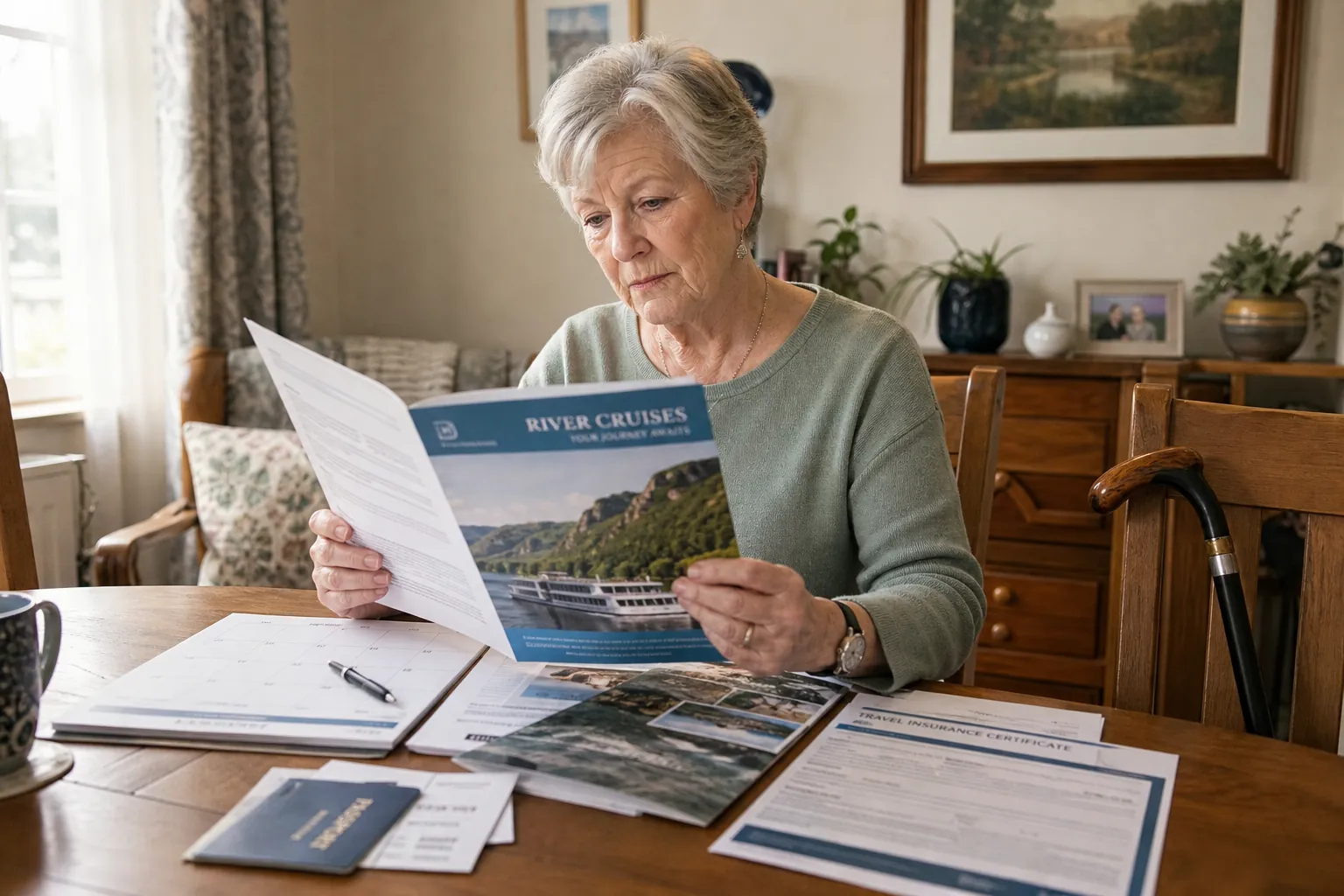
The cancellation clock matters more than the reason at first
A broken wrist, a new walker, dizziness on stairs, or a doctor’s warning not to travel may be the human reason for canceling. But the first financial question is usually colder: how many days remain before departure?
Uniworld’s 2026 river cruise terms show how quickly the penalty can rise. Its schedule moves from a $250-per-person cancellation charge at 120 days or more before departure to 100% of the fare inside 30 days of departure, with final payment due 120 days before departure under those terms.[1] Cruise Critic’s 2025 overview describes similar timing pressure across major cruise cancellation policies, including final-payment dates and escalating penalties as departure approaches, though terms vary by line and fare type.[2]
| When cancellation happens | What Uniworld’s 2026 terms show | What it means after a fall |
|---|---|---|
| 120 days or more before departure | $250 per person cancellation penalty | A painful nuisance, but usually not the whole trip cost |
| 119 to 90 days before departure | 20% of fare | The loss starts to become large enough that insurance wording matters |
| 89 to 60 days before departure | 35% of fare | A fall during this window can put thousands of dollars at stake on a higher-priced trip |
| 59 to 30 days before departure | 50% of fare | Half the fare may be non-refundable before airfare, hotels, or extensions are considered |
| Under 30 days before departure | 100% of fare | The cruise line may treat the fare as fully non-refundable |
That table is why “I have insurance” is not a complete answer. Insurance is not a magic eraser for the cruise line’s penalty. It is a separate contract, with its own covered reasons, exclusions, time limits, look-back periods, and documentation rules.
Falls are a real river cruise disruption, not a nervous traveler’s fantasy
River cruising is appealing precisely because it reduces some of the strain of travel. You unpack once. The ship moves while you sleep. The excursions bring you close to old towns, museums, churches, markets, and vineyards without a string of hotel changes.
But the walking is not imaginary. Gangways can be angled. Docking positions can require crossing another ship. Old town centers may have cobblestones, curbs, uneven paving, and steps. A person who was safe enough at the time of deposit may not be safe after a fall, medication change, fracture, balance setback, or new mobility aid.
Medjet reported in 2025, based on its own transport-call experience, that slip-and-fall injuries such as broken bones, spinal injuries, and head trauma were the number-one cause of medical disembarkation from river cruises. The same article notes that river ships do not carry a full infirmary, only basic first aid equipment such as a first aid kit and AED.[3] That is useful information, but it should be read for what it is: company operational data, not a peer-reviewed study of all river cruise passengers.
For families still in the planning stage, a fall-risk conversation before deposit is not an insult to anyone’s independence. It is part of deciding whether the trip fits the traveler’s current walking, balance, stamina, and medication situation. A practical starting point is a written fall prevention action plan, especially if there has already been a recent fall or near-fall.
The two insurance provisions that change the answer
For fall-related river cruise cancellations, two provisions deserve special attention: a pre-existing condition waiver and Cancel for Any Reason coverage. They are not the same. They do not solve the same problem. And they usually have to be bought early.
The pre-existing condition waiver is usually a deposit-window decision
Many travel insurance policies look backward from the purchase date or trip date to decide whether a medical problem was already present. That look-back period matters for seniors because the reason for canceling after a fall may not be a brand-new medical event in the insurer’s eyes. It could involve arthritis, osteoporosis, neuropathy, dizziness, heart medication, prior balance problems, a recent surgery, or another condition already in the medical record.
A pre-existing condition waiver can remove that exclusion when its requirements are met. The important catch is timing: senior cruise insurance guidance from American Visitor Insurance and Allianz describes waiver availability as tied to buying coverage soon after the first trip deposit, commonly within about 14 to 21 days.[4][5] Waiting until final payment, or until the traveler starts feeling unsteady, may be too late for that protection.
That deadline is easy to miss because nothing bad has happened yet. The deposit is paid, the brochure is still exciting, and the calendar seems generous. But from an insurance standpoint, the clock may already be running. If there is one date to put in the travel folder in red ink, it is the last day to buy a policy that includes the waiver.
Cancel for Any Reason covers a different problem
Medical cancellation coverage generally requires a covered medical reason and proof that travel is medically inadvisable. Cancel for Any Reason, often shortened to CFAR, is different. It can reimburse a portion of non-refundable costs when the traveler cancels for a reason that may not fit the standard covered-reason language.
Allianz describes CFAR as an optional benefit that may reimburse about 75% of non-refundable trip costs, subject to plan rules and purchase requirements.[5] That 75% figure is not the same as getting all your money back. On a fully non-refundable cruise, a CFAR claim can still leave a meaningful loss. But it may be far better than receiving nothing when the reason for canceling falls outside the medical-cancellation wording.
This is where adult children and parents often talk past each other. The parent says, “The doctor didn’t forbid it, but I know I can’t manage the gangway.” The child says, “Then cancel.” The insurer asks, “What covered reason applies?” CFAR is built for some of that gray area, but only if it was purchased in time and the cancellation follows the policy’s rules.
Cruise-line protection and third-party insurance are not interchangeable
A cruise-line protection plan may be convenient because it appears during booking. A third-party comprehensive travel insurance policy may offer broader choices. Neither label is enough. The question is what the actual document says about medical cancellation, pre-existing conditions, CFAR, trip interruption, emergency medical care, evacuation, age limits, and required proof.
Price alone does not settle it either. American Visitor Insurance shows sample senior cruise insurance pricing that can range widely by tier; one cited quote-engine range for a 65-year-old runs from $73 to $514 depending on coverage level.[4] That kind of range is useful for scale, not as a promise. Actual premiums can change with age, trip cost, destination, state of residence, and plan selection.
Medicare is not the safety net many travelers assume
Cancellation is only one part of the risk. If the traveler goes anyway and needs care abroad, Medicare may not help. Allianz’s senior cruise insurance guidance states that Medicare generally does not provide coverage outside the United States or on cruise ships.[5] That gap matters on river cruises because a fall can create both a medical problem and a logistics problem: local treatment, changed flights, mobility equipment, hotel nights, or transport home.
This does not mean every senior needs the most expensive plan. It does mean the policy should be read for overseas medical expense coverage and evacuation or transport benefits, not just trip cancellation. A beautiful itinerary does not make a river ship a hospital.
What to do in the first 24 to 72 hours after the fall
After a fall, the family’s first job is medical safety. The second is documentation. Those two should happen together as much as possible, because a later claim may depend on dates, wording, and proof that no one was thinking about while waiting for X-rays.
- Call the treating physician promptly. Ask for an evaluation that addresses travel, not only the injury. A note that says “patient fell” is weaker than a note explaining whether river cruise travel is medically inadvisable and why.
- Document the date of onset. The insurer may ask when symptoms began, when the fall occurred, when the traveler first sought care, and when the doctor advised against travel.
- Collect medical records, not just a receipt. Keep discharge instructions, imaging reports if available, visit summaries, medication changes, mobility restrictions, and follow-up orders.
- Notify the cruise line in writing. The cancellation date can affect the penalty tier, so do not rely only on a casual phone conversation.
- Notify the insurer and ask for the claim checklist. Use the insurer’s language when requesting physician forms, proof of payment, cancellation invoices, and refund statements.
- Preserve the whole paper trail. Keep the original invoice, deposit receipt, final payment confirmation, policy certificate, coverage confirmation, cancellation confirmation, medical records, and every email.
Avoid vague explanations if a claim may be filed. “She is nervous about traveling” may be true, but it may not match a medical-cancellation claim. “Her physician advised against travel after a fall on this date because she cannot safely manage stairs or uneven walking surfaces” is a different kind of statement, if the doctor can truthfully support it.
The adult child helping with calls should ask for permission to be copied on emails and, when necessary, should help the parent organize the claim packet. A simple folder can prevent the same information from being hunted down three times while the traveler is in pain.
If you bought insurance early
If the policy was purchased within the required post-deposit window, start by checking whether the pre-existing condition waiver is included and whether all its conditions were met. Some waivers require insuring the full non-refundable trip cost. Some require the traveler to be medically able to travel when the policy was purchased. Some require purchase within a stated number of days after the first deposit.
Then look at the cancellation reason. If a physician says the traveler cannot safely travel because of the fall or resulting condition, the claim may fit medical cancellation coverage. If the problem is more judgment-based—too much uncertainty, new fear of falling, concern about cobblestones, or a family decision that the trip is no longer wise—CFAR may be the more relevant path, if it was purchased and the cancellation happens within the policy’s required timing.
| Provision | What it may help with | What to verify |
|---|---|---|
| Pre-existing condition waiver | A claim involving a condition that might otherwise be excluded under the look-back rules | Purchase deadline, full-trip-cost insurance requirement, medical ability to travel at purchase |
| Medical cancellation | A physician-supported cancellation for illness or injury | Doctor statement, onset date, records, policy definition of covered medical reason |
| Cancel for Any Reason | A cancellation that does not fit standard covered reasons | Reimbursement percentage, purchase deadline, cancellation deadline, insured trip-cost rules |
| Emergency medical and evacuation coverage | Costs if the traveler goes and needs care or transport | Overseas medical limits, evacuation terms, exclusions, coordination with existing coverage |
If you did not buy the waiver or CFAR
Do not assume nothing can be done. Still call the cruise line, still get the medical documentation, and still open the insurance claim if there is any possible covered reason. But expectations should be careful. Without a pre-existing condition waiver, a medical claim tied to an older or ongoing condition may run into the policy’s look-back exclusion. Without CFAR, a cancellation based on reasonable fear, reduced stamina, or family caution may not be reimbursable unless it meets a covered reason.
Ask the cruise line whether any future cruise credit, transfer, name change, or exception is available, especially if the cancellation is supported by medical records. Get the answer in writing. A goodwill credit is not the same as an insurance benefit, and it may come with its own expiration date or restrictions.
If the trip was booked through a travel advisor, bring that person into the conversation early. A good advisor will know which department handles cancellations, what wording the cruise line requires, and whether similar exceptions have ever been granted. The advisor cannot rewrite the insurance policy, but can sometimes keep the process from drifting.
For the next trip, put the insurance deadline beside the deposit date
The best time to solve this problem is not after the fall. It is when the deposit is paid, while the traveler is still medically stable and the waiver window may still be open. That is also the time to compare cruise-line protection with third-party comprehensive plans and decide whether CFAR is worth the extra cost for this particular traveler.
For seniors with recent falls, balance issues, neuropathy, osteoporosis, medication changes, or a new mobility aid, the insurance folder should sit beside the health folder. A general fall prevention FAQ can help families name the risks before they become travel problems, and a caregiver fall-prevention handout can make the conversation less personal and more practical.
The plain boundary is this: if the pre-existing condition waiver and CFAR were bought early and the paperwork is solid, there is a real claim path. If they were not, the best remaining move is fast documentation, prompt cancellation, and careful negotiation, but the financial protection may be limited.
References
- 2026 Terms & Conditions, Uniworld.
- Cruise Line Cancellation Policies: A Closer Look, Cruise Critic, 2025.
- Top 5 River Cruise Dangers, Medjet, 2025-04-04.
- Best Cruise Insurance for Seniors in the US 2026, American Visitor Insurance.
- The Best Cruise Travel Insurance Plans for Seniors, Allianz Partners.
Questions to bring to a clinician or OT
This is not medical, legal, or a family's final decision — only a framework. Bring these questions to a clinician, occupational therapist, or your local Area Agency on Aging.
Find Local HelpRelated reading
Noticed something outdated or inaccurate on this page? Flag a correction. We review every report against CDC, NIA, and AARP HomeFit guidance before updating a page.