
Caregiver decision guide
Senior Travel Safety Checklist for Nonstop Flights
Plan a safer nonstop flight for an older parent with a timed checklist covering medical prep, airline and TSA assistance, in-cabin circulation, and post-flight warning signs. The riskiest parts of the trip are the airport transitions, and this guide shows what to do at each stage to reduce them.
A nonstop flight does not make an older traveler invulnerable. What it does is remove one of the hardest parts of air travel: the rushed transfer between gates, often with stairs, escalators, unfamiliar signage, fatigue, and a tight boarding clock. For a parent who walks more slowly, uses a cane or walker, manages medications, or gets flustered when the crowd surges, fewer transitions are not a luxury detail. They are the safety plan.
The airport is where the trip most often becomes physically demanding. In one published study of falls at a major U.S. airport, researchers identified 316 falls requiring EMS response during 2009–2010, or about one every 2.3 days. In that airport’s cases, 96% of falls happened in terminals, 44% involved escalators, 37% of fallers were transported to a hospital emergency department, and 43% of fallers were age 65 or older.[1] Those are not national fall statistics, and they do not prove that every nonstop flight is safer than every connecting itinerary. They do show why the curb, terminal, escalator, security checkpoint, and gate deserve more planning than the cute neck pillow.
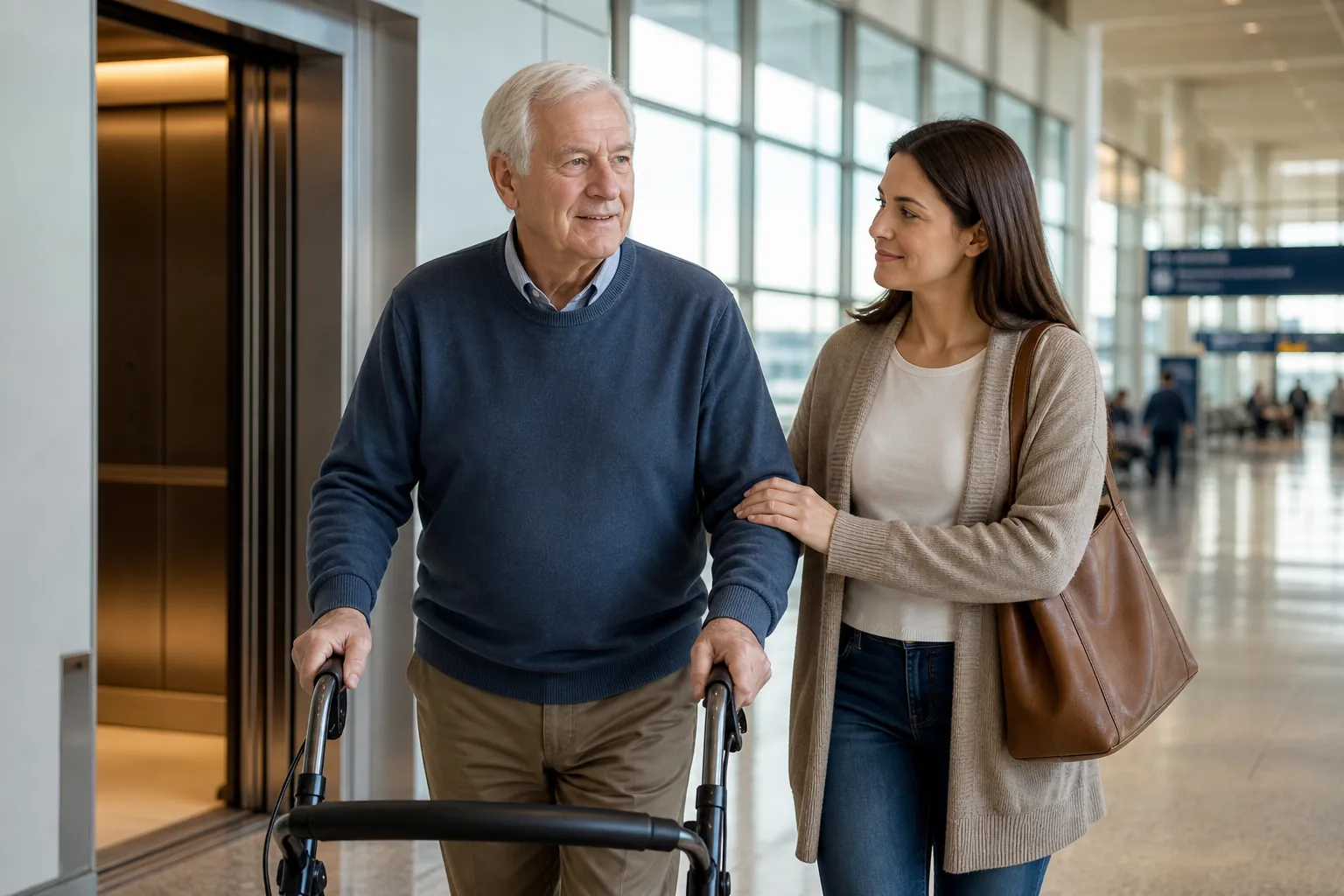
This senior travel safety checklist for nonstop flights is written for the routine trip: a domestic or international flight where the main concern is helping an older adult move through the airport, board safely, manage chronic conditions, reduce circulation risk in the cabin, and arrive with help waiting. It is not medical advice. Use it as a planning layer, then confirm medical decisions with the traveler’s clinician and airline-specific rules with the carrier. Reviewed for practical aging-in-place and mobility considerations by Elaine Porter, OTR/L, CAPS.
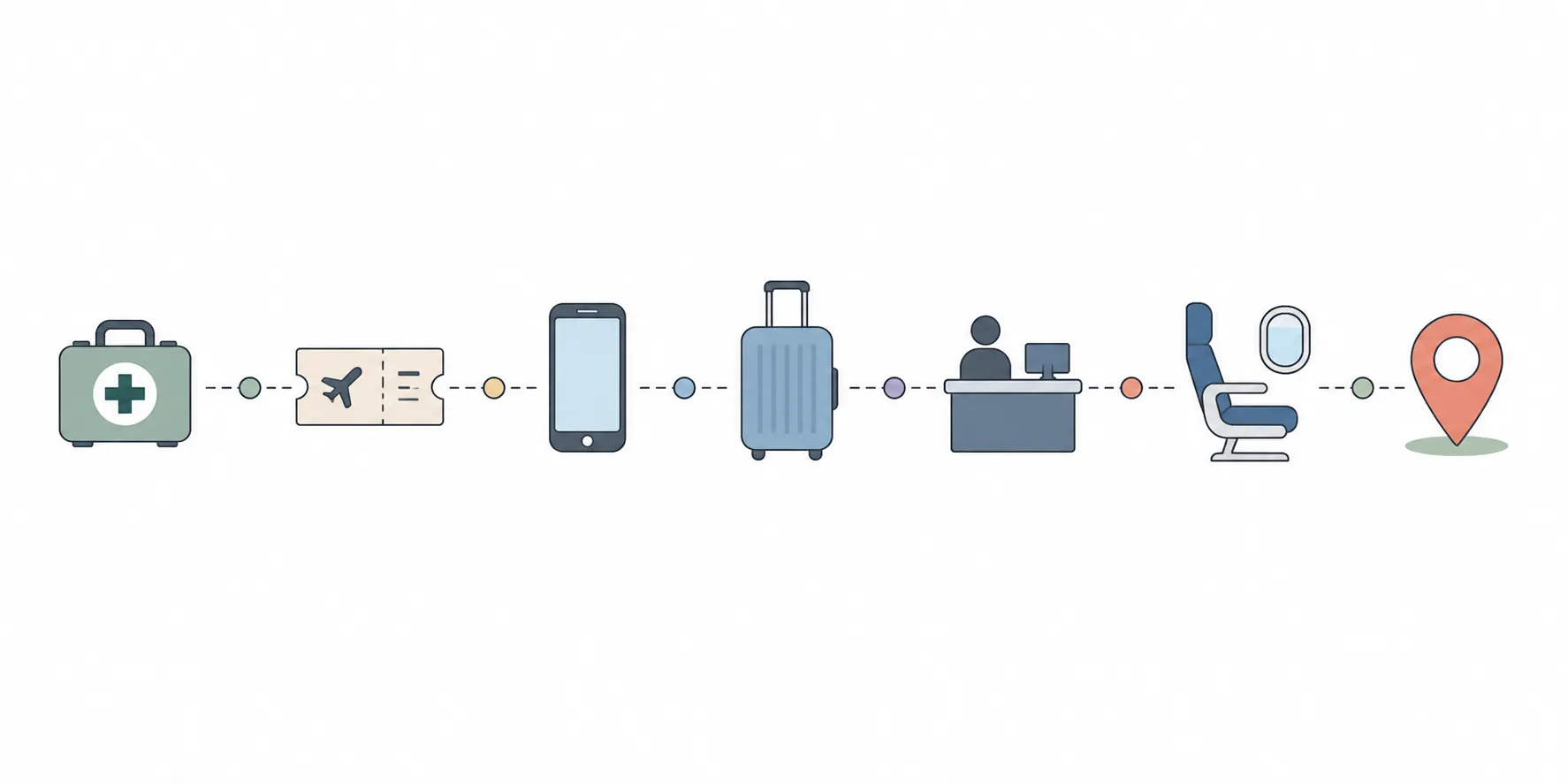
The timed checklist
| When | What to do | Why it matters |
|---|---|---|
| Before booking | Choose nonstop when feasible; compare total walking, gate changes, and arrival time, not fare alone. | A nonstop itinerary removes the connection: no second security-style rush, no gate-to-gate transfer, no unfamiliar escalator decision under pressure. |
| 4–6 weeks before departure | Schedule a pre-travel medical visit; review chronic conditions, vaccines, medications, oxygen needs, mobility limits, and whether the destination changes risk. | This is early enough to adjust medications, request documentation, and meet airline medical timelines. |
| At booking | Request wheelchair or guided assistance, preboarding, and an aisle seat; choose a flight time that fits the parent’s energy and medication schedule. | Assistance must be in the reservation, but the plan still has to work for the person’s real day. |
| 72 hours before departure | Call TSA Cares at 855-787-2227 if checkpoint assistance is needed; reconfirm airline wheelchair assistance. | This is the point when help can still be attached to the trip rather than begged for in a crowded terminal. |
| Packing week | Put all medications, documents, mobility-aid instructions, and an itinerary photo in the carry-on. | Checked bags can be delayed; the parent still needs medication, identification, and arrival coordination. |
| Airport day | Self-identify at the curb or airline counter; use elevators instead of escalators; ask for seated screening if needed. | The most exposed part of the trip is the terminal transition, not the cruising altitude. |
| In the cabin | Walk when safe every 2–3 hours, do calf exercises, hydrate, and keep medications on destination time when advised. | Long sitting, low humidity, and schedule disruption are manageable only if someone planned for them. |
| After landing | Watch for warning signs of blood clots or pulmonary embolism and know when to seek urgent care. | The safety checklist does not end at baggage claim. |
Before booking: choose the itinerary that removes the avoidable transition
For an older traveler with balance, stamina, cognitive, or chronic-condition concerns, the first safety decision is the route. A nonstop flight is worth pricing first because it eliminates the connection. That means no second boarding push, no search for an elevator in a new concourse, no unexpected terminal train, no escalator while holding a carry-on, and no anxious adult child texting, “Are you at the next gate yet?”
The fare may be higher. Sometimes it is much higher. Still, compare the nonstop fare against the actual burden of the cheaper itinerary: another long walk, another bathroom calculation, another chance for wheelchair service to be delayed, another medication or meal timing problem, and another place where the parent may insist “I’m fine” until the line starts moving.
If a connection cannot be avoided, choose a long connection over a tight one and check whether the airport requires terminal changes. U.S. Department of Transportation rules require airlines to provide wheelchair and guided assistance from the terminal entrance through security to the gate, as well as between gates for connections; the rules also prohibit leaving a passenger who is not independently mobile unattended for more than 30 minutes in a wheelchair or other device when the passenger cannot move independently.[2] That is a legal protection, not a guarantee that the handoff will be elegant or fast.
Pick the flight time around the person, not the schedule fantasy
Very early flights often look efficient to the person buying the ticket. They can be miserable for someone who needs time to wake up, eat, take medication, use the bathroom, dress carefully, and get into the car without being rushed. Late flights can be just as hard if confusion or fatigue worsens in the evening. For many families, a midmorning or afternoon nonstop flight is the safer compromise: enough time to move slowly before leaving home, but not so late that the traveler is landing exhausted.
At booking, reserve an aisle seat if the traveler can safely transfer and walk. The aisle makes bathroom access and short movement breaks less awkward. If the parent has strong reasons to avoid being bumped by carts or passengers, weigh that against the need to get up during the flight. There is no perfect seat; there is only the seat that best fits the body and habits of the traveler.
4–6 weeks out: get the medical paperwork before anyone is standing at a counter
The medical visit should happen early enough to change plans. CDC Travelers’ Health advises older adults to talk with a healthcare provider or travel medicine specialist before travel, especially when chronic conditions, medications, vaccines, or destination-specific risks are involved.[3] The CDC Yellow Book also emphasizes pretravel planning for travelers with chronic illnesses, including assessing whether the traveler’s condition is stable, whether medications and supplies are adequate, and whether documentation may be needed.[4]
- Ask whether the parent is medically stable enough for the planned flight and destination.
- Review heart, lung, diabetes, kidney, neurologic, balance, vision, hearing, memory, and recent-fall concerns.
- Check vaccine status and destination-specific health precautions.
- Review all prescriptions, over-the-counter medications, supplements, timing, and what to do if a dose is delayed.
- Ask whether compression stockings are appropriate; do not start them casually if the parent has circulation, skin, heart, or arterial disease concerns.
- Ask for a doctor’s letter on office letterhead listing diagnoses, medications, implanted devices if relevant, allergies, mobility needs, and oxygen or medical equipment needs.
The letter is not always legally required, but it is the kind of boring document that becomes valuable when a screener, gate agent, overseas customs officer, urgent care clinician, or worried relative needs the facts quickly. It should match the medication list and the name on the traveler’s identification.
Oxygen and medical devices need airline confirmation, not assumptions
If the traveler uses oxygen, a portable oxygen concentrator, CPAP, or another medical device, contact the airline before booking or immediately after. FAA rules allow airlines to accept portable oxygen concentrators that meet FAA acceptance criteria, but passengers still need to follow airline procedures for approved devices, batteries, seating, and advance notice.[5] Some carriers require medical clearance forms or specific timing. This is one place where “we’ll explain at the airport” can derail the trip.
At booking: attach assistance to the reservation
Wheelchair assistance is not an admission that the parent is helpless. It is a way to preserve walking capacity for the parts of the trip where walking actually matters: transfers, bathroom use, boarding, and arrival. Request it at booking even if the parent “usually walks fine.” Airports are not usual walking. They are long, polished, crowded, noisy spaces with hard deadlines.
Under DOT guidance, passengers may request wheelchair or guided assistance from the terminal entrance through security and to the gate, and airlines must provide assistance with boarding and deplaning when needed.[2] Make the request in the reservation, then save proof: screenshot the confirmation page, note the date of the call if you phoned, and add the request to the shared itinerary.
- Request wheelchair assistance from curb or check-in through the gate.
- Request preboarding if the parent needs extra time, uses a mobility aid, or cannot safely move in the aisle while others are boarding.
- Ask how the airline handles walkers, rollators, canes, scooters, and batteries.
- Confirm whether the mobility aid will be gate-checked and returned at the aircraft door or another location.
- If the parent cannot walk to the aircraft seat, ask about aisle chair assistance.
- If a companion is not flying, ask where that person may accompany the traveler and whether a gate pass is available.
Assistance can still be imperfect. There may be a wait at the curb, a handoff between contractors, or confusion about whether help begins outside or at the ticket counter. That is why the airport-day plan below starts with self-identifying again, not trusting the reservation to speak for the traveler.
72 hours out: call TSA Cares and reconfirm the airline help
TSA Cares provides information and assistance for travelers with disabilities, medical conditions, and other special circumstances. TSA directs travelers to call 855-787-2227 before travel, and travelers may request checkpoint assistance from a Passenger Support Specialist.[6] Make this call about 72 hours before departure when possible, especially if the parent has a mobility device, difficulty standing, medical equipment, dementia, anxiety in crowds, or a condition that makes screening physically hard.
This call does not replace airline wheelchair assistance. TSA Cares is about the security checkpoint. Airline assistance is about getting from the curb or check-in through the airport and onto the aircraft. Both can matter on the same trip.
- Call TSA Cares at 855-787-2227 and write down any instructions given.
- Ask whether a Passenger Support Specialist can be available at the checkpoint.
- Reconfirm wheelchair assistance with the airline.
- Recheck departure terminal, curb location, wheelchair meeting point, and boarding time.
- Send the traveler and pickup person a photo or screenshot of the itinerary, flight number, arrival airport, terminal, and pickup plan.
If the trip involves a country with an active advisory, political disruption, or a more complicated evacuation plan, use this routine checklist as the base layer and add the steps in Senior Travel Checklist When a State Department Warning Is Active. For broader go/modify/cancel thinking, see Emergency preparedness for elderly travelers during warnings.
Packing: put the non-negotiables in the carry-on
Medication is not a checked-bag item. The National Council on Aging notes that about 9 in 10 older adults take at least one medication, citing CDC National Center for Health Statistics data.[7] For a parent who depends on blood pressure medication, insulin, inhalers, anticoagulants, seizure medication, Parkinson’s medication, eye drops, or pain medicine, a delayed suitcase is not a minor inconvenience.
- Pack all medications in the carry-on, not checked luggage.
- Bring extra doses in case of delays.
- Carry a printed medication list with drug names, doses, timing, prescribing clinician, pharmacy, allergies, and emergency contacts.
- Keep medications in original labeled containers when practical, especially for international travel, even though TSA does not require prescription medications to be in prescription bottles.
- Pack glasses, hearing-aid batteries or charger, dentures, mobility-device accessories, and medical-device batteries in the carry-on.
- Attach identification to canes, walkers, rollators, and device bags.
Practice the awkward pieces before departure day. Collapse the walker. Remove the cane tip if it tends to fall off. Show the parent where the medication list is. If an adult child is not flying, put a large-print itinerary in the parent’s carry-on and save a photo of it on the parent’s phone. If a cell outage or phone confusion would create a real arrival problem, build the communication backup before the trip using Plan for Cell Phone Outages Before Your Senior Travels.
Airport day: make help visible before the terminal gets busy
The safest airport plan starts at the curb, not at the gate. If wheelchair or guided assistance was requested, self-identify immediately to airline staff, skycap service, or the designated assistance point. DOT guidance states that passengers needing assistance should identify themselves to airline personnel when they arrive at the airport.[2] Do not wait until the parent is already tired from walking to the counter.
Give the parent permission, in advance, to accept the wheelchair even if pride flares up in public. The language can be simple: “Use the chair through the airport so you have energy when you arrive.” This avoids turning the curb into a debate while traffic is stacking up behind the car.
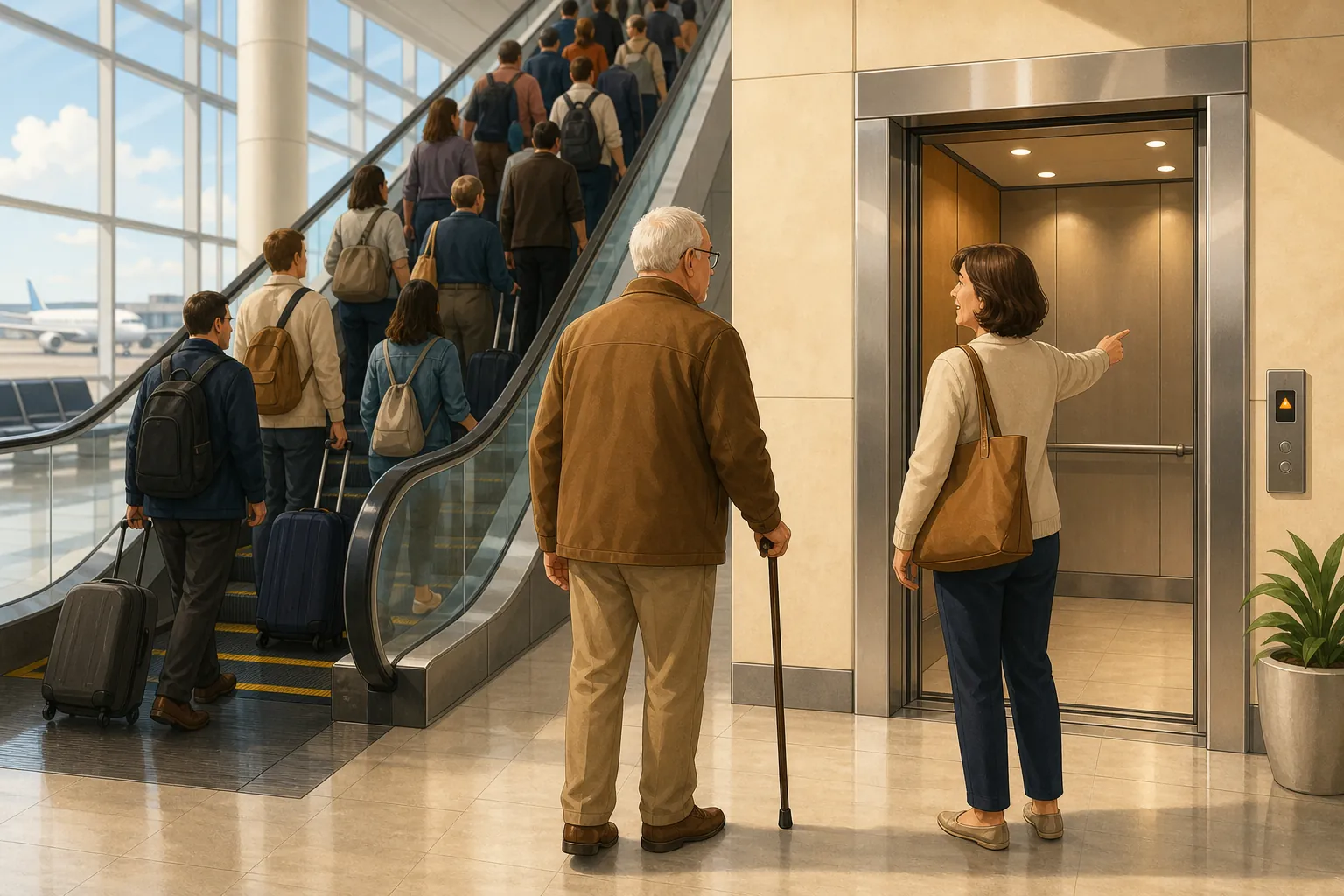
Use elevators, not escalators, when balance or timing is uncertain
Escalators deserve a hard rule. If the parent uses a cane, walker, rollator, wheelchair, has poor depth perception, freezes when rushed, or needs a handrail and luggage at the same time, choose the elevator. The airport falls study’s finding that 44% of EMS-requiring falls involved escalators at that airport is enough reason to stop treating the escalator as the default.[1]
The elevator may take longer. Build that time into the plan. A slower vertical route is better than asking an older adult to step onto a moving staircase while the crowd behind them sighs.
Security screening: know the 75-and-older accommodations
TSA says passengers age 75 and older can receive modified screening procedures, including generally being able to leave shoes and a light jacket on during screening, though additional screening may still be required. TSA also describes screening options for passengers who use wheelchairs or need to remain seated.[8] If standing, bending, removing shoes, or raising arms is difficult, say so before the screening starts.
- Tell the officer if the traveler is 75 or older.
- Say clearly if the traveler cannot stand for long, cannot walk through the scanner, cannot raise arms, or needs to remain seated.
- Keep medications and medical devices together and easy to inspect.
- Use the TSA Cares arrangement if one was made, but still speak up at the checkpoint.
- After screening, pause before moving on: shoes, cane, walker, phone, ID, boarding pass, medication bag.
That last pause matters. Security is one of the places where people get separated from their rhythm. A forgotten cane or medication pouch at the checkpoint can turn a well-planned trip into a scramble.
At the gate: protect preboarding from politeness
If preboarding was requested, do not wait for the crowd to form and then hope someone notices. Check in with the gate agent early. Confirm that the parent needs extra time or assistance boarding. If an aisle chair is needed, say that well before boarding begins.
Preboarding reduces the chance that the parent is stepping sideways into a narrow row while other passengers are pressing forward. It also gives time to stow the cane or walker properly, place medication within reach, and get settled before the aisle becomes a moving obstacle course.
In the cabin: circulation, hydration, medication timing
Once seated, the safety plan becomes quieter but not less important. Long sitting increases the chance of blood pooling in the legs. CDC travel guidance notes that blood clots can be a risk during travel lasting more than 4 hours, and risk is higher for some travelers based on medical history and other factors.[9] The CDC Yellow Book’s air travel chapter also discusses venous thromboembolism risk during air travel and the importance of traveler-specific prevention planning.[10]
- When the seatbelt sign is off and it is safe, walk the aisle every 2–3 hours if the traveler can do so safely.
- Do ankle circles, heel raises, toe raises, and gentle calf contractions while seated.
- Drink water regularly; do not rely on thirst alone.
- Limit alcohol if it worsens balance, dehydration, sleep disruption, or medication side effects.
- Use compression stockings only if the clinician recommends them and the size and pressure are appropriate.
- Do not use aspirin as a do-it-yourself clot-prevention plan unless the traveler’s clinician specifically instructed it for that person.
Cabin air is dry; the CDC Yellow Book states that commercial aircraft cabin relative humidity is typically low, in the range of 10%–20%.[10] That does not mean every older traveler needs a complicated hydration schedule, but it does mean the water bottle should be reachable and refilled when possible.
For longer trips or time-zone changes, plan meals, sleep, and medication timing before departure. Mayo Clinic notes that jet lag can affect sleep, alertness, stomach function, and overall well-being after crossing time zones.[11] If medication timing is medically sensitive — insulin, Parkinson’s medication, seizure medication, anticoagulants, heart medications — ask the clinician how to shift the schedule rather than improvising over the ocean.
After landing: the trip is not over when the wheelchair reaches arrivals
Arrival is another transition: deplaning, waiting for a mobility aid, finding a bathroom, collecting bags, locating the pickup person, and absorbing a new place. If wheelchair assistance was used on departure, request or confirm it for arrival too. Do not let the parent wave it away because the destination feels close. The last long walk can happen after the flight, when the traveler is stiff, dehydrated, and eager to be done.
The pickup person should have the flight number, terminal, baggage claim area if known, and a backup plan if phones fail. A photo of the itinerary is better than a vague text thread. If severe weather could affect arrival, booking-stage insurance questions belong in a separate decision; see Does Travel Insurance Cover Weather Delays for Seniors? rather than trying to solve that at baggage claim.
Watch for blood clot and pulmonary embolism warning signs
CDC Travelers’ Health places travel-associated clot concern around trips longer than 4 hours, while the American Society of Hematology says that for flights longer than 4 hours, about 1 in 6,000 passengers develops a blood clot; ASH also notes that risk is greatest on flights of 8–10 hours or longer and is higher for people over age 60.[9][12] Those statements measure risk differently, so they should not be mashed into one number. The practical point is simple enough: after a long flight, symptoms deserve attention.
- Possible deep vein thrombosis warning signs: new swelling in one leg, calf or thigh pain, tenderness, warmth, redness, or a heavy aching feeling on one side.
- Possible pulmonary embolism warning signs: sudden shortness of breath, chest pain that may worsen with breathing, coughing blood, rapid heartbeat, fainting, or unexplained severe weakness.
- Seek urgent medical care for symptoms of pulmonary embolism or serious unexplained breathing or chest symptoms.
- Call the traveler’s clinician promptly for new one-sided leg swelling or pain after travel, especially if the traveler has clotting risk factors.
Verify-before-you-go notes
Several rules that affect senior air travel are real but easy to misremember. TSA, DOT, FAA, and airline policies are not interchangeable. TSA controls screening. DOT sets U.S. airline disability-assistance obligations. FAA rules affect aviation safety, including portable oxygen concentrator acceptance criteria. Airlines set many operational details for medical clearance, seating, batteries, in-flight oxygen policies, and timing.
- Confirm the airline’s wheelchair, preboarding, mobility-aid, battery, aisle chair, oxygen, and medical-clearance rules directly with the carrier.
- Check TSA’s current identification and screening rules shortly before travel.
- If using TSA PreCheck, verify the current enrollment price through TSA or the enrollment provider before building a family budget around it.
- If flying domestically in the United States, verify current REAL ID enforcement status and acceptable identification before departure.
- If the trip is a cruise rather than a flight-only itinerary, use a mode-specific checklist such as Room-by-Room Cruise Safety Tips for Elderly Passengers.
A nonstop flight is worth considering as the lower-risk structure for many older travelers because it removes the connection. The real protection, though, is the timed preparation around it: medical review early enough to matter, assistance requested before the airport, TSA help arranged before the line, elevators chosen without apology, movement planned in the cabin, and warning signs taken seriously after landing.
References
- Older Adult Falls at a Metropolitan Airport: 2009–2010, Journal of Safety Research, 2012
- Wheelchair and Guided Assistance, U.S. Department of Transportation
- Older Adults and Healthy Travel, CDC Travelers’ Health
- Travelers with Chronic Illnesses, CDC Yellow Book 2026
- Portable Oxygen Concentrators, Federal Aviation Administration
- TSA Cares, Transportation Security Administration
- How to Travel Safely as an Older Adult, National Council on Aging
- Screening for Passengers 75 and Older, Transportation Security Administration
- Blood Clots During Travel, CDC Travelers’ Health
- Air Travel, CDC Yellow Book 2026
- Jet lag disorder, Mayo Clinic
- Clots and Travel, American Society of Hematology
Questions to bring to a clinician or OT
This is not medical, legal, or a family's final decision — only a framework. Bring these questions to a clinician, occupational therapist, or your local Area Agency on Aging.
Find Local HelpRelated reading
Noticed something outdated or inaccurate on this page? Flag a correction. We review every report against CDC, NIA, and AARP HomeFit guidance before updating a page.