
Caregiver decision guide
Is Staying Home Cheaper Than Senior Housing in 2026?
Compare 2026 costs for staying home — paid care hours plus one-time safety modifications — against independent living, assisted living, memory care, and CCRCs, and see the care-hour and fall-risk thresholds where the cheaper choice flips.
The short answer: the cheaper option changes when the care hours change
If you are comparing housing prices for seniors moving in 2026, the first mistake is treating “staying home” as one price. Staying home with a few hours of paid help each week can be much cheaper than assisted living. Staying home with near-daily help, unsafe transfers, wandering risk, or repeated fall concerns can become more expensive and less workable than moving.
The clean comparison is this: paid home care hours plus one-time safety modifications on one side; independent living, assisted living, memory care, nursing home care, or a continuing care retirement community on the other. The home side gets expensive as weekly care hours rise. The moving side gets expensive when the care level rises, when community fees are added, or when a spouse or second person is included.

This article is educational, not medical, legal, or financial advice. A family should still check local pricing, care contracts, licensing, benefits, taxes, and clinical needs with qualified professionals. But the first pass can be done at the kitchen table: count the hours, inspect the home, and compare the real monthly number against local availability.
Put the two choices on the same page
The table below is not a quote for any one city. It is a national comparison frame using the 2025 and 2026 sources available now, with each figure tied to the method behind it. Local prices can run above or below these numbers, but the shape of the decision is the same.
| Option | What the number measures | National figure to anchor the comparison |
|---|---|---|
| Staying home with non-medical home care | Hourly paid care; monthly cost depends on hours used | $35/hour national median in CareScout’s provider-reported 2025 Cost of Care Survey; A Place for Mom reports $34/hour and about $2,944/month at a common 20-hour weekly schedule [1][2] |
| Staying home at 44 hours/week | A heavier home-care schedule, often closer to daily support | $80,080/year, or about $6,673/month if divided by 12, using CareScout’s 44-hours/week assumption [1] |
| Independent living | Housing and services with little or no hands-on personal care | About $3,065/month in SeniorLiving.org’s 2026 sample of roughly 4,000 facilities; about $3,200/month in A Place for Mom move-in data [3][4] |
| Assisted living | Housing plus help with activities of daily living | $5,419/month paid-move-in median and $5,830/month average in A Place for Mom data; $6,200/month, or $74,400/year, in CareScout’s provider-reported 2025 survey [5][1] |
| Memory care | Residential care for dementia-related supervision and support | $6,690/month median in A Place for Mom data [2] |
| Nursing home care | Skilled nursing facility care, generally a higher medical-support level than assisted living | $114,975/year for a semi-private room and $129,575/year for a private room, annualized from CareScout’s daily-rate-based 2025 survey [1] |
| CCRC or life plan community | A campus model that may combine independent living, assisted living, and nursing care access | Average entrance fees were over $480,000 in 2025, up from about $400,000 in 2020, according to NIC [6] |
The most important row is the first one, because home care is the row families most often undercount. A parent who needs help twice a week is in a different financial situation from a parent who needs help every morning, every evening, and whenever bathing or toileting is unsafe.
The home-care number is not $34 or $35. It is hours times weeks.
CareScout’s 2025 Cost of Care Survey, released in 2026, reports a national median of $35 per hour for non-medical home care, based on provider-reported data collected from July through November 2025 [1]. A Place for Mom reports $34 per hour and about $2,944 per month at the most common 20-hour weekly schedule in its 2026 long-term care cost data [2]. Those hourly figures are close enough that they can lull a family into thinking the answer is simple. It is not.

At 20 hours a week, the home-care bill is in the neighborhood of an independent-living monthly fee and below most assisted-living medians. At 44 hours a week, CareScout’s own annualized figure is $80,080, or about $6,673 a month before rent, utilities, groceries, repairs, taxes, home modifications, or family caregiving time are counted [1].
| Weekly paid home-care hours | Approximate monthly care cost | What it means for the stay-versus-move question |
|---|---|---|
| 20 hours/week | About $2,944/month in A Place for Mom’s 2026 data; about $3,033/month using CareScout’s $35/hour median | Often still financially competitive with moving, especially if the home is already safe or needs only manageable one-time modifications [1][2] |
| 44 hours/week | $80,080/year, or about $6,673/month when divided by 12 | Now overlaps or exceeds many assisted-living and memory-care monthly figures before ordinary home costs are added [1][2][5] |
This is why the care-hour threshold deserves more attention than the national median. A family may start with four hours on Tuesdays and Thursdays and still be clearly in the aging-in-place lane. The same family may be in a different lane after a hospitalization, a fall, or a new need for bathing, dressing, toileting, meal support, medication reminders, or safe transfers.
If the expected schedule is already climbing toward 35 to 40 hours a week, it is worth reading a more direct care-setting comparison, such as When to Choose Senior Home Care Assistance Over Assisted Living. That is usually the zone where the spreadsheet stops being about a few extra hours and starts being about whether the house can safely function as a care setting.
Before comparing rent, check the fall-risk gate
A house that is cheap on paper can be expensive in practice if the bathroom threshold is wrong, the stairs have no reliable handrail, the bedroom is too far from the toilet, or a walker cannot pass through the place where someone must turn. Those are not cosmetic details. They decide how many paid hours are needed and whether unpaid family help becomes a nightly safety net.
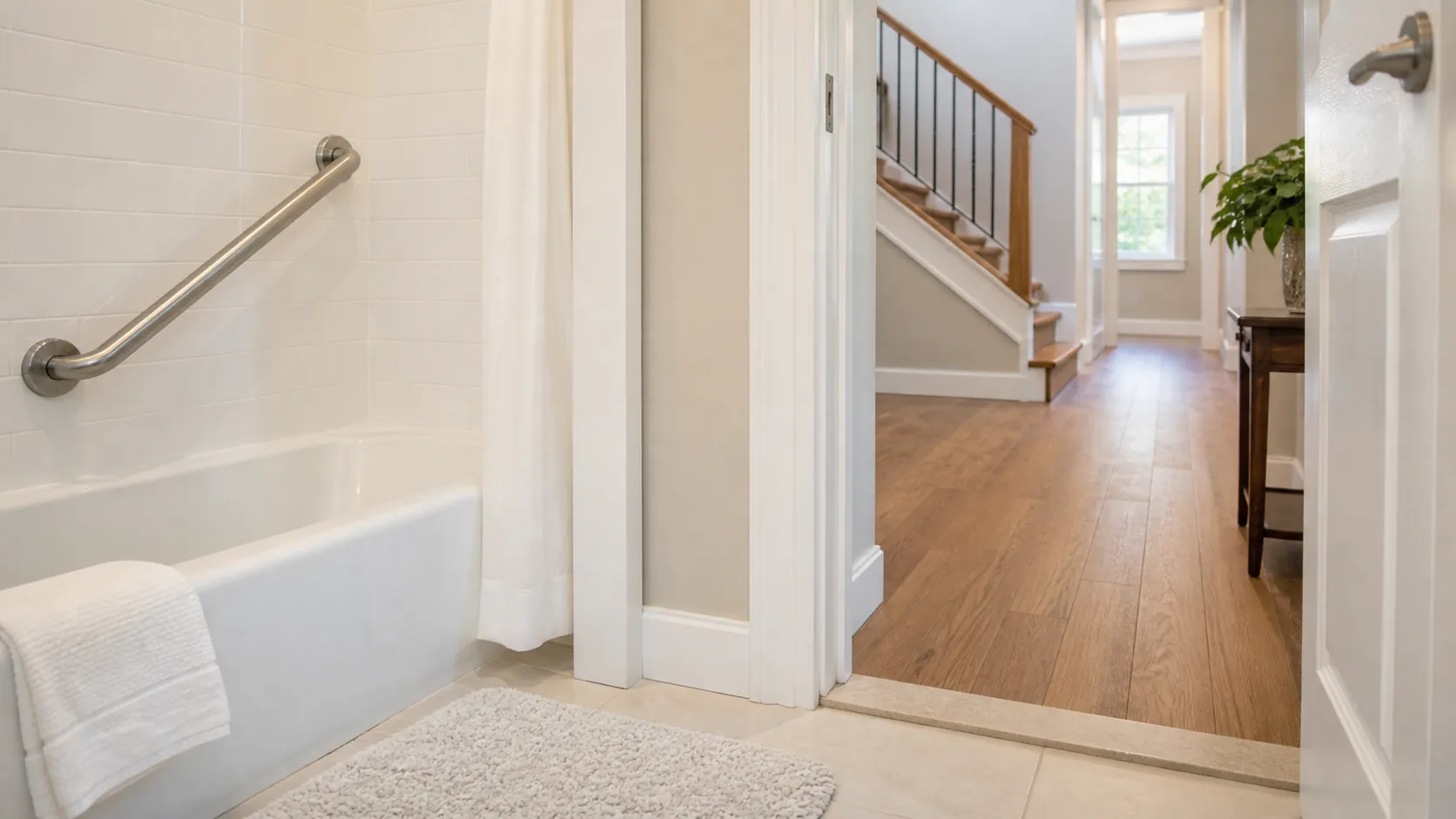
The home side of the calculation should include two different items: recurring paid help and one-time safety work. One-time work may include grab bars, lighting changes, threshold adjustments, stair rail improvements, bathroom changes, safer flooring, furniture rearrangement, or a first-floor sleeping plan. The exact cost is local and project-specific, so it should be quoted in the home, not borrowed from a national average that does not know the layout.
Start with the practical walk-through: where does the person bathe, rise from the toilet, get to the bed, reach the kitchen, answer the door, and move at night? The fall-prevention services roadmap can help families decide who should assess the home, while a CDC STEADI home fall-prevention checklist gives the inspection a more disciplined structure.
The safety gate does not automatically point away from home. Plenty of homes become safer and kinder after the right changes. But there are warning signs that one-time modifications may not be enough: repeated falls, unsafe transfers, nighttime confusion, missed medications, wandering, increasing help with several activities of daily living, or a caregiver who cannot sleep because the next fall feels likely. At that point, the move-versus-stay question is no longer only about rent. It is about supervision, response time, and whether someone is actually available when help is needed.
A fall-risk conversation can also start in routine care. Families who have not used it yet can look at why the free Medicare wellness visit matters for fall prevention. The useful question is not simply, “Can Mom stay home?” It is, “What has to change before home is safe enough, and who is responsible if it is not?”
What senior housing prices actually buy in 2026
Independent living is the lower-care housing baseline. SeniorLiving.org reports an average independent-living cost of about $3,065 per month in 2026, based on a sample of roughly 4,000 facilities [3]. A Place for Mom reports about $3,200 per month from its move-in data [4]. Those numbers can make independent living look close to a 20-hour home-care schedule. The difference is that independent living is usually not a substitute for hands-on daily care.
Assisted living is where the national numbers need careful handling. A Place for Mom reports a $5,419 monthly paid-move-in median from 24,305 move-ins and a $5,830 monthly average [5]. CareScout reports $6,200 per month, or $74,400 per year, in its provider-reported 2025 survey, up 5% year over year [1]. Those are not contradictions so much as different data pipelines. One is based on A Place for Mom’s move-in and proprietary cost data; the other is based on a provider-reported survey. A family should not average them into one tidy “true” number.
The assisted-living quote also has to include fees that do not show up in the monthly median. A Place for Mom reports a typical one-time assisted-living move-in or community fee of about $3,000 and a second-person fee of about $1,200 per month in its proprietary data [5]. For a couple, that second-person line can change the comparison quickly.
Memory care is a different escalation point, not just a nicer assisted-living apartment. A Place for Mom reports a $6,690 monthly median for memory care [2]. Nursing homes sit higher again, with CareScout reporting $114,975 per year for a semi-private room and $129,575 per year for a private room, annualized from daily rates in its 2025 survey [1]. Those figures are not interchangeable with assisted living; they reflect different care levels.
CCRCs, also called life plan communities, are their own financial structure. NIC reported that average CCRC entrance fees were over $480,000 in 2025, up from about $400,000 in 2020, a 22.3% cumulative increase [6]. That kind of entrance fee belongs in a long-range housing and estate-planning discussion, not in a quick monthly-rent comparison.
Availability now belongs in the calculation
Price is not the only constraint in 2026. NIC MAP reported senior housing occupancy at 89.5% in Q1 2026, the 19th consecutive quarterly gain, with inventory growth at a record-low 0.4% and construction at its lowest level since 2012 [7]. PwC also noted the supply pressure and the expectation that occupancy would rise above 90% before the end of 2026 as the oldest baby boomers turn 80 [8].
That does not mean every community is full or every family must move sooner. It means availability can disappear while a family is still trying to make the math feel perfect. Waiting until after a fall, a discharge, or a caregiver collapse can leave fewer choices, higher urgency, and less time to compare contracts.
The practical move is to check availability before it feels necessary. A family can still choose home modifications, still bring in care, and still avoid a move. But if assisted living or memory care may be needed within the next year, a few phone calls now are part of the planning, not a betrayal of aging in place.
Run the stay-or-move calculation in this order
- Write down current paid care hours per week. Do not estimate from memory. Count bathing help, meal help, medication reminders, transportation, transfers, overnight coverage, and the hours family members are quietly filling in.
- Price two home-care scenarios: today’s hours and the likely next step. A 20-hour week and a 44-hour week are not the same decision.
- Walk the home for fall risk and daily-function problems. Pay special attention to the bathroom, stairs, thresholds, lighting, bedroom-to-bathroom route, and the places where a person must stand, turn, or transfer.
- Get local quotes for the modifications that would make staying home safe enough. Treat those as one-time costs separate from the monthly care bill.
- Compare the resulting monthly home number with local independent living, assisted living, and memory care quotes. Ask about move-in fees, second-person fees, care-level charges, medication management, and what happens after a fall.
- Check availability before the need is urgent. If there is a waitlist, a deposit requirement, or limited memory-care space, that belongs in the decision alongside price.
For families leaning toward modifying the current home rather than selling or downsizing, the home-modification side deserves its own review. A practical starting point is the site’s rainy-day home safety checklist, and the broader companion question is covered in Why Seniors Are Choosing Home Modifications Over Downsizing. The point here is narrower: modifications only protect the budget if they also reduce risk enough to keep the paid-care schedule realistic.
Where the decision usually lands
Staying home is often cheaper when paid care is limited, family support is sustainable, and one-time safety modifications can make the home work. Moving becomes more financially and practically plausible as paid hours rise, activities-of-daily-living needs increase, memory issues require supervision, or fall risk keeps returning after the easy fixes have been made.
In 2026, the family also has to plan around supply. A good assisted-living or memory-care option may not be available on the exact week a crisis happens. The next decision is simple enough to begin: count the real care hours, inspect the home for fall risk, price the modifications, compare local senior-housing quotes, and start checking availability before everyone is exhausted.
References
- CareScout Releases 2025 Cost of Care Survey Results, CareScout / Genworth, March 2026
- Long-Term Care Costs, A Place for Mom, 2026
- How Much Does Independent Living Cost?, SeniorLiving.org, 2026
- How Much Do Retirement Communities Cost?, A Place for Mom
- Cost of Assisted Living, A Place for Mom
- CCRC Performance 3Q 2025: Five-Year Trends in CCRC Entrance Fees, NIC
- Senior Living Occupancy Grows Amid Construction Slowdown, Limiting Options for Older Adults, NIC MAP
- Senior housing, PwC
Questions to bring to a clinician or OT
This is not medical, legal, or a family's final decision — only a framework. Bring these questions to a clinician, occupational therapist, or your local Area Agency on Aging.
Find Local HelpRelated reading
Noticed something outdated or inaccurate on this page? Flag a correction. We review every report against CDC, NIA, and AARP HomeFit guidance before updating a page.