
What Companion Care for Seniors Really Means
A family-focused guide explaining what companion care is, how it differs from medical home care, what it costs in 2026, and how to arrange it for an aging parent — with practical steps for families just starting to explore their options.
A family usually starts asking about companion care for seniors before anyone is ready to call the situation “care.” Mom still showers and dresses on her own. Dad can make his coffee. Nobody needs a nurse at the bedside. But the refrigerator is almost empty, the mail is piling up, appointments are getting missed, and the house can go quiet for days.
That is the space companion care is meant to occupy: the missing middle between pretending everything is fine and bringing in medical or hands-on personal care. It is non-medical help for the parts of daily life that keep an older adult fed, connected, on schedule, and reasonably safe at home.

What Companion Care Means at Home
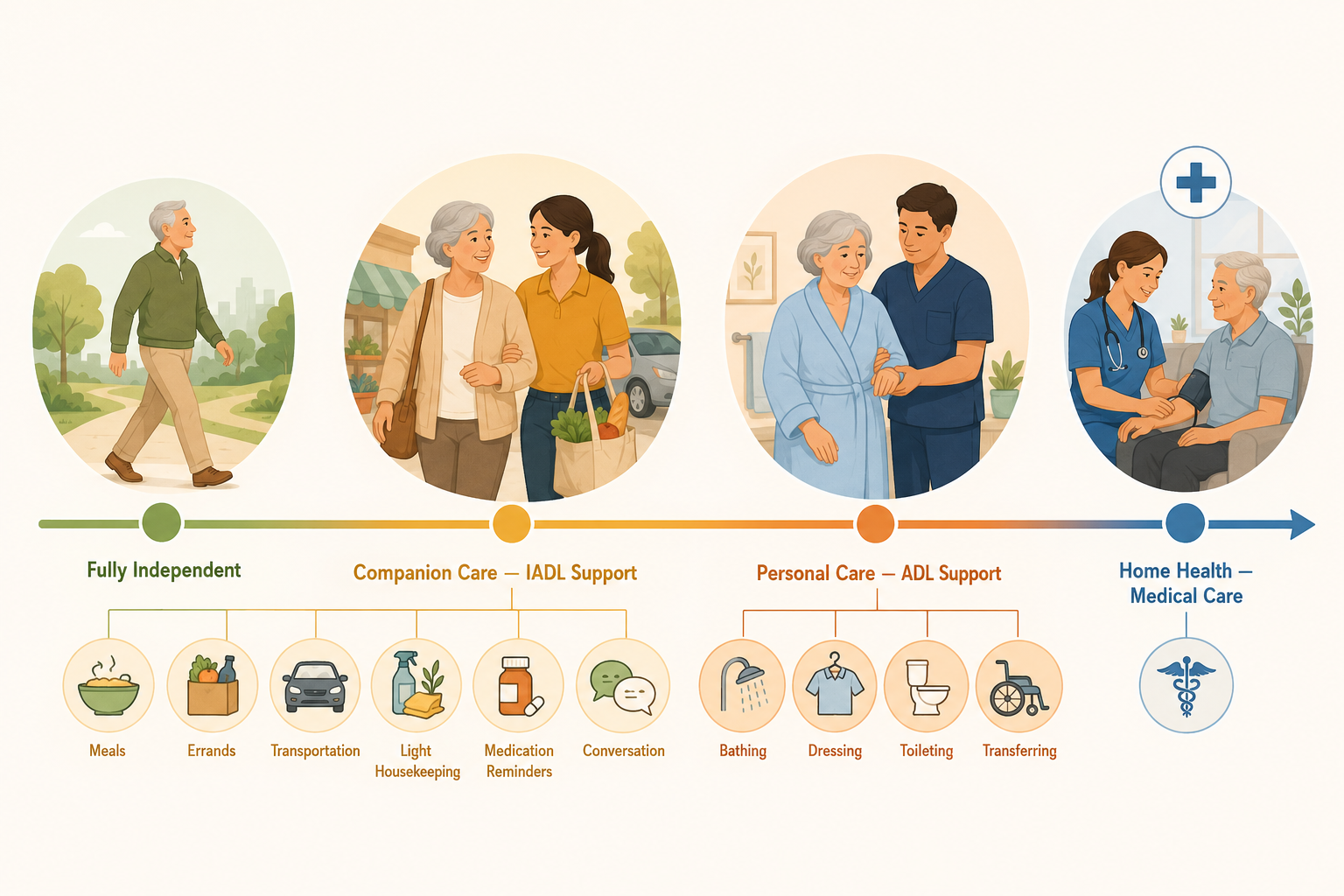
Companion care is non-medical support built around presence, routine, conversation, transportation, errands, light household help, meal support, and reminders. The caregiver may sit with an older adult over lunch, drive them to the grocery store, help sort the week’s appointments, start a load of laundry, or notice that the milk has expired again.
The important boundary is not whether the work feels “serious.” The important boundary is what kind of daily function is being supported. AARP describes companion care as help with instrumental activities of daily living, often called IADLs, rather than basic activities of daily living, or ADLs.[1]
| Type of need | Common examples | Usual care category |
|---|---|---|
| IADLs: tasks that support independent living | Meal preparation, errands, transportation, light housekeeping, laundry, scheduling, reminders, social engagement | Companion care |
| ADLs: basic personal care tasks | Bathing, dressing, toileting, eating, transferring from bed to chair | Personal care or home care aide services |
| Medical needs | Wound care, injections, therapy ordered by a clinician, skilled nursing assessment | Home health care |
This distinction saves families from two common mistakes. The first is waiting too long because the parent does not yet need bathing help. The second is hiring the wrong kind of help because every service that happens in the home gets called “home care” in casual conversation.
A companion caregiver is not there to take over the parent’s life. In a good arrangement, the older adult still decides what lunch sounds good, which errands matter, whether the living room needs attention, and how much conversation is welcome. The caregiver supplies the extra structure and assistance that keep those ordinary choices from becoming exhausting or unsafe.
What a Companion Caregiver Usually Does
The exact task list depends on the provider, state rules, and the family’s agreement, but companion care usually stays on the non-medical side of the line. The work is practical, repetitive, and easy to undervalue until nobody is doing it.
- Social connection: conversation, games, reading aloud, walks, hobbies, or simply being present during long quiet stretches.
- Transportation and errands: rides to appointments, grocery shopping, pharmacy pickups, post office trips, and other routine outings.
- Meal support: planning simple meals, preparing food, setting food out, encouraging regular eating, and noticing when groceries are running low.
- Light housekeeping: dishes, laundry, changing linens, tidying common areas, taking out trash, and keeping walkways clearer.
- Reminders and routine: prompting medication times, appointments, hydration, meals, exercise, or daily habits without administering medical treatment.
- Family updates: reporting practical observations, such as a missed meal, a new fall concern, spoiled food, or a change in mood.
Medication reminders deserve careful wording. A companion may be able to remind a parent that it is time to take medication, depending on the arrangement and local rules. That is different from deciding which medication to take, filling pill organizers if the provider does not permit it, giving injections, changing doses, or judging side effects. Those belong in a medical or licensed care conversation.
What Companion Care Does Not Cover
Companion care is often the right first support, but it is not a workaround for personal care or medical care. If an older adult needs help getting in and out of the shower, cleaning after toileting, transferring safely, managing wounds, or recovering after a hospitalization under a clinician’s orders, the family should ask about personal care, home health, or another level of support.
For a broader map of how these categories fit together, see the essential guide to home care services for the elderly. The label matters because it affects who is qualified to help, what the care plan includes, and whether any insurance or public benefit is even worth checking.
| If you are seeing this | Companion care may be enough? | What to consider instead |
|---|---|---|
| Parent is lonely, missing errands, eating irregularly, or no longer driving | Often yes | Start with IADL and social support |
| Parent needs reminders but can take medications independently | Possibly | Confirm the provider’s medication reminder rules |
| Parent needs help bathing, dressing, toileting, or transferring | Usually no by itself | Personal care or a home care aide |
| Parent needs wound care, injections, skilled therapy, or clinical monitoring | No | Home health care or medical services |
| Parent has dementia and may wander, become unsafe alone, or resist care | It depends | Ask about dementia-trained care and supervision needs |
Why Social Support Is a Health-Relevant Need
Companion care should not be reduced to “someone to chat with,” but the social part is not fluff. The CDC reports that nearly one in four adults age 65 and older are socially isolated, and one in three U.S. adults report loneliness.[2] The National Institute on Aging also connects social isolation and loneliness with higher risks for conditions including heart disease, depression, cognitive decline, and earlier death.[3]
That evidence does not prove that hiring a companion caregiver will prevent a specific illness for a specific person. It does make one thing clear: long days without contact, meals, movement, transportation, or meaningful routine are not just lifestyle inconveniences. They are part of the health picture families need to take seriously.
Families who want the deeper evidence base can read Companion Care for Seniors: The Health Evidence for Social Connection. For the first decision, the more practical question is whether a parent’s social isolation is showing up in daily life: skipped meals, unopened curtains, fewer showers, missed church or club meetings, no rides, no visitors, and nobody close enough to notice a change.
When Companion Care Is the Right First Step
Companion care is most useful when the older adult is still mostly independent but the household is starting to wobble. The parent may not need hands-on care, but the family is quietly compensating: a daughter orders groceries from another state, a son calls every morning to check whether pills were taken, a neighbor drives to the pharmacy, and everyone hopes the system holds.
- The parent has stopped driving or is driving less, and transportation gaps are causing missed appointments or fewer outings.
- Meals are becoming less regular, less nutritious, or more dependent on snacks and packaged foods.
- The home is not unsafe enough for emergency action, but laundry, dishes, trash, mail, or clutter are starting to build.
- The parent spends long stretches alone and has lost easy contact with friends, faith communities, neighbors, or hobbies.
- Family caregivers are handling many small tasks remotely or after work, and the arrangement is becoming fragile.
If the family is still unsure whether the signs add up to a care need, When Does an Aging Parent Need a Companion? can help sort normal aging changes from patterns that deserve support.
What Companion Care Costs in 2026
In 2026, A Place for Mom reports a national median home care cost of $34 per hour, with state medians ranging from $25 per hour in Mississippi to $44 per hour in South Dakota.[4] Those figures are useful for planning, but families should read the methodology carefully: A Place for Mom’s reported home care costs reflect agency rates, not every private-pay arrangement in the market.[4]
| 2026 cost reference | Hourly rate |
|---|---|
| National median home care cost | $34 |
| Lowest state median reported: Mississippi | $25 |
| Highest state median reported: South Dakota | $44 |
The weekly total depends more on hours than on the label. A four-hour visit twice a week at the national median would be a very different commitment from weekday afternoon coverage. Many agencies also have minimum shift lengths, minimum weekly hours, or different rates for evenings, weekends, holidays, and short visits.
Agency care and direct hire care are priced differently. A Place for Mom reports that agencies charge about $45 to $57 per hour while caregivers receive about $15 to $25 per hour, and that hiring privately may cost 20% to 30% less than using an agency.[5] The lower hourly cost does not erase the work the family takes on when it hires directly.
| Hiring path | What the family is buying | Main tradeoff |
|---|---|---|
| Home care agency | Recruiting, screening, scheduling, backup coverage, payroll handling, supervision, and a formal service agreement | Higher hourly cost, usually less employer burden |
| Private caregiver or direct hire | A direct relationship with an individual caregiver | Lower potential cost, but the family may become responsible for taxes, payroll, insurance questions, backup coverage, and oversight |
For a closer comparison, use How to Choose Between a Home Care Agency and a Private Caregiver before deciding that the cheaper hourly rate is the cheaper arrangement.
Will Medicare, Medicaid, VA Benefits, or Insurance Pay?
Families should check payment sources, but they should not build the plan around a vague hope that “Medicare will cover it.” Original Medicare does not cover companion care.[6] That is often the first disappointing answer, and it is better to learn it before spending weeks gathering the wrong paperwork.
- Original Medicare: Does not cover companion care as a stand-alone non-medical service.[6]
- Medicare Advantage: Some plans may offer in-home support through supplemental benefits, but benefits vary by plan and can change each year; families need to check the specific plan documents during open enrollment.[6]
- Medicaid HCBS waivers: Home- and community-based services may help some eligible people, but rules, waiting lists, covered services, and eligibility vary by state.[6]
- VA benefits: Some veterans or surviving spouses may qualify for help that can be used toward care, depending on eligibility and benefit rules.[6][7]
- Long-term care insurance: Coverage depends on policy language, benefit triggers, elimination periods, approved provider rules, and whether companion care qualifies under that policy.[7]
A useful payment check is specific, not general: call the plan, policy, state Medicaid office, VA benefits contact, or insurance administrator and ask whether non-medical companion care, homemaker services, or personal assistance services are covered; whether an agency must be licensed or approved; what assessment is required; and whether family members can be paid caregivers.
For a broader payment map, see What Will Pay for Senior Home Healthcare in 2026? The answer may still be private pay, but a careful check can prevent families from missing a real benefit or chasing one that does not apply.
How to Arrange Companion Care Without Turning It Into a Crisis
The first arrangement does not have to solve every future care need. It needs to match the parent’s current risks, be financially plausible, and create a way to notice when the plan is no longer enough.
1. Write down the actual problems
Start with what is happening, not with the service label. “Needs companion care” is less useful than “has missed two appointments because she no longer drives,” “is eating toast for dinner most nights,” or “goes from Sunday to Thursday without seeing anyone.”
- Which errands, appointments, or household tasks are not getting done?
- Which tasks can the parent still do safely with a little support?
- Which tasks now require hands-on help with the body?
- Which days or times of day are most fragile?
- What would make this week safer or less isolated?
2. Decide whether agency or direct hire fits the family
An agency can be the better fit when the family needs screening, backup coverage, scheduling help, payroll handling, and a supervisor to call when something goes wrong. Direct hire can work when the family has time to recruit, check references, manage payment and tax obligations, arrange backup care, and monitor the relationship closely.
Neither option is automatically more caring. The question is who will carry the invisible work around the caregiver: hiring, training, sick days, vacations, conflict, documentation, and replacement if the match fails.
3. Check payment sources before signing
Before the first visit, check whether any benefit requires a prior assessment, approved provider, care plan, physician documentation, or claim form. Some families can pay privately and start quickly. Others need to know whether using the wrong provider would make reimbursement impossible.
4. Talk with the parent as if this is support, not surrender
This conversation goes better when it begins with the parent’s goals. A parent who rejects “care” may still want to keep going to the grocery store, stay in the house, get to church, stop worrying about asking neighbors for rides, or have help after a tiring medical appointment.
Practical wording helps: “Let’s try someone on Tuesday mornings to drive you to errands and help with lunch” is less threatening than “You need a caregiver.” If the parent is cautious, start with a task they already want done. The first visit might be grocery shopping and lunch, not a sweeping announcement that the family has arranged ongoing care.
5. Vet the provider or caregiver
Vetting should cover both safety and fit. Ask what tasks the caregiver may and may not perform, how background checks work, whether caregivers are bonded and insured, how scheduling and backup coverage are handled, who supervises the caregiver, how complaints are addressed, and what happens if the parent’s needs increase.
For agency interviews, How to Choose a Home Care Agency Your Family Can Trust offers a more complete question set.
6. Start small if the risk level allows it
A small schedule can make the first step easier: two mornings a week for errands, meals, and company; one afternoon for appointments and laundry; or a regular post-hospitalization check-in if no skilled care is required. A modest start also gives the family a cleaner read on whether the parent accepts the help and whether the caregiver notices useful information.
Do not start small if the parent is already unsafe alone for long periods, wandering, falling frequently, unable to toilet safely, or missing essential medication in a way that creates immediate danger. That is a different assessment.
7. Reassess after the first few weeks
Companion care should make daily life more stable in observable ways. Look at whether meals are more regular, appointments are being kept, the parent seems less cut off, errands are no longer a weekly scramble, and family caregivers are receiving useful updates.
Also watch for signs that the care category has changed. If the caregiver is repeatedly being asked to help with bathing, toileting, transfers, medication decisions, or medical problems, the plan has moved beyond ordinary companion care. That is not a failure. It is information.
A Useful First Support, When the Boundaries Are Clear
Companion care is often the earliest formal support a family can add without turning a parent’s home into a medical setting. It can bring another person through the door, put food and appointments back on a schedule, make transportation possible again, and give the family a steadier view of what is happening.
It works best when the family can answer three questions clearly: Is the parent’s main need IADL and social support rather than hands-on personal care or medical care? Is the schedule and cost realistic? Who will make the first call or start the first conversation this week?
If those answers point toward companion care, the next step can be small and concrete. If they point toward bathing help, dementia supervision, or skilled medical needs, the family has still made progress by naming the real level of care.
References
- Is Companion Care Right for Your Loved One? AARP
- Health Effects of Social Isolation and Loneliness Centers for Disease Control and Prevention
- Loneliness and Social Isolation — Tips for Staying Connected National Institute on Aging
- In-Home Care Costs A Place for Mom
- Home Care Agency vs Private Caregiver A Place for Mom
- Does Medicare or Medicaid Cover Companion Care? (2026) SeniorLiving.org
- What Is Companion Care? Companion Caregiver Costs, Duties, and More Careforth
Where this decision comes from
Suggest a correction
We keep this content strictly product-neutral and reviewed against CDC STEADI, NIA, and AARP HomeFit guidance. If something here looks outdated, unclear, or inaccurate, tell us — this page does not carry open public comments, because it touches medical urgency, cost, or capacity-adjacent decisions where a discussion thread is a trust liability rather than a trust asset.
See the correction process on our editorial standards page →