
Caregiver decision guide
Building an Aging in Place Services Plan: A Staged Decision Framework for Family Caregivers
A practical, staged framework for adult children who are new caregivers, showing which aging-in-place services to arrange first, in what order, and how to layer them as needs progress — from home safety assessment through monitoring, personal care, medical support, and community services.
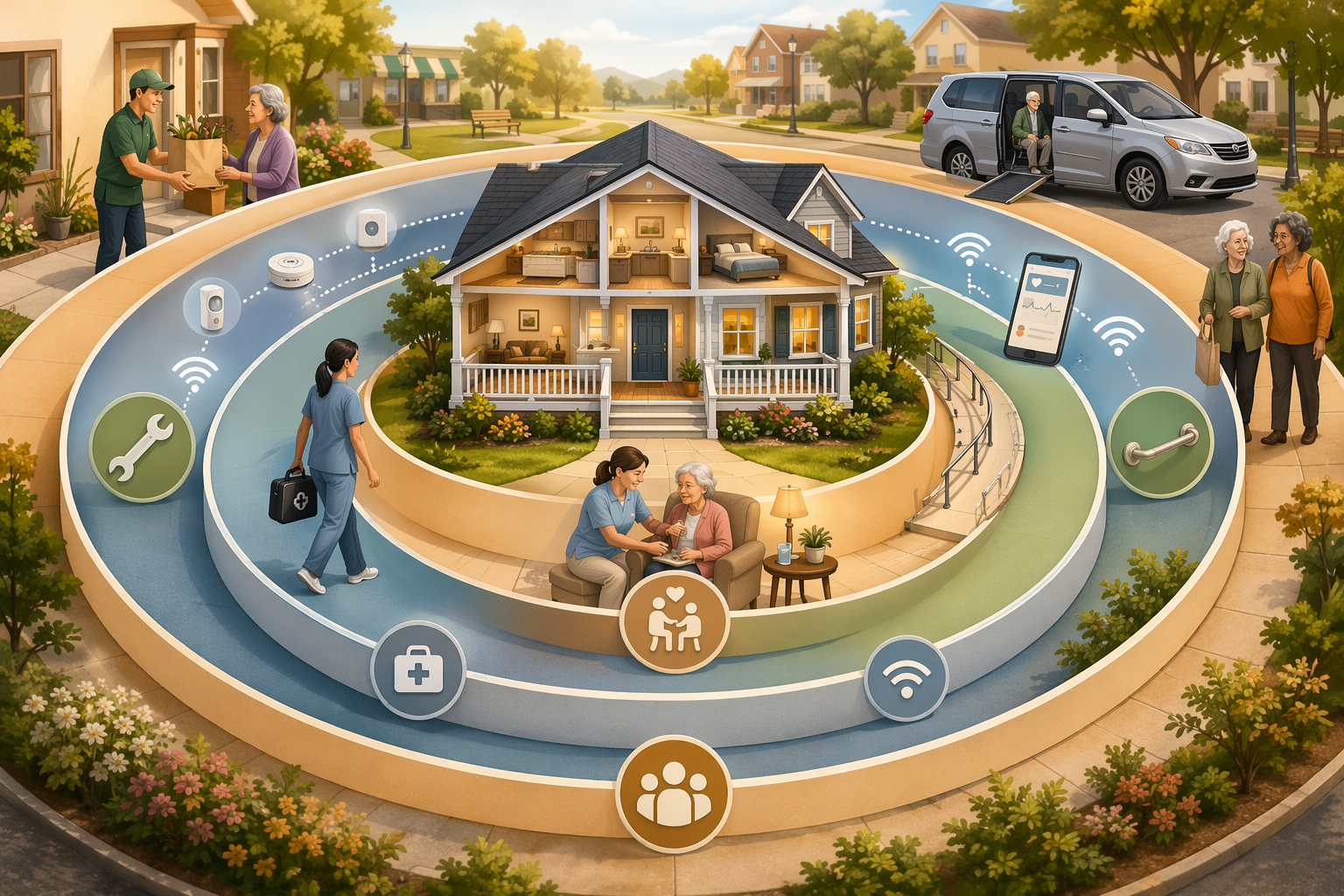
Why a Staged Approach to Aging in Place Services Matters
The numbers are clear: 88% of adults between ages 50 and 80 want to age in place, according to a National Council on Aging poll. A February 2026 Pew Research Center survey found that 93% of U.S. adults 65 and older already live in their own home. Yet the same Pew survey revealed a deep confidence gap: among those living at home without a caregiver, only 37% believe it is extremely or very likely they will be able to stay there if they can no longer manage alone.
That gap exists for a reason. Most families approach aging-in-place planning in one of two ways — neither of which works well. Some do nothing until a fall, a hospitalization, or a dementia crisis forces a rushed decision. Others try to arrange every possible service at once, burning through time and money on solutions that may not be needed for years.
A staged framework — starting with a thorough assessment, then layering home modifications, monitoring technology, personal care, medical support, and community services as needs actually emerge — can delay or prevent facility placement while keeping costs manageable. Family caregivers already provide an estimated $873 billion of free labor annually, according to data cited by Choice Mutual. A proactive, sequenced plan helps ensure that unpaid labor is spent on the right things at the right time.
Stage 1: Assessment — Know Where You Stand Before You Act
Assessment is the single most important step, and the one most families skip. Without a clear picture of your parent's current functional level, home environment, and health status, every subsequent decision is a guess. Assessment prevents two common mistakes: spending money on services your parent does not yet need, and missing hazards that will cause the next crisis.
A complete assessment covers three domains:
- Home safety audit: Walk through every room using the CDC STEADI model to identify trip hazards, missing grab bars, poor lighting, and unsafe stairs. The Room-by-Room Fall Prevention Checklist provides a practical tool you can use immediately.
- Health status evaluation: Review current medications (nearly 35% of adults ages 60 to 79 take five or more prescription drugs, per CDC data cited by UCLA Health), fall risk factors, and chronic conditions. A medication review alone can identify drugs that increase fall risk or interact dangerously.
- ADL/IADL assessment: Determine which Activities of Daily Living (bathing, dressing, toileting, transferring, eating) and Instrumental Activities of Daily Living (medication management, meal preparation, transportation, housekeeping) your parent can perform independently. This becomes the baseline for deciding which service layers to add and when.
The Senior Care Assistance Triage guide can help you distinguish between what needs to happen now, next week, and next month — a useful companion to this assessment phase.
Stage 2: Foundation Services — Home Modifications for Safety and Accessibility
Home modifications are the foundational layer because they create a safe physical environment before you add technology or care services. According to data from Choice Mutual, about 90% of U.S. homes are not "aging ready," and only 18% of adults 50 and older have made any modifications. That means most families are trying to deliver care in an environment that is actively working against them.
The most impactful modifications are not the most expensive. Focus first on low-cost, high-impact changes:
- Grab bars in the shower, next to the toilet, and at entry points
- Improved lighting in hallways, stairways, and the bathroom
- Non-slip flooring or mats in the bathroom and kitchen
- Handrails on both sides of stairways
- Removal of loose rugs and clutter from walking paths
Basic home modifications typically cost between $3,000 and $15,000, according to industry estimates. Compare that to the $64,200 per year ($5,350 per month) median cost of assisted living reported by Choice Mutual. If modifications delay facility placement by even one year, the return on investment is substantial.
| Modification | Typical Cost Range | Impact |
|---|---|---|
| Grab bars (bathroom) | $50 – $200 per bar | Reduces bathroom fall risk significantly |
| Improved lighting | $100 – $500 per room | Reduces trip hazards in low-light areas |
| Non-slip flooring | $500 – $2,000 per room | Prevents slips in wet areas |
| Stair handrails | $200 – $600 per side | Provides stability on stairs |
| Basic whole-home package | $3,000 – $15,000 | Addresses most common fall hazards |
For a detailed breakdown of costs, contractor considerations, and funding sources, see the Aging in Place Home Modifications cost and planning guide.
Stage 3: The Monitoring Layer — Choosing Technology Based on Risk Profile
Monitoring technology is not a one-size-fits-all category. The right system depends on three factors: your parent's fall risk, whether they live alone, and their cognitive status. A 2022 scoping review published in PMC identified 16 types of sensor technologies used in in-home monitoring, with passive infrared (PIR) motion sensors being the most common, appearing in 21 of 30 studies reviewed.
Here is how to match technology to risk profile:
| Risk Profile | Recommended Technology | Key Features to Evaluate |
|---|---|---|
| Low fall risk, lives with others, cognitively intact | Basic PERS (personal emergency response system) | Waterproof pendant, long battery life, simple one-button call |
| Moderate fall risk, lives alone, cognitively intact | PERS with automatic fall detection | Fall detection accuracy, response time, two-way communication |
| High fall risk, lives alone, cognitively intact | PERS with fall detection + passive motion sensors | Sensor range (up to 30 feet for PIR), alert customization, privacy controls |
| Cognitive impairment, any living situation | GPS tracker for wandering + passive sensors + smart lighting | Geo-fencing, real-time location, nighttime guidance features |
| Multiple chronic conditions | Remote patient monitoring (RPM) for vitals | Blood pressure, glucose, oxygen monitoring; data sharing with providers |
The PMC review reported that a fall detection system using WiFi signal interference achieved a 95% detection rate, while a millimeter-wave radar-based system reached 98.74% accuracy with an average prediction time of 51.4 milliseconds. Sensor-based systems also detected depression with up to 96% accuracy by analyzing daily activity patterns, and could distinguish normal from abnormal days with 88% accuracy.
Privacy and consent are non-negotiable considerations, especially when cognitive impairment is involved. A 12-week pilot study with five older adults with dementia used sensor-based technology to guide nighttime wanderers toward the bedroom or bathroom using smart lighting and speakers — a promising approach, but one that requires careful discussion with the person and, where appropriate, their legal decision-maker.
Stage 4: Personal Care and Home Care Services — Starting Small, Scaling Up
Personal care services are typically the first "human layer" families add, and the most common mistake is starting too big. A few hours per week of companion care — help with grocery shopping, light housekeeping, and social interaction — can be enough to extend independence for months or years. As ADL needs increase, you scale up to personal care (bathing, dressing, toileting assistance) and eventually to skilled care.
Understanding the three levels of home care is essential for matching services to needs:
| Care Level | What It Includes | National Median Cost (2026) | Who Provides It |
|---|---|---|---|
| Companion care | Social interaction, light housekeeping, meal preparation, transportation | $35/hour ($6,673/month for 44 hrs/week) | Nonmedical caregiver |
| Personal care | Bathing, dressing, toileting, transferring, medication reminders | $35/hour (same rate; hours typically increase) | Nonmedical caregiver with personal care training |
| Skilled care | Wound care, injections, physical therapy, occupational therapy | $90/hour ($17,160/month for 44 hrs/week) | Private duty nurse or home health agency |
For families whose parent has dementia, the decision of which care type to use is more complex. The Choosing Home Care for a Parent with Dementia guide walks through the specific considerations for companion, personal, adult day, and skilled care in the context of cognitive decline.
Stage 5: Medical Home Health and Chronic Condition Management
Skilled home health services become necessary when chronic conditions require professional management or after a hospitalization. This stage includes nursing care, physical therapy, occupational therapy, and speech therapy — all delivered in the home. Unlike the personal care layer, these services are typically prescribed by a physician and are time-limited.
Remote patient monitoring (RPM) is an increasingly important component of this stage. RPM systems track vital signs — blood pressure, heart rate, blood glucose, oxygen saturation — and share the data with healthcare providers. This allows clinicians to detect problems early and adjust treatments without requiring the patient to travel to a clinic. For a detailed explanation of how RPM works and what to look for, see the Remote Patient Monitoring for Seniors guide.
Medicare covers home health services only when the patient is homebound and needs skilled nursing or therapy on a part-time or intermittent basis. It does not cover 24-hour care, meal delivery, or personal care. The Medicare Home Health Care in 2026 guide explains the current coverage rules and recent policy changes.
For families who need to arrange skilled nursing or therapy services at home, the In-Home Nursing Care step-by-step guide provides practical instructions for finding, vetting, and coordinating with home health agencies.
Stage 6: Community Support and Social Engagement
The outermost layer of the services ecosystem is often the most affordable and the most overlooked. Community-based services — meal delivery, transportation, adult day programs, and care coordination — reduce caregiver burden and combat social isolation, which is itself a significant health risk for older adults.
Key community services to consider:
- Meal delivery (Meals on Wheels): Provides nutritious meals to homebound seniors. Costs vary by program; many operate on a sliding scale or are subsidized.
- Transportation services: Senior-specific ride programs, volunteer driver networks, and subsidized taxi or rideshare programs help older adults attend medical appointments and social activities.
- Adult day programs: Provide structured activities, meals, and supervision during daytime hours. The median monthly cost is $1,690, according to NCOA data from Genworth's 2021 Cost of Care Survey. This is significantly less than in-home personal care and gives family caregivers a break during working hours.
- Care coordination: Aging and Disability Resource Centers (ADRCs) and Area Agencies on Aging (AAAs) provide free or low-cost assistance navigating local services, benefits, and programs.
These services are often more affordable than in-home care and can delay the need for higher levels of support. They also directly address social isolation, which research links to increased risks of cognitive decline, depression, and mortality in older adults.
Cost Mapping: What Each Stage Costs and How to Pay for It
Understanding the full cost picture across all stages helps families make informed trade-offs. The table below consolidates typical costs and applicable funding sources for each service layer.
| Service Layer | Typical Monthly Cost | Funding Sources |
|---|---|---|
| Home modifications (one-time) | $3,000 – $15,000 (total) | Medicaid HCBS waivers, VA grants, home equity loans, personal savings |
| PERS with fall detection | $30 – $50/month | Out-of-pocket; some Medicare Advantage plans may cover |
| Passive sensor monitoring | $20 – $40/month | Out-of-pocket; some long-term care insurance policies |
| Companion care (10 hrs/week) | $1,400/month | Out-of-pocket, VA benefits, long-term care insurance |
| Personal care (20 hrs/week) | $2,800/month | Out-of-pocket, VA benefits, long-term care insurance, Medicaid HCBS |
| Adult day program | $1,690/month (median) | Medicaid HCBS, VA benefits, out-of-pocket |
| Skilled home health | Covered by Medicare (time-limited) | Medicare Part A/B, Medicare Advantage |
| Private duty nursing (44 hrs/week) | $17,160/month | Out-of-pocket, long-term care insurance |
For homeowners aged 62 and older, home equity can be a funding source through reverse mortgages, home equity loans, or home equity lines of credit (HELOCs). The NCOA notes that these options can provide funds for home modifications and in-home care, but they carry risks — including the potential for foreclosure if property taxes or insurance are not paid — and should be discussed with a financial advisor.
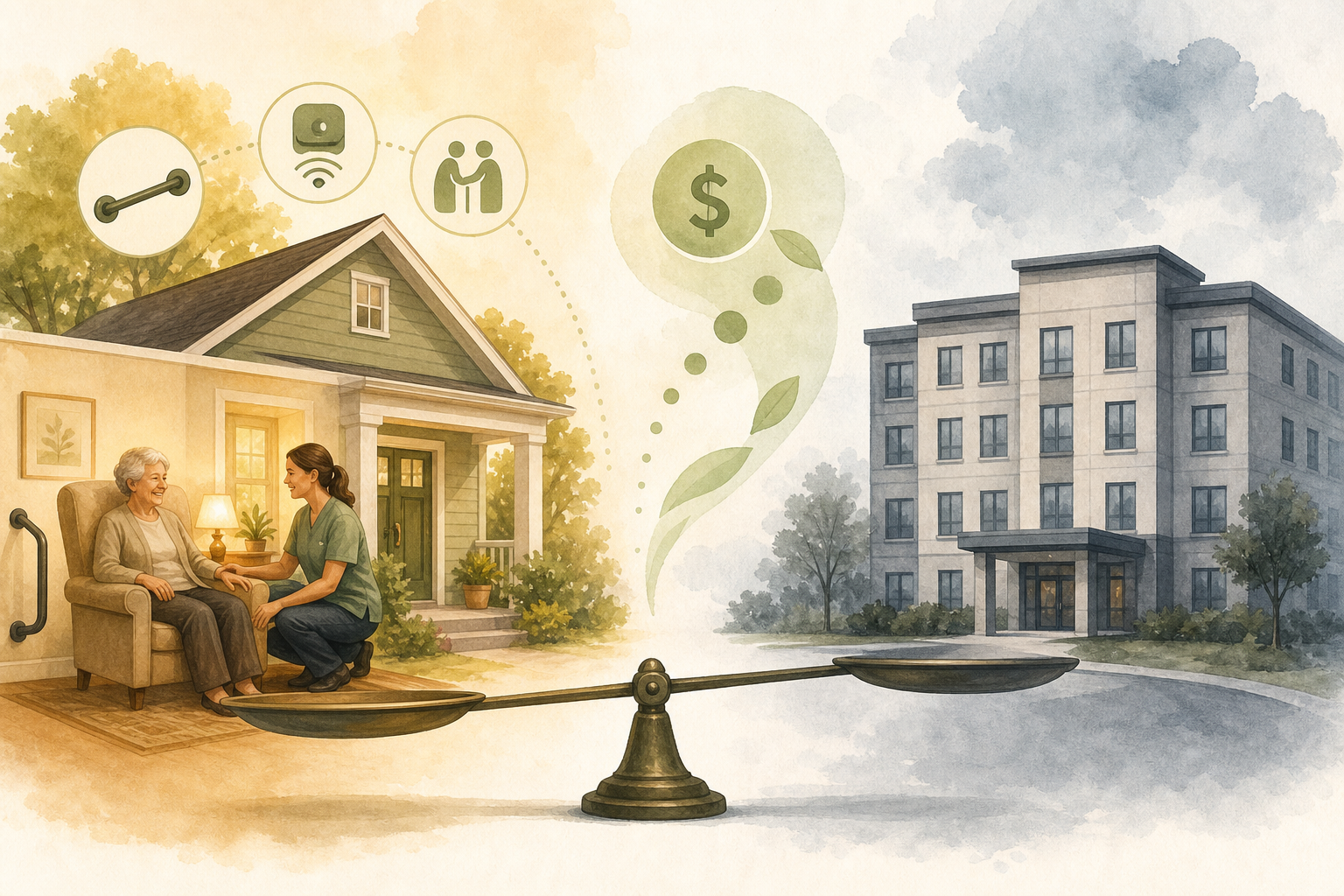
Re-Evaluation Triggers: When to Move to the Next Stage
The staged framework is not a one-time plan. It is a living document that should be re-evaluated whenever your parent's condition changes. The following triggers signal that it is time to add the next service layer:
- A fall or near-fall: Immediate trigger for adding or upgrading monitoring technology (PERS with fall detection) and revisiting the home safety audit.
- Weight loss or missed meals: Signals that meal preparation or grocery shopping has become difficult. Trigger for meal delivery services or increased companion care hours.
- Hospital discharge: Trigger for skilled home health services (nursing, PT, OT) and, if needed, a temporary increase in personal care hours during recovery.
- Caregiver burnout: If you are experiencing signs of burnout — exhaustion, irritability, declining health — it is time to add community support services (adult day program, increased home care hours, or respite care).
- Wandering or safety concerns: Trigger for GPS tracking, passive sensor monitoring, and increased supervision. May also signal the need for a cognitive re-assessment.
- Decline in ADL performance: If your parent can no longer bathe, dress, or toilet independently, it is time to scale personal care hours or consider a higher level of support.
It is also important to acknowledge that the framework is not strictly linear. Some families will need to start at Stage 4 or 5 because their parent is already in decline post-hospitalization. Others may skip Stage 3 entirely if their parent has no fall risk and lives with a capable spouse. The framework is a guide for thinking about services in sequence, not a prescription that every family must follow in order.
Questions to bring to a clinician or OT
This is not medical, legal, or a family's final decision — only a framework. Bring these questions to a clinician, occupational therapist, or your local Area Agency on Aging.
Find Local HelpRelated reading
Noticed something outdated or inaccurate on this page? Flag a correction. We review every report against CDC, NIA, and AARP HomeFit guidance before updating a page.