
Caregiver decision guide
Is It Time for a Senior Living Home? 11 Signs Your Parent Needs More Support
Most families wait until a crisis forces a decision about senior living. This guide helps adult children recognize 11 evidence-based signs of declining independence — from ADL difficulty and medication errors to caregiver burnout — and provides a practical 3-step framework for making a planned, less stressful transition.

Why Families Wait Too Long — and Why a Planned Move Is Better
The decision to move a parent into a senior living community rarely follows a calm, deliberate timeline. More often, it arrives in the wake of a crisis: a fall that sends an older adult to the emergency room, a hospitalization for a medication error, or a frantic phone call from a neighbor who found the front door unlocked at midnight. These moments force families into rushed decisions with fewer options, higher costs, and greater emotional fallout for everyone involved.
The data bears this out. According to the CDC, more than 1 in 4 older adults falls each year, and about 37% of those falls result in an injury that requires medical treatment or restricts activity for at least a day. Each year, roughly 3 million emergency department visits among older adults are fall-related. Yet fewer than half of older adults who fall tell their doctor — meaning families often remain unaware of the accumulating risk until a serious injury forces the issue.
Waiting until a crisis narrows the field. Facilities may have limited availability. The senior may be recovering from a hospital stay and unable to participate in tours or make their own choices. The family is under time pressure and emotional strain, making it harder to evaluate options objectively. A planned transition, by contrast, preserves the senior's autonomy, gives the family time to research and compare options, and typically results in a better fit between the resident's needs and the community's capabilities.
This guide provides a structured alternative to crisis-driven decision-making. It covers 11 evidence-based signs that a senior may need more support than family caregiving or home care can provide, a 3-step framework for evaluating options and touring facilities, a conversation playbook for talking to a reluctant parent, and a self-check for the caregiver's own wellbeing. The goal is not to push a specific outcome but to help families recognize the warning signs early and act while they still have choices.
11 Evidence-Based Signs It May Be Time for More Support
The following signs are drawn from data published by the CDC, the National Institute on Aging (NIA), and AARP. No single sign alone means a move is necessary, but the presence of multiple signs — especially those that are worsening over time — warrants a serious conversation and a formal assessment.
1. Difficulty with Activities of Daily Living (ADLs)
ADLs are the basic self-care tasks that most adults perform without thinking: bathing, dressing, toileting, transferring (getting in and out of a chair or bed), continence management, and eating. When a senior struggles with one or more of these, the need for hands-on assistance has arrived. According to the CDC, 13.8% of adults aged 75 and older needed personal care assistance in 2024. If you notice your parent skipping showers, wearing the same clothes for days, or having difficulty getting up from the sofa, these are not just quirks of aging — they are functional changes that require a response.
2. Poor Nutrition and Unexplained Weight Loss
An empty refrigerator, expired food in the pantry, or a parent who has lost noticeable weight without trying are red flags. Cooking becomes difficult when standing for long periods is painful, when cognitive decline makes following a recipe confusing, or when the motivation to eat alone has faded. Poor nutrition accelerates muscle loss, weakens the immune system, and increases fall risk.
3. Medication Mismanagement
Medication errors send more than 600,000 older adults to the emergency room each year, according to the CDC. Missed doses, double-dosing, taking expired medications, or mixing drugs without understanding interactions are common problems. If you find pill bottles from multiple pharmacies with different refill dates, or if your parent cannot explain what each medication is for, the current system is not working.
4. Declining Health with Complex Care Needs
Chronic conditions such as diabetes, heart failure, COPD, and arthritis often become harder to manage as a person ages. When a senior requires daily monitoring, wound care, physical therapy, or multiple specialist appointments, family caregivers may lack the training or time to provide adequate support. A doctor who recommends more care than the family can deliver at home is a signal that a higher level of support is needed.
5. Social Isolation and Loneliness
A senior who has stopped attending church, declined invitations from friends, or spends most days alone in front of the television is at risk. Social isolation is linked to higher rates of depression, cognitive decline, and even mortality. Assisted living and independent living communities offer built-in social engagement — group meals, activities, and shared spaces — that can reverse the trajectory of isolation in ways that home care alone cannot.
6. Home Neglect and Poor Housekeeping
A home that was once tidy but is now cluttered, dirty, or in disrepair may indicate that the senior no longer has the energy, mobility, or cognitive capacity to maintain it. Piles of unopened mail, spoiled food, dirty dishes, and unwashed laundry are not signs of laziness — they are signs that daily life has become overwhelming.
7. Unsafe Home Conditions and Fall Hazards
Falls are the leading cause of fatal and nonfatal injuries among older adults. The CDC reports that about 37% of older adults who fall sustain an injury requiring medical treatment or activity restriction. In 2021, falls caused 38,000 deaths and 3 million emergency department visits. The total healthcare cost of non-fatal older adult falls reached $80 billion in 2020, with 67% paid by Medicare. If your parent has fallen — even if they were not injured — the risk of falling again doubles. Home hazards such as loose rugs, poor lighting, lack of grab bars in the bathroom, and cluttered walkways are correctable, but a pattern of falls suggests that the environment alone may not be the root cause.
8. Family Caregiver Overwhelm
When the primary family caregiver — often an adult child in their 40s or 50s — is missing work, neglecting their own health, or feeling constantly anxious and exhausted, the care arrangement is unsustainable. The average age of an assisted living resident is 87, and most move in between ages 75 and 84. The caregiving journey can span a decade or more. If you are the primary caregiver and you feel you are running on empty, that is a legitimate sign that the current level of support is insufficient — not a personal failure.
9. Doctor Recommendation
If your parent's physician has suggested that a higher level of care is needed, take it seriously. Doctors see the clinical trajectory — declining lab values, increasing frailty, medication complexity — that families may not notice day to day. A doctor's recommendation for assisted living, memory care, or skilled nursing is one of the strongest signals that home care alone is no longer adequate.
10. Caregiver Burnout as a Distinct Sign
Caregiver burnout is not just a side effect of caregiving — it is a distinct warning sign that the care arrangement is failing. Symptoms include chronic exhaustion, irritability, changes in sleep or appetite, withdrawal from friends and activities, and declining physical health. When the caregiver's health deteriorates, the quality of care for the senior deteriorates as well. Recognizing burnout in yourself is not a sign of weakness; it is a sign that the current system needs to change.
11. Care Coordination Difficulty
Managing multiple specialists, home health aides, medication deliveries, and insurance paperwork becomes a full-time job. If coordinating your parent's care feels like a second career — and one you are not trained for — that is a sign that an integrated care setting could provide better oversight. Assisted living and nursing homes handle care coordination as part of their service, reducing the burden on family members.
A 3-Step Decision Framework: Assess, Explore, Tour
Once you have identified several warning signs, the next step is to move from observation to action. The following three-step framework provides a structured path from assessment to decision.
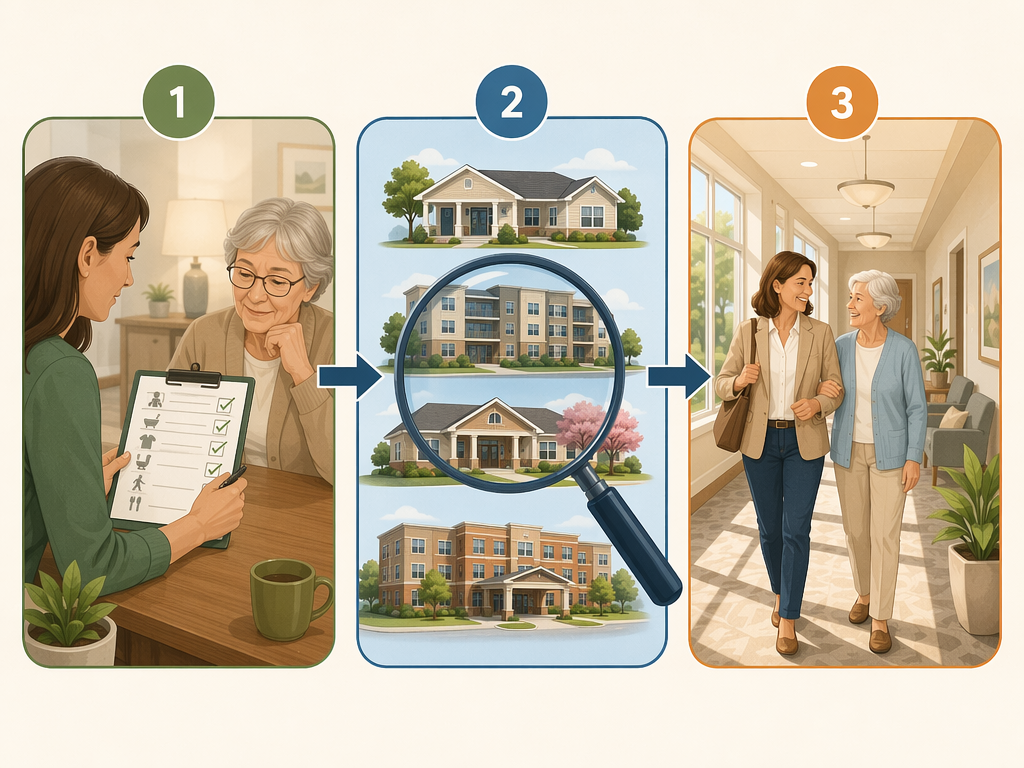
Step 1: Assess Functional Level Using an ADL and IADL Checklist
Before you can match a senior to the right living option, you need an objective picture of their functional abilities. The standard tool for this is the ADL (Activities of Daily Living) and IADL (Instrumental Activities of Daily Living) assessment.
| Domain | Specific Tasks | Sign of Difficulty |
|---|---|---|
| ADLs: Bathing | Getting in and out of the tub or shower, washing all body parts | Skipping showers, fear of water, visible dirt or odor |
| ADLs: Dressing | Putting on and removing clothes, managing buttons and zippers | Wearing the same clothes repeatedly, difficulty with fasteners |
| ADLs: Toileting | Getting to and from the toilet, cleaning oneself | Accidents, soiled clothing, avoiding fluids to reduce bathroom trips |
| ADLs: Transferring | Getting in and out of bed or a chair | Using furniture to push up, needing physical assistance |
| ADLs: Eating | Bringing food to mouth, chewing, swallowing | Weight loss, choking, leaving food untouched |
| IADLs: Medication Management | Taking correct doses at correct times | Missed doses, expired medications, confusion about schedule |
| IADLs: Meal Preparation | Planning and cooking meals | Spoiled food, reliance on microwave meals, weight loss |
| IADLs: Housekeeping | Cleaning, laundry, home maintenance | Clutter, dirt, unpaid bills, broken appliances |
| IADLs: Transportation | Driving or using public transit | New dents on the car, getting lost, giving up driving |
| IADLs: Money Management | Paying bills, budgeting, tracking expenses | Unpaid bills, unusual spending, calls from creditors |
For each task, note whether the senior can perform it independently, needs verbal cueing or supervision, needs hands-on assistance, or cannot perform it at all. A pattern of needing assistance with two or more ADLs, or several IADLs, typically indicates that some form of residential care is appropriate.
Step 2: Explore Option Types by Care Level
Once you have a clear picture of the senior's functional needs, you can match them to the appropriate care setting. The table below summarizes the main option types and the level of need each is designed to serve.
| Option Type | Best For | Typical Resident Profile | Care Services Included |
|---|---|---|---|
| Independent Living | Seniors who need minimal to no help with ADLs but want a maintenance-free lifestyle with social opportunities | Able to live independently; may use a cane or walker; no hands-on care needs | Meals, housekeeping, activities, transportation; no personal care or nursing |
| Assisted Living | Seniors who need help with some ADLs (bathing, dressing, medication) but do not require 24/7 skilled nursing | Average age 87; needs assistance with 1–2 ADLs; may have mild cognitive impairment | Personal care assistance, medication management, meals, activities, 24-hour supervision |
| Memory Care | Seniors with Alzheimer's disease or other dementias who need a secure environment and specialized programming | Moderate to advanced dementia; may wander, exhibit behavioral symptoms, or need assistance with all ADLs | Secure environment, structured activities, behavior management, personal care, 24-hour specialized staff |
| Skilled Nursing / Nursing Home | Seniors with complex medical needs who require 24-hour nursing care and rehabilitation services | Multiple chronic conditions, post-hospital rehabilitation, advanced frailty, need for daily nursing interventions | 24-hour skilled nursing, rehabilitation therapy, wound care, medication management, personal care |
For a deeper comparison of home care versus assisted living, see our guide on Home Care vs. Assisted Living: How to Decide. For a broader overview of all senior housing types organized by mobility level, see Senior Home Living Options Decoded. And if you are unsure whether home care is still sufficient, read When Home Care Isn't Enough.
Step 3: Tour with a Focused Set of Questions
Touring a facility is not the same as visiting a hotel. You are evaluating a potential home and a care provider. The NIA recommends making at least one unannounced visit — ideally during a meal or activity time — to see how the facility operates when it is not expecting guests. Use the following questions as a starting point.
- What is the staff-to-resident ratio during the day and overnight? What is the staff turnover rate?
- What training do staff members receive, especially for dementia care or medication management?
- Is a registered nurse on site 24 hours a day? If not, what is the protocol for medical emergencies?
- Can residents age in place, or are they required to move if their care needs increase?
- What safety features are in place — grab bars, call buttons, backup power, emergency response systems?
- What happens if a resident runs out of money? Does the facility accept Medicaid?
- Can the prospective resident do a trial stay (a few days or weeks) before committing?
- Review the contract carefully. Does it include an arbitration clause? What are the move-out terms?
AARP also recommends checking leadership stability, reviewing organizational charts, and being wary of high-pressure sales tactics. A facility that is reluctant to answer questions or provide written information should raise concerns.
How to Have the Conversation with a Reluctant Parent

For many families, the hardest part of the decision is not the research or the finances — it is the conversation. A parent who has lived in the same home for 40 years may see a move as a loss of independence, a sign of decline, or a betrayal of their identity. Approaching the conversation with empathy and strategy can make the difference between a productive discussion and a painful standoff.
A Conversation Playbook
- Start early and talk often. Do not wait until a crisis. Begin with general questions: "How are you feeling about living here long-term?" or "What would make your life easier?" Multiple short conversations over weeks or months are more effective than one big intervention.
- Frame the conversation around the parent's values, not your stress. Instead of saying "I can't keep driving you to appointments," try "I want you to have more time to enjoy your hobbies instead of worrying about home maintenance." Connect the move to what matters to them — safety, dignity, social connection, staying in control of their own life.
- Use "I" statements to express concern without blame. "I worry about you being alone all day" is less accusatory than "You are isolated." "I would feel better knowing someone is checking on you at night" focuses on your feelings rather than their deficits.
- Involve them in the process. Ask which communities they would like to visit. Bring them on tours. Let them choose between two or three options rather than presenting a single decision. Maintaining a sense of control is critical for a positive transition.
- Avoid ultimatums. Statements like "You are moving whether you like it or not" almost always backfire. Instead, present the evidence you have gathered (the ADL assessment, the doctor's recommendation, the fall history) and ask for their perspective. The goal is shared decision-making, not unilateral action.
- Acknowledge the loss. Moving out of a long-term home is a genuine loss, even when the new setting is objectively better. Validate your parent's feelings: "I know this is hard. You have built a life here. It makes sense that you would feel sad about leaving." Validation does not mean agreeing to stay — it means respecting the emotional weight of the decision.
Cost Reality Check: What You Need to Know Before You Tour
Cost is often the most intimidating part of the senior living decision, but having a realistic financial picture before you tour prevents the shock of discovering later that a preferred community is out of reach. The following figures are national medians; actual costs vary significantly by state and region.
| Care Type | National Median Monthly Cost (2026) | Source |
|---|---|---|
| Independent Living | $3,200 | A Place for Mom |
| Assisted Living | $5,419 | A Place for Mom |
| Memory Care | $6,690 | A Place for Mom |
| Nursing Home (Semiprivate Room) | $9,842 | SeniorLiving.org |
| Nursing Home (Private Room) | $11,294 | SeniorLiving.org |
| Home Care (20 hours/week) | $2,944 | A Place for Mom |
Questions to bring to a clinician or OT
This is not medical, legal, or a family's final decision — only a framework. Bring these questions to a clinician, occupational therapist, or your local Area Agency on Aging.
Find Local HelpRelated reading
- Where to Start When Your Aging Parent Needs Help: A 5-Step Triage Framework for New Caregivers
- When Is It Time for a Senior Citizen Home? 11 Signs It's Time to Consider Residential Care
- The Cost of Waiting: What It Really Costs Families — in Money, Choice, and Wellbeing — to Delay the Elderly Housing Decision
Noticed something outdated or inaccurate on this page? Flag a correction. We review every report against CDC, NIA, and AARP HomeFit guidance before updating a page.