
Caregiver decision guide
When Home Care Isn't Enough: How to Know When a Senior Needs More Than In-Home Caregiver Services
Many families continue paying for escalating in-home care past the point where assisted living becomes more cost-effective and safer. This guide helps you recognize the hidden cost threshold, safety red flags, social isolation indicators, and caregiver burnout signals that suggest it's time for a higher level of care.

The Hidden Cost Threshold: When Home Care Costs More Than Assisted Living
Most families assume that keeping a parent at home is always the less expensive option. That assumption holds true when care needs are light — a few hours a week for grocery shopping, transportation to appointments, or light housekeeping. But as needs escalate, the math flips, and it flips quietly because no one talks about the crossover point.
According to A Place for Mom's 2026 cost data, the national median rate for non-medical in-home care is $34 per hour. At 44 hours per week — roughly the point where a senior needs someone present for most of the waking day — monthly home care costs reach $6,478. The same source reports that the median monthly cost of assisted living is $5,190. That means at 44 hours of weekly care, home care is approximately $1,288 more expensive per month than a facility that provides 24/7 staffing, three meals a day, social programming, and medication management.
The crossover point typically falls between 35 and 45 hours of paid care per week, depending on local labor rates and facility pricing. Below that threshold, home care is usually cheaper. Above it, the financial equation reverses — and families who do not recalculate regularly can spend thousands of dollars more per month than necessary.
| Weekly Home Care Hours | Monthly Home Care Cost ($34/hr) | Monthly Assisted Living Cost (Median) | Which Is More Expensive? |
|---|---|---|---|
| 7 hours | $1,031 | $5,190 | Assisted living costs ~$4,159 more |
| 15 hours | $2,208 | $5,190 | Assisted living costs ~$2,982 more |
| 30 hours | $4,416 | $5,190 | Assisted living costs ~$774 more |
| 44 hours | $6,478 | $5,190 | Home care costs ~$1,288 more |
| 60 hours (24/7) | $8,840 | $5,190 | Home care costs ~$3,650 more |
This table uses A Place for Mom's $34/hr home care rate and $5,190/mo assisted living median. If your local home care rate is higher (state medians range from $25 to $44 per hour), the crossover happens at even fewer hours. The key takeaway: if your parent requires more than 35 hours of paid care per week, run the numbers for your specific area before automatically renewing a home care arrangement.
Safety Red Flags That Intermittent Care Cannot Address
Cost is only one dimension of the decision. Even when home care is still financially viable, safety concerns can make a facility setting the safer choice. Some risks simply cannot be managed by a single caregiver who is present for only part of the day.
Escalating Fall Risk Despite Supervision
A home care aide can assist with transfers, clear pathways, and remind a senior to use a walker. But falls often happen in the moments between care visits — during the 2 a.m. bathroom trip, the 15 minutes the aide is in the kitchen preparing lunch, or the hour between shifts. If your parent has had two or more falls in the past six months despite having home care, the current level of supervision is insufficient. Assisted living and nursing homes have staff available 24/7, with call buttons in every room and scheduled check-ins that reduce the window of unsupervised time to minutes rather than hours.
Dementia-Related Wandering and Agitation
Wandering is one of the most dangerous behaviors associated with dementia, and it is notoriously difficult for a single in-home caregiver to manage. A person who wanders may exit the home within seconds — while the caregiver is in the bathroom, on the phone with a doctor, or preparing a meal. Memory care units are designed with secured exits, alarmed doors, and wandering paths that allow residents to move safely. If your parent has attempted to leave the home unaccompanied, or if you have had to install additional locks or alarms, the home environment may no longer be safe even with paid care.
Medication Errors from Complex Regimens
Home care aides can remind a senior to take medications, but they cannot administer them unless they are licensed nurses. If your parent's medication regimen has grown to include multiple daily doses, insulin injections, or medications that require timing adjustments based on vital signs, the risk of error increases significantly. Assisted living communities have licensed staff who manage medication administration as part of the monthly fee. Nursing homes provide the highest level of medication oversight, with nurses on duty around the clock.
Kitchen and Fire Safety Hazards
Forgetting to turn off the stove, leaving food burning, or misusing appliances are common early signs of cognitive decline that home care may not fully address. An aide can prepare meals during their shift, but what happens during the hours they are not there? If your parent has left the stove on, caused a small kitchen fire, or shown confusion about how to use appliances, the home environment presents a daily fire risk that a facility's kitchen staff and fire suppression systems are designed to handle.
- Two or more falls in six months despite home care
- Attempted wandering or exiting the home unaccompanied
- Complex medication regimen requiring licensed oversight
- Stove left on or kitchen fire incident in the past year
- Hospitalization or ER visit related to a preventable home accident
Social Isolation: When Companion Care Isn't Enough
Many families add companion care services specifically to combat loneliness. A companion can play cards, go for walks, or simply be present in the home. But companion care, even at 20 or 30 hours per week, cannot replicate the social structure of a community designed for older adults.
Social isolation in older adults is linked to depression, cognitive decline, weight loss, and a higher risk of mortality. When a senior lives alone with a companion who comes and goes, the social interaction is still limited to one person, and it is contingent on a paid relationship. In assisted living and memory care, social engagement is built into the environment: communal dining for every meal, scheduled activities and exercise classes, game nights, holiday celebrations, and the simple daily interaction of passing neighbors in the hallway.
- Weight loss or poor appetite despite having meals prepared
- Expressing loneliness or saying "I have no one to talk to" even with a companion
- Withdrawing from activities they previously enjoyed
- Sleeping excessively during the day
- Decline in personal hygiene or grooming despite assistance
If your parent has a companion caregiver but still shows signs of depression or social withdrawal, the issue is not the quality of care — it is the structure of the environment. A community setting provides a baseline level of social interaction that is difficult to replicate in a private home, regardless of how many hours of companion care are scheduled.
Caregiver Capacity: When Family Burnout Threatens the Entire Arrangement
Even when paid home care is in place, family caregivers — usually adult children or spouses — still provide a significant number of unpaid hours. The Johns Hopkins Bloomberg School of Public Health study published in Health Affairs (February 2025) found that family caregivers of older adults with dementia provide an average of 31 hours of care per week — up nearly 50% from 21.4 hours in 2011. That is the equivalent of a part-time job on top of paid work, childcare, and the emotional labor of managing a parent's decline.
The NAC/AARP Caregiving in the US 2025 report paints a stark picture of the toll: nearly half of all family caregivers report at least one negative financial impact, including taking on debt, depleting short-term savings, or being unable to save for retirement. Half of working caregivers experience impacts on their employment, and 24% provide 40 or more hours of care per week — a full-time job worth of unpaid labor.
The Aging in Place Readiness Checklist is a practical tool for assessing whether both the home environment and your own capacity as a caregiver are sustainable for the long term. If the checklist reveals gaps in either area, it may be time to consider a higher level of care.
- You have missed work, reduced your hours, or turned down promotions because of caregiving responsibilities
- You have used up short-term savings or taken on debt to pay for home care
- Your own health has declined — you are sleeping poorly, skipping doctor appointments, or experiencing chronic stress symptoms
- You feel resentful, trapped, or guilty about your caregiving role
- You have had arguments with siblings or your spouse about care decisions
When family caregiver capacity is exhausted, the entire home care arrangement becomes fragile. A single health crisis for the caregiver — a heart attack, a stress-induced illness, a mental health breakdown — can collapse the system overnight. Moving a parent to a higher level of care before that crisis happens is an act of foresight, not abandonment.
Home Care vs. Assisted Living vs. Memory Care vs. Nursing Home: A Comparison
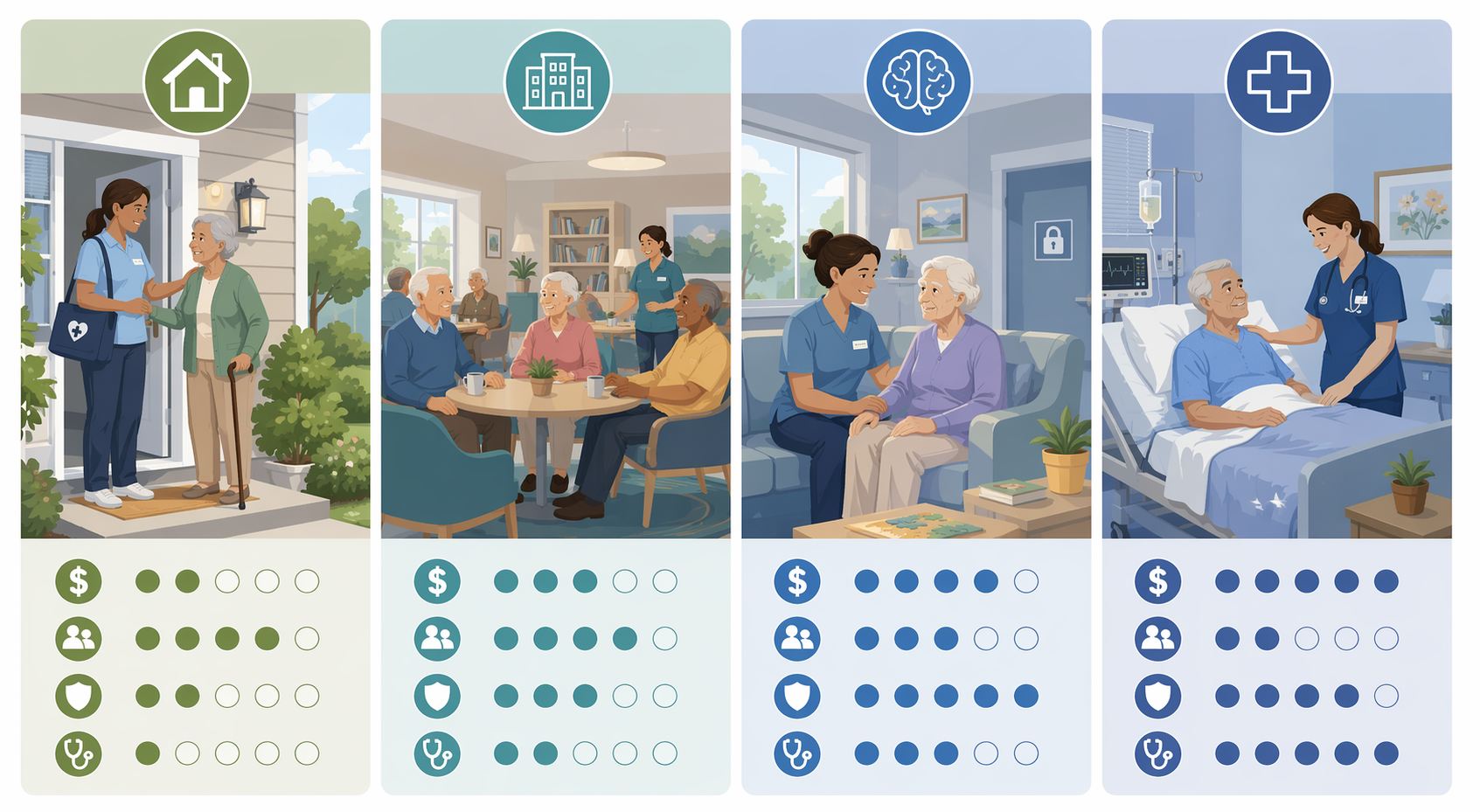
Once you recognize that home care may no longer be sufficient, the next question is: which type of facility is the right fit? The answer depends on the senior's medical needs, cognitive status, and social preferences. The table below compares the four most common options across the dimensions that matter most for decision-making.
| Dimension | Home Care | Assisted Living | Memory Care | Nursing Home |
|---|---|---|---|---|
| Monthly cost (national median) | $1,031–$8,840 (varies by hours) | $5,190–$6,200 | $6,000–$8,000+ | $9,581 (semi-private) – $10,798 (private) |
| Staff availability | Intermittent (scheduled hours) | 24/7 staff on site | 24/7 specialized dementia-trained staff | 24/7 licensed nursing staff |
| Medical oversight | Limited to non-medical care; RN/LPN available at higher cost | Medication management; nurse on site during business hours | Medication management; dementia-specific care plans | Full skilled nursing; on-site physicians available |
| Social engagement | Dependent on companion; limited to one-on-one | Built-in: communal dining, activities, events | Structured dementia-appropriate activities | Limited; varies by facility |
| Meals | Prepared by aide or meal delivery | Three meals daily in communal dining | Three meals daily with dementia-appropriate supervision | Three meals daily; therapeutic diets available |
| Safety and security | Home hazards remain; no 24/7 monitoring | Call buttons, secured entrances, staff patrols | Secured wandering paths, alarmed exits, dementia-safe design | Hospital-grade safety; bed alarms, fall prevention protocols |
| Independence | Highest — senior remains in familiar environment | Moderate — private apartment with support as needed | Moderate — structured environment with secure freedom | Low — medical model; shared or private rooms |
For a deeper exploration of how to match your parent's specific needs to the right care setting, see our guide Home Care vs. Assisted Living vs. Memory Care: How to Match Care to Your Loved One's Needs. That article provides a more detailed framework for evaluating which option aligns with your parent's current functional level and medical requirements.
A Decision Framework: Questions to Ask and Assessment Tools to Use
Making the decision to move a parent from home care to a higher level of care is rarely straightforward. The following framework is designed to help you and your family work through the key dimensions systematically. Answer each question honestly, and use the answers to guide your next conversation with a geriatric care manager, primary care physician, or the facilities you are considering.
Safety Assessment
- Has your parent fallen more than once in the past six months, even with home care in place?
- Has your parent attempted to leave the home alone or become lost while outside?
- Has there been a kitchen fire, stove left on, or other safety incident in the past year?
- Is your parent's medication regimen too complex for a non-medical caregiver to manage safely?
Health and Functional Assessment
- Has your parent lost weight unintentionally or shown a decline in appetite?
- Is your parent having difficulty with two or more activities of daily living (bathing, dressing, toileting, transferring, eating)?
- Has there been a noticeable decline in cognitive function — memory, judgment, or orientation to time and place?
- Has your parent been hospitalized or visited the ER in the past six months?
Social and Emotional Assessment
- Does your parent express loneliness, boredom, or a desire for more social interaction?
- Has your parent withdrawn from hobbies, television, or phone calls with family?
- Does your parent seem depressed, anxious, or apathetic most of the time?
Caregiver Capacity Assessment
- Are you or other family members experiencing burnout — exhaustion, irritability, declining health, or resentment?
- Has caregiving affected your ability to work, maintain relationships, or care for your own health?
- Have you taken on debt or depleted savings to pay for home care?
- Is there a plan in place if you become ill or unable to provide care?
How to Transition Without Guilt: Making the Move from Home Care to a Higher Level of Care
The emotional weight of transitioning a parent from home to a facility is often heavier than the financial or logistical considerations. Guilt is the most common emotion families report — guilt that they did not do enough, guilt that they are "giving up," guilt that they are prioritizing their own well-being over their parent's preference to stay home.
It may help to reframe the decision: you are not moving your parent out of their home because you have failed. You are moving them because their needs have changed, and the home environment — even with paid care — can no longer meet those needs safely. The guilt belongs to the situation, not to you.
- Involve your parent early. Visit communities together before a crisis forces the decision. Let them see the social activities, the dining room, and the private apartment. Familiarity reduces fear.
- Frame the move positively. Instead of "you need more care than we can provide," try "this community has activities and friends waiting for you, and I will visit often."
- Acknowledge the loss. Your parent is losing their home, their routines, and their independence. Validate that grief. Say "I know this is hard, and I am sorry you have to go through this."
- Plan the transition gradually. If possible, start with short stays — a week of respite care — before committing to a permanent move. This allows both you and your parent to adjust.
- Give yourself permission to feel relief. It is normal to feel relieved when the 24/7 worry of keeping your parent safe at home is lifted. Relief does not mean you do not love them.

For families who are not yet ready for a full transition but want to explore additional in-home interventions first, our article Beyond the Binary Choice: The Layered Home Intervention Path to Senior Care offers an alternative perspective on how to layer additional services — overnight care, adult day programs, or technology monitoring — before making a permanent move.
Questions to bring to a clinician or OT
This is not medical, legal, or a family's final decision — only a framework. Bring these questions to a clinician, occupational therapist, or your local Area Agency on Aging.
Find Local HelpRelated reading
- Is It Time? A Practical Framework for Assessing When an Elderly Parent Needs Home Assistance
- A Complete Guide to In-Home Care Options for Seniors: Services, Costs, and How to Choose
- ACASA Senior Care vs. Visiting Angels vs. Comfort Keepers vs. Home Instead: How to Choose Between National Franchise Home Care Providers
Noticed something outdated or inaccurate on this page? Flag a correction. We review every report against CDC, NIA, and AARP HomeFit guidance before updating a page.