
Caregiver decision guide
Help for Elderly and Disabled in 2026: What the Budget, ACL Restructuring, and Medicaid Cuts Mean for Families
The 2026 budget bill funds key aging programs but leaves OAA nutrition flat, the Administration for Community Living faces restructuring, and Medicaid cuts loom. This article explains what changed, what's at stake, and how family caregivers can prepare.

The 2026 Budget Bill: What It Funds and What It Leaves Out
On February 3, 2026, after a brief government shutdown, Congress passed and the President signed the 2026 budget bill. For family caregivers and the older adults they support, the bill is a mixed document — it extends several critical programs through 2027 and beyond, but it also leaves the core nutrition program for seniors flat-funded at a time when need is climbing.
The Older Americans Act (OAA) Nutrition Program, which funds Meals on Wheels and congregate meal sites, received $1.059 billion — the same level as the previous year. Ellie Hollander, president of Meals on Wheels America, called the funding a "missed opportunity." The concern is not abstract: the National Council on Aging (NCOA) estimates that 9 million older adults are eligible for but not receiving benefits they qualify for, and poverty among older adults has held at 15% for the third consecutive year.
The broader context makes the funding gap starker. Research from NCOA and the LeadingAge LTSS Center at UMass Boston found that older adults with the fewest financial resources die, on average, nine years earlier than their wealthiest peers. Programs like home-delivered meals, transportation assistance, and caregiver support are not conveniences — they are lifelines that directly affect health outcomes and longevity.
What's Funded: Key Programs Extended or Continued Through 2026 and Beyond
Despite the flat nutrition funding, the 2026 budget bill does extend or continue a wide range of programs that directly support older adults and people with disabilities. The table below summarizes the major provisions, their funding status, and their expiration dates.
| Program / Service | Funding Status | Duration |
|---|---|---|
| OAA Title III Supportive Services & Home-Delivered Meals | Flat-funded at $1.059 billion | FY 2026 |
| OAA Falls Prevention Programs | Continued | FY 2026 |
| MIPPA (Medicare Improvements for Patients and Providers Act) Premium Assistance | Funded | Through end of 2027 |
| Telehealth Flexibilities (Medicare & broader access) | Extended | Through end of 2027 |
| Long-Term Care Ombudsman Program (LTCOP) | Continued | FY 2026 |
| Adult Protective Services (APS) & Elder Justice | Continued | FY 2026 |
| Caregiver Support Programs (Title III-E) | Continued | FY 2026 |
| Senior Community Service Employment Program (SCSEP) | Continued | FY 2026 |
| Hospital-at-Home Program | Extended | Through 2030 |
| Area Agencies on Aging (AAAs) & Aging and Disability Resource Centers (ADRCs) | Funded | Through 2027 |
| Medicare Part D Coverage of Oral Antivirals | Continued | Through Dec. 31, 2026 |
| Grants for Home Modifications for Low-Income Seniors | New funding | FY 2026 |
| Transportation Services for Older Adults | Continued | FY 2026 |
For a detailed breakdown of each major federal and state program — including eligibility criteria, application processes, and benefit amounts — see our comprehensive guide to government benefit programs for seniors.
ACL Restructuring and HHS Layoffs: What the Proposed Changes Mean for Aging Services
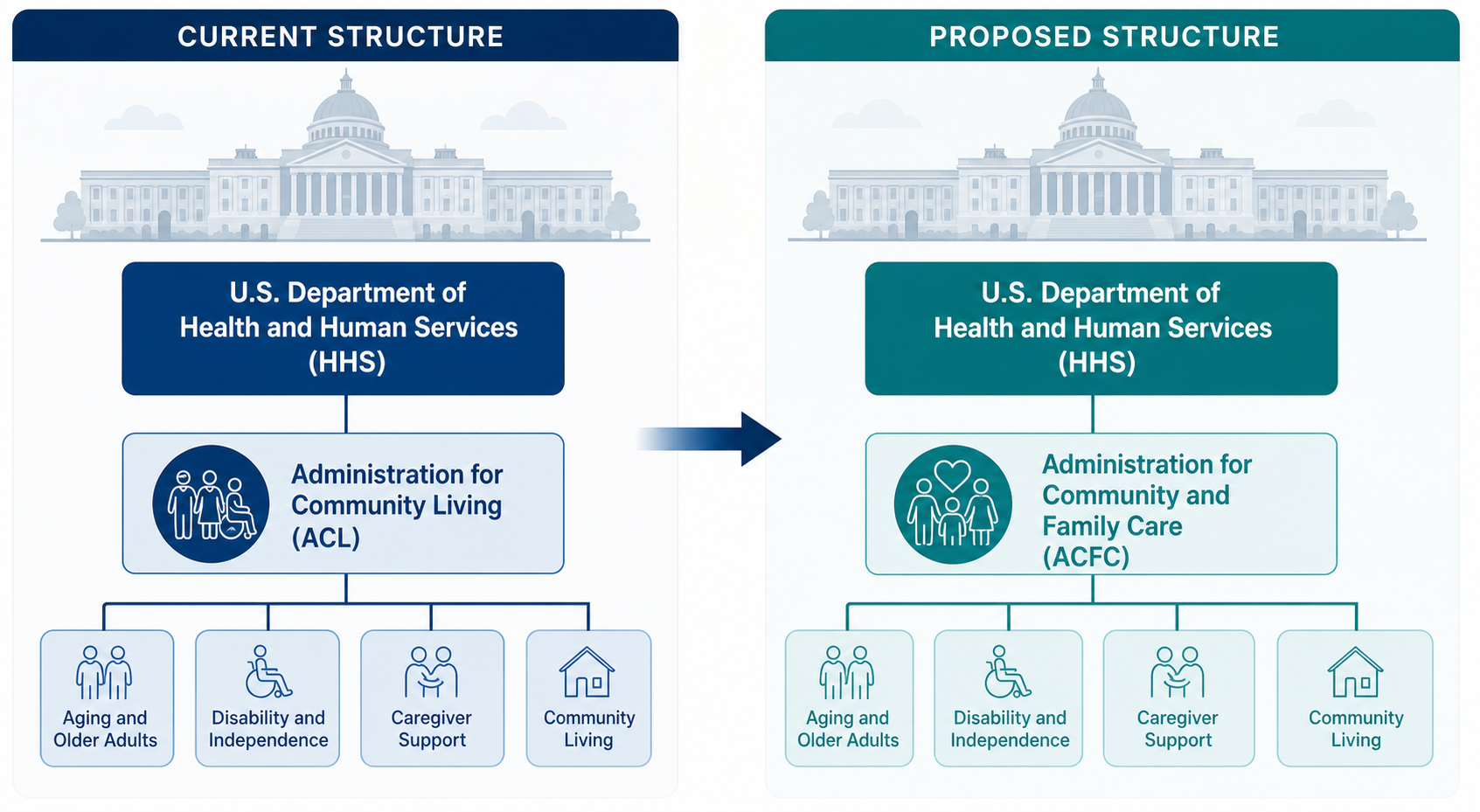
Beyond the budget bill, a separate but equally consequential change is underway: the Trump administration has proposed dissolving the Administration for Community Living (ACL) and integrating its functions into a newly established Administration for Children, Families, and Communities (ACFC) within the Department of Health and Human Services (HHS). This restructuring comes alongside layoffs of 10,000 HHS employees, according to a KFF brief published in June 2025.
ACL is the federal agency that administers the Older Americans Act, including the nutrition, caregiver support, falls prevention, and elder justice programs listed above. It also oversees the State Health Insurance Assistance Programs (SHIPs), which provide free counseling to Medicare beneficiaries. The proposed restructuring creates significant uncertainty about how these programs will be administered going forward.
The practical effect for families is hard to predict, but the pattern is clear: an agency that coordinates services for millions of older adults is being reorganized at the same time its workforce is being reduced. For caregivers who rely on SHIPs for Medicare enrollment help or on their local AAA for caregiver support referrals, the near-term risk is slower response times and reduced capacity.
The Medicaid Context: Cuts That Could Reshape Access for Older Adults and People with Disabilities
The most significant downstream risk for older adults and people with disabilities comes not from the budget bill or ACL restructuring, but from the 2025 reconciliation law's Medicaid cuts. The Congressional Budget Office (CBO) projects that these cuts will increase the uninsured population by 7.5 million people by 2034.
Older adults and people with disabilities are disproportionately affected. According to KFF, they represent 1 in 5 Medicaid enrollees but account for over half of Medicaid spending due to higher per-person costs for long-term care, home health, and institutional services. When Medicaid funding is cut, states face pressure to restrict eligibility, reduce benefits, or both — and this population is the most expensive to cover.
A KFF survey conducted in March 2026 provides a snapshot of the current state-level landscape before any cuts take effect:
| Medicaid Pathway or Policy | Number of States (incl. DC) | Key Detail |
|---|---|---|
| States with optional eligibility pathways for people 65+ or with disabilities | 51 (all states + DC) | Every jurisdiction has at least one optional pathway |
| States offering an optional income-related pathway | 50 (all except Alabama) | Allows higher income limits for 65+/disabled |
| States offering Medicaid Buy-In for working adults with disabilities | 47 | Allows people with disabilities to work and keep Medicaid |
| States offering optional coverage for people using long-term care | 50 (all except Montana) | Covers nursing home and home- and community-based services |
| States that increased personal needs allowances for institutional care in 2025 | 13 | Washington had the largest increase: from $42 to $109/month |
| States that added a new home care eligibility pathway in the last year | 1 (New Hampshire) | New pathway for people using home care |
The personal needs allowance increase in Washington state — from $42 to $109 per month — is a rare bright spot. Most states have not adjusted these allowances in years, leaving nursing home residents with minimal funds for personal items. But 13 states did act in 2025, suggesting some awareness of the issue at the state level.
What This Means for Families: Service Gaps, Increased Reliance on AAAs, and the Importance of Acting Early
Taken together, these three policy developments — flat OAA funding, ACL restructuring, and Medicaid cuts — create a challenging environment for family caregivers. Here is what they mean in practical terms:
- Longer waitlists for meals, transportation, and caregiver support. Flat funding for OAA programs means that as demand rises, local AAAs and meal providers will have to stretch the same dollars further. If your parent currently receives Meals on Wheels or uses senior center transportation, expect service reductions or eligibility tightening.
- Increased reliance on Area Agencies on Aging. With federal programs under strain, AAAs become the default safety net. But they are funded through the same OAA budget that is flat-funded. More demand with the same resources means longer wait times for caregiver assessments, support groups, and benefit enrollment help.
- Higher out-of-pocket costs for home care and institutional care. If states respond to Medicaid cuts by restricting optional eligibility pathways, more older adults will need to pay for home care, assisted living, or nursing home care out of pocket. For a detailed comparison of what each type of care actually costs and how to pay for it, see our Senior Help Services Cost Guide.
- Reduced access to Medicare counseling. SHIPs, which provide free, unbiased Medicare enrollment and claims help, are administered by ACL. The restructuring and layoffs may reduce SHIP capacity just as the Medicare Annual Enrollment Period approaches.
- Greater risk for the most vulnerable. The NCOA/LeadingAge finding that older adults with fewest resources die nine years earlier is a stark reminder that policy cuts do not affect everyone equally. Those already struggling to afford food, medicine, and housing will bear the brunt of service reductions.
The 15% poverty rate among older adults — now sustained for three consecutive years — underscores that this population has very little financial cushion. When programs are cut or flat-funded, the margin for error disappears.
Action Steps for Caregivers in 2026: How to Navigate an Uncertain Policy Landscape
Uncertainty does not mean helplessness. The following steps can help you prepare for potential disruptions and protect your parent's access to care:
- Apply for benefits early. If your parent may qualify for Medicaid, Supplemental Security Income (SSI), SNAP, or Medicare Savings Programs, do not wait. If states begin restricting eligibility pathways, those who have already been determined eligible are likely to be grandfathered in. Delaying could mean losing access entirely.
- Contact your local Area Agency on Aging. AAAs are the front door to OAA-funded services. Call them to ask about current waitlists for home-delivered meals, caregiver support, and transportation. If services are already strained, you can plan alternatives now rather than scrambling later.
- Check your state's personal needs allowance and Medicaid Buy-In options. If your parent is in a nursing home or considering one, the personal needs allowance affects how much money they can keep each month. If they are under 65 and have a disability, the Medicaid Buy-In program (available in 47 states) allows them to work without losing coverage.
- Verify current telehealth coverage under your parent's plan. Telehealth flexibilities were extended through the end of 2027, but coverage details vary by insurance plan. Confirm that your parent's provider still offers virtual visits and that their plan covers them, especially if they rely on telehealth for routine checkups or specialist consultations.
- Stay informed about ACL restructuring. The proposed dissolution of ACL into ACFC is not yet final, but it could affect how OAA programs, SHIPs, and the RAISE Family Caregivers Act are administered. Bookmark the ACL website and check for updates quarterly.
- Learn how to navigate the health care system step by step. When programs shift and services become harder to access, knowing the right entry point saves time and frustration. Our guide to navigating the senior health care system walks through how to find the right agency, ask the right questions, and avoid common dead ends.
The 2026 policy landscape is genuinely uncertain, but the direction of travel is clear: federal funding for aging programs is not keeping pace with need, and state-level Medicaid cuts will likely follow. The families who fare best will be those who act early, stay informed, and build relationships with their local AAA and other community resources before a crisis hits.
For a deeper look at the Medicare home health coverage gap and how to plan ahead for out-of-pocket costs, see our guide to the Medicare home health care gap.
Questions to bring to a clinician or OT
This is not medical, legal, or a family's final decision — only a framework. Bring these questions to a clinician, occupational therapist, or your local Area Agency on Aging.
Find Local HelpRelated reading
- The Complete Guide to Government Help for Elderly and Disabled Adults: 8 Major Programs and How to Access Them
- Options for Elderly Care: A Complete Guide to Paying for Home Care, Assisted Living, and Nursing Homes in 2026
- How to Pay for Senior Health Care Services: A Family Guide to Medicare, Medicaid, Private Pay, and Everything in Between
Noticed something outdated or inaccurate on this page? Flag a correction. We review every report against CDC, NIA, and AARP HomeFit guidance before updating a page.