A Room-by-Room Fall Prevention Checklist for Caregivers
all roomsenvironmental📄 PrintableReviewed: 2026-06-29
A Room-by-Room Fall Prevention Checklist for Caregivers
Use this room-by-room fall prevention checklist to systematically identify and fix common hazards in your aging parent's home — from entryways and bathrooms to bedrooms and outdoor steps — with specific fix instructions and cost guidance for each area.
By Editorial Team
bathroom safety
bedroom safety
stair safety
kitchen safety
entryway access
grab bars
non-slip flooring
balance exercises
medication fall risk
home hazard audit
checklist
STEADI
Start at the front door with a pen, a roll of painter's tape, and permission to move one thing at a time. A useful fall prevention handout for seniors should not stop at "make the home safer." It should help you walk through the house, mark hazards, fix the cheap and obvious items first, and know when a Saturday project has crossed into professional territory.
The urgency is real. About one in four older adults falls each year, falls cause 95% of hip fractures, and older adult falls account for about 3 million emergency department visits annually in the United States.[1] More than half of falls happen at home, which is why a room-by-room check deserves the same seriousness as a medication list or a doctor visit.[2]
The CDC's STEADI Check for Safety checklist is a good baseline: it is short, plain, and built around hazards that are often simple to fix.[3] This version goes further for caregivers who are actually standing in the hallway, negotiating about a throw rug, wondering whether a grab bar can go into tile, and trying to decide what must be done today versus what can wait until a contractor or occupational therapist looks at it.
How to Use the Walkthrough
Do the house in order: entry, stairs, living room, kitchen, bathroom, bedroom, hallways, and outdoor areas. In each space, write down the hazard, decide whether it is a quick fix, a purchase, or a professional job, and then leave a visible marker only if your parent is comfortable with that. Painter's tape on a cord or rug edge can be useful; turning the whole house into a crime scene is not.
DIY only when wall support, mounting surface, and instructions are clear
Escalate
Repeated falls, transfer trouble, unclear wall support, tile drilling, major stair defects, rental restrictions
Varies
Healthcare provider, occupational therapist, landlord, or CAPS-informed contractor
For product decisions, it helps to keep one separate list for things to buy and another for things that need a person with tools. A grab bar that is only screwed into drywall is not a safety improvement. A shower chair that does not fit the tub or the person using it is another thing to trip over.
Entryways and Stairs
This is where the house starts making demands: a step up from the porch, a loose mat, a dim bulb, a railing that stops one step too early. Stairs and entries deserve more attention than their square footage suggests because they combine movement, changes in level, weather, packages, keys, and often poor lighting.
Check for handrails on both sides of stairways. The NIA recommends handrails on both sides of stairs, not just the open side.[2] If one side is missing, loose, too low, or difficult to grip, price it as a professional or skilled handyman job unless you already know how the wall is framed.
Stand at the top and bottom of every stairway and test the lighting from the position your parent actually uses. Replace dim bulbs, add switches where practical, and consider motion-sensor lighting for entries. People with vision problems are more than twice as likely to fall, so lighting is not cosmetic work.[2]
Look for loose carpet, polished wood, worn stair edges, or curled tread covers. Nonslip treads are usually a modest purchase, but they must be installed flat and securely. Anything peeling up becomes its own hazard.
Remove shoes, umbrellas, boxes, pet items, plant stands, and seasonal decorations from the walking line. If the entry has no landing place for bags or mail, add a stable table or wall hook outside the path rather than letting things collect on the floor.
Test outdoor mats. If a mat slides, curls, bunches, or catches a toe, replace it with a low-profile nonslip mat or remove it. A mat that protects the floor but endangers the person is doing the wrong job.
Cost can stay low here if the problem is clutter, bulbs, or treads. It rises when the real issue is a missing railing, cracked step, uneven threshold, or poor exterior wiring. Those are not failures of caregiving; they are signs that the house needs someone who installs safety hardware for a living.
Living Room
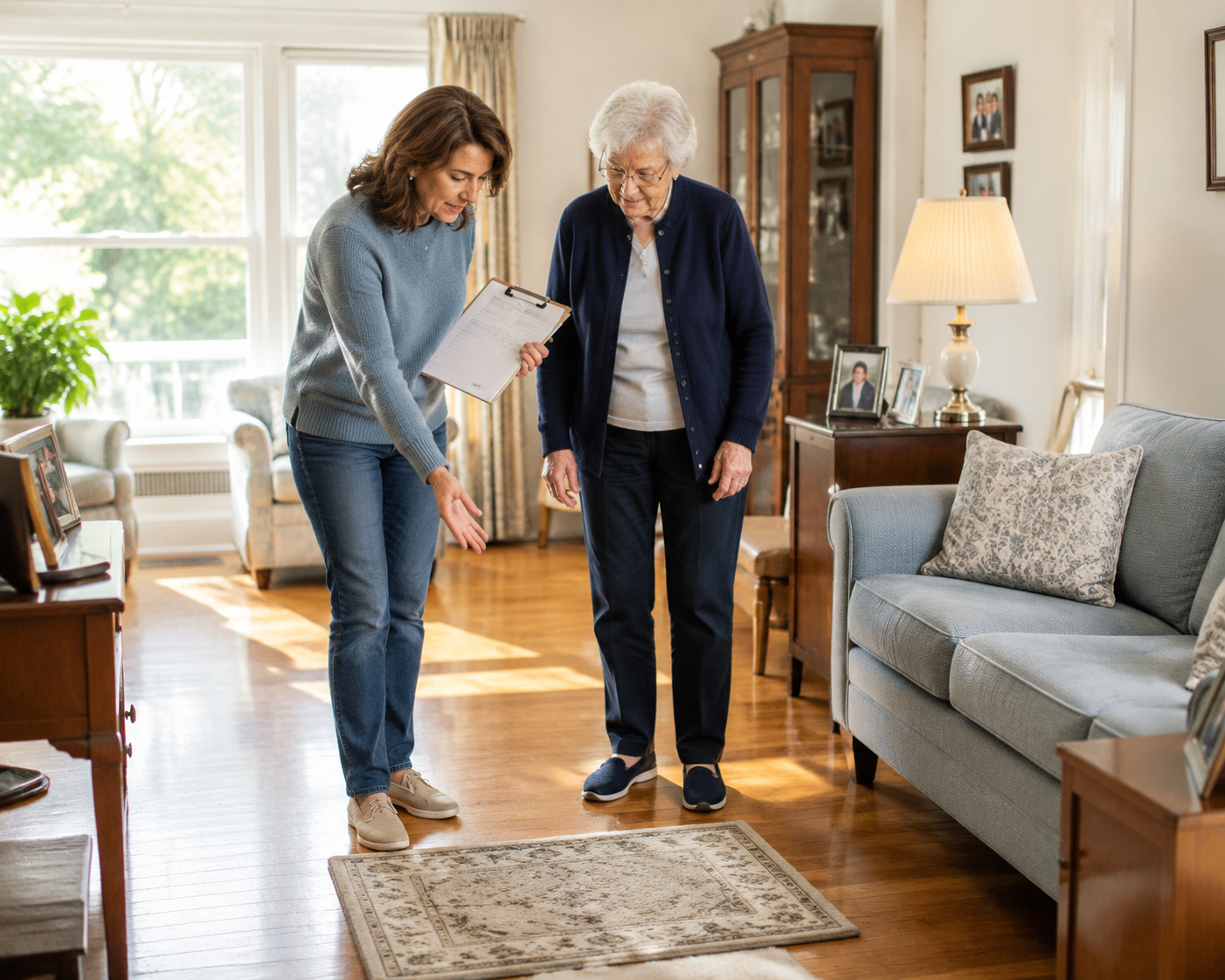
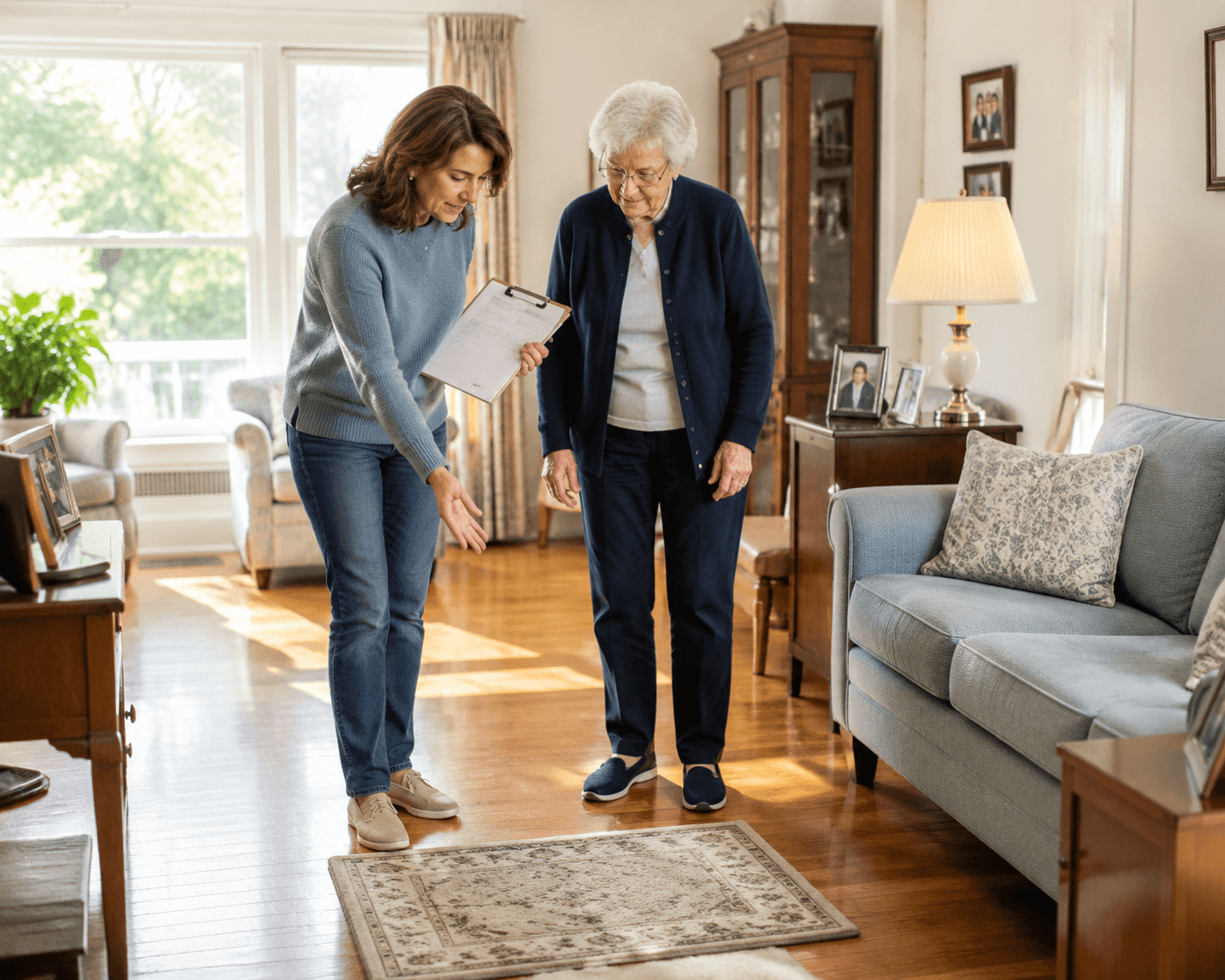
The living room is where "it's always been there" does the most damage. Furniture, cords, magazines, ottomans, and small rugs become invisible to the person who lives with them every day. During the walkthrough, watch the route from the main chair to the bathroom, kitchen, front door, and phone.
Remove throw rugs or replace them with low-profile rugs that have secure nonslip backing. Tape is a temporary compromise, not a permanent plan for a rug that curls or bunches.
Create wide, direct pathways. If your parent has to turn sideways between the coffee table and sofa, the furniture arrangement is asking too much.
Move electrical cords, phone chargers, lamp cords, and extension cords out of walking paths. Run them along walls or behind furniture, and remove extension cords that are being used as permanent wiring.
Check the favorite chair. If it is too low, too soft, or unstable when your parent pushes up from the arms, consider a firmer chair with solid arms before buying extra gadgets.
Improve task lighting near the chair and path lighting toward exits. Mayo Clinic includes removing home hazards and improving lighting among practical fall prevention steps.[4]
This is also the room where dignity matters. Ask what can go before you start carrying things out. If a rug is sentimental, offer a trade: hang it, move it under a heavy table where no one walks, or photograph it before removing it. The safety answer may be obvious; the permission part is still real.
Kitchen
Kitchens create fall risk through reaching, bending, rushing, and wet floors. The goal is to make ordinary tasks boring again: coffee cup, cereal bowl, saucepan, medication organizer, trash bag, and dish towel all reachable without a climb or deep bend.
Move daily-use items between waist and shoulder height. Put holiday platters, extra appliances, and bulk supplies higher or lower instead.
Get rid of unsteady step stools. If a stool is still necessary, choose one with a wide base, nonslip feet, and a handhold, but treat frequent climbing as a storage problem first.
Check for floor mats near the sink. Use a low-profile nonslip mat only if it lies flat and is easy to clean. Remove curled or thick mats.
Keep cleaning supplies within reach for spills. A spill that waits for someone else is a fall hazard with a timer running.
Improve lighting over the sink, stove, and route to the table. Under-cabinet lighting can be a modest purchase if overhead lighting leaves shadows.
Most kitchen fixes cost little unless cabinets, flooring, or electrical work need changing. Start by rearranging storage. It is the least glamorous fix in the house and one of the easiest to complete before dinner.
Bathroom
Slow down in the bathroom. Water, hard surfaces, tight turns, low toilets, tub walls, and privacy all meet in one small room. The bathroom safety after a fall guide summarizes research indicating that bathroom falls are more likely to cause injury than living room falls, with bathrooms accounting for 17% of injurious in-home falls. That does not justify scare statistics that cannot be traced to CDC or NIA sources, but it does justify giving this room extra time.
Grab bars
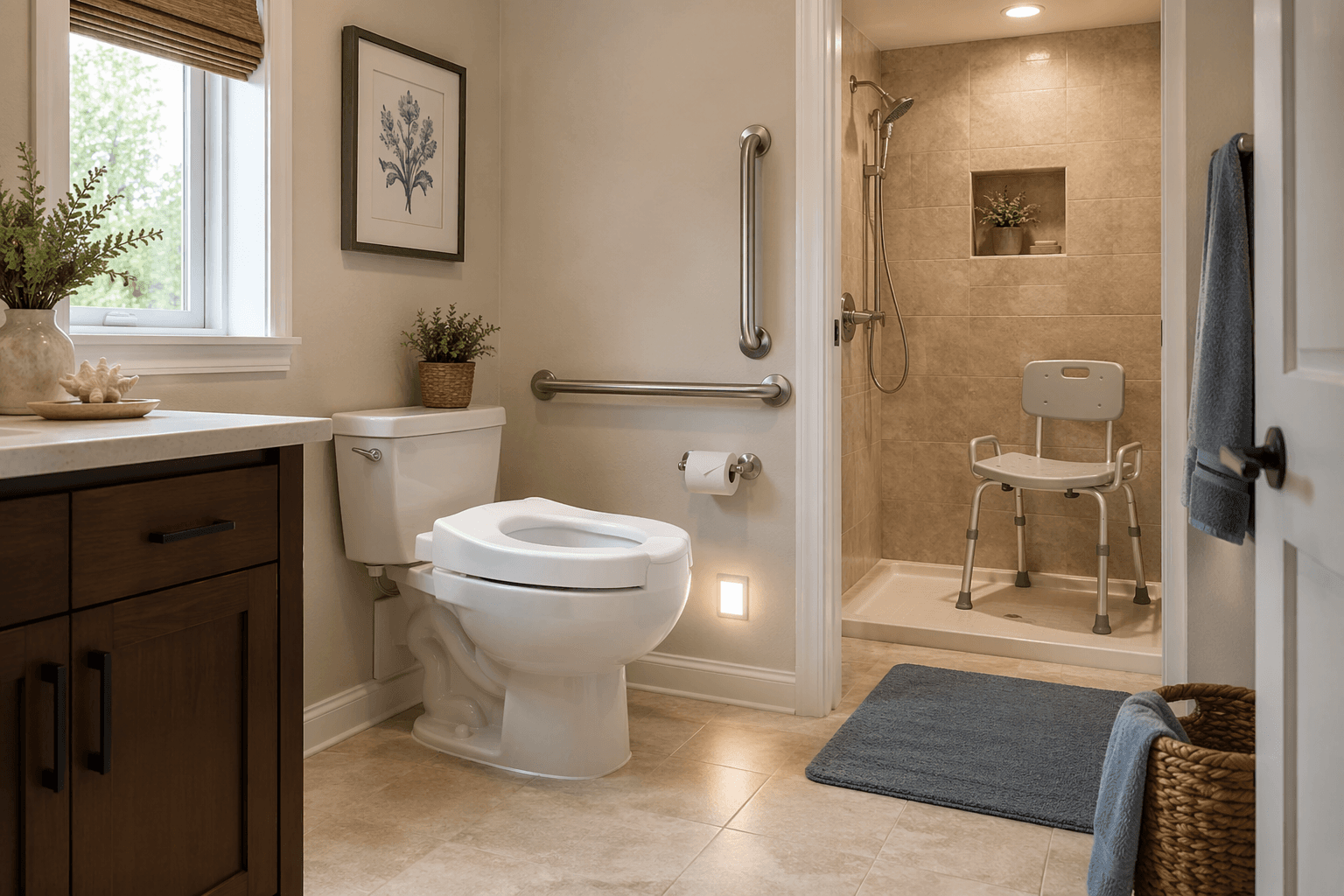
The NIA recommends grab bars near toilets and both inside and outside tubs and showers.[2] That placement matters because the risky moments are not only standing under the water. They include stepping over a tub wall, turning to sit, rising from the toilet, reaching for a towel, and shifting weight with wet feet.
Beside the toilet: install a horizontal or angled bar where your parent can push up and steady themselves without twisting.
At the tub or shower entry: place a bar where it supports the step in and the step out, not where it merely looks balanced on the wall.
Inside the shower: add a vertical or horizontal bar based on the entry style, shower chair position, and how your parent turns.
Do not count towel bars as grab bars. They are not designed for body weight.
Grab bars themselves are often inexpensive, commonly in the rough range of $15 to $50 before installation, but prices vary by region, finish, length, and rating. Installation is the part to respect. If you cannot confirm studs or blocking, if the wall is tile, if the surface is fiberglass, or if your parent pulls hard during transfers, bring in a qualified installer, occupational therapist, or CAPS-informed contractor.
Toilet height and transfers
Watch the sit-to-stand movement without hovering. If your parent drops the last few inches, rocks several times before standing, grabs the towel bar, or reaches for the sink, the toilet area needs help. A raised toilet seat is often a moderate-cost purchase, roughly $30 to $100 depending on height, arms, locking style, and brand. It must attach securely and still allow safe hygiene.
If transfers are already difficult, do not solve this by ordering the tallest seat online. Ask for an occupational therapy evaluation or medical guidance. Too high can be unstable; too low can be exhausting. The right height is the one your parent can use safely with the equipment and support they actually have.
Tub, shower, and floor surfaces
Use nonslip strips or a nonslip mat inside the tub or shower. Check that suction cups hold on the actual surface.
Replace loose bath rugs with low-profile nonslip mats, or remove them entirely if they bunch.
Consider a shower chair if standing to bathe is tiring, balance is uncertain, or your parent rushes because they are afraid of falling. Basic models are often moderate-cost; fit and stability matter more than extras.
Add a handheld showerhead if it lets your parent bathe while seated without twisting or reaching.
Keep soap, shampoo, towels, and clothing within reach from the seated or standing position your parent uses.
For a deeper bathroom-only plan, use Bathing Safety for Seniors alongside the bathroom roadmap. The short version is this: anything involving water, transfers, drilling, or uncertain support deserves more caution than a product listing can provide.
Bedroom
The bedroom test happens in the dark, even if you are doing the walkthrough at noon. Trace the route from bed to bathroom, bed to light switch, and bed to phone. Then imagine it at 2:00 a.m., with socks on, no glasses, and urgency.
Add night lights from bed to bathroom. Motion-sensor lights are useful if switches are hard to reach.
Keep the phone, glasses, hearing aids, walker, cane, water, and lamp within easy reach from bed.
Check bed height. Feet should reach the floor securely when sitting at the edge. If the bed is too high or too low, transfers become harder.
Remove loose rugs, laundry baskets, shoes, storage bins, and extra furniture from the route to the bathroom.
Secure blankets and bed skirts so they do not trail into the walking path.
If your parent has fallen getting out of bed or rushing to the bathroom, write down the time of day, lighting, footwear, urgency, and whether an assistive device was nearby. That note is useful for a clinician or occupational therapist because the fall pattern matters.
Hallways
Hallways should be boring: clear, lit, predictable. They become risky when they collect furniture that did not fit elsewhere, stacks of mail, laundry, or a half-open door that narrows the path.
Remove narrow tables, plant stands, hampers, boxes, and decorative items from walking paths.
Replace dim bulbs and add night lights, especially on the path between bedroom and bathroom.
Check floor transitions between rooms. Raised thresholds, curled carpet edges, and uneven flooring should be repaired or made clearly visible until repaired.
Make sure mobility aids can pass through without catching on furniture or rugs.
Outdoor hazards are easy to postpone because they feel like yard work instead of health work. Do not postpone the route your parent uses for mail, trash, parking, pets, and visitors.
Check steps for cracks, wobble, uneven height, loose boards, worn edges, and missing railings.
Improve porch, garage, and walkway lighting. Test it after dark, not from memory.
Trim shrubs or branches that narrow the walking route or block light.
Look for uneven pavement, lifted concrete, gravel patches, moss, wet leaves, and hoses.
Plan for ice and snow before the first storm. Keep treatment supplies where they can be reached without crossing the slippery area.
A burned-out porch bulb is a caregiver fix. A broken step, missing exterior rail, or buckled walkway is a repair job. If money is tight, document the hazard with photos and measurements so the family can decide what gets funded first.
What to Fix First
Once the walkthrough is marked up, do not treat every item as equal. Start with the hazards most likely to cause a fall this week and the fixes that remove risk without waiting for estimates.
Priority
Fix
Why it comes first
Today
Remove loose rugs, clutter, cords, and blocked pathways
No purchase required, immediate reduction in trip hazards
Today
Clean spills, move daily items within reach, clear bedroom-to-bathroom route
Reduces rushing, reaching, bending, and night walking risk
This week
Add night lights, brighter bulbs, nonslip mats, nonslip stair treads
Low to moderate cost and usually simple to install
This week
Buy properly fitted bathroom equipment if needed
Shower chairs and raised toilet seats can help when matched to the person and space
Installation quality determines whether the fix is actually safe
Discuss with care team
Repeated falls, dizziness, medication concerns, vision issues, transfer problems
The home may be only one part of the fall pattern
The National Council on Aging includes home safety assessment as one of its fall prevention steps, along with broader actions such as talking with healthcare providers and reviewing medications.[5] That distinction matters. A safer house is necessary, but it does not replace clinical fall risk assessment, vision care, medication review, strength and balance work, or evaluation after repeated falls.
Before you leave, sort the notes into four groups: removed today, bought this week, scheduled for installation, and discussed with a clinician. Take photos of anything that needs family approval or a professional estimate. Keep the list short enough that it can actually be finished.
Remove the obvious trip hazards: loose rugs, cords, clutter, unstable mats, and blocked paths.
Improve lighting at entries, stairs, hallways, bathrooms, and the bedroom-to-bathroom route.
Secure the highest-stakes areas: stairs, entryways, bathroom transfers, and shower surfaces.
Address outdoor routes used for mail, trash, parking, and visitors.
Document anything left unresolved, especially installation work, repeated falls, vision concerns, dizziness, or transfer problems.

Comments
Join the discussion with an anonymous comment.