
Clinical term
Independent Living vs. Assisted Living vs. Nursing Home: How to Match Your Parent’s Needs to the Right Level of Care
Why Getting the Level of Care Right Matters More Than Choosing a Specific Facility
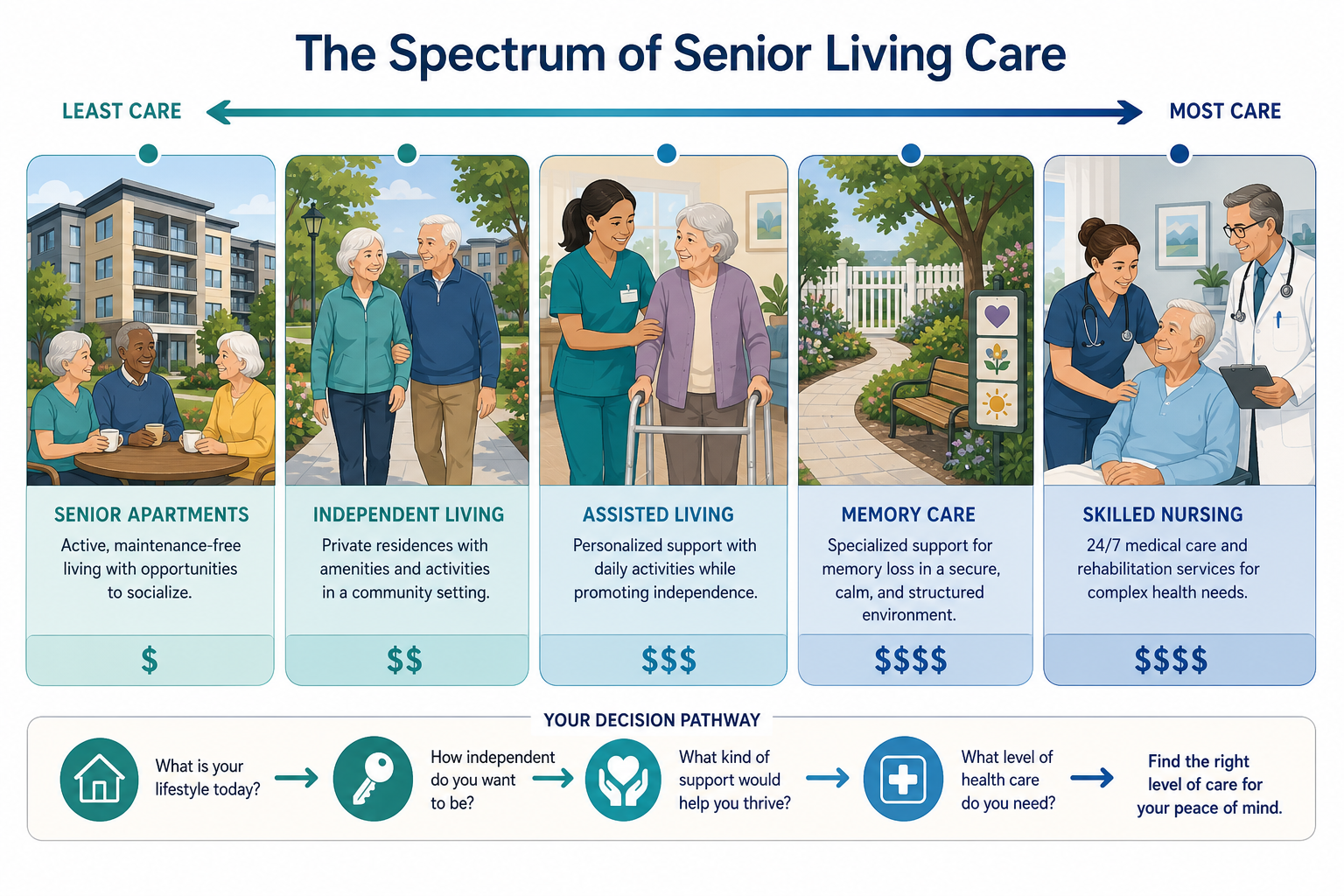
When a parent needs more help than family can provide, the natural instinct is to start touring facilities and comparing amenities. But the most consequential decision you will make is not which building has the nicer dining room or the larger activity calendar. It is whether your parent belongs in independent living, assisted living, memory care, or a skilled nursing facility in the first place.
Choosing the wrong level of care has real, measurable consequences. The median length of stay in assisted living is just 22 months, according to the National Center for Assisted Living (NCAL). A family that places a parent in assisted living when they actually need skilled nursing will face another move — and another transition — within two years. Each move carries risks: falls during the transition period, medication errors from new pharmacy setups, and the emotional toll of uprooting an older adult who has already adjusted to one new environment.
This guide is built around a decision tree, not a facility tour checklist. You will start by assessing your parent's ability to perform activities of daily living (ADLs) and their medical complexity. From there, you will match them to the appropriate level of care — and only then consider which specific community fits best. For a broader survey of all nine care types, see our complete comparison of senior care options.
The Decision Tree: Start with Your Parent's ADL Status and Medical Complexity
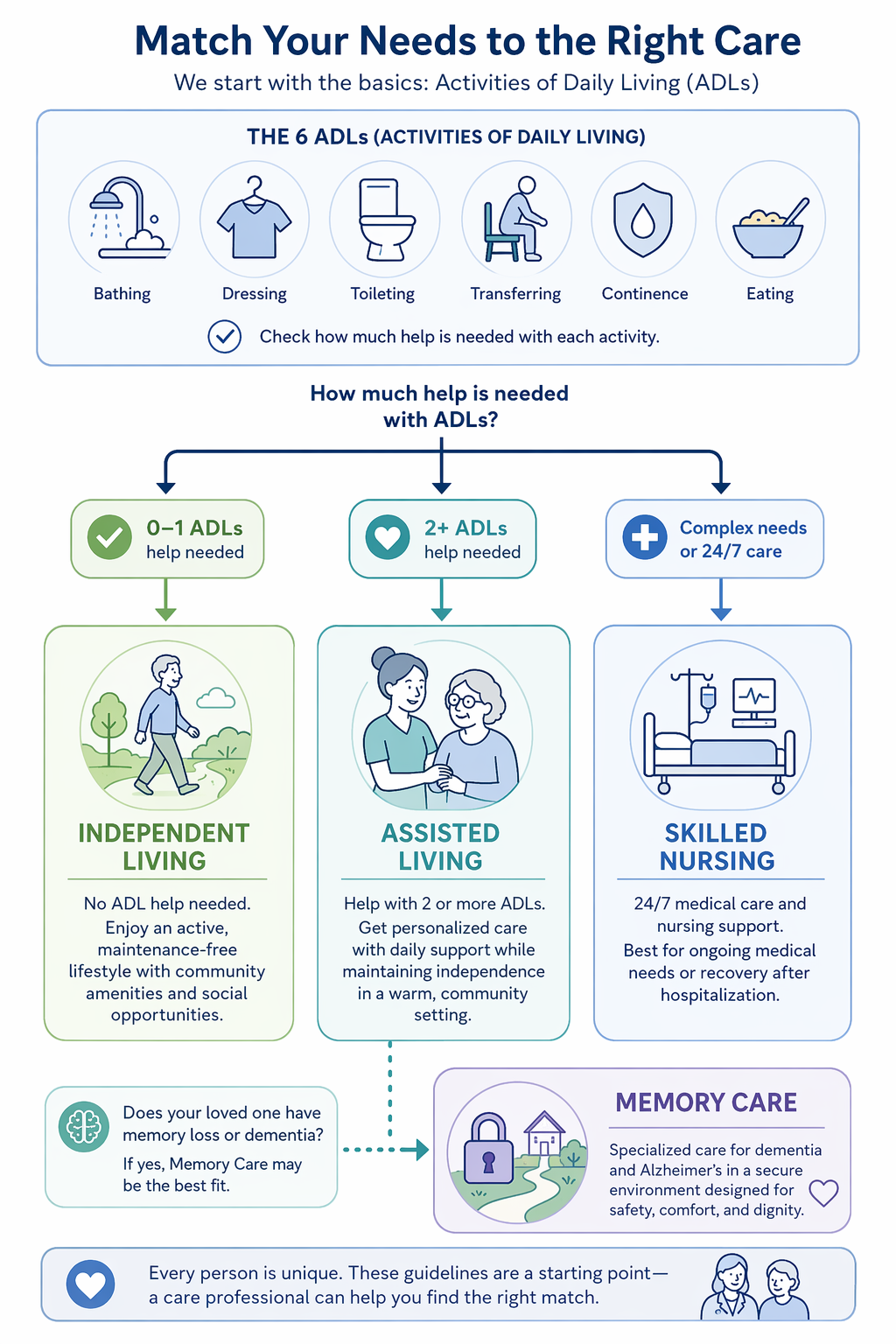
Before you can match your parent to a facility type, you need an honest assessment of two things: their functional status and their medical stability. The six basic ADLs are the standard framework used by clinicians, insurers, and facility admissions teams to determine care needs.
- Bathing — Can they shower or bathe independently, or do they need help getting in and out of the tub, washing hard-to-reach areas, or managing the water temperature?
- Dressing — Can they select appropriate clothing, fasten buttons and zippers, and put on garments without assistance?
- Toileting — Can they get to the toilet, clean themselves, and manage clothing afterward, or do they need help with transfers or incontinence care?
- Transferring — Can they get in and out of bed, a chair, or a wheelchair on their own, or do they need a steady arm or a mechanical lift?
- Continence — Do they have bladder or bowel control, or do they need scheduled toileting reminders, pads, or catheter care?
- Eating — Can they feed themselves, cut food, and drink without choking risk, or do they need help with meal preparation, cutting, or feeding?
Medical complexity is the second axis. A parent with stable chronic conditions — well-controlled hypertension, type 2 diabetes managed with oral medication, mild arthritis — has different needs than a parent with recent hospitalizations, multiple specialists, complex medication regimens, or conditions that require daily nursing assessment like wound care, IV medications, or feeding tubes.
Here is how the two factors combine to point toward the right level of care:
| ADL Status | Medical Complexity | Recommended Level of Care |
|---|---|---|
| Needs no help with any ADL | Stable or well-managed chronic conditions | Independent Living |
| Needs help with 2 or more ADLs (typically bathing, dressing, or medication management) | Stable chronic conditions; no daily skilled nursing needs | Assisted Living |
| Needs help with ADLs and has dementia-related behaviors (wandering, agitation, exit-seeking) | Stable medical condition but requires secured environment and specialized programming | Memory Care |
| Needs help with most or all ADLs, or requires skilled nursing tasks (wound care, tube feeding, IV medications) | Complex, unstable, or post-hospital; requires 24/7 licensed nursing supervision | Skilled Nursing Facility |
Independent Living: For Active Seniors Who Need No Daily Care
Independent living is not a care setting — it is a lifestyle choice for seniors who can manage all of their ADLs independently but want the convenience of a community setting. Residents typically live in private apartments or cottages, have access to shared dining, social activities, and transportation, and do not receive any hands-on personal care.
The national median cost for independent living is approximately $3,000 to $3,239 per month, according to data from the Federal Long Term Care Insurance Program (FLTCIP) and MyLifeSite. This typically covers rent, utilities, one or two meals per day, housekeeping, transportation, and access to community amenities. It does not cover personal care assistance, medication management, or nursing services.
Independent living is the right choice when your parent:
- Can bathe, dress, toilet, transfer, and eat without any assistance
- Manages their own medications accurately and on schedule
- Is socially active but wants a built-in community to reduce isolation
- Wants to stop maintaining a house, yard, or large property
- Has stable health that does not require regular nursing oversight
A common mistake families make is assuming independent living will be sufficient because their parent is still active. If your parent needs help with even one ADL — especially bathing or medication management — independent living will not provide it. You would need to arrange and pay for outside home care services separately, which often costs more than simply choosing assisted living from the start.
Assisted Living: For Seniors Who Need Help With 2+ ADLs but Have Stable Health
Assisted living is the most common entry point for seniors who can no longer manage daily activities independently but do not require round-the-clock medical care. Nearly 800,000 Americans live in assisted living communities, and more than half are aged 85 or older, according to NCAL data cited by SeniorLiving.org.
The assisted living model provides help with ADLs — bathing, dressing, toileting, transferring, and medication management — along with 24-hour staff availability, three meals per day, housekeeping, and social activities. What it does not provide is skilled nursing care: wound care, catheter management, IV medications, or complex medical monitoring. Those belong in a skilled nursing facility.
Costs vary significantly by geography and pricing model. A Place for Mom's 2026 report, based on data from over 24,000 residents who moved into communities in their network in 2025, puts the national median at $5,419 per month. SeniorLiving.org's May 2026 estimates place the median higher at $6,313 per month. The difference reflects different data collection methods and geographic weighting, but both sources agree on the key point: assisted living costs roughly 40% more than independent living and about half the cost of a nursing home.
Most assisted living communities use a tiered pricing model. A nurse conducts an assessment at move-in and again at 30 days to determine the appropriate care tier, as noted by A Place for Mom. Families frequently underestimate the level of help their parent will need during this initial assessment. If your parent requires help with bathing and dressing at home, they will almost certainly need the same level of help — or more — in a new environment where routines are unfamiliar.
The median length of stay in assisted living is 22 months (NCAL). This relatively short duration underscores why getting the level right matters: if your parent's needs are already at the threshold where they require significant help, they may progress to needing skilled nursing within that window. Choosing a community that offers a continuum of care — or at least has a clear transfer relationship with a nearby nursing home — can prevent a disruptive move later.
Memory Care: For Seniors With Dementia Who Need a Secured, Specialized Environment
Memory care is a specialized setting within the senior living spectrum, designed specifically for individuals with Alzheimer's disease or other forms of dementia. It is not a separate regulatory category in most states — memory care units may be licensed as assisted living or as part of a nursing home, depending on state regulations.
What distinguishes memory care from standard assisted living is the environment and the staff training. Memory care units are secured to prevent wandering, with alarmed doors, enclosed outdoor spaces, and layouts designed to reduce confusion and agitation. Staff receive specialized training in dementia care techniques, including how to respond to behaviors like sundowning, repetitive questioning, and aggression. Activities are structured around cognitive stimulation and sensory engagement rather than general social programming.
The cost of memory care typically runs 10 to 15 percent above standard assisted living. Using the A Place for Mom assisted living median of $5,419 per month, that translates to approximately $5,960 to $6,232 per month. SeniorLiving.org estimates the national median for memory care at approximately $6,690 per month.
Memory care is the right choice when:
- Your parent has a confirmed dementia diagnosis and requires a secured environment to prevent wandering or exit-seeking
- Behaviors like agitation, aggression, or sundowning make standard assisted living unsafe or unsustainable
- Your parent cannot follow simple safety instructions or recognize common hazards
- The current caregiver (often a spouse or adult child) is experiencing significant burnout from managing dementia-related behaviors
A common point of confusion is whether a parent with early-stage dementia can start in assisted living and transition to memory care later. Some assisted living communities have designated memory care wings or floors, which makes the transition less disruptive. Others do not, which means the move to memory care requires leaving the community entirely. If your parent has a dementia diagnosis, prioritize communities that offer both assisted living and memory care on the same campus.
Skilled Nursing: For Seniors Who Need 24/7 Medical Supervision and Complex Care
Skilled nursing facilities — commonly called nursing homes — provide the highest level of care outside of a hospital. They are designed for residents who need round-the-clock licensed nursing supervision, complex medical management, or rehabilitation services after a hospitalization.
The cost reflects the intensity of care. According to U.S. News (April 2026), a semiprivate room in a nursing home costs a national median of $9,581 per month, while a private room averages $10,798 per month. A Place for Mom's 2026 data puts the range at $9,277 to $10,646 per month. These figures are roughly double the cost of assisted living.
Skilled nursing is appropriate when your parent:
- Requires skilled nursing tasks that cannot be performed by unlicensed staff — wound care, catheter changes, tube feeding, IV medications, or oxygen management
- Needs 24/7 monitoring for unstable medical conditions, such as heart failure, advanced COPD, or uncontrolled diabetes
- Is recovering from a hospitalization, surgery, or stroke and needs short-term rehabilitation (physical, occupational, or speech therapy)
- Has advanced dementia with significant functional decline and requires total care for all ADLs
One of the most important distinctions between nursing homes and assisted living is regulatory oversight. Nursing homes are federally regulated by the Centers for Medicare & Medicaid Services (CMS), which publishes star ratings for every Medicare- and Medicaid-certified facility through the Medicare Care Compare tool. You can look up inspection results, staffing levels, and quality measures for any nursing home in the country. Assisted living has no equivalent federal database.
CCRCs: One Campus, All Levels — But at a Price
Continuing care retirement communities (CCRCs), also called life plan communities, offer independent living, assisted living, and skilled nursing on a single campus. The value proposition is straightforward: residents can age in place within one community, moving between levels of care as their needs change without the trauma of leaving familiar surroundings and relationships.
The trade-off is the entrance fee. The national average entrance fee for a CCRC is approximately $400,000, according to U.S. News, with AARP citing a figure around $402,000. On top of the entrance fee, residents pay monthly fees that typically range from $3,000 to $5,000, depending on the contract type and the level of care needed.
CCRC contracts fall into three main types:
- Type A (Life Care) — The entrance fee and monthly fee cover unlimited access to all levels of care, including skilled nursing, with little or no increase in monthly costs when moving to a higher level. This is the most expensive contract type but offers the most predictable long-term costs.
- Type B (Modified) — The entrance fee covers a set amount of higher-level care (e.g., 30 or 60 days per year in the skilled nursing unit). After that, residents pay discounted daily rates for additional care.
- Type C (Fee-for-Service) — The entrance fee is lower, but residents pay market rates for assisted living or skilled nursing when they need it. This offers the lowest upfront cost but the least financial predictability.
CCRCs are an excellent option for seniors who are currently independent but want the security of knowing their future care needs are covered on the same campus. They are less suitable for families who cannot afford the entrance fee or who need immediate access to assisted living or skilled nursing without the upfront investment.
Side-by-Side Comparison: Care Levels, Costs, and Key Questions
The following table summarizes the five options across the dimensions that matter most for decision-making. Use it as a quick reference when comparing communities.
| Care Level | Who It Serves | Typical Monthly Cost (National Median) | Regulatory Oversight | Typical Length of Stay | Key Question to Ask on Tour |
|---|---|---|---|---|---|
| Independent Living | Active seniors who need no ADL help | $3,000–$3,239 | State (minimal) | Varies widely (often years) | What happens if I need help with bathing or medications later — can I bring in home care, or do I have to move? |
| Assisted Living | Seniors needing help with 2+ ADLs; stable health | $5,419–$6,313 | State (varies by state) | Median 22 months (NCAL) | How does your tiered pricing work, and what triggers a reassessment? |
| Memory Care | Seniors with dementia needing secured environment | $5,960–$6,690 (10–15% above AL) | State (may be licensed as AL or nursing home) | Varies by disease progression | What specific dementia training does your staff receive, and what is your staff-to-resident ratio during overnight hours? |
| Skilled Nursing | Seniors needing 24/7 skilled nursing or post-hospital rehab | $9,277–$10,798 | Federal (CMS star ratings via Medicare Care Compare) | Short-term: days to months; Long-term: years | What is your CMS star rating, and can I see your most recent state inspection report? |
| CCRC | Seniors who want all levels on one campus; typically enter while independent | $3,000–$5,000 monthly + $400,000 average entrance fee | Varies by level of care within the community | Lifetime (if contract covers all levels) | What type of contract do you offer (A, B, or C), and what percentage of the entrance fee is refundable? |
When to Consider Aging in Place With Home Care as an Alternative
Facility-based care is not the only option. For families who have the financial resources, the physical space, and the willingness to coordinate services, aging in place with home care can be a viable alternative — particularly when needs are moderate and family support is available.
Home care provides assistance with ADLs — bathing, dressing, meal preparation, medication reminders — in the senior's own home. The national median cost for home care is approximately $34 per hour, according to A Place for Mom's 2026 data, which translates to roughly $2,944 per month for 20 hours per week of care. For a parent who needs only a few hours of help each day, home care can be significantly less expensive than assisted living.
However, home care has limitations. It does not provide 24/7 supervision. It does not offer the social engagement and structured activities of a community setting. And the cost escalates quickly as hours increase — if your parent needs 40 or more hours of care per week, the monthly cost can exceed assisted living. For a detailed cost comparison between home care and assisted living, see our guide on live-in caregiver vs. assisted living costs.
Ultimately, the decision between facility-based care and home care comes down to the same framework that governs the rest of this guide: assess your parent's ADL status and medical complexity honestly, consider the financial and logistical realities of your family situation, and choose the level of support that matches their needs — not the one that feels least disruptive in the moment. For a broader view of how care options evolve over a longer caregiving journey, see our stage-aware guide to home care, assisted living, and nursing home options.
Browse more in the Glossary.