
Clinical term
How Much Do Senior Residential Homes Really Cost in 2026? Breaking Down Prices, Payment Models, and Hidden Fees

What Are Senior Residential Homes? A Quick Guide to Facility Types
The term "senior residential homes" is a broad consumer search phrase, not a formal industry classification. It generally refers to any long-term housing option where older adults live in a shared or campus setting with access to meals, personal care, supervision, or medical services. The specific type of facility — and its cost — depends entirely on the level of care provided.
Here are the main facility types you will encounter during your research:
- Independent Living: Designed for seniors who need minimal to no assistance with daily activities. Residents live in private apartments or cottages with access to communal dining, social activities, and transportation. No personal care or medical supervision is included in the base rate.
- Assisted Living: For individuals who need help with activities of daily living (ADLs) such as bathing, dressing, medication management, and mobility. Residents typically have their own apartments and receive 24-hour supervision, meals, and personal care services. As the National Institute on Aging (NIA) notes, assisted living is for people who need more help than independent living but less than a nursing home.
- Memory Care: A specialized form of assisted living for individuals with Alzheimer's disease or other dementias. These units or communities feature secured environments, specially trained staff, and structured programming to manage behaviors like wandering and agitation. Memory care typically costs 10–15% more than standard assisted living.
- Nursing Homes (Skilled Nursing Facilities): Provide the highest level of care outside a hospital, including 24-hour skilled nursing care, rehabilitation services, and medical supervision. Residents often have complex medical needs or require significant assistance with all ADLs. The NIA defines nursing homes as facilities that offer nursing care, 24-hour supervision, and rehabilitation services.
- Board and Care Homes: Small, private residential facilities (typically 20 or fewer residents) that offer personal care, meals, and 24-hour staff supervision. According to the NIA, they do not provide nursing or medical care. They are often more affordable than larger assisted living communities and can feel more like a family home.
- Continuing Care Retirement Communities (CCRCs): Also known as life care communities, CCRCs offer a full continuum of care on one campus — from independent living to assisted living to skilled nursing. Residents typically pay a large upfront entrance fee plus ongoing monthly fees. The NIA describes CCRCs as offering independent housing, assisted living, and skilled nursing care on one campus.
National Cost Benchmarks for 2026: All Facility Types at a Glance
Before diving into state-by-state variation, it helps to understand the national landscape. The table below compiles 2026 cost data from multiple authoritative sources. Note that the figures vary depending on whether the source tracks actual resident moves, posted rates, or survey data — we have cited each source's methodology so you can interpret the numbers with appropriate context.
| Facility Type | National Median Monthly Cost (2026) | Source & Methodology |
|---|---|---|
| Independent Living | $3,200 | A Place for Mom (based on 24,000+ actual resident moves in 2025) |
| Assisted Living | $5,419 – $6,313 | A Place for Mom ($5,419, actual moves); SeniorLiving.org ($6,313, May 2026 survey); NCAL ($6,200, industry data) |
| Memory Care | $6,690 | A Place for Mom (actual moves) |
| Nursing Home (Private Room) | $10,965 | Genworth/CareScout 2025 data (cited by A Place for Mom and SeniorLiving.org) |
| Nursing Home (Semi-Private Room) | $9,555 | Genworth/CareScout 2025 data (cited by A Place for Mom and SeniorLiving.org) |
| Board and Care Home | $3,500 – $6,000 (estimated) | Limited national data; costs vary widely by state and services included |
To put these numbers in perspective, the average Social Security benefit as of January 2026 is approximately $2,071 per month, according to SeniorLiving.org. That covers only about one-third of the median assisted living cost — a gap that underscores the importance of understanding payment sources and planning ahead.
Assisted Living Costs by State: 2026 Comparison
Assisted living costs vary dramatically by state — by a factor of roughly 3x from the least expensive to the most expensive. The table below presents data from both A Place for Mom and SeniorLiving.org side by side. Use these figures as planning baselines, not exact quotes. Actual costs within a state can vary significantly by city, neighborhood, apartment size, and the level of care your family member requires.
| State | A Place for Mom Median (2026) | SeniorLiving.org Median (May 2026) |
|---|---|---|
| Mississippi | ~$4,100 | $4,715 |
| Alabama | $4,100 | $4,800 |
| Louisiana | $3,983 | $4,900 |
| Arkansas | ~$4,200 | $5,000 |
| Missouri | ~$4,300 | $5,100 |
| Georgia | ~$4,400 | $5,200 |
| Tennessee | ~$4,500 | $5,300 |
| Texas | ~$4,600 | $5,400 |
| Ohio | ~$4,700 | $5,500 |
| Florida | ~$4,800 | $5,600 |
| Arizona | ~$5,000 | $5,800 |
| California | ~$5,500 | $6,500 |
| New York | ~$6,000 | $7,200 |
| Massachusetts | ~$6,500 | $7,800 |
| Vermont | $7,885 | $8,500 |
| District of Columbia | $8,960 | $9,500 |
| Alaska | ~$10,000 | $10,819 |
| Hawaii | ~$11,000 | $12,000 |
The geographic pattern is clear: the ten least expensive states are concentrated in the Southeast, while seven of the ten most expensive states are in the Northeast. This reflects regional differences in real estate costs, labor markets, and state regulatory environments.
How Pricing Models Work: All-Inclusive, Tiered, and À La Carte
The base rent you see on a facility's website is rarely the full picture. Senior residential communities use three primary pricing models, and understanding which one a facility uses is essential to comparing costs accurately.
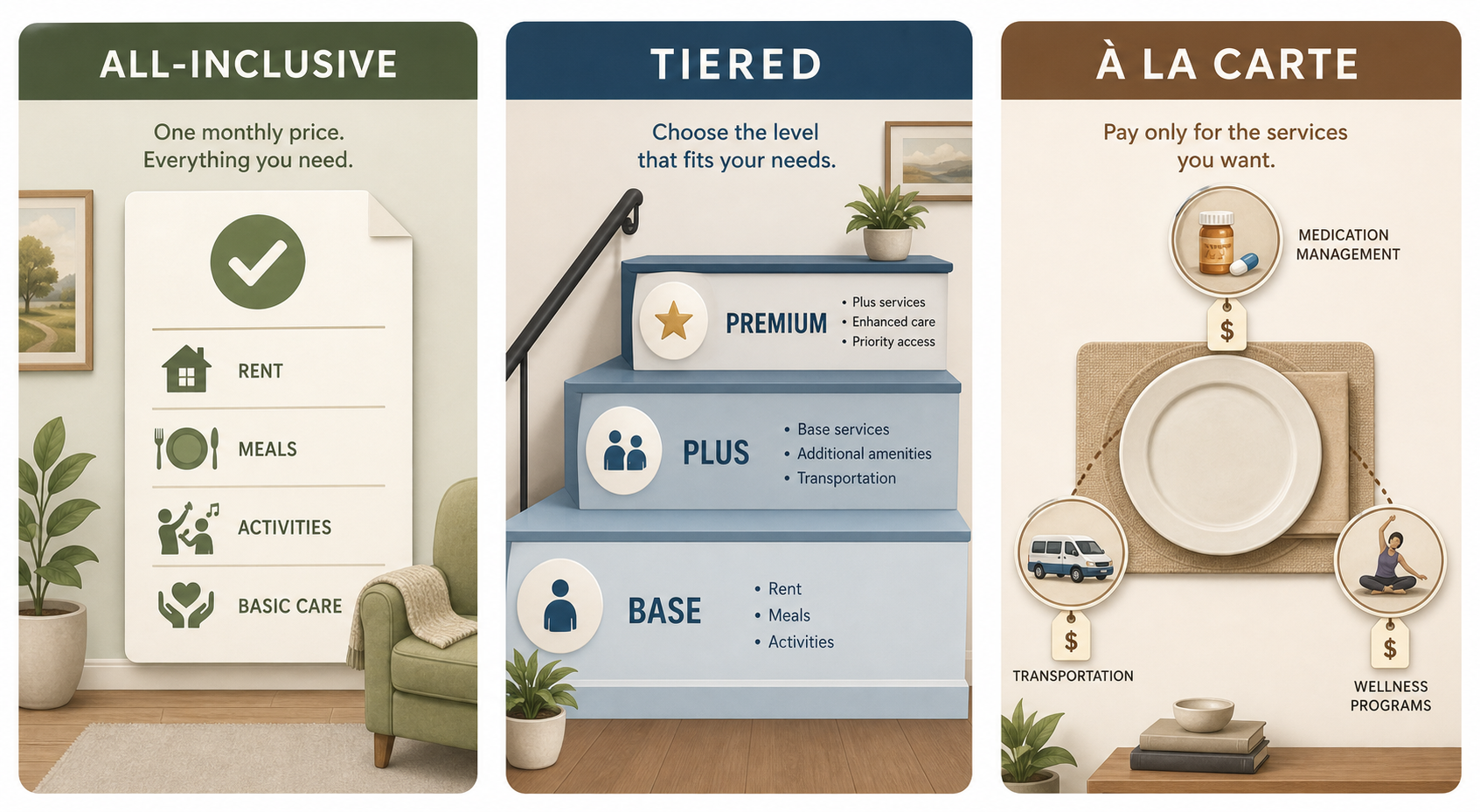
- All-Inclusive: A single flat monthly fee covers rent, meals, utilities, housekeeping, and a defined set of personal care services. This model offers predictability — you know exactly what you will pay each month. However, it may include services your family member does not need, and it may not cover specialized care like dementia management or skilled nursing.
- Tiered (Levels of Care): The facility offers two to four predefined care packages (e.g., Level 1, Level 2, Level 3), each at a different price point. Residents are assessed upon move-in and periodically reassessed. As care needs increase, the resident moves to a higher (more expensive) tier. This model is common in assisted living and memory care. For a deeper dive into how tiered pricing works specifically in assisted living, see our guide to assisted living levels of care and tiered pricing.
- À La Carte: A low base rent covers housing and basic amenities (meals, activities, utilities). All personal care services — medication management, bathing assistance, incontinence care, escorting to meals — are charged separately as add-ons. This model can appear affordable at first glance, but costs can escalate quickly as care needs increase.
Key questions to ask about pricing models:
- Which pricing model does this facility use?
- What specific services are included in the base rate?
- How are care needs assessed, and how often are they reassessed?
- What is the cost difference between each tier or add-on service?
- Can I get a written estimate of my total monthly cost based on my family member's current care needs?
The Hidden Costs Families Often Miss
The advertised base rate is rarely the full monthly cost. Several common fees can add hundreds or even thousands of dollars to your bill. Being aware of these hidden costs upfront can prevent budget shocks down the road.
| Hidden Cost | Typical Amount | What It Covers |
|---|---|---|
| Second-Person Fee | ~$1,200/month (national median) | Additional charge when a second person (usually a spouse) shares the same unit. This is common in assisted living and independent living. |
| Move-In / Community Fee | ~$3,000 (national median) | One-time, non-refundable fee charged upon move-in. Covers administrative costs, apartment preparation, and sometimes a deposit. |
| Annual Rate Increase | ~5% per year (typical) | Most facilities raise rates annually. A 5% increase on a $5,500/month facility adds $275/month — or $3,300/year — to your costs. |
| Care Level Add-Ons | Varies widely | In tiered or à la carte models, moving from Level 1 to Level 2 care can add $500–$1,500/month. Incontinence care, medication management, and escorting are common add-on charges. |
| Specialized Services | Varies | Physical therapy, occupational therapy, specialized dementia programming, and transportation to medical appointments are often billed separately. |
According to A Place for Mom's 2026 report, costs have been rising approximately 5% per year, as confirmed by industry expert Niki Gewirtz. This means a facility that costs $5,000/month today could cost $6,077/month in three years — a difference of nearly $13,000 over that period.
How to Pay for Senior Residential Care: A Payment Source Breakdown
Most families pay for senior residential care through a combination of sources. Understanding each option — and its limitations — is critical to building a realistic financial plan.
- Private Pay (Out-of-Pocket): The most common payment method. Families use personal savings, retirement accounts, pension income, Social Security benefits, and proceeds from selling a home. According to SeniorLiving.org, the average Social Security benefit as of January 2026 is $2,071/month — covering only about one-third of median assisted living costs.
- Long-Term Care Insurance: Policies purchased before care is needed can cover a portion of assisted living, memory care, or nursing home costs. Coverage varies widely by policy. Most policies have a waiting period (elimination period) before benefits begin, and many have daily or monthly benefit caps.
- VA Aid & Attendance: A tax-free monthly benefit for qualifying veterans and their surviving spouses who need assistance with daily activities. The benefit can be used to pay for assisted living, board and care, or nursing home care. Eligibility is based on service requirements, medical need, and financial need.
- Medicaid HCBS Waivers: Medicaid does not typically cover room and board in assisted living, but Home and Community-Based Services (HCBS) waivers can help pay for personal care services within a residential setting. According to NCAL, 63.8% of Medicaid long-term services and supports (LTSS) spending — $145.9 billion — went to HCBS in FY 2023, up 12.8% from FY 2022. Nearly 1 in 5 assisted living residents (17%) relies on Medicaid for daily services.
- Medicare: Medicare does not cover long-term residential care. It may cover short-term skilled nursing facility stays (up to 100 days) following a qualifying hospital stay, and it covers some home health services. For a detailed explanation of what Medicare does and does not cover, see our FAQ on Medicare and short-term care coverage.
For a comprehensive overview of all payment sources — including state-specific programs, tax credits, and nonprofit assistance — see our guide to paying for senior care in 2026 and our complete guide to elder care assistance programs.
Building Your Affordability Picture: A Framework for Comparing Costs
One of the most useful exercises a family can do is compare their current home-related expenses against the bundled cost of a residential facility. This "affordability calculator" approach reveals the net financial impact and can make residential care more affordable than it first appears.
Step 1: Calculate your current monthly home-related costs.
- Mortgage or rent payment
- Property taxes and homeowners insurance
- Utilities (electricity, gas, water, internet, trash)
- Home maintenance and repairs (average 1–2% of home value per year)
- Groceries and dining out
- Transportation (car payment, gas, insurance, maintenance)
- Home health aide or personal care assistant costs (if applicable)
Step 2: Estimate the total monthly cost of the residential facility.
- Base rent (including the appropriate apartment size)
- Care level or tier cost (based on current needs)
- Second-person fee (if applicable)
- Estimated add-on services (medication management, incontinence care, etc.)
- One-time move-in fee (amortize over expected length of stay)
Step 3: Compare the two totals.
For many families, the bundled cost of a residential facility — which includes housing, meals, utilities, transportation, activities, and personal care — is closer to their current home-related expenses than they expect. The gap is often smaller than the sticker shock of a $5,000/month base rate suggests.
Questions to Ask Every Facility About Pricing Before You Tour
Armed with national benchmarks, state-level data, and an understanding of pricing models and hidden fees, you are ready to evaluate individual facilities. Use the following checklist during your phone calls and in-person visits to ensure you get a complete picture of costs.
- What is your pricing model? All-inclusive, tiered, or à la carte? Can you provide a written breakdown?
- What is included in the base rate? Meals, utilities, housekeeping, laundry, transportation, activities, and personal care services?
- What services cost extra? Medication management, incontinence care, bathing assistance, escorting to meals, specialized dementia programming, physical therapy?
- Is there a second-person fee? If my parent shares a unit with a spouse, what is the additional monthly charge?
- What is the move-in or community fee? Is it refundable? What does it cover?
- How often do rates increase? What was the average annual increase over the past three years? Can you provide it in writing?
- How are care needs assessed and reassessed? Who performs the assessment? How often does it happen? What triggers a reassessment?
- What is your refund and discharge policy? If my family member needs to leave within the first 30 days, do we get any refund? Under what circumstances can the facility ask a resident to leave?
- Do you accept Medicaid? If not, what happens if my family member exhausts their private funds?
For a broader perspective on how senior residential care fits into the full landscape of 2026 options, see our cost reality check on senior care options in 2026 and our guide to long-term care costs and payment pathways.
Browse more in the Glossary.