
Caregiver decision guide
Home Care vs. Home Health Care vs. Private Duty Nursing: A Three-Way Comparison for Families
Many families confuse home care, home health care, and private duty nursing — but these are fundamentally different services with different costs, caregiver qualifications, and insurance coverage. This guide provides a clear three-way comparison to help you match the right service to your loved one's actual needs.
Why the Distinction Between These Three Services Matters
When a parent or spouse begins to need help at home, families often reach for the nearest term they have heard — "home care," "home health care," or "private duty nursing" — and assume they all describe roughly the same thing. They do not. These three service categories sit on fundamentally different parts of the care spectrum, and the consequences of confusing them are not semantic. They are financial and medical.
A family that hires a private duty nurse at $90 per hour when what their loved one actually needs is nonmedical companionship and help with bathing will burn through savings at roughly 2.5 times the necessary rate. A family that assumes Medicare will cover a full-time home health aide for custodial care will discover — often after a hospital discharge — that Medicare explicitly does not pay for personal care when that is the only service needed. And a family caring for a medically complex child or adult who requires ventilator management or IV therapy may not realize that private duty nursing exists as a distinct service category with its own (limited) insurance pathways.
If you are deciding only between home care and home health care for a chronic condition, our two-way comparison article covers that ground. This guide adds a third category — private duty nursing — and provides a full three-way framework so you can match the right service to your loved one's actual needs, avoid costly mismatches, and understand what your insurance will and will not pay for.
The Core Distinction: Nonmedical vs. Medical Care
Before comparing the three service types directly, it is essential to understand the single axis that separates them: whether the service provides nonmedical assistance with activities of daily living (ADLs) or skilled medical care. This distinction determines everything that follows — the caregiver's credentials, the cost, the insurance coverage, and the situations in which each service is appropriate.
The credentialing spectrum for in-home caregivers ranges from informal family members and friends through registered nurses, as described by the National Alliance for Care at Home's CaringInfo program. At the nonmedical end, personal care aides and companions provide help with bathing, dressing, meal preparation, light housekeeping, and companionship. At the medical end, registered nurses (RNs) and licensed practical nurses (LPNs) administer IV medications, manage ventilators, perform complex wound care, and contribute to clinical care plans.
| Service Category | Type of Care | Who Provides It | Typical Credentials |
|---|---|---|---|
| Home Care | Nonmedical | Personal care aides, home care aides, companions, CNAs | Varies by state; on-the-job training or state-specific certification |
| Home Health Care | Skilled medical (part-time/intermittent) | RNs, LPNs, physical therapists, occupational therapists, speech therapists, medical social workers | State licensure; RN (NCLEX-RN), PT/OT/SLP (graduate degree + licensure) |
| Private Duty Nursing | Skilled medical (extended/high-acuity) | RNs, LPNs | Same as home health; often requires higher-acuity clinical competency |
This spectrum is not a hierarchy of quality. A personal care aide who helps your mother bathe and dress every morning is providing a service that a registered nurse is overqualified and overpriced to perform. The question is not which type of caregiver is "better" — it is which type matches the care your loved one actually needs.
Home Care (Nonmedical): What It Includes, Who Provides It, and What It Costs
Home care — sometimes called nonmedical home care, personal care, or companion care — is assistance with the activities of daily living and instrumental activities of daily living that a person can no longer manage independently. It does not include skilled nursing, medical treatment, or therapy.
Typical services include:
- Bathing, dressing, grooming, and toileting assistance
- Mobility assistance (transferring from bed to chair, walking)
- Meal preparation and feeding assistance
- Light housekeeping, laundry, and grocery shopping
- Medication reminders (not medication administration)
- Companionship and supervision for safety
- Transportation to appointments
Home care is provided by personal care aides, home care aides, professional companions, and certified nursing assistants (CNAs). Training and certification requirements vary significantly by state. Some states require formal training and registration; others allow agencies to train aides on the job. The CaringInfo framework notes that CNAs must complete state-specific training and certification, while home care aides may have less standardized requirements.
The national median cost of nonmedical home care in 2026 is $34 per hour, according to A Place for Mom's state-by-state cost analysis. U.S. News, citing the CareScout 2025 Cost of Care Survey, reports a slightly higher national median of $35 per hour for a nonmedical caregiver. At 44 hours per week (roughly full-time), monthly costs range from approximately $6,478 to $6,673 depending on the source. State-level variation is substantial: the same A Place for Mom report shows median rates as low as $25 per hour in Mississippi and as high as $44 per hour in South Dakota.
Typical use cases for home care include an older adult aging in place with gradual functional decline, a person recovering from a hospitalization who needs help with daily tasks but not skilled nursing, a socially isolated senior who needs companionship and supervision, and a family caregiver who needs respite from daily caregiving responsibilities.
Home Health Care (Skilled Medical Care at Home): What It Includes, Who Provides It, and How Medicare Pays
Home health care is skilled medical care provided in the home by licensed professionals. It is a fundamentally different service from home care, and the two are often confused because both take place in the home and both may involve a person who helps with bathing.
Services covered under home health care include:
- Skilled nursing care (wound care, ostomy care, intravenous therapy, medication management, pain control)
- Physical therapy
- Occupational therapy
- Speech-language pathology
- Medical social services (counseling, community resource coordination)
- Home health aide services (personal care like bathing and dressing, but only when the patient is also receiving skilled nursing or therapy)
Home health care is provided by registered nurses, licensed practical nurses, physical therapists, occupational therapists, speech-language pathologists, and medical social workers. Home health aides may provide personal care, but only as part of a plan of care that includes skilled services.
Medicare covers home health services at no cost to the beneficiary when all of the following criteria are met, as defined by Medicare.gov:
- The patient is homebound (leaving home requires considerable and taxing effort)
- A doctor certifies that the patient needs skilled nursing care or therapy on a part-time or intermittent basis
- The care is provided by a Medicare-certified home health agency
- The care is part-time or intermittent — up to 8 hours per day (combined skilled nursing and aide) for a maximum of 28 hours per week, with up to 35 hours per week possible for a short time if medically necessary
Medicare does not cover: 24-hour care at home, home-delivered meals, homemaker services that are not part of the care plan, or custodial or personal care when that is the only care needed. This last point is the most common source of confusion: a home health aide can help with bathing and dressing, but only if the patient is also receiving skilled nursing or therapy. If your loved one only needs help with daily activities and does not need skilled care, Medicare will not pay for that help.
For a deeper explanation of the homebound requirement — which is the most misunderstood Medicare eligibility criterion — see our article on the Medicare homebound rule. For a complete breakdown of what Medicare actually pays for under the home health benefit, see our Medicare home health benefit guide.
Private Duty Nursing: Higher-Acuity Medical Care at Home
Private duty nursing is the least understood of the three service categories, yet it is the most critical for families caring for someone with complex, high-acuity medical needs. Unlike home health care — which is designed for part-time, intermittent skilled care — private duty nursing provides extended, often continuous skilled nursing care for patients whose medical needs exceed what Medicare home health can cover.
Services typically include:
- Ventilator management and respiratory care
- Complex wound care and wound vac therapy
- IV therapy and medication administration
- Tracheostomy care
- Enteral feeding (tube feeding) management
- Seizure management and monitoring
- Post-surgical care for complex procedures
Private duty nursing is provided by registered nurses (RNs) and licensed practical nurses (LPNs). The level of care is comparable to what a patient would receive in a hospital or skilled nursing facility, but delivered at home. The nurse may be present for a full shift (8, 12, or even 24 hours) depending on the patient's needs.
The cost is substantially higher than nonmedical home care. The national median hourly rate for a private duty nurse is $90 per hour according to the CareScout 2025 Cost of Care Survey, as reported by U.S. News. At 44 hours per week, monthly costs reach approximately $17,160. For 24/7 care (168 hours per week), the monthly cost is approximately $65,520.
Insurance coverage for private duty nursing is limited. Medicare generally does not cover extended private duty nursing at home. Medicaid may cover it through home- and community-based services waivers for individuals who meet nursing facility level-of-care criteria, but coverage varies significantly by state. Some private health insurance plans and long-term care insurance policies may cover private duty nursing if it is deemed medically necessary, but prior authorization is almost always required.
Typical use cases for private duty nursing include a medically complex child who requires ventilator management and tracheostomy care, an adult with a traumatic brain injury who needs extended neurological monitoring, a patient with a complex wound that requires daily wound vac changes, and a person receiving IV antibiotics or total parenteral nutrition who cannot manage the infusion independently.
Combination Models: Using Home Care and Home Health Together
Many families discover that their loved one needs both nonmedical home care and skilled home health care simultaneously. This is not a failure of the system — it is a common and appropriate arrangement for patients who have clinical needs that require skilled professionals but also need daily living support that skilled providers do not cover.
Here is how a typical combination model works:
- A Medicare-certified home health agency provides skilled nursing visits (e.g., wound care, medication management) and physical therapy two to three times per week. During those visits, a home health aide may provide personal care (bathing, dressing) as part of the skilled plan of care.
- A privately paid home care agency provides a personal care aide for 20 to 30 hours per week to handle the daily living support that Medicare does not cover — meal preparation, light housekeeping, companionship, transportation, and assistance with bathing and dressing on days when the home health aide is not present.
- The home health agency and the home care agency coordinate the care plan so that the patient receives consistent support without duplication or gaps.
This combination is particularly common after a hospitalization. The patient may need skilled nursing and therapy for a few weeks (covered by Medicare) while also needing daily assistance with activities that Medicare will not pay for. The family pays out-of-pocket for the home care component while Medicare covers the skilled component.
The same principle applies when private duty nursing is involved, though the cost burden is much higher. A family caring for a medically complex child might have a private duty nurse for 8 to 12 hours per day (paid through Medicaid waiver or private insurance) while also using a home care aide for additional supervision and daily living support.
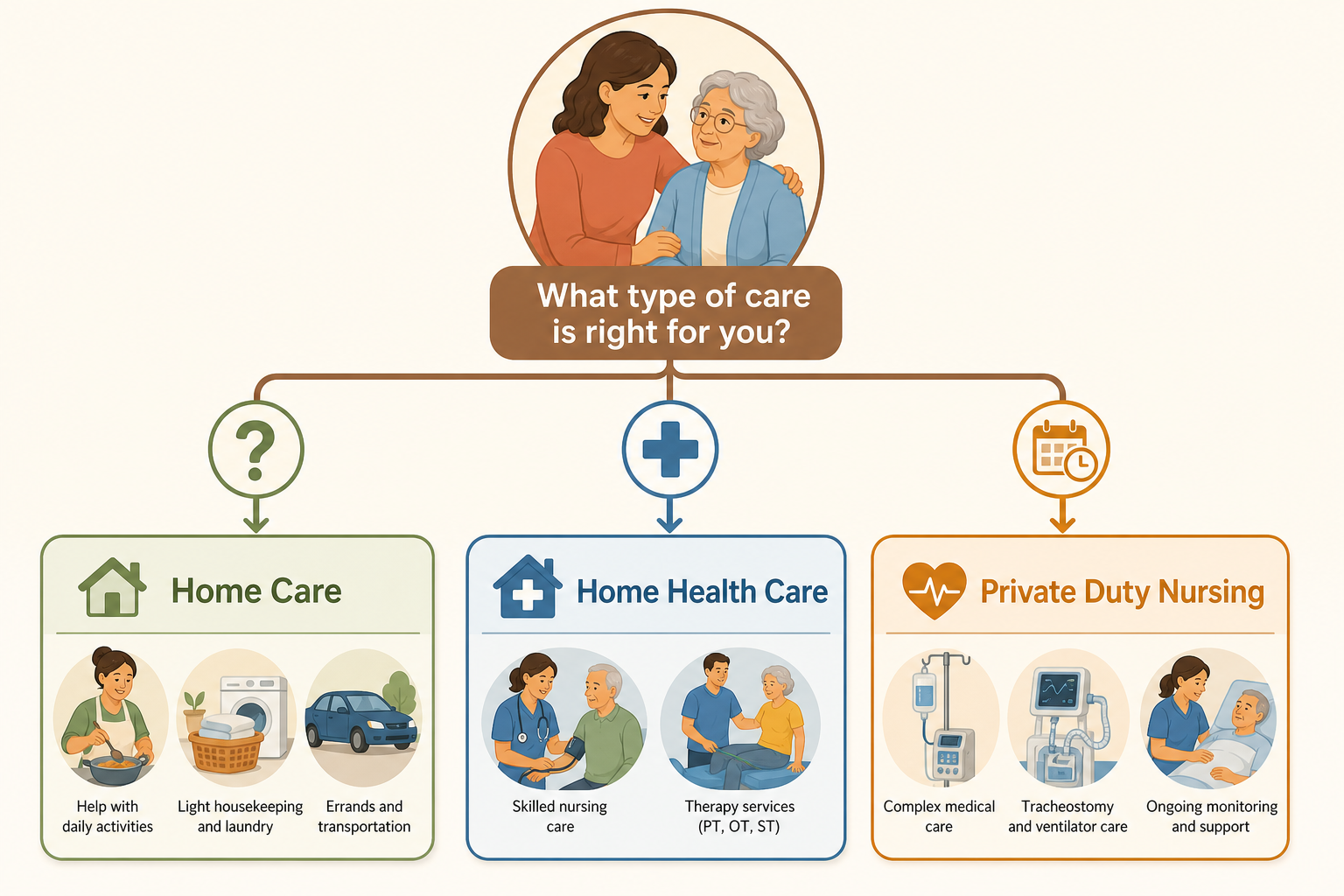
Decision Algorithm: Matching Your Loved One's Needs to the Right Service
The following decision framework can help you identify which service type — or combination of service types — matches your loved one's situation. Work through the questions in order.
- Does your loved one need skilled medical care (wound care, IV therapy, ventilator management, complex medication management, or therapy)?
- If yes: Is the need short-term and part-time (a few hours per day, a few days per week) or extended and high-acuity (full shifts, continuous monitoring)?
- If short-term and part-time: Home health care is likely the right fit. Verify Medicare coverage criteria (homebound, doctor-ordered, part-time/intermittent).
- If extended and high-acuity: Private duty nursing is likely needed. Investigate Medicaid waiver programs, private insurance, or long-term care insurance for coverage.
- If no: Does your loved one need help with activities of daily living (bathing, dressing, toileting, eating), instrumental activities (meal preparation, housekeeping, transportation), or companionship and supervision?
- If yes: Home care (nonmedical) is the appropriate service. Expect to pay out-of-pocket unless Medicaid waivers or long-term care insurance apply.
- If no: Your loved one may not need in-home services at this time. Consider adult day programs, meal delivery services, or other community-based supports.
If your loved one needs both skilled medical care and daily living support, the answer is likely a combination model: home health care (or private duty nursing) for clinical needs plus home care for daily support.
Once you have identified the right service type, our 8-step action plan for setting up home assistance can help you find and evaluate providers, verify credentials, and get services started.
Cost Comparison: Hourly, Weekly, and Monthly Across All Three Service Types
The cost differences between the three service types are substantial and should be a primary factor in your decision. The table below presents the most current national median figures available, drawn from the CareScout 2025 Cost of Care Survey (as reported by U.S. News) and A Place for Mom's 2026 cost analysis.
| Service Type | Hourly Rate (Median) | Weekly (44 hrs) | Monthly (44 hrs/wk) | 24/7 Monthly (168 hrs/wk) |
|---|---|---|---|---|
| Home Care (Nonmedical) | $34–$35/hr | $1,496–$1,540 | $6,478–$6,673 | $25,479 |
| Home Health Care (Skilled) | Covered by Medicare (no cost to beneficiary) | N/A | N/A | N/A |
| Private Duty Nursing | $90/hr | $3,960 | $17,160 | $65,520 |
| Semi-Private Nursing Home (for context) | N/A | N/A | $9,581/mo | N/A |
State-level variation is significant. The A Place for Mom report shows home care rates ranging from $25 per hour in Mississippi to $44 per hour in South Dakota. Private duty nursing rates are likely to vary similarly by region, though state-level data is less consistently reported.
For context, a semi-private nursing home room costs approximately $9,581 per month nationally (CareScout 2025 data). For families needing only 15 to 30 hours per week of help, home care is substantially more affordable than a nursing home. For families needing 24/7 skilled nursing, private duty nursing at home may be comparable to or more expensive than a skilled nursing facility, depending on the level of care required.
What Your Insurance Covers: Medicare, Medicaid, VA, and Private Insurance
Insurance coverage for in-home services varies dramatically by service type and payer. The table below provides a quick-reference overview.
| Payer | Home Care (Nonmedical) | Home Health Care (Skilled) | Private Duty Nursing |
|---|---|---|---|
| Medicare (Original) | Not covered | Covered when criteria met (homebound, doctor-ordered, part-time/intermittent, Medicare-certified agency) | Not covered (generally) |
| Medicare Advantage (Part C) | May offer limited coverage through supplemental benefits | Covered (must meet same criteria as Original Medicare) | May offer limited coverage; varies by plan |
| Medicaid | Covered through HCBS waivers in many states (eligibility varies) | Covered (mandatory benefit; coverage varies by state) | Covered through HCBS waivers for individuals meeting nursing facility level of care (varies by state) |
| VA | Covered through Veteran-Directed Care, Aid and Attendance, and Respite programs | Covered through VA health benefits | May be covered through VA health benefits for qualifying veterans |
| Private Insurance | Rarely covered | May cover skilled home health care; varies by plan | May cover if deemed medically necessary; prior authorization required |
| Long-Term Care Insurance | Often covered (check policy terms) | Often covered (check policy terms) | May be covered (check policy terms) |
For a complete breakdown of what Medicare actually pays for under the home health benefit, see our Medicare home health benefit guide.
Special Considerations: Dementia, Post-Surgery, and Palliative Care at Home
Certain care situations require additional nuance when choosing between service types. Below are three common scenarios where the standard framework may need adjustment.
Dementia Care
For a person with Alzheimer's disease or another form of dementia, the primary need is typically nonmedical home care — assistance with daily activities, supervision for safety, and companionship. However, dementia care requires specialized training that not all home care agencies provide. Caregivers should be trained in dementia communication techniques, behavior management, and safety strategies for wandering and sundowning.
Home health care may be needed if the person with dementia develops a medical condition that requires skilled nursing (e.g., a urinary tract infection, a fall-related injury, or difficulty swallowing). Private duty nursing is rarely needed for dementia alone, but may become necessary in late-stage dementia if the person develops complex medical needs such as feeding tube management or seizure management.
For more detail on matching care types to dementia-specific needs, see our guide on choosing home care for a parent with dementia.
Post-Surgery Transitions
After a hospitalization for surgery (hip replacement, knee replacement, cardiac surgery, etc.), many patients need both skilled home health care and nonmedical home care simultaneously. The home health agency provides physical therapy, occupational therapy, and skilled nursing for wound care and medication management. The home care agency provides daily living support — meal preparation, bathing assistance, transportation to follow-up appointments — that Medicare does not cover.
This is the most common scenario in which families discover that Medicare's home health benefit does not cover custodial care. Planning for the home care component before the hospital discharge can prevent a stressful scramble after the patient arrives home.
Palliative and Hospice Care at Home
Palliative care and hospice care at home involve a different set of services than the three categories discussed above. The Medicare hospice benefit covers an interdisciplinary team (nurse, social worker, chaplain, aide, volunteer) for patients with a terminal prognosis of six months or less. Hospice care includes skilled nursing, personal care, medications related to the terminal diagnosis, medical equipment, and respite care (up to five consecutive days in a facility).
Palliative care, which can be provided alongside curative treatment, may include home health services or private duty nursing depending on the patient's needs. The key distinction is that palliative care is not limited to the homebound or terminal criteria that govern Medicare home health and hospice.
If your loved one is eligible for hospice, the hospice benefit covers a level of in-home support that may reduce or eliminate the need for separately paid home care or home health services. Always ask the hospice provider what services are included before arranging additional paid care.
Questions to bring to a clinician or OT
This is not medical, legal, or a family's final decision — only a framework. Bring these questions to a clinician, occupational therapist, or your local Area Agency on Aging.
Find Local HelpRelated reading
Noticed something outdated or inaccurate on this page? Flag a correction. We review every report against CDC, NIA, and AARP HomeFit guidance before updating a page.