Home Modification Costs for Aging in Place: A Room-by-Room Budget Guide
Planning home modifications for aging in place but unsure about costs? This guide breaks down expenses by room and priority tier, showing how a $200 grab bar or a $2,000 ramp can deliver meaningful safety and why a one-time investment often costs far less than a year of assisted living.
By Editorial Team
new caregiver
experienced caregiver
long-distance caregiving
spousal caregiver
working caregiver
daily routines
medication management
personal hygiene
care coordination
first steps
ADLs
IADLs
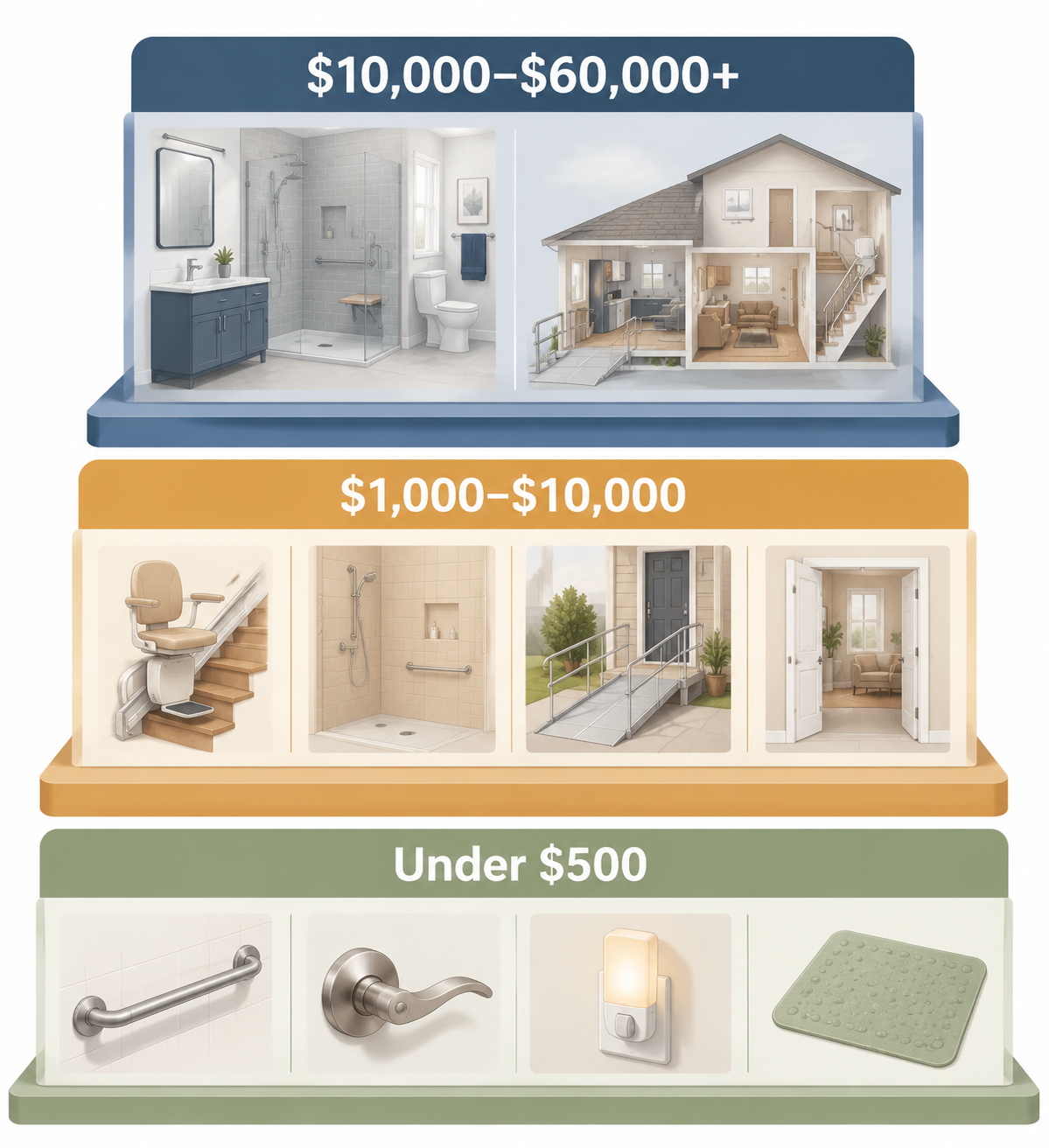
The useful way to price home modifications for aging in place is not to ask for one grand total. That number will either be too vague to plan around or so high that the family freezes. A better first pass is three budget tiers: under $500 for immediate safety fixes, $1,000 to $10,000 for access projects such as ramps and stair lifts, and $10,000 to $60,000+ for major bathroom, entry, or whole-home work. Those ranges come from current cost guides that price common aging-in-place projects differently by scope, home condition, and installation complexity.[1][2][3]
That framework matters because many families do not need to start with a full remodel. A parent who is still walking but unsteady in the bathroom may need $150 to $300 grab bars, better lighting, a handheld showerhead, and a safer entry path before anyone talks about tearing out tile. A parent using a walker may need a ramp, doorway widening, or a shower conversion. A parent who cannot manage stairs may need a stair lift or a serious conversation about whether the bedroom and bathroom can move to the main floor.
For scale, the 2026 national median cost of assisted living is $6,313 per month, or $75,756 per year.[4] That does not mean every home modification plan is cheaper than assisted living, and it does not include recurring in-home care. But it does put a $2,000 ramp, a $6,000 shower conversion, or even a $15,000 package of targeted modifications into a more realistic frame. The point is not to spend as little as possible. It is to spend first where the home is most likely to fail the person using it.
The Three Cost Tiers Families Actually Need
Budget tier
Typical projects
Best use
Under $500
Grab bars, lever handles, handheld showerheads, brighter lighting, motion-sensor night lights, nonslip mats, adhesive treads
Fast safety improvements when mobility is declining but the home still mostly works
Access problems that block daily movement through the home
$10,000-$60,000+
Full bathroom remodels, vertical platform lifts, whole-home modification packages, broader doorway and layout changes
Major structural barriers or multiple rooms that no longer match the person’s mobility
Under $500: fix the obvious hazards first
This is the tier families often underestimate because the items look too ordinary. Installed grab bars are commonly listed around $150 to $300. Lever-style door handles and faucets are often under $50 each. Handheld showerheads run about $30 to $100 before basic installation. Lighting improvements such as brighter bulbs, motion-sensor night lights, and rocker switches can fall around $20 to $200 per room, while nonslip mats and adhesive treads are often $10 to $50.[1]
None of that sounds dramatic. That is the point. A parent who grips a towel bar to get out of the shower does not need a sales pitch about luxury aging-in-place design; they need a properly anchored grab bar. A hallway that is dark at 2 a.m. does not need a remodel before it needs lighting. A knob that requires wrist strength does not need to become a symbol of decline; it can simply be swapped for a lever.
The under-$500 tier is especially useful after a near fall, hospital discharge, or noticeable change in balance. It buys time and reduces immediate friction while the family decides whether larger work is justified. For bathroom-specific details, the existing grab bar installation guide is the right next stop before anyone screws hardware into drywall.
$1,000-$10,000: solve the movement bottlenecks
The middle tier is where aging-in-place costs start to feel like projects instead of purchases. A modular ramp may cost $1,000 to $3,000. A straight stair lift is commonly listed around $2,500 to $8,000. A single widened doorway may run $700 to $2,000. Comfort-height toilets may cost $150 to $600 before installation. Walk-in shower conversions are often listed around $6,000 to $12,000, which can push just above this tier depending on scope.[2]
These projects should be chosen by the parent’s actual movement problem, not by a generic list. If the parent cannot safely get from the driveway into the house, the ramp or entry threshold comes before a prettier bathroom. If the only full bathroom is upstairs and the stairs are becoming dangerous, the stair decision may come before new flooring. If a walker cannot pass through the bathroom doorway, new grab bars alone will not solve the bottleneck.
Stairs deserve special caution because the right answer is not always a stair lift. A straight stair lift may be far less expensive than moving plumbing or building a first-floor suite, but it still requires the user to transfer on and off safely. If stairs are the central problem, compare the lift against main-floor living, rail improvements, and other options in the stair lift decision guide before treating the equipment quote as the whole decision.
$10,000-$60,000+: reserve this for structural barriers
The high-cost tier is real, but it should not be used to scare families away from starting. Full bathroom remodels are listed around $9,000 to $40,000, depending on what is included.[3] Vertical platform lifts are listed around $9,000 to $20,000.[2] Whole-home modification packages can run $15,000 to $60,000+.[1]
Those numbers cover very different scopes. A bathroom project that replaces a tub with a low-threshold shower is not the same as moving plumbing, widening the doorway, changing the flooring, replacing the vanity, and rebuilding the room for wheelchair turning space. A whole-home package in a one-story ranch is not the same problem as a narrow older house with steep stairs, tight bathrooms, and a raised entry. This is why national ranges are useful for orientation but poor substitutes for local quotes.
Spend in this tier when the house itself is blocking safe daily life. If a wheelchair cannot enter the bathroom, if the only shower is inaccessible, if the entrance has steps that cannot be navigated, or if the bedroom-bathroom route is unsafe every day, the larger project may be justified. If the problem is one dark hallway and a slippery tub transfer, start smaller.
Room-by-Room Budget Priorities
Room-by-room planning keeps the family from buying scattered upgrades that do not work together. The question is not “What can we modify?” It is “Where does the parent have to move every day, and where would a failure cause the most harm?”
Bathroom: usually the first serious money question
The bathroom often gets priority because it combines wet surfaces, transfers, privacy, and urgency. A person who can move slowly through the living room may still be at real risk stepping over a tub wall or standing from a low toilet. This is where a $200 grab bar and a $12,000 shower conversion can both be reasonable, depending on the person’s function.
Start under $500 if the person is walking independently but uses walls, towel bars, or the vanity for balance: add anchored grab bars, a handheld showerhead, nonslip surfaces, and better lighting.
Move into the $1,000-$10,000 range if the tub transfer is unsafe, the toilet is too low, or a walker cannot fit comfortably through the approach.
Consider the $10,000+ range if the room needs a full layout change, plumbing movement, a curbless or low-threshold shower, or wider access for wheelchair use.
Bathroom spending also needs a family-readiness check. Some parents accept a handheld showerhead but resist visible grab bars because the hardware feels like an announcement that they are becoming frail. That resistance does not make the hazard disappear. It does mean the family may need to choose finishes that blend in, explain the change as a normal home upgrade, and avoid turning the bathroom into a medical-looking space unless function truly requires it.
If dementia is part of the bathing problem, structural changes may not be enough. The issue may include fear, sequencing, privacy, water temperature, or caregiver approach. In that case, pair the physical plan with guidance on bathing a parent with dementia rather than assuming a new shower solves the whole routine.
Entryway: the home has to be reachable first
The entryway is easy to overlook until the parent stops leaving the house. Steps from the driveway, a high threshold, loose exterior railings, poor porch lighting, or a narrow landing can turn every appointment into a production. A modular ramp at $1,000 to $3,000 may be a better early investment than interior upgrades if the parent is already avoiding outings because getting in and out is too hard.[2]
Not every entry needs a ramp. Sometimes the first purchase is lighting, a second handrail, repair of an uneven walking surface, or a threshold transition. But if a walker, wheelchair, or transport chair is now part of daily life, the entrance should be priced before cosmetic interior work. A beautiful bathroom does not help much if the parent cannot safely come home from the doctor.
Stairs: price the transfer, not just the equipment
A straight stair lift quote can look straightforward beside the cost of remodeling a first floor, but the equipment only works if the person can use it safely. They have to sit, position themselves, ride, stand, and continue moving at the top and bottom. If there is a walker on only one level, someone also has to solve how mobility equipment is available on both floors.
For some homes, a stair lift in the $2,500 to $8,000 range is the practical middle path.[1] For others, the better investment is moving the bedroom to the main floor, adding a half-bath improvement, or making one level fully usable. The cost question is really a daily-route question: how many times a day must the parent use the stairs, what happens if they stop using them, and who is there if a transfer goes badly?
Doorways and hallways: small openings create expensive decisions
Door widening is one of those projects that sounds simple until the contractor opens the wall. A single widened doorway may be listed around $700 to $2,000, but costs can change if electrical, plumbing, structural framing, or finish work is involved.[2] Widening one bathroom doorway is a different decision from widening multiple interior doors throughout a house.
The practical test is whether the parent’s current mobility aid can move through the route they actually use: bedroom to bathroom, chair to kitchen, entry to living area. If the walker has to be folded sideways, if the wheelchair scrapes the frame, or if a caregiver cannot assist without twisting, the doorway is no longer a neutral feature. It is part of the care workload.
Lighting and controls: cheap, visible, and often delayed too long
Lighting rarely gets the family meeting that a bathroom remodel gets, but it should be handled early. Nighttime bathroom trips, basement steps, garage entries, and dim hallways are predictable trouble spots. Motion-sensor night lights, brighter bulbs, rocker switches, and better task lighting often fit inside the under-$500 tier, especially when the work is limited to a few rooms.[1]
Controls matter for the same reason. A lever handle or rocker switch reduces the fine-motor demand of ordinary movement. That may not sound like a safety upgrade to a healthy adult child, but it changes the number of small struggles a parent faces before breakfast.
Where to Spend First
The cleanest priority order is based on consequence. Spend first where a common daily action has a high chance of causing injury or trapping the parent in one part of the house. That usually means bathroom transfers, stairs, entry access, nighttime routes, and the path between bedroom and bathroom.
If this is happening
Price first
Why it moves up the list
Parent grabs towel bars, walls, or the vanity to bathe or use the toilet
Grab bars, toilet height, shower transfer changes
The bathroom combines wet surfaces with standing and transfer risk
Parent avoids leaving home because of steps or a difficult threshold
Low-cost fixes can reduce predictable nighttime hazards
A useful first budget for many families is not a remodel budget. It is a stabilization budget: a few hundred dollars for bathroom and lighting fixes, then a second round of quotes for the one route that still does not work. That route might be the entrance. It might be the stairs. It might be the bedroom-to-bathroom path. Let the parent’s daily movement choose the project.
This also protects against misplaced spending. A family can spend heavily on a walk-in shower and still leave the parent unable to enter the house after discharge. Another family can install a ramp and still have a bathroom doorway that blocks the walker. The problem is not that either project is wrong; it is that the home was priced room by room without mapping the daily sequence.
Get an Occupational Therapy Home Assessment Before the Bigger Quotes
Before signing a contract for a stair lift, shower conversion, ramp, or doorway work, consider an occupational therapy home assessment. These assessments are commonly referenced around $300 to $500 and can identify which modifications match the parent’s actual strength, balance, cognition, transfer ability, and daily routines.[1]
That is not a bureaucratic extra. It is a spending checkpoint. A contractor can tell you what it costs to build what you ask for. An occupational therapist can help decide whether you are asking for the right thing. The distinction matters when the family is about to spend thousands.
For example, a family might assume the parent needs a stair lift because stairs are the obvious problem. An assessment may show that the more urgent issue is unsafe bathroom transfer after reaching the second floor, or that the parent cannot safely transfer onto the lift seat without help. In another home, the therapist may confirm that the lift is exactly the right bridge because the parent has enough transfer ability and the upstairs bathroom is otherwise workable. Same price range, different decision.
Why So Few Homes Are Ready
The desire to stay home is not the same as preparation. A University of Michigan National Poll on Healthy Aging finding cited by NCOA reported that 88% of older adults wanted to age in place, while only 18% had made home modifications.[5] That gap is where many adult children find themselves: a parent wants the familiar house, but the house still has the same tub, steps, knobs, shadows, and narrow doors it had twenty years ago.
Delay is understandable. Modifications cost money, and they can feel emotionally loaded. A grab bar may be received as criticism. A ramp may make a private change visible to neighbors. A stair lift may feel like crossing a line. Still, the house does not become safer because everyone politely avoids the subject. The more useful approach is to separate the first safety layer from the larger identity questions: install what reduces immediate risk, then keep talking about the bigger changes.
Cost Ranges Are Starting Points, Not Quotes
Every number in this kind of guide needs humility. Costs vary by region, contractor availability, home age, materials, permit requirements, wall construction, plumbing surprises, and whether the project is done as a single repair or bundled into broader remodeling. A national range can tell you whether a project belongs in the $300 conversation or the $30,000 conversation. It cannot tell you what the contractor down the road will find behind the wall.
For structural work, get at least three local quotes. Ask each contractor to separate labor, materials, permits, and optional upgrades. Ask whether the quoted price assumes standard framing and plumbing. If the project is a bathroom remodel, make sure everyone is pricing the same scope: tub-to-shower conversion, full gut remodel, plumbing relocation, flooring, vanity changes, doorway widening, and finish level are not interchangeable.
Funding sources can help, especially for veterans or people who qualify for local accessibility programs, but they should not be used to justify the wrong project. If grants or loans are part of the plan, compare eligibility and timing before assuming the money will be available when the contractor is ready. NerdWallet’s guide to accessible home modification grants and loans is a useful starting point for that separate funding search.[3]
Home Modification Is Only One Part of the Aging-in-Place Budget
It is fair to compare one-time home modification costs with assisted living, but only if the comparison is kept honest. The 2026 national median assisted living cost of $75,756 per year is a strong reference point, and SeniorLiving.org reports state-level medians ranging from $4,715 per month in Mississippi to $12,000 per month in Hawaii.[4] A $10,000 to $25,000 modification plan can look modest beside those figures, but geography and care needs change the math quickly.
This guide is about one-time home modification costs. It does not price recurring in-home care, aide hours, nursing visits, transportation, meal support, or family caregiving time. If the parent now needs supervision, hands-on bathing help, overnight support, or dementia-related care, the home may need both modifications and ongoing people. In that situation, a live-in companion decision guide may be more relevant than another hardware quote.
The practical next move is simple enough to start this week: identify the two highest-risk rooms or routes, fund the under-$500 fixes that clearly apply, schedule an occupational therapy home assessment before larger work, and collect multiple local quotes for anything structural. Home modifications for aging in place become manageable when they are separated into tiers, sequenced by safety impact, and checked against the actual house and the actual person living in it.

Comments
Join the discussion with an anonymous comment.